Video Game Lore Is the New Mythology
Video game lore is a game world's hidden history — not just the plot, but the clues players rebuild from item text, ruins and in-game books. Why that reconstructive hobby works like mythology, and how FromSoftware, Bethesda, Nintendo and Blizzard build it.
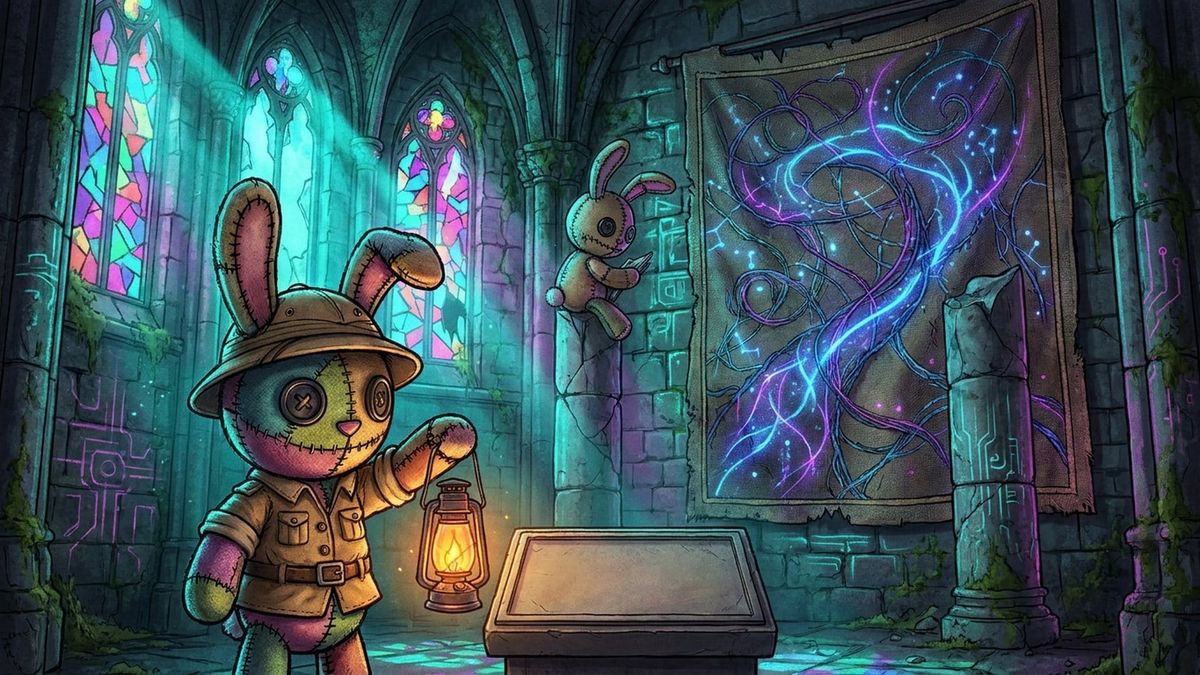
Video game lore is the accumulated backstory of a game world — the history, cosmology, leftover clues and arguments that sit around the main plot. It is what you reconstruct from an item description, a ruined cathedral, a contradictory in-game book, or a three-hour video someone made at 2 a.m. In the twenty-first century, that reconstructive hobby is doing a lot of the work mythology used to do: giving people a shared story to argue about, a cosmology to map, and a way to feel that a made-up world is older and stranger than the tutorial let on.
This is a nerd-pillar page about that shift. It is not a plot recap and not a ranking of the “best lore.” It is about what the word means, why hidden history feels more mythical than a cutscene, how studios from FromSoftware to Bethesda, Nintendo and Blizzard actually build it, and why lore books, timeline charts and podcasts took off. Related reading on this site: superheroes as modern mythology, the nerd hub, and the pocket legend of TI-83 DrugWars.
What “lore” means in games
In ordinary English, lore is a body of knowledge or tradition held by a group — closer to “what the culture remembers” than to “what happened in chapter three.” Game writers borrowed the word and turned it into both the content and the delivery system. Narrative designer Matthew Weise has pointed out that in this modern usage, “lore” usually means the writing around the main plot — character backgrounds, item text, documents and recordings that fill in history and context — and that people now use the same word for the backstory itself and for those delivery systems.1 When someone says a game has great video game lore, they usually mean two things at once: there is a deep fictional history, and the game lets you find it in pieces instead of lecturing you.
That is why video game lore is not the same as plot. Plot is what happens to you while you play: the boss, the betrayal, the ending. Lore is why the boss has that sword, who built the ruin you are standing in, and which god the local priests are lying about.
Some games are “lore-heavy” on purpose. Discovering the backstory is one of the pleasures they sell, the way a mystery novel sells the pleasure of assembling clues. Other games have lore the way a city has plumbing: it is there so the streets make sense, and you can ignore the pipes if you just want to get downtown.
Why it feels like mythology
Myths, in the anthropological sense rather than the “untrue story” sense, are the tales a culture uses to explain where the world came from, why suffering exists, and what kind of person is worth becoming. They were rarely delivered as a single official novel. They were retold, contradicted, locally varied, and argued over. Homeric poems existed in performance long before anyone had a definitive edition. That messiness is not a bug of myth. It is the texture.
Video game lore reproduces a surprising amount of that texture, especially when the studio refuses to stand outside the world and announce what is true. Players become priests, archaeologists and cranks. They compare versions. They draw charts. They get emotionally attached to a cosmology that no one handed them in a prologue.
We have already made this argument about capes. Superheroes, as Grant Morrison and others have said, do the job gods and demigods used to: they give a culture larger-than-life figures for its hopes and its arguments about right and wrong. That case lives on our superheroes-as-modern-mythology page, and it has a sibling in the psychology of Batman’s rogues. Games add something comics cannot do as easily. You walk the ruin. You choose whether to read the plaque. The myth is optional, which makes finding it feel earned.
Item descriptions and the archaeology of play
The house style most people now associate with video game lore is the FromSoftware method: a world that looks like it already ended, and a trail of item descriptions, enemy placements and architectural jokes that let you reconstruct how.
Hidetaka Miyazaki has been unusually direct about why. In a 2016 WIRED interview about Dark Souls III, he said he wants to leave interpretation of the world’s stories to the player — that players get more value when they find hints of plot themselves, from items or side characters, than when the game automatically tells the story.2 In earlier Japanese interviews he described writing the story around the game rather than forcing the game to chase a linear script, and planting a lot of the information in item text for anyone who wanted to go looking.3
That design has a mythic side effect. It turns every player into a field archaeologist. The sword is not just plus-twelve slashing damage. It is a tombstone for a knight who failed. The community then does what oral cultures did: it retells, debates and canonizes. Lore videos and podcasts are the campfire version of that work. They are not a replacement for playing. They are what happens when a story is distributed as fragments on purpose.
Miyazaki has also said, a little sheepishly, that part of the reason he leans on environmental storytelling is that he does not think he is especially good at implementing direct narrative.2 That honesty is useful. The mythic feeling of Souls lore is not magic. It is a set of constraints — fragmentary delivery, player interpretation, a world that looks lived-in — that happen to resemble how old stories survived.
Unreliable narrators, on purpose
If Souls lore is archaeology, Elder Scrolls lore is historiography: a pile of documents written by people who were biased, limited, or wrong.
Bethesda’s writers made that a policy. Michael Kirkbride, speaking to PC Gamer about the post-Daggerfall years, said the team committed “to never release anything into the world that wasn’t written by somebody that lived there.” The authorial voice, he argued, should not step in and shut down the argument about what is true.4 Kurt Kuhlmann, a senior designer, described the same habit as “deniability”: as long as lore comes from someone inside the fictional world, someone else inside that world can disagree. The moment the studio steps outside and says “this is actually true,” contradictions become much harder to live with.5
That is why Tamriel is full of books that do not match. It is also why a famous timeline gap — a likely typo that opened a hole of centuries — could be patched in-world by rival explanations, including the “Dragon Break,” rather than by a press release.5 Myths do this too. When two temples disagree about a god’s childhood, the culture does not usually hold a shareholder call. It keeps both stories and lets priests fight.
Official lore books sit on the other end of the spectrum. They are the studio putting on a historian’s hat and offering a cleaned-up chronicle. They scratch a different itch: the desire for a map after years of walking in fog.
Lore books, charts and the hunger for a map
Search data and bookstore tables tell the same story: people do not just want to play these worlds. They want the chart.
Nintendo’s The Legend of Zelda: Hyrule Historia, published in Japan in December 2011 and in English by Dark Horse on January 29, 2013, finally printed an official chronology after years of fan speculation about how the games fit together.6 Dark Horse’s own account of the book highlights “the official version of the timeline that has spawned so many fan theories,” laid out as a history of Hyrule rather than a strategy guide.6 That is a creation-myth document with a SKU. Fans had been doing priestly work — drawing timelines, arguing over how the games fit together after Ocarina of Time — and Nintendo eventually published an official chart.
Blizzard did a similar thing with World of Warcraft: Chronicle, an illustrated multipart history published with Dark Horse. Volume I (2016) presents itself as a journey through an age of myth and legend, “long before the Horde and the Alliance,” covering the birth of the cosmos and the forces that shaped Azeroth.7 Later volumes continued the official history; Volume IV arrived in 2024 and covers later expansions.7 When a living game gets a hardcover cosmology, you are no longer looking at “flavor text.” You are looking at a studio admitting that the backstory has become one of the products.
Podcasts and long-form videos are the cheap, continuous version of those books. They exist because fragmentary design creates leftover questions, and leftover questions are an engine. The format is closer to a weekly Homeric recitation than to a let’s-play: here is what the item said, here is what the architecture implies, here is the theory that makes the contradictions fit.
Small worlds count too
Not every mythic game world is a thousand-page chronicle. Sometimes the lore is a handful of rules that a subculture remembers together.
In the late 1990s, a generation of kids met a stripped-down economic sim on a graphing calculator. TI-83 DrugWars had no cutscenes and almost no text, but it still had a world: boroughs, a loan shark, cops, interest that would wreck you. The original DOS game dates to John E. Dell in 1984; the calculator port turned it into classroom folklore.8 Nobody needed a wiki. The lore was the shared memory of almost getting busted before homeroom.
That is a useful corrective to the idea that lore equals lore-wiki. A world can be mythic because a group of people kept retelling it, not because a studio employed a loremaster. The nerd instinct — taking a small system too seriously, on purpose — is the same instinct our nerd hub treats as the modern mythical mode.
How to read a game like a myth
You do not need a graduate seminar. You need a few habits that old readers of myths already had.
- Separate plot from lore. What happened to you this playthrough is not the same as the history of the world. Both can be true.
- Ask who is speaking. An item description, a priest, a king’s chronicle and a studio’s hardcover are four different kinds of testimony. Elder Scrolls taught a whole generation to treat in-world books as evidence, not gospel.4
- Treat contradictions as data. Myths accumulate variants. Some variants are sloppy continuity. Some are the point.
- Walk before you wiki. The archaeological pleasure Miyazaki is protecting disappears if you open a spoiler compilation at the first fog gate.2 Read the ruin, then read the commentary.
- Watch what the official book is doing. A timeline chart or a Chronicle-style volume is the studio trying to stabilize the story. That can be a gift. It can also flatten the argument that made the world feel alive.
None of this requires you to believe the fiction is “real.” Nobody had to believe in Achilles as a historical person for the Iliad to shape ideas about rage and honor. The test of a modern myth is not literal belief. It is whether people keep using the story to think with — and whether they get angry when someone gets the cosmology wrong.
What the shift costs, and what it buys
There is a failure mode. Lore-as-wiki-completionism can turn a living story into homework: every item collected, every page tabulated, the sense of mystery replaced by a spreadsheet. Official chronicles can over-explain a world that was more interesting when priests disagreed. And because lore is optional, some players reasonably ignore it and then get told they “didn’t really play the game.” That is convert energy, and it is not charming.
What it buys, when it works, is a form of meaning-making that older mass media made harder. A film has to tell you the story in two hours. A novel usually has one narrator, or at least one binding. A game can hide a cosmology in a junk item and trust that someone, somewhere, will pick it up, argue about it, draw the chart, and hand the argument to a friend. That is very old behavior wearing a very new controller.
If you want more of this video game lore and nerd-myth beat — capes, calculators, and the stories we use instead of Olympus — start at the nerd hub, detour through superheroes as modern mythology, or browse the MoneySexNerd shop for the books and guides.
Sources
- Matthew Weise, “Narrative design myth-busting: It’s not ‘just lore,’” Game Developer, October 27, 2021, gamedeveloper.com. On the modern games-industry usage of “lore” as both backstory and the systems (item text, documents, bios) that deliver it.
- Matt Kamen, “Dark Souls 3 director: it’s about ‘accomplishment by overcoming tremendous odds,’” WIRED, April 12, 2016 (originally WIRED UK, March 29, 2016), wired.com. Miyazaki on leaving interpretation to the player and on finding plot hints in items and side characters.
- Hidetaka Miyazaki, comments in the Game no Shokutaku interview, translated at Souls Lore / Wikidot, soulslore.wikidot.com. Miyazaki on writing “story for the game,” keeping hints vague, and placing a lot of information in item descriptions. Treat as a translated secondary posting of the original Japanese interview, not as a studio site.
- Kirkbride quoted in “The battle to control what’s fact and fiction in The Elder Scrolls’ lore,” PC Gamer, pcgamer.com. The post-Daggerfall commitment to in-world authorship.
- Kurt Kuhlmann on “deniability” and the Dragon Break, as reported in “The Loremasters: How developers keep their fictions straight,” archived at UESP, en.uesp.net.
- Dark Horse Books, “Back to the Beginning of a Legend” (Patrick Thorpe) and “The Legend of Zelda: Hyrule Historia,” darkhorse.com; English edition January 29, 2013. Japanese first edition: Shogakukan, December 2011. The book’s “History of Hyrule” section prints the official chronology after years of fan timeline debate.
- Blizzard Entertainment, “World of Warcraft Chronicle Vol. I,” official book page, worldofwarcraft.blizzard.com; see also later volumes in the Chronicle series (Vol. II–IV, the last released 2024).
- John E. Dell’s 1984 DOS Drug Wars and the classroom afterlife of the calculator port are covered on this site’s TI-83 DrugWars page.
MoneySexNerd on Substack
The rabbit hole goes deeper.
This page is the field guide. The Substack is where the bunny gets weird: longer essays on sex, money and nerd culture, with more research, more opinions and nothing watered down for search engines.
Go deeper on Substack →Free to read. Unsubscribe whenever.