Batman's Villains, Diagnosed: The Psychology of the Rogues Gallery
Joker, Harley, Two-Face, Riddler, Scarecrow, Ivy, Freeze and Bane on the couch: where each villain came from, the diagnosis the internet hands them, and what the research really says.

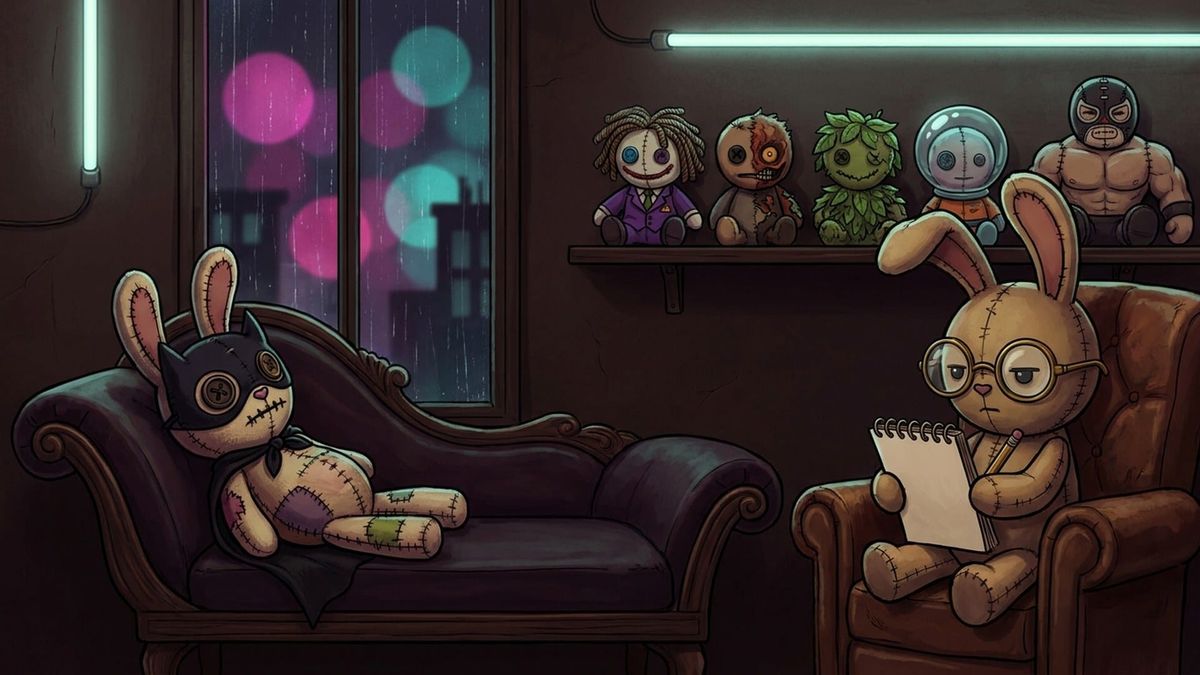
Short answer: almost none of the Batman villains is an accurate portrait of a real mental illness, and that's the point. Each one takes a single human need or fear (to be seen, to be safe, to never feel loss again) and turns it up until it breaks a city. Psychology is a better lens for reading them than a manual for diagnosing them. When forensic psychiatrists combed 400 films for realistic psychopaths, they kept only 126 characters whose profiles held up clinically, and they concluded that realistic fictional psychopaths "remain in the minority" (Leistedt & Linkowski, 2014). Gotham's rogues are mostly in the other pile.
So consider this an armchair session with a very weird client list. For each villain: where they came from, the diagnosis the internet hands them, and what the actual research says. It's also the front door to our Batman series, which argues that the rogues gallery is really Batman's dysfunctional polycule. Fictional characters can't consent to a diagnosis, and neither can your ex, so keep the labels on the page.
Why Gotham runs on psychology
Batman's world has had a psychiatric hospital at its center since October 1974, when writer Dennis O'Neil introduced Arkham in Batman #258, naming it after the fictional Massachusetts town in H. P. Lovecraft's horror stories (CBR). Since then, the villains have been less "bank robbers in costumes" and more "case files with gadgets." The psychology runs deep enough that Travis Langley wrote a whole book on it, Batman and Psychology: A Dark and Stormy Knight (Wiley, 2012).
The useful question isn't "what disorder does the Joker have?" It's "what part of us is the Joker made of?" That question has good answers.
Batman villains at a glance
| Villain | Debut | The pop diagnosis | The better lens |
|---|---|---|---|
| Joker | Batman #1, 1940 | Psychopath | A trauma bond with Batman |
| Harley Quinn | BTAS, 1992 | "Crazy girlfriend" | A textbook abusive relationship |
| Two-Face | Detective Comics #66, 1942 | Multiple personalities | Trauma and a man who outsources his choices to a coin |
| Riddler | Detective Comics #140, 1948 | Narcissist / OCD | The need to be seen as brilliant |
| Scarecrow | World's Finest Comics #3, 1941 | Mad scientist | Fear conditioning with no ethics board |
| Poison Ivy | Batman #181, 1966 | Femme fatale | Control through desire |
| Mr. Freeze | Batman #121, 1959 | Cold-hearted | Grief that never moved |
| Bane | Vengeance of Bane #1, 1993 | Muscle | Batman's masochism, given a body |
| Catwoman | Batman #1, 1940 | Love interest | His avoidant mirror |
The Joker: not a psychopath, a partner
The Joker debuted in Batman #1 in spring 1940, from Bill Finger, Bob Kane and Jerry Robinson, in the same issue as the woman who became Catwoman (ComixCatalog). The internet's favorite label for him is "psychopath." Real psychopathy is measured with a structured clinical checklist, the PCL-R, and the forensic team that studied movie psychopaths sorted the realistic ones into clinical subtypes such as "prototypical" and "manipulative" (Leistedt & Linkowski).
The Joker fails on consistency alone. Grant Morrison's 1989 graphic novel Arkham Asylum: A Serious House on Serious Earth made that the joke: his doctors call it "super-sanity," a mind with no fixed personality that reinvents itself day to day (Arkham Asylum). That's not a diagnosis. That's a writer's license to have him be whatever the story needs.
What stays constant is the Bat. The best read of the Joker is relational. Psychologists Donald Dutton and Susan Painter coined "traumatic bonding" in 1981 to describe the fierce attachment that forms under intermittent abuse and a power imbalance (Dutton & Painter). Swap "abuse" for "eighty years of near-death encounters" and you have the most committed couple in comics. We make the full case in Batman and Joker: the most beautiful trauma bond ever written.
Harley Quinn: the psychiatrist who got groomed
Harley is the rare rogue who started on television. She first appeared in the Batman: The Animated Series episode "Joker's Favor," which aired September 11, 1992, written by Paul Dini, who modeled her on his friend Arleen Sorkin's jester bit on Days of Our Lives and cast Sorkin as the voice; Bruce Timm designed the look (DC). She was meant to appear once.
Her origin came in the 1993 comic Mad Love by Dini and Timm: Dr. Harleen Quinzel, a psychiatrist at Arkham, starts sessions with the Joker, and he uses them to emotionally manipulate her. It won the Eisner for Best Single Issue (DC).
The pop label is "crazy girlfriend." The better one is "victim of a professional who should have been stopped, and then of a partner." Harley isn't the Joker's diagnosis; she's the clearest portrait of what loving him costs, and the same Dutton and Painter dynamic in its most honest form. Her later glow-up into her own person is the most hopeful arc in Gotham.
Two-Face: what the coin is really for
Two-Face debuted in Detective Comics #66 in August 1942 as district attorney Harvey "Apollo" Kent, scarred by acid in court; he became Harvey Dent in 1948 to avoid confusion with a certain Metropolis reporter (DC). Bob Kane cited the 1931 film of Dr. Jekyll and Mr. Hyde as inspiration, and the 1990 story "The Eye of the Beholder" (Batman Annual #14) rebuilt him around childhood abuse by his father (Two-Face).
Modern comics present him with dissociative identity disorder. Real DID involves two or more distinct personality states plus recurring gaps in memory beyond ordinary forgetting, and it's strongly associated with severe childhood trauma (StatPearls). The trauma part tracks. The rest is pure comics: real alters don't usually announce themselves with a flip of a scarred silver dollar.
The coin is the more interesting symptom. Harvey hands his moral choices to chance so he never has to own them. If you've ever said "let's see what happens" about a decision you'd already made, you've met a tiny Two-Face. It's the same split we see in Bruce himself, which we cover in Bruce vs. Batman: the real dissociation.
The Riddler: a man who needs to be figured out
Edward Nygma arrived in Detective Comics #140 in 1948, from Bill Finger and Dick Sprang. As DC's own character history puts it, the crimes are just the way he gets people to look at his puzzles, and the message of every riddle is the same: "I'm smarter than you are" (DC).
The internet calls that narcissism, and the need for admiration is real. But look at the behavior. He leaves the exact clues that get him caught, over and over. In the 1994 BTAS episode "Riddler's Reform," he goes legit designing puzzle toys and earns the esteem he craved, and the contentment doesn't last without the Bat to beat (DC). Winning was never the point. Being solved by the one mind he respects is. We think that's a kink, and we argue it in the Riddler as intellectual cuck.
Scarecrow: fear conditioning without an ethics board
Jonathan Crane is the only rogue who is literally a psychologist. He first appeared in World's Finest Comics #3 in 1941 as a Gotham University psychology professor obsessed with fear (DC).
His real-world ancestor is a 1920 experiment. John Watson and Rosalie Rayner taught an 11-month-old, "Little Albert," to fear a white rat by striking a steel bar behind his head whenever the rat appeared, and the fear spread to other furry things (Watson & Rayner, 1920). Crane is that study with a gas mask and no review board. He isn't mentally ill so much as a researcher who decided consent was optional, which is the scariest kind of villain because it's the most human.
Poison Ivy: control through desire
Pamela Isley first appeared in Batman #181 in June 1966, written by Robert Kanigher and drawn by Sheldon Moldoff (DC). Batman: The Animated Series later turned her from a femme fatale into an environmental crusader (DC).
Her power is making people want what she wants, usually by pheromones. Good news for the rest of us: the science on human pheromones is a mess. A 2015 review in Proceedings of the Royal Society B found no robust evidence that the famous candidate molecules, like androstadienone, work as human pheromones at all (Wyatt, 2015). No cologne will make anyone obey you.
The kink bridge is obvious once you see it. Ivy controls people by giving them pleasure, which is exactly what a pleasure dom does, minus the part where everyone agreed to it first. Consent is the whole difference between a villain and a good night. Why her chemistry never quite works on him is the subject of Batman and Poison Ivy: parallel sovereignty.
Mr. Freeze: grief that never moved
Freeze first showed up as "Mr. Zero" in Batman #121 in February 1959, a gimmick villain fans mostly ignored. Then the BTAS episode "Heart of Ice," written by Paul Dini, directed by Bruce Timm and aired September 7, 1992, gave him a dying wife, Nora, and a reason to be cold. Timm's pitch was a man who considers himself "dead to emotions." The episode won a Daytime Emmy for Outstanding Writing in an Animated Program (Heart of Ice).
Victor Fries is the closest thing Gotham has to a real diagnosis. In 2022 the American Psychiatric Association added prolonged grief disorder to the DSM-5-TR: for adults, a loss at least 12 months old, with intense yearning or preoccupation with the person nearly every day, plus symptoms like emotional numbness (APA). A man who freezes his wife and then his own feelings, waiting for a cure that never comes, is that criterion set wearing a fishbowl.
Bane: Batman's masochism, given a body
Bane is the youngest major rogue. He debuted in Batman: Vengeance of Bane #1 in January 1993, created by Chuck Dixon, Doug Moench and Graham Nolan, and broke Batman's back in Batman #497 during "Knightfall" (DC). He runs on a super-steroid called Venom (Bane).
The internet sees muscle. We see the other half of a pairing. Psychologist Paul Rozin's team documented 29 activities people enjoy because they hurt, from chili peppers to sad movies to exhausting workouts, and called it "benign masochism": pleasure in a negative body reaction when the mind knows it's safe (Rozin et al., 2013). Bruce's whole lifestyle is that, minus the "benign." In consensual kink, masochism comes with limits and a safeword; Bane is what it looks like with neither. Our kink field guide covers the safe version, and Batman and Bane: the masochism arc covers the Gotham one.
Catwoman and Talia: the two who get close
Catwoman debuted as "the Cat" in the same 1940 issue as the Joker (ComixCatalog). She doesn't need a diagnosis. She needs a therapist who specializes in couples where both people bolt the moment it gets real. In attachment terms she's Bruce's avoidant mirror, the subject of Bruce and Selina: the only one he almost lets in.
Talia al Ghul is the opposite problem: a family system that won't let anyone have their own edges. We call it enmeshment across enemy lines.
The patient nobody diagnoses
Here's the twist every rogue points to. The most consistent case file in Gotham belongs to the man in the cape. A boy watches his parents die and spends the rest of his life recreating the night he couldn't stop. Every villain above is one of his needs given a face: the bond, the pain, the control, the frozen grief.
His support system doesn't help. Alfred loves him and patches him up so he can do it again, which we cover in Batman and Alfred: the enabler. Oddly, the movie that understood him best was a Lego one (The Lego Batman Movie understood the assignment), and the internet's "sigma male" is just Batman without the bat.
The honest complication
Gotham has one bad habit worth naming: Arkham treats mental illness as the engine of violence. Real data runs the other way. A study pooling five U.S. samples of 4,480 adults with mental illnesses found 23.9% had committed community violence in the previous six months, while 30.9% had been victims of it (Desmarais et al., 2014). People with mental illness are more likely to be hurt than to hurt anyone.
So enjoy the rogues as myths, which is what superheroes are (our take on superheroes as modern mythology). Just don't take the asylum home with you.
Read the whole polycule
If this was your kind of nerding, the full version is a book. The Rogue Polycule maps the entire rogues gallery through attachment theory in 159 designed pages of cyberpunk graphic non-fiction, as a digital download. Start with the free series at Batman's dysfunctional polycule, browse the rest of our nerd culture coverage on the Nerd hub, or dig through every run in the MoneySexNerd series index.
Sources
- Leistedt, S. J., & Linkowski, P. "Psychopathy and the Cinema: Fact or Fiction?" Journal of Forensic Sciences 59(1), 2014. doi.org
- "The Strange Origins of Batman's Arkham Asylum, Explained." CBR. cbr.com
- Langley, T. Batman and Psychology: A Dark and Stormy Knight. Wiley, 2012. books.google.com
- "Batman #1 (1940)." ComixCatalog. comixcatalog.com
- "Arkham Asylum: A Serious House on Serious Earth." Wikipedia. wikipedia.org
- Dutton, D. G., & Painter, S. L. "Traumatic bonding." Victimology 6, 1981. researchgate.net
- "Lady of Lunacy: Twelve Moments that Defined Harley Quinn." DC, 2022. dc.com
- "Making a Dent: Twenty-two Facts About Two-Face." DC, 2022. dc.com
- "Two-Face (comics)." Wikipedia. wikipedia.org
- "Dissociative Identity Disorder." StatPearls, NCBI Bookshelf. ncbi.nlm.nih.gov
- Jaffe, A. "Who is the Riddler?" DC, 2022. dc.com
- "Scarecrow." DC character page. dc.com
- Watson, J. B., & Rayner, R. "Conditioned Emotional Reactions." Journal of Experimental Psychology 3(1), 1920. pages.ucsd.edu
- "Brilliant Women of Batman: Poison Ivy Steals it with a Kiss." DC, 2019. dc.com
- Wyatt, T. D. "The search for human pheromones: the lost decades and the necessity of returning to first principles." Proceedings of the Royal Society B 282, 2015. doi.org
- "Heart of Ice (Batman: The Animated Series)." Wikipedia. wikipedia.org
- American Psychiatric Association. "Prolonged Grief Disorder." psychiatry.org
- "Being Bane: The Truth About the Bat's Most Devastating Foe." DC, 2017. dc.com
- "Bane (DC Comics)." Wikipedia. wikipedia.org
- Rozin, P., et al. "Glad to be sad, and other examples of benign masochism." Judgment and Decision Making 8(4), 2013. doi.org
- Desmarais, S. L., et al. "Community Violence Perpetration and Victimization Among Adults With Mental Illnesses." American Journal of Public Health 104(12), 2014. doi.org
MoneySexNerd on Substack
The rabbit hole goes deeper.
This page is the field guide. The Substack is where the bunny gets weird: longer essays on sex, money and nerd culture, with more research, more opinions and nothing watered down for search engines.
Go deeper on Substack →Free to read. Unsubscribe whenever.