Batman's Rogues Gallery Is Just His Dysfunctional Polycule
Batman's rogues gallery reads like a polycule with one exhausted hinge. Here's who plays which role, through attachment theory, with sources.


Short answer: Batman's rogues gallery works like a polycule because nobody in it ever really leaves. A polycule is a network of people linked by overlapping romantic, sexual or platonic relationships, and the word is a blend of "poly" and "molecule" (Cambridge Dictionary; Wiktionary). Gotham's version has Bruce Wayne as the exhausted hinge in the middle: the Joker is his trauma bond, Catwoman his avoidant mirror, Talia his enmeshment, Bane his masochism and Alfred the enabler who keeps the lights on. It's a reading, not canon. It does explain why he never wins, never quits and never kills the clown.
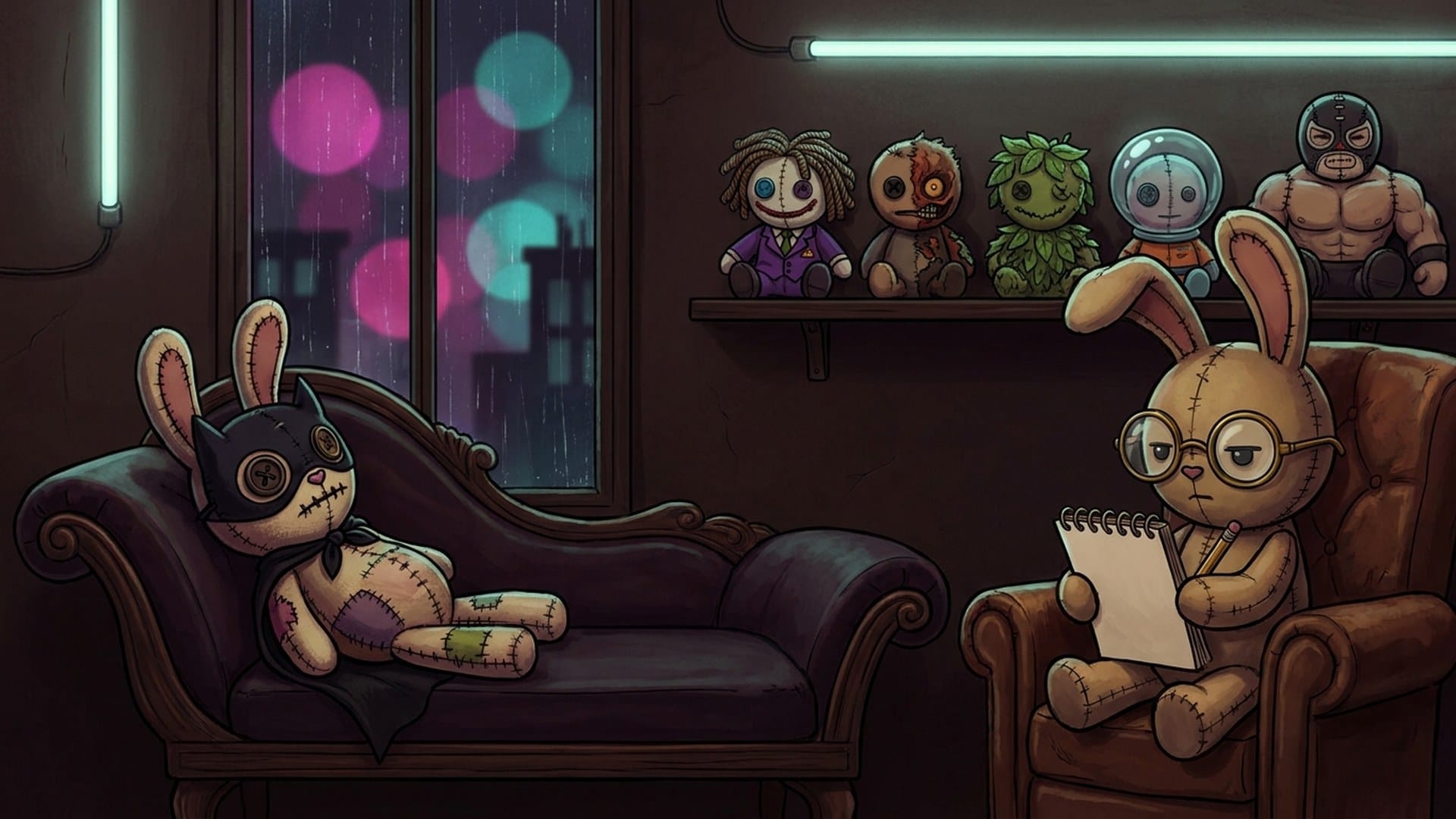
This page is the front door to our Batman series, which runs attachment theory through Gotham one relationship at a time. It's one series on our Nerd hub, which reads Gotham, the X-Men and the rest of pop culture as the new modern myth. If you'd rather start with the clinical side, every villain gets put on the couch in Batman's villains, diagnosed.
What a polycule is, and why the word fits Gotham
Poly people borrowed the chemistry because relationship maps look like molecule diagrams: people are atoms, relationships are bonds. The 2014 poly handbook More Than Two defines a "molecule" as a set of polyamorous relationships, such as a triad, a vee or a quad, or a whole romantic network (Veaux & Rickert, via Wiktionary). We break down the common shapes in polycule architectures.
The shape that matters here is the vee. One person, the hinge, connects partners who aren't dating each other. The hinge does double the work and is the single point of failure. Now scale that up to a dozen partners, all in costume, most of whom share a building (Arkham) and a grudge. That's the Bat. Every rogue is bonded to him first and to each other only loosely, which is why the gallery falls apart the second he isn't in the room.
The obvious difference from real polyamory: an ethical polycule runs on consent and communication. Gotham's runs on grappling hooks. Nobody agreed to this structure. They just keep showing up to it.
The attachment theory toolkit, in 90 seconds
Attachment theory started with John Bowlby and Mary Ainsworth studying how infants bond with caregivers. In 1987, psychologists Cindy Hazan and Phillip Shaver translated it to adult romance, arguing that romantic love is an attachment process and sorting adults into the same three styles seen in babies: secure, avoidant and anxious/ambivalent. Their questionnaire studies found the styles show up in roughly the same proportions in adults as in infants (Hazan & Shaver, 1987).
In 1991, Kim Bartholomew and Leonard Horowitz split the avoidant group in two, giving the four-box model most quizzes still use: secure, preoccupied, dismissing and fearful, based on whether you see yourself and other people as basically good or basically bad (Bartholomew & Horowitz, 1991). Hold onto "fearful." It's the one that wants closeness and fights it at the same time, and it describes a certain billionaire uncomfortably well. If you want to use the styles on your own dating life, start with attachment styles as a relationship structure filter.
Bruce is the hinge, and the hinge is a wound
The Bat debuted in Detective Comics #27, cover-dated May 1939. Readers didn't learn why he did it until Detective Comics #33 in November 1939, when Bill Finger and Bob Kane gave him two pages of origin: young Bruce watching a mugger kill his parents (DC).
Through an attachment lens, that's the whole engine. A kid whose secure base gets shot in an alley grows into a man who builds bonds he can control: with people he can fight, lock up and see again next month. He can't lose them, because he never really has them. That's a theory about a fictional man, not a diagnosis. But it's a theory eighty-plus years of comics keep feeding.
The map: who's who in the Batman polycule
| Partner | First appeared | The bond | Deep dive |
|---|---|---|---|
| The Joker | Batman #1, spring 1940 | Trauma bond | The trauma bond |
| Catwoman | Batman #1, spring 1940 (as "the Cat") | Avoidant mirror | Bruce and Selina |
| Alfred | Batman #16, April 1943 | The enabler | Alfred |
| The Riddler | Detective Comics #140, 1948 | Needs to be seen | The Riddler |
| Poison Ivy | Batman #181, June 1966 | Parallel sovereignty | Poison Ivy |
| Talia al Ghul | Detective Comics #411, May 1971 | Enmeshment | Talia |
| Bane | Batman: Vengeance of Bane #1, January 1993 | Masochism | Bane |
Debut sources: ComixCatalog (Batman #1), ComixCatalog (Alfred), DC (Riddler), DC (Ivy), DCU Guide (Talia), Bane.
The Joker: the partner who says it out loud
The Joker and the Cat both debuted in Batman #1, which means Bruce met his two longest relationships in the same issue. The Joker is the one who names the arrangement. In The Dark Knight (2008) he tells him, "You won't kill me out of some misplaced sense of self-righteousness. And I won't kill you because you're just too much fun. I think you and I are destined to do this forever" (Wikiquote). Alan Moore has described the end of The Killing Joke (1988) as a brief moment of shared lucidity where the two of them see how absurd and doomed their relationship is, and laugh about it together (Bleeding Cool).
Psychologists Donald Dutton and Susan Painter coined "traumatic bonding" in 1981 for the intense attachment that forms when a power imbalance meets intermittent abuse, with cruelty alternating with relief (Dutton & Painter). Swap the abuse for decades of near-death encounters and you get the most committed couple in comics. The full case is in Batman and Joker: the most beautiful trauma bond ever written.
Catwoman: the one who almost gets in
Selina is the only partner Bruce tries to make official. In Batman #24 (June 2017), writer Tom King had an unmasked Bruce get down on one knee on a Gotham rooftop with a diamond he'd kept for decades and say "Marry me" (USA Today). In Batman #50 (2018) she left him waiting on the roof, writing that a happy Bat wouldn't be the Bat: "You are an engine that turns pain into hope" (Polygon). They finally married in Batman/Catwoman #12 in 2022 (Polygon).
Two people who keep running at the moment of closeness is textbook avoidant-meets-avoidant, and it took the comics four more years and a supervillain to get past it. More in Bruce and Selina: the only one he almost lets in.
Talia: the in-laws are the problem
Talia first appeared in Detective Comics #411 (May 1971), written by Dennis O'Neil and pencilled by Bob Brown. A month later, in Batman #232, her father Ra's al Ghul staged a kidnapping as a test of whether the Bat was fit to be Talia's husband and his heir. In a 1978 story, "I Now Pronounce You Batman and Wife!", Ra's and Talia simply decided he was married to her, with their consent counting as the only consent required (Talia al Ghul). That's not a polycule. That's a cult with a dowry.
Their son came later: an unnamed baby in Batman: Son of the Demon (1987), then Damian Wayne in Batman #655 (2006) from Grant Morrison and Andy Kubert (Damian Wayne). Enmeshment means boundaries dissolve until you can't tell where the family ends and you begin, and it's covered in Batman and Talia al Ghul.
Bane: the one who studies him
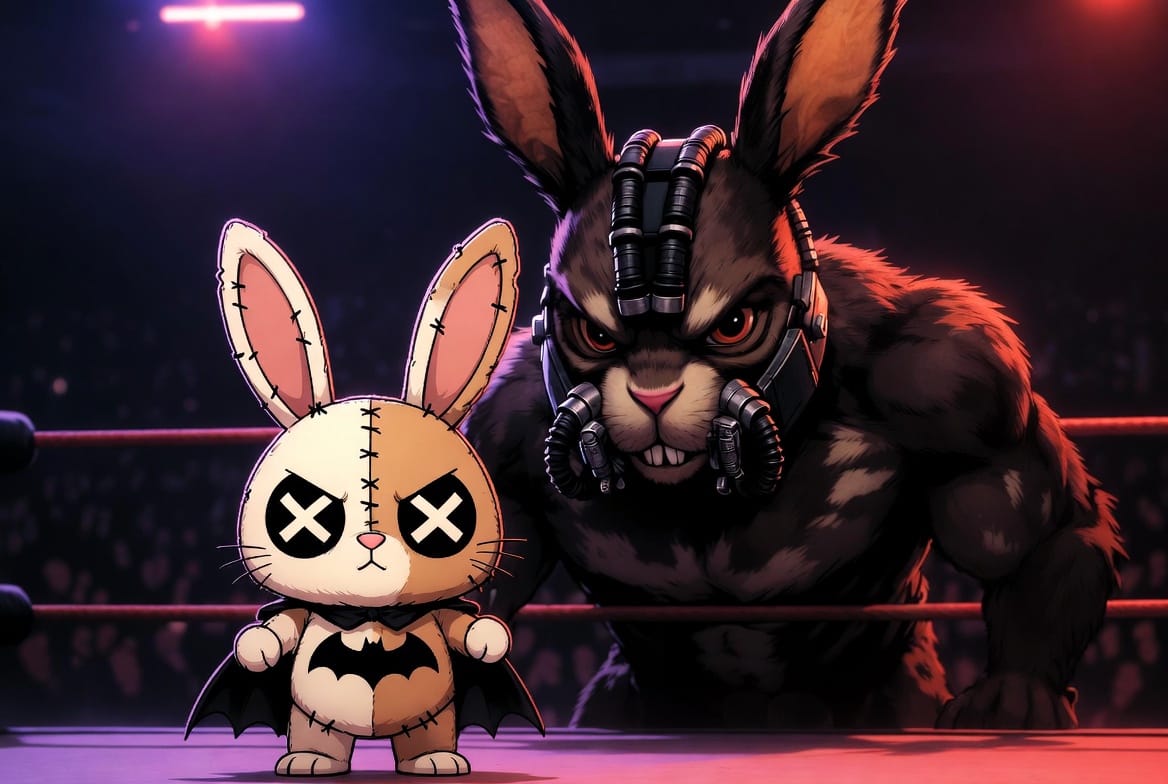
Bane debuted in January 1993, built by Chuck Dixon, Doug Moench and Graham Nolan for one job. In Knightfall he emptied Arkham so the Bat would exhaust himself recapturing everyone, then met him at Wayne Manor and broke his back in Batman #497 (July 1993) (CBR). Twenty-five years later, the last page of Batman #50 revealed Bane had engineered the failed wedding too (Entertainment Weekly). Same man, his spine and then his heart. If that sounds like a scene partner who reads your limits and then goes past them, that's the point of Batman and Bane: the masochism arc.
Alfred: the one who keeps the lights on
Alfred showed up in Batman #16 (April 1943) in a story literally titled "Here Comes Alfred!" (ComixCatalog). Every polycule has the person who stocks the fridge and never asks the big question. Alfred stitches the wounds, feeds the man and keeps the cave running, which is love and also the reason nothing changes. That's Batman and Alfred: the enabler.
Harley and Ivy: the metamours who fell for each other
In poly, your partner's partner is your metamour. Gotham's metamours mostly meet through Batman, and occasionally they skip him entirely. In the season 2 finale of the Harley Quinn animated series, Ivy leaves Kite Man at the altar, she and Harley declare their love and kiss, and they drive off together (TVLine). The showrunners later said they would not break the couple up (Variety). Two women leaving their worst relationships to choose each other is the healthiest thing that's ever happened in this city.
The Lego Batman Movie: the one that said it plainly
The most honest relationship movie in the franchise is the one with plastic bricks. The Lego Batman Movie (2017) runs on the Joker being devastated when the Bat tells him he isn't his greatest enemy and doesn't mean anything to him (Wikiquote). The plot is one long fight about whether they mean something to each other. We think it understood the assignment better than most prestige films, and we explain why in The Lego Batman Movie understood the assignment.
Why the Batman polycule never breaks up
Real polycules fail in predictable ways: an overloaded hinge, communication that only flows through one person, and a cascade when one relationship blows up and drags the others down. Gotham has all three, permanently. Bruce is the only channel between the rogues, so nothing gets resolved. He does the emotional labor of a dozen relationships at night and then gets up and runs a company. And when one bond breaks, like the wedding, the whole gallery shows up in the next arc.
What keeps it going is the same thing that keeps a bad real-life arrangement going: everyone gets something. The Joker gets meaning. The Riddler gets an audience. Bruce gets to stay the boy in the alley who never has to grieve, because there's always another fight. Stories need that. People don't.
If you're reading this because a relationship of yours feels like Gotham, the takeaway is the boring one. Healthy non-monogamy is built on informed consent, honest talk and the freedom to leave, which is everything this polycule lacks. Start with what ENM actually is, and if the pattern is one partner you can't quit despite the damage, that's a trauma bond, and it's worth taking to a therapist rather than a comic shop.
Read the Batman series
Start with the diagnosis guide, then read the rest in any order. Every piece is also listed in our series index.







Sources
- Cambridge Dictionary, "polycule." dictionary.cambridge.org
- Wiktionary, "polycule" (etymology; cites Merriam-Webster and Veaux & Rickert, More Than Two, 2014). en.wiktionary.org
- Hazan, C., & Shaver, P. (1987). Romantic love conceptualized as an attachment process. Journal of Personality and Social Psychology, 52(3), 511–524. PubMed
- Bartholomew, K., & Horowitz, L. M. (1991). Attachment styles among young adults: a test of a four-category model. Journal of Personality and Social Psychology, 61(2), 226–244. PubMed
- DC, "Batman, a History of Heroics: The Beginning." dc.com
- ComixCatalog, Batman #1 (1940) and Batman #16 (1943). #1, #16
- DC, "Who Is the Riddler?" and "Poison Ivy Steals It With a Kiss." Riddler, Ivy
- DCU Guide, Detective Comics #411. dcuguide.com; Wikipedia, "Talia al Ghul" and "Damian Wayne." Talia, Damian
- Wikiquote, The Dark Knight (2008) and The Lego Batman Movie (2017). Dark Knight, Lego Batman
- Bleeding Cool, "Alan Moore on … the end of The Killing Joke." bleedingcool.com
- Dutton, D. G., & Painter, S. L. (1981). Traumatic bonding. Victimology, 6, 139–155. ResearchGate
- USA Today (June 6, 2017); Polygon (July 4, 2018; 2022); Entertainment Weekly (July 4, 2018) on Batman #24, #50 and Batman/Catwoman #12. USA Today, Polygon, Polygon, EW
- Wikipedia, "Bane (DC Comics)"; CBR, "Batman After Bane." Wikipedia, CBR
- TVLine, Harley Quinn season 2 finale recap; Variety (2022). TVLine, Variety
MoneySexNerd on Substack
The rabbit hole goes deeper.
This page is the field guide. The Substack is where the bunny gets weird: longer essays on sex, money and nerd culture, with more research, more opinions and nothing watered down for search engines.
Go deeper on Substack →Free to read. Unsubscribe whenever.