The Riddler Is a Cuck (Intellectually)
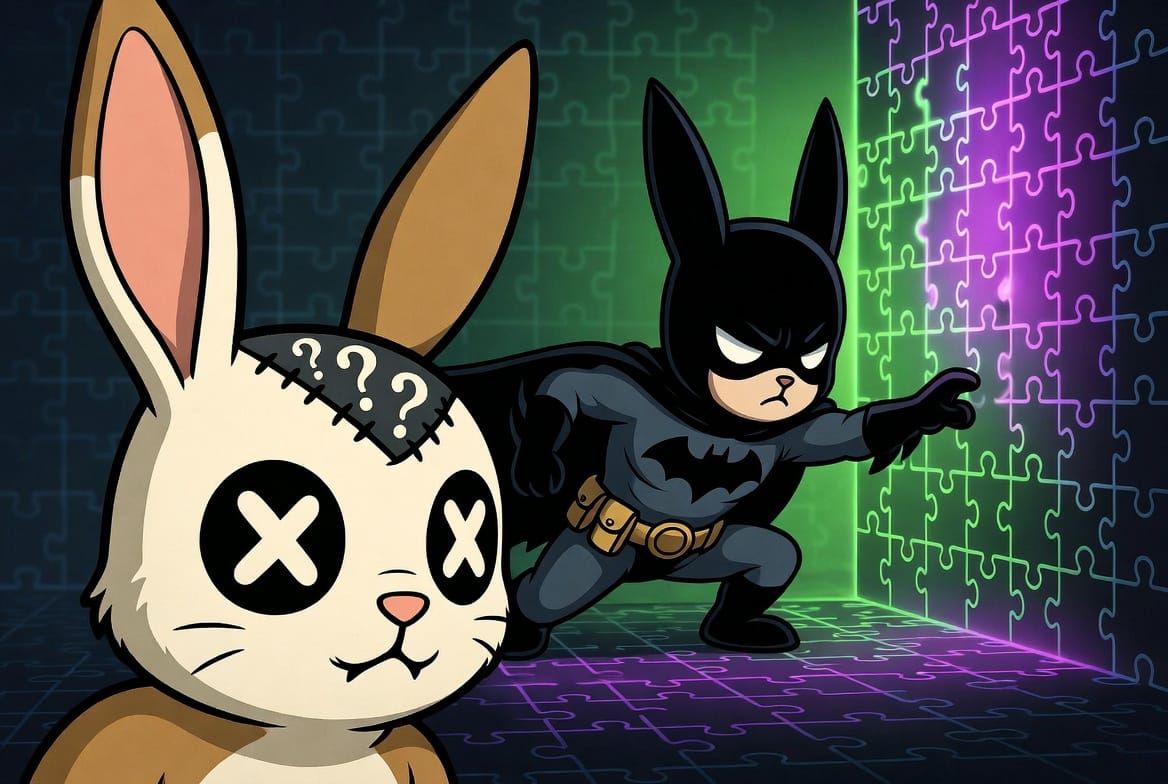
The Riddler doesn't want to win. He wants to watch Batman solve it. The clues are erotic foreplay — intellectual cuckolding at its purest.

Let's call it what it is.
Edward Nygma doesn't want to beat Batman. He wants to watch Batman solve his puzzles. He wants to observe the genius at work, to be present for the moment of comprehension, to bear witness to the mind that can match his own.
He gets off on being figured out.
This is intellectual cuckolding. The Riddler's entire criminal career is structured around the pleasure of being bested by someone smarter. The riddles aren't obstacles—they're invitations. The clues aren't mistakes—they're foreplay.
The Compulsion That Doesn't Make Sense
Every other rogue has a coherent win condition. Joker wants chaos. Catwoman wants valuables. Bane wants dominance. Penguin wants power.
What does Riddler want?
If he wanted to win, he wouldn't leave clues. The clues are the thing that guarantees his defeat. Every time he commits a crime, he compulsively provides the exact information Batman needs to catch him.
The standard explanation is ego—he can't help showing off, he needs to prove he's smart, his narcissism undermines his criminal efficiency.
But that's a surface reading. Look at the behavior, not the explanation. A man repeatedly creates elaborate puzzles, delivers them to a specific individual, then waits to see if that individual can solve them.
That's not crime. That's courtship.
The compulsion is the tell. Riddler knows the clues doom him. He's been caught dozens of times using this exact pattern. He's smart enough to recognize cause and effect. But he can't stop. The need to be solved is stronger than the need to succeed. This isn't self-sabotage—it's the actual goal dressed up as sabotage. He commits crimes as an excuse to give Batman puzzles. The crime is foreplay. The puzzle is the real point.
Epistemophilia
There's a term in psychoanalysis: epistemophilia. The erotic investment in knowledge. The pleasure of knowing and being known.
Riddler is an epistemophile. His sexuality—his deepest drive structure—is organized around intelligence. He doesn't want to have sex with Batman. He wants to have his mind penetrated by Batman.
The riddles are display. "Look at how smart I am. Look at how complex I can make things. Look at the beauty of my mental architecture."
Batman solving the riddles is consummation. "Yes. You saw me. You understood me. You penetrated my defenses and found the truth I hid inside."
Every time Batman solves a riddle, Riddler gets what he actually wants: proof that someone out there is smart enough to truly see him.
The Cuck Dynamic
Cuckolding has a specific structure. The cuck derives pleasure not from performing but from watching. Not from being the one who does but from being witness to the one who can.
Riddler sets up crimes. Batman solves them. Riddler watches.
The pleasure isn't in committing the crime successfully. The pleasure is in seeing Batman demonstrate superiority. Every solved riddle is Riddler saying: "You're better than me. Prove it. Let me watch."
There's an erotic structure here even if there's no sexual content. The setup, the anticipation, the moment of penetration when Batman understands the puzzle, the release when the solution is achieved. Riddler gets off on the process—not the outcome of the crime, but the experience of being mentally dominated by someone he considers worthy.
He loses on purpose. Not consciously—he'd never admit it. But structurally, his entire MO guarantees failure. He creates conditions for his own defeat and then witnesses that defeat with something like satisfaction.
Why He Can't Stop
If Riddler wanted to commit successful crimes, he could. He's genuinely brilliant. Without the compulsion to leave clues, he'd be nearly impossible to catch.
But he can't stop leaving clues because the clues are the point. Crime without clues would be empty. It would be success without recognition. Winning without being seen winning.
The compulsion to leave clues is the compulsion to be known. Riddler cannot tolerate being a mystery himself. He must be solved. He must be understood. He must have his interiority witnessed by someone capable of appreciating it.
Batman is the only one smart enough to appreciate it. So Batman is the only one Riddler can show himself to.
The Zero Year Arc
Scott Snyder's Zero Year (2013-2014) shows Riddler at his most extreme. He takes over Gotham. He holds the entire city hostage. He's winning.
And what does he do with his victory? He sets up a game show. He challenges Batman to solve riddles on live television. He creates an elaborate public spectacle where everyone can watch him be defeated.
This is the tell. At the moment of maximum power, Riddler's deepest drive isn't to maintain power. It's to create conditions for Batman to demonstrate superiority in front of an audience.
Most villains want to humiliate the hero publicly. Riddler wants to be humiliated publicly. He wants everyone to see that Batman is smarter, faster, better. He's not just offering himself to Batman—he's offering himself to Batman in front of witnesses. The public nature of it amplifies the charge. Everyone will know that Riddler created this brilliant system and Batman took it apart. Everyone will know who's superior.
He wants witnesses. He wants the world to see how good Batman is. He wants his cuckolding to be public.
The Narcissism Paradox
Riddler is usually read as a narcissist, but his behavior contradicts narcissistic structure.
A narcissist needs to feel superior. A narcissist would rig the game to win. A narcissist would not repeatedly create situations that guarantee they lose to the same person.
Riddler's relationship with superiority is more complex. He needs to feel like he's in proximity to superiority. He needs to be the one who identifies genius, challenges genius, gets close enough to genius to be defeated by it.
This is narcissism turned inside out. Instead of "I am the smartest," it's "I am smart enough to recognize the smartest and offer myself for comparison."
The riddles are gifts. Offerings to a superior being. "Here is the best my mind can produce. Please demonstrate that you're better."
The Intellectual Intimacy
What Riddler wants is what all the rogues want: a relationship with Batman. His particular modality is intellectual.
Joker wants emotional mirroring. Catwoman wants romantic tension. Bane wants physical dominance. Riddler wants minds touching.
When Batman solves a riddle, two intelligences have made contact. Riddler's thought has been received, processed, understood. His mental architecture has been inhabited by another mind.
This is the most intimate thing Riddler can imagine. Not bodies touching—brains touching. Not sexual consummation—cognitive consummation.
The riddles are love letters. Every one says: "I made this for you. No one else could appreciate it. Only you are worthy."
Why Batman Engages
Batman could probably find Riddler without solving the riddles. He has resources, technology, allies. The riddles slow him down if anything.
But he always solves them. He always engages with the intellectual challenge. He always gives Riddler what Riddler wants before taking him down.
Why?
Because Batman also needs intellectual stimulation. The mission is physical—punching, chasing, enduring. But Bruce Wayne's mind is as extraordinary as his body, and the mission rarely uses it.
Most of Batman's opponents require physical prowess or tactical planning. The Riddler requires pure cognition—pattern recognition, lateral thinking, the ability to hold multiple variables and find the elegant solution. It's a different part of Bruce's brain, one that doesn't get exercised as often. Solving riddles is play for his intellect in a way that fighting thugs isn't.
Riddler gives Batman permission to be smart. To think in complex patterns. To solve beautiful problems. It's the one relationship in the rogues gallery that engages Batman's mind rather than his fists.
They're giving each other something. Riddler gets witnessed. Batman gets challenged. Both get the intellectual intimacy they can't find elsewhere.
The Humiliation Element
Here's the thing about intellectual cuckolding: it requires humiliation.
Riddler isn't just losing. He's losing at the thing he's supposed to be best at. His whole identity is "the smart one," and he keeps being outsmarts by the same person.
This should be devastating. For most people, repeated failure at their core competency would be destructive.
For Riddler, it's fuel. He comes back. He tries again. He keeps offering himself up for the same humiliation.
Because the humiliation is part of it. Being beaten by Batman is proof of Batman's superiority, and proof of Batman's superiority is proof that Riddler is in a relationship with someone truly remarkable.
Better to lose to a worthy opponent than to win against inferiors.
The Unrequited Structure
The tragedy of Riddler is that Batman doesn't care about him.
For Riddler, the relationship is central. Batman is his main character. The riddles are Riddler's primary creative output, his life's work, his love letters.
For Batman, Riddler is a problem to solve. One of many. Not even the most dangerous—Joker, Bane, Ra's all rank higher. Riddler is a nuisance. Annoying. Intellectually engaging sometimes, but not emotionally significant.
This is unrequited intellectual love. Riddler gives everything. Batman gives attention only when required.
The power asymmetry is part of the cuck dynamic. Riddler doesn't want an equal. He wants to worship from below, to offer his best to someone who might not even appreciate it, to be used for Batman's purposes rather than valued for his own.
The not-caring might be the hottest part.
The Function in the Polycule
In the rogues gallery as relational system, Riddler serves a specific function: he affirms Batman's intellectual superiority without threatening Batman emotionally.
Catwoman threatens—she might actually get in. Joker threatens—he sees too much. Talia threatens—she demands commitment.
Riddler is safe. He only wants to watch. He only wants to lose. He'll never demand reciprocity or intimacy or vulnerability. He's the pure admirer, the fan who becomes a villain just to get the object of admiration's attention.
Every polycule has someone like this. The one who's just happy to be there. The one whose needs are met by proximity rather than engagement.
Riddler is Batman's groupie. And he's fine with that.
Part of the Batman Polycule series. Previous: Batman and Talia al Ghul: Enmeshment Across Enemy Lines. Next: Batman and Alfred: The Enabler