The Lego Batman Movie Understood the Assignment
Joker begging to be Batman's greatest enemy. Batman unable to say the words. A children's film in plastic blocks got his attachment disorder exactly right.

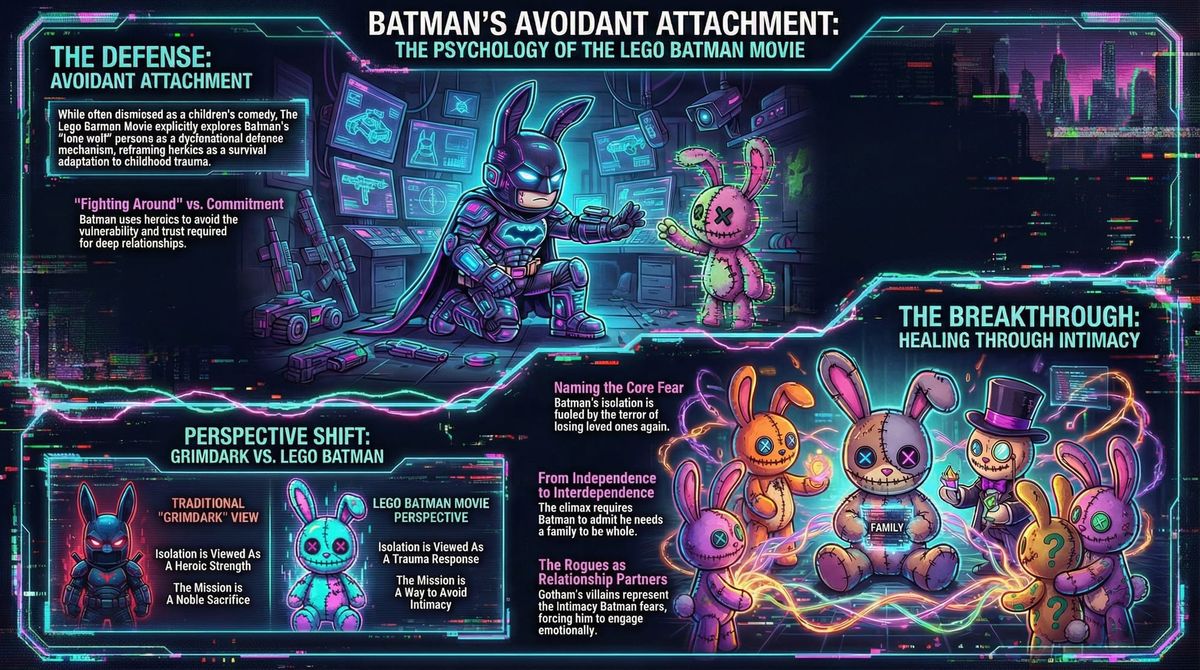
The most psychologically accurate Batman film ever made is animated, made of Legos, and marketed to children.
"I like to fight around."
That's Batman's response when Joker asks if he's fighting other villains. It's framed as a joke. It's not a joke. It's the most concise description of avoidant attachment ever put in a superhero movie. Batman can't commit to one enemy because he can't commit to anything—not because he's playing the field, but because commitment requires vulnerability and vulnerability requires trust and trust was murdered in an alley when he was eight.
The Lego Batman Movie understood what decades of grimdark adaptations missed: Batman's dysfunction isn't cool. It's sad. It's a coping mechanism calcified into a lifestyle. And the rogues gallery isn't opposition—it's a polycule of people trying to have relationships with a man who can't let anyone close enough to hurt him again.
The brilliance is in making this explicit. Most Batman stories treat the isolation as strength—the lone wolf thing, the dark knight who stands apart. Lego Batman treats it as the problem. The entire plot is about Batman learning that his independence is a defense mechanism, not a virtue. That the mission is a way to avoid intimacy, not a noble calling that requires sacrifice.
"I Don't Currently Have a Bad Guy"
The movie opens with Joker demanding acknowledgment. He wants to be Batman's greatest enemy. He wants exclusivity. He wants the words.
Batman refuses. "There is no 'us,'" he says. Joker isn't special. Joker is just another villain. Batman fights around.
This is textbook avoidant deflection. When someone asks for commitment, the avoidant partner minimizes the relationship. "It's not that serious." "We're just having fun." "You're reading too much into this." The avoidant person isn't lying exactly—from their perspective, they haven't committed, because they've structured their life to avoid commitment entirely.
The nervous system logic makes sense: if you never acknowledge the relationship as primary, you can't be devastated when it ends. You can always say it didn't matter that much. The pre-emptive devaluation is protection. Batman is protecting himself from caring about Joker by refusing to name what they have. But the protection has a cost—it means never experiencing the depth of connection he's actually already in.
Joker's reaction is the reaction of anyone who's dated an avoidant: devastation masked as anger. He's been showing up, night after night, putting in the work, and Batman won't even call him his greatest enemy. The lack of acknowledgment is the cruelty.
For a full video recap, find us on Youtube.
"Batman, Stop! You're Going to Feel Something!"
The movie's central joke is that Batman can't say basic relational words. He can't say "I hate you" to Joker. He can't say he needs his family. He can't express emotional reality because expressing emotional reality would mean having emotional reality, and avoidant attachment is built on the suppression of emotional reality.
This gets played for laughs, but it's clinically accurate. Avoidant attachment develops when early caregivers are unavailable or dismissive. The child learns that expressing needs leads to rejection or abandonment, so they learn to not have needs—or at least not acknowledge them. The suppression becomes automatic. By adulthood, the avoidant person genuinely doesn't know what they feel because they've trained themselves not to feel it.
In Batman's case, the caregivers weren't just unavailable—they were murdered in front of him. The message his eight-year-old nervous system received wasn't just "expressing needs is dangerous," it was "people you love die violently and there's nothing you can do about it." The only solution: don't love. Don't need. Don't let anyone matter enough that their loss could destroy you again. The emotional shutdown isn't a choice—it's a survival adaptation that became permanent architecture.
Batman knows he needs Robin, Barbara, Alfred. He acts like he needs them. But he can't say it. Saying it would make it real, and real things can be taken away. Better to maintain the fiction that he works alone, that he doesn't need anyone, that all these relationships are incidental rather than essential.
The movie forces him to finally say the words. That's the climax. Not a fight scene—a commitment.
"I Have Abs I've Never Even Seen"
The movie understands that Batman's hypercompetence is a symptom, not a virtue.
He's ripped. He's skilled. He's prepared. He has a vehicle for every occasion and a plan for every contingency. The Batcave is a monument to optimization.
And he eats lobster thermidor alone in a dark mansion, watching romantic comedies by himself, refusing to admit he's lonely.
This is the avoidant trap. You become excellent at everything except connection. You build a life that's impressive to observe and empty to inhabit. Every capability is a defense mechanism. Every skill is a way to prove you don't need people, that you can handle everything yourself, that dependency is for the weak.
The hypercompetence is compensation. Each new vehicle, each martial arts discipline mastered, each contingency plan filed away—it's all evidence for the case that he doesn't need anyone. See? I can do everything. I can handle every threat. I don't need help, support, companionship, or love. Just give me enough time to prepare and I can solve any problem.
Except the problem of being a person. That one doesn't yield to preparation.
The abs you've never seen are the self you've never known. Batman is so armored against vulnerability that he's become a stranger to himself.
The Rogues as Relationship Modalities
The Lego Batman Movie doesn't deep-dive each villain, but it establishes the framework this series will explore.
Joker wants exclusive commitment. He's the one demanding the relationship be named and honored. His villainy is partly about forcing Batman to acknowledge the bond.
Catwoman appears briefly as someone Batman has history with—the one who got closest, who might actually understand both Bruce and Batman.
The rest of the rogues function as the collective evidence that Batman "fights around." He's been intimate with all of them in the way combat is intimate—but he won't give any of them the words.
The movie's genius is making this relational rather than adversarial. The villains aren't obstacles to overcome. They're partners in a dysfunctional dance. They need Batman as much as he needs them. The whole system persists because everyone's getting something out of it, even if what they're getting is pathological.
This reframes the entire rogues gallery. They're not trying to destroy Batman—they're trying to have relationships with him. Each one offers a different kind of connection: Joker offers mirroring and recognition, the Riddler offers intellectual engagement, Catwoman offers romantic possibility. Batman rejects all of them not because he's strong but because he's terrified. The fighting is intimacy he can handle. Actual intimacy would require dropping the armor.
"I Was Afraid of Being Part of a Family Again"
The movie's resolution isn't that Batman defeats the villains. It's that he admits he has attachment needs.
"I was afraid of being part of a family again because losing my family was the worst thing that ever happened to me."
That's the diagnosis. Batman's avoidance isn't strength—it's fear. He's not detached because he's above attachment. He's detached because attachment led to catastrophic loss and his psyche decided never again.
The line is devastating because it names the thing avoidants never name: the fear underneath the independence. Every "I work alone" is actually "I'm terrified of caring about you and watching you die." Every "I don't need anyone" is actually "I need people so badly that needing them feels like a threat to my survival." The armor isn't confidence—it's terror management.
And here's what's radical about the movie: it says this fear is valid and also that it's destroying him. Both can be true. Yes, loving people makes you vulnerable to loss. Yes, you still have to do it. The alternative—the isolated fortress of competence—looks like survival but it's actually just slow death by disconnection.
The Lego Batman Movie says something no live-action Batman has been willing to say: this isn't working. The lone wolf thing isn't noble. It's a trauma response that's preventing healing. Batman doesn't need to fight harder or prepare better or be more committed to the mission. He needs to let people in.
Why a Kids' Movie Got It Right
Serious Batman adaptations are invested in Batman being cool. The darkness is the draw. The dysfunction is aestheticized.
Lego Batman has no such investment. It's a comedy. It's allowed to point out that the emperor has no clothes—or rather, that the armored billionaire who can't say "I love you" is kind of a mess.
This gives it freedom that Nolan and Snyder don't have. It can show Batman as pathetic without betraying the brand. It can make his avoidance a punchline, which reveals it more clearly than making it a virtue ever could.
Serious Batman stories have to maintain that the darkness is justified. The isolation is necessary. The emotional shutdown is what makes him effective. They can gesture toward dysfunction, but they can't fully name it without undermining the whole edifice. If Batman's methods don't work—if the mission is actually just elaborate avoidance—what are we watching?
Lego Batman has no such constraints. It's a kids' movie about a toy. It can say the quiet part loud: Batman is a lonely weirdo whose gadgets and muscles can't fix the fact that he's too scared to let anyone love him.
The movie works because it loves Batman while clearly seeing him. That's rare. Most Batman media either mocks him or worships him. Lego Batman does both. It sees the absurdity and the tragedy in the same frame.
The Framework for This Series
The Lego Batman Movie establishes what the rest of this series will explore in depth:
- Batman has avoidant attachment rooted in childhood trauma
- His rogues gallery is a polycule of relationships that each serve specific psychological functions
- The dysfunction is sustainable because everyone's getting their needs met enough to keep showing up
- Real resolution requires acknowledging attachment needs, not defeating enemies
The next articles will go villain by villain, exploring each relationship through this lens. We'll pull from specific comic runs, analyze the attachment dynamics, and show how Gotham's rogues gallery is the most sophisticated exploration of relational dysfunction in popular fiction.
The thesis is set. Let's meet the partners.
Part of the Batman Polycule series. Next: Bruce and Selina: The Only One He Almost Lets In