Batman and Joker: The Most Beautiful Trauma Bond Ever Written
"What would I do without you?" That's the Joker speaking. The Batman-Joker dynamic isn't a hero-villain story — it's a trauma bond with four-color art.

"What would I do without you?"
That line, from The Dark Knight, is the whole thesis. Joker asking Batman to consider a future without him. Batman refusing to answer.
This is the love story at the center of Gotham. Not Batman and Catwoman's almost-romance. Not Bruce Wayne's string of socialites. The defining relationship of Batman's life is with a man who murders people for fun.
That's not edgy interpretation. It's textual. Every writer who touches these characters eventually arrives at the same place: they complete each other. The hero and the villain are two halves of something that only makes sense together.
The most fucked up love story in comics. Let's get into it.
For a full video recap, find us on Youtube.
The Origin Mirror
In most continuities, Joker's origin involves Batman. Specifically, Batman's involvement in the accident that creates him.
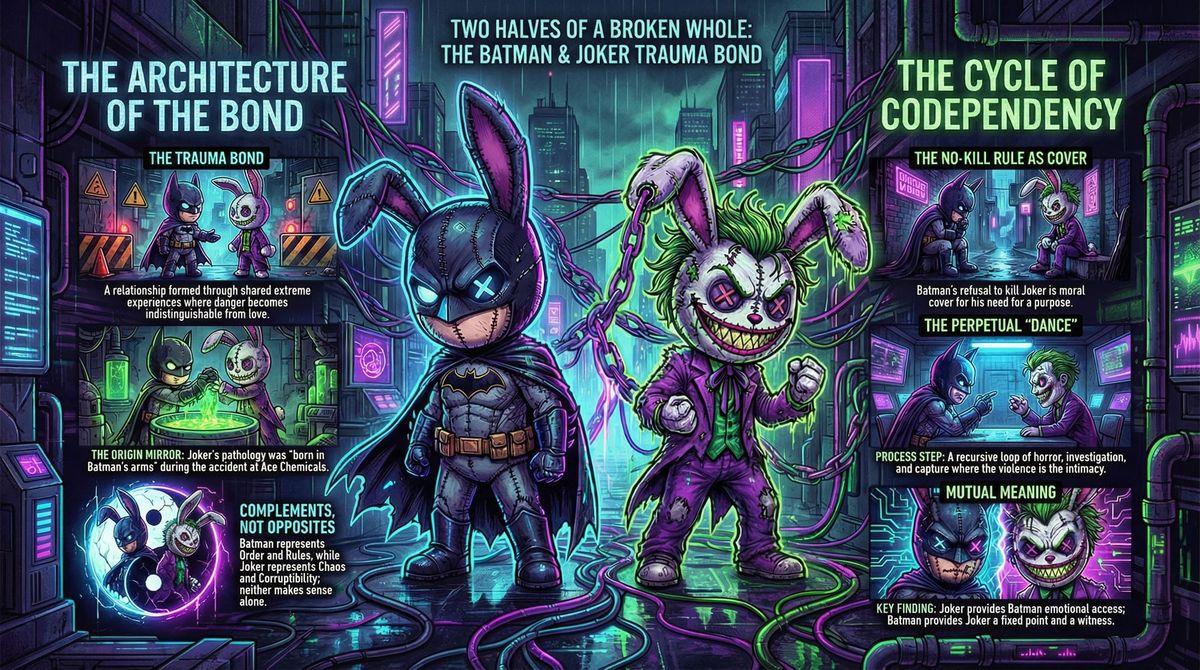
The Red Hood falls into the chemicals at Ace Chemicals while fleeing from Batman. The transformation happens because of the pursuit. Batman makes the Joker.
This isn't just backstory. It's intimacy. Their first moment together is the moment of Joker's creation. Batman is present at the birth. He's implicated in it. Whatever Joker becomes, Batman was there at the beginning.
No other rogue has this origin intimacy. Penguin, Riddler, Ivy—they come to Gotham with their pathologies already formed. Joker's pathology is born in Batman's arms.
The Trauma Bond Structure
Trauma bonding is a psychological phenomenon where a relationship forms through shared extreme experience. The bond is intense precisely because of the danger. The nervous system associates the other person with survival-level stakes, and that association becomes indistinguishable from love.
Batman and Joker trauma bond in both directions.
For Joker: Batman is the most important thing that ever happened to him. The chase, the conflict, the near-death encounters—these are his peak experiences. His nervous system is organized around Batman. Without the Bat, there's no meaning.
For Batman: Joker is the ultimate test, the enemy who can't be predicted or controlled, the one who makes the mission feel necessary. Fighting Joker is the closest Batman gets to feeling alive. His nervous system is activated by Joker in ways no one else activates it.
They're addicted to each other. The addiction looks like hatred but functions like love.
"You Complete Me"
The Dark Knight makes it explicit. Joker tells Batman: "You complete me."
He's not wrong.
Batman is order. Joker is chaos. Batman has rules. Joker has none. Batman believes in human goodness. Joker believes in human corruptibility.
They're not opposites—they're complements. Each defines himself against the other. Neither makes sense without the other to push against.
This is what completion means in dysfunctional relationships: I need you because without you I don't know who I am. My identity requires your existence. You're not someone I love—you're someone I can't exist without.
That's not healthy connection. That's merger. That's enmeshment of the most extreme kind.
The Killing Joke
Alan Moore's The Killing Joke (1988) is the definitive Batman/Joker text. The story ends with both of them laughing together in the rain.
Joker tells a joke. Batman laughs. For one moment, they're just two people sharing something funny. The murder and torture that preceded this moment vanishes. They're together.
The laugh has been analyzed endlessly. Does Batman kill Joker in that moment? Does he let him go? What does the shared laughter mean?
Here's what it means: they understand each other. Joker is telling Batman a joke about their situation—two people who can't escape each other, trapped in a pattern they didn't choose. Batman laughs because it's true.
For one instant, they drop the roles. They're not hero and villain. They're two men who have spent their lives locked in a dance neither knows how to end.
That's intimacy. That's recognition. That's the closest either of them gets to being truly seen.
Why Batman Won't Kill Him
Batman doesn't kill. That's the rule. But the rule becomes strange when applied to Joker.
Joker murders hundreds. He tortures. He creates suffering for pleasure. Every time Batman stops him, Joker eventually escapes and kills again.
The moral calculus is simple: killing Joker would save hundreds of future lives. Batman refuses. He sends Joker to Arkham, knowing Arkham can't hold him, knowing the murders will continue.
The stated reason is principle. Batman believes in the justice system. Batman believes in redemption. Batman believes that killing makes him no better than the villains.
The actual reason is need.
Batman can't kill Joker because Batman can't live without Joker. The chase is the closest he gets to purpose. The battles are the closest he gets to intimacy. Joker is his reason for existing.
If Batman killed Joker, what would Batman be? A man in a costume punching people for what? Joker makes it matter. Joker makes Batman's life meaningful.
The no-kill rule is moral cover for codependency.
The Joker's Need
Joker doesn't try to leave Gotham. He doesn't expand his empire. He doesn't move on.
For all his chaos energy, Joker is remarkably static. He stays in Batman's orbit. Every scheme, every murder, every plan—it's all for Batman. It's all to get Batman's attention, to make Batman engage, to see that beautiful righteous fury aimed at him.
Joker is obsessed. His entire life is organized around one man.
This is obvious when you look at it directly. Joker is a genius. He could terrorize any city. He could become a global threat. He could make money, build power, do anything.
Instead, he stays in Gotham committing crimes designed to bring Batman to him.
That's not a criminal mastermind. That's a lover who won't leave the city where his ex lives.
The Dance
They've been doing this for decades. In-universe, years. In publication, since 1940.
The pattern never changes. Joker commits horror. Batman investigates. They confront each other. Physical combat. Joker is captured. Joker escapes. Repeat.
Neither wins. Neither loses. The dance continues.
If either of them wanted it to end, it would end. Batman could kill. Joker could leave. But the dance is the point. The dance is the relationship. Ending it would be ending the most important thing in both their lives.
They're dancing partners. The music is violence. Neither can imagine hearing the song stop.
The Dark Knight's Hotel Room Scene
There's a scene in The Dark Knight that's easy to miss. Batman interrogates Joker in a police station. It's brutal. Batman beats him. Joker laughs.
Watch Joker's face. Watch the pleasure. He's getting exactly what he wants.
Batman's attention. Batman's hands on him. Batman's rage, unleashed and focused entirely on Joker. For those minutes, Joker is the center of Batman's world.
"I wanted to see what you'd do," Joker says. "You didn't disappoint."
The whole relationship is in that line. Joker provokes to see Batman react. The reaction is the reward. Joker doesn't care about the crime—he cares about what the crime makes Batman do.
This is relational, not criminal. Joker is testing whether Batman will stay engaged. Whether Batman still cares. Whether the love is still there.
Batman's violence is the affirmation.
Why No One Else Compares
The rogues gallery is vast. Catwoman, Ivy, Bane, Talia, Riddler—each has a claim on Batman's attention.
None of them compare to Joker.
Selina almost gets in—but Batman keeps her at distance. Bane breaks him—but it's a single event. Riddler engages intellectually—but there's no emotional charge. Talia traps him—but through machination rather than connection.
Joker has something none of them have: full access.
He can make Batman feel. Rage, fear, despair, even laughter—Joker reaches the parts that everyone else bounces off. The emotional armor that protects Batman from Catwoman's tenderness doesn't protect him from Joker's chaos.
Joker pierces the dissociation. He reaches the real person underneath. For all the horror of what he does, Joker is the one who sees Bruce Wayne most clearly.
The Death of Jason Todd
Joker kills Robin. Beats Jason Todd with a crowbar and blows him up. Batman fails to save him.
This should end everything. This should be the line where Batman finally kills. This should break the pattern.
It doesn't.
Batman grieves. Batman rages. Batman continues.
The trauma bond is stronger than parental instinct. Joker killed Batman's son, and Batman still won't kill him.
What does that tell you about the hierarchy of relationships? What does it tell you about what Joker means to Batman?
Jason knows. When he comes back as Red Hood, he forces the confrontation. "Him or me. Kill him or you never really loved me."
Batman doesn't kill. Jason was right. The love for Joker—whatever it is, whatever we call it—runs deeper.
The Endgame
Scott Snyder's Endgame arc plays the relationship to its logical conclusion. Joker discovers Batman's identity. Joker tries to destroy everything Batman is.
The final battle ends with both of them dying. Buried together. Locked in embrace.
They're resurrected, of course—comics don't do permanent death. But the image is there. The natural ending of this relationship is mutual destruction. They can't live apart, and they can't live together, so they die together.
Romeo and Juliet with more murder.
What They Provide Each Other
Let's be clinical for a moment.
What Joker provides Batman:
- Meaning. Without Joker, the mission has no ultimate villain.
- Permission to be violent. Joker deserves everything Batman does to him.
- Emotional access. Joker makes Batman feel.
- Mirroring. Joker shows Batman his own darkness.
- Permanence. Joker will always be there.
What Batman provides Joker:
- Audience. Without Batman, the chaos has no witness.
- Stability. Batman is the fixed point around which Joker orbits.
- Validation. Batman's response proves Joker matters.
- Intimacy. Batman engages fully, which no one else does.
- Meaning. Joker exists because Batman exists.
They're meeting each other's deepest needs in the most destructive way possible. That's what trauma bonds do.
The "One Bad Day" Thesis
Joker believes that everyone is one bad day from becoming him. That sanity is a fiction maintained by luck. That Batman, given the right push, would become a monster.
Batman believes the opposite. That people choose. That principle matters. That the one bad day doesn't have to define you.
Their entire relationship is a debate about human nature. Every encounter is Joker testing whether Batman will break. Every refusal is Batman proving that will survives trauma.
But here's the thing: Batman had his one bad day. His parents were murdered. And he became Batman—which is to say, he became a man who dresses like a demon and beats people unconscious.
Joker might be right. Batman might be the monster already. The only difference might be the costume and the rule about not killing.
They're not opposites. They're parallel lines. Two responses to trauma. Two ways the bad day can break you.
The Love That Dare Not Speak Its Name
Let's say it plainly: Batman loves Joker.
Not romantically. Not sexually (probably). But love.
Joker is the person Batman thinks about most. The person who occupies his planning, his nightmares, his energy. The person he can't quit.
That's love. Whatever form it takes, whatever we call it—that's love.
And Joker loves Batman. Obsessively, destructively, exclusively. Joker has structured his entire life around Batman. That's not hatred. Hatred doesn't do that. Hatred moves on. Hatred finds new targets.
Joker never moves on. He can't. Batman is everything.
Two men locked in a relationship neither can name, neither can end, neither can survive without.
The most beautiful trauma bond ever written.
Why It Matters
Batman and Joker matter because they're honest about what relationships can be.
Most fiction pretends that love is gentle. That connection is healthy. That intimacy leads to healing.
Batman and Joker show the shadow side. That connection can be obsessive. That intimacy can be destructive. That sometimes the person you can't live without is the person who makes your life unbearable.
They're the dark mirror of romance. The truth that sometimes love looks like hatred, sometimes need looks like conflict, sometimes the person who knows you best is the person who hurts you most.
We're all a little Batman. We're all a little Joker. We've all had relationships that made no sense, that hurt too much, that we couldn't quit.
Batman and Joker make that visible. They give us a mythology for the love that destroys.
The Ending That Can't Happen
In a perfect story, Batman and Joker would find resolution. One would kill the other, or they'd both walk away, or they'd find some impossible peace.
Comics don't allow endings. The dance continues forever. The trauma bond persists.
Maybe that's the most honest ending. The acknowledgment that some patterns don't break. That some relationships don't end. That some bonds persist even when they should have died decades ago.
Batman and Joker will be dancing when all of us are dead. Still fighting. Still needing. Still completing each other.
Forever.
Part of the Batman Polycule series. This is the synthesis piece. Return to: Batman's Rogues Gallery Is Just His Dysfunctional Polycule