Why Loneliness Hits Dysregulated Nervous Systems Like a Truck

The surprising neuroscience of sadness sensitivity—and what it means for emotional resilience
Here's a finding that caught the researchers off guard.
When Francesca Fusina, Marco Marino, and Alessandro Angrilli at the University of Padova showed emotionally evocative film clips to women while recording EEG and heart rate, they expected the strongest physiological responses to the most intense content. Fear clips featuring threats. Erotic clips with high biological salience.
Instead, the most dramatic neural-cardiovascular coupling showed up during something quieter: sadness clips depicting isolation and desolation. Characters alone in scenes of anguish. No gore, no threat, no high arousal. Just loneliness.
And it only happened in one group.
The Setup
The study selected 50 women from a pool of 422, split into two groups based on emotion regulation capacity. Half scored in the top 15% for dysregulation—difficulty managing emotional responses, lability, impulsivity. Half scored in the bottom 15%—highly regulated, emotionally stable.
Both groups watched 18 validated film clips spanning six emotional categories: erotic, scenery, neutral, sadness, compassion, and fear. Throughout viewing, the researchers recorded 64-channel EEG and continuous heart rate, then computed connectivity between brain networks in both alpha (8-13 Hz) and gamma (30-50 Hz) frequency bands.
They were particularly interested in the Ventral Attention Network—the brain's system for orienting toward emotionally salient stimuli—and how its connectivity with other networks correlated with heart rate changes.
Citation: Fusina F, Marino M and Angrilli A (2025) Heart rate and EEG gamma band connectivity in the ventral attention network during emotional movie stimulation in women with high emotion dysregulation. Front. Neurosci. 19:1599349. doi: 10.3389/fnins.2025.1599349
The Sadness Surprise
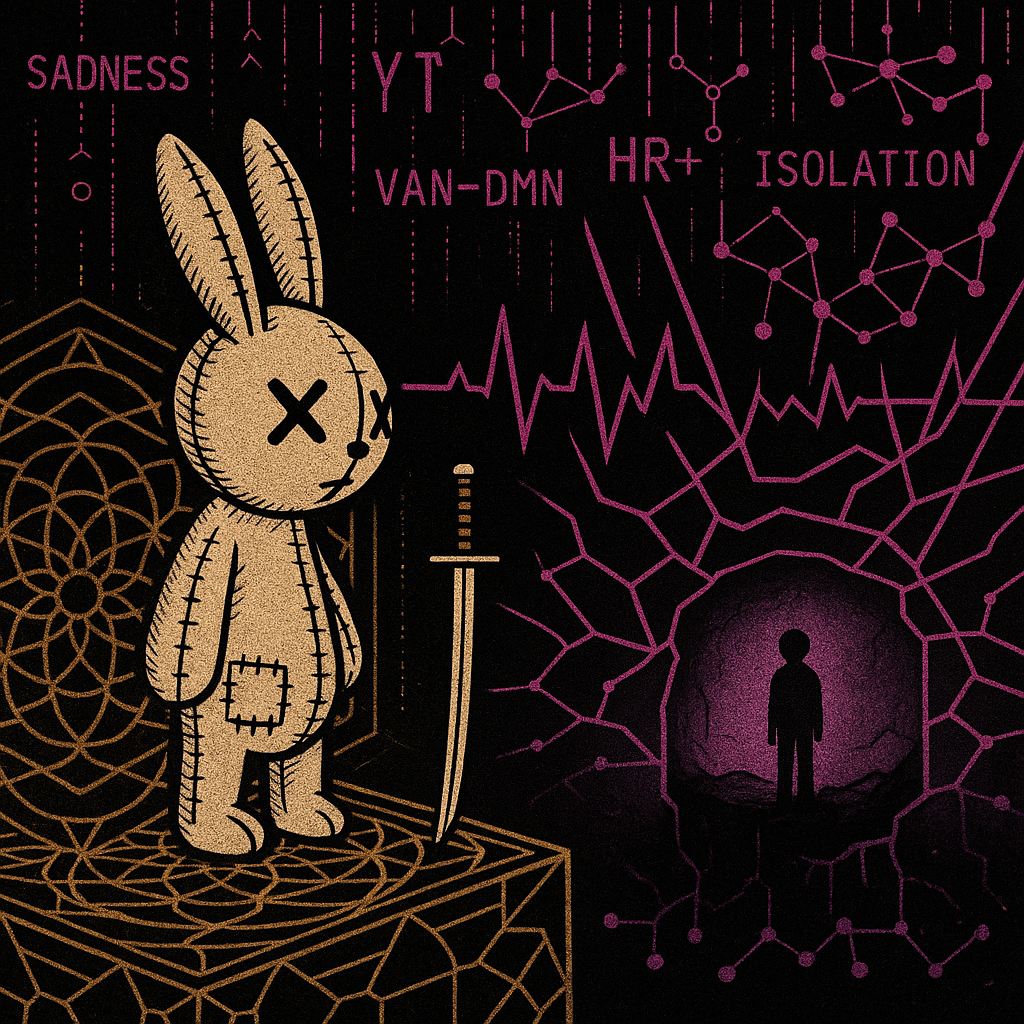
In the high-dysregulation group, sadness clips produced the strongest and most widespread correlations between heart rate and gamma-band brain connectivity. Not just within the Ventral Attention Network, but across nearly every network measured: VAN, Default Mode Network, Language Network, Visual Network, Somatomotor Network.
The correlations were positive—meaning higher heart rate associated with higher connectivity. When these women watched scenes of isolation, their cardiovascular and neural systems synchronized in a whole-brain response. The more their hearts raced, the more their attention networks fired together.
The low-dysregulation group? No such effect. Sadness clips didn't trigger the same neural-cardiovascular coupling. They could witness loneliness without their entire system recruiting into reactive attention.
This wasn't what the researchers predicted. Sadness is a low-arousal emotion. You'd expect the high-arousal clips—fear, erotic content—to produce the biggest physiological responses. Instead, something about depicted isolation specifically captured the dysregulated nervous system in a way that even threat content didn't.
Why Sadness, Not Fear?
The researchers speculate—carefully, with appropriate hedging—that sadness content may be particularly salient for individuals who already struggle with emotion regulation.
Here's the chain of reasoning: emotion dysregulation is associated with greater symptoms of anxiety and depression. (The high-dysregulation group in this study showed significantly elevated scores on both dimensions compared to their regulated counterparts.) Loneliness predicts social anxiety, with emotion dysregulation mediating the relationship. Emotion dysregulation also partially mediates the longitudinal relationship between loneliness and both depression and stress.
In other words, for people who struggle to regulate emotional responses, scenes of isolation may hit a nerve that more dramatic content doesn't. Fear clips show external threats—something out there to escape from. Sadness clips depicting loneliness show something more existentially concerning: the absence of connection itself.
The dysregulated nervous system may read aloneness as a special category of threat.
The Architecture of Reactive Attention
What does it actually mean for heart rate to correlate with gamma connectivity across multiple brain networks?
Gamma oscillations (30-50 Hz) are associated with active information processing, binding of features into coherent percepts, and communication between task-relevant neural populations. When gamma connectivity increases across multiple networks simultaneously, the brain is recruited broadly—attention isn't focused on one thing but spread across systems.
The Ventral Attention Network specifically handles bottom-up attentional capture. It's what orients you toward something unexpected or emotionally relevant. When VAN connectivity extends to language networks, default mode networks, visual networks—all while heart rate climbs—the picture is of a system mobilizing comprehensively.
The high-dysregulation women weren't just noticing the sadness clips. Their entire brain-body axis was responding as if to something demanding full-system attention.
This is dramatically different from calm witnessing. A regulated nervous system can observe depicted suffering without becoming enlisted by it. The boundary between observer and observed remains intact. An dysregulated system has thinner boundaries—what's seen bleeds through into visceral response.
Loneliness as Coherence Threat
There's a theoretical frame that makes sense of this: loneliness threatens coherence.
Social connection isn't just pleasant—it's regulatory. Two nervous systems in proximity influence each other. Breathing patterns synchronize. Heart rate variability aligns. Prosodic voice tones attune. This co-regulation is the mechanism beneath "feeling safe with someone," and it's not metaphorical. It's measurable physiological entrainment.
Isolation removes the co-regulatory other. For a well-regulated nervous system with robust self-regulatory capacity, this is manageable. The system can maintain coherence without external scaffolding.
For a dysregulated nervous system—one that struggles to self-regulate and may depend more heavily on external regulation—isolation is genuinely threatening. The scaffold that helps maintain organization is absent. Coherence becomes harder to sustain.
This is why the sadness clips—depicting characters alone in anguish, cut off from connection—might register as particularly significant to the dysregulated brain. Not because they're the most arousing content. Because they depict the condition that makes everything harder: being alone with emotional states you can't manage alone.
The Heart-Brain Axis
The Fusina study sits within a larger body of research on neurovisceral integration—the bidirectional communication between heart and brain.
The Central Autonomic Network (CAN) includes the anterior cingulate, insular, and ventromedial prefrontal cortices, along with subcortical structures that regulate cardiac function through sympathetic and parasympathetic outflow. The heart doesn't just respond to brain commands—it sends signals back through vagal afferents, baroreceptor reflexes, and other feedback loops.
Heart rate isn't just an output variable. It's part of the loop.
When heart rate and brain connectivity correlate strongly—as they did in dysregulated women during sadness clips—it suggests tight coupling between visceral state and neural processing. The heart and brain are moving together, influencing each other, locked in a mutual escalation.
This is different from the regulated pattern, where brain networks can process emotional content without dragging the cardiovascular system along for the ride. Looser coupling allows more flexibility. Tighter coupling means the whole system moves together—which can be adaptive for true emergencies but exhausting for everyday emotional processing.
What the Numbers Actually Show
For specificity: in the high-dysregulation group during sadness clips, heart rate showed significant positive correlations with gamma connectivity in multiple network pairs:
Intra-VAN (within the Ventral Attention Network): r = 0.39
VAN-DMN (connecting to Default Mode): r = 0.40
VAN-LN (connecting to Language Network): r = 0.44
VAN-VN (connecting to Visual Network): r = 0.42
All correlations significant after FDR correction for multiple comparisons.
The low-dysregulation group showed no significant heart-brain correlations during sadness clips in the gamma band. Same content, same viewing conditions, same analysis pipeline. Dramatically different physiological response.
The groups didn't differ in baseline heart rate, and both showed the expected emotion-dependent heart rate patterns across clip categories. The difference wasn't in overall cardiac reactivity—it was in the coupling between cardiac response and neural connectivity specifically during content depicting isolation.
The Implications for Doom-Scrolling
Here's where this gets practical.
Social media feeds serve up endless content depicting human misery, isolation, conflict, and distress. If your nervous system is on the dysregulated end—if you're someone who struggles with emotional lability, anxiety, depression—this content may be hitting harder than you realize.
Not because it's so extreme. Because it's specifically tuned to the frequencies your system is sensitive to. Loneliness and isolation content—the subtle despair that pervades so much of contemporary online life—may be producing full-system physiological responses that you experience as exhaustion, anxiety, or just feeling terrible without knowing why.
The regulated nervous system has some buffering. It can observe, process, and move on without the whole brain-heart axis synchronizing to each piece of content. The dysregulated nervous system lacks that buffer. Every sad post is a mini-mobilization.
This isn't about being weak or oversensitive. It's about neurophysiological reality. Some systems are more tightly coupled than others, and tight coupling means external content has more leverage on internal state.
The Barbell of Emotional Witnessing
There's a structural principle here: the capacity to feel with without drowning in.
One pole: connection. Empathy. Resonance. The ability to be moved by another's suffering, to feel with them, to have their state touch yours. This is prosocial, relational, human.
Other pole: boundaries. The observer position. The capacity to witness without merging. The maintenance of self even while holding space for other.
The forbidden middle: porous boundaries without self-regulation. Feeling everything but having no ground. Each piece of content destabilizing internal state. No buffer between what's observed and what's felt.
Regulated individuals can occupy both poles—connected when appropriate, boundaried when necessary, moving between them flexibly. Dysregulated individuals get stuck in the middle: unable to not-feel, unable to metabolize what they feel, chronically reactive to emotional content without the capacity to process it through.
The Fusina study captures this in physiological terms. Regulated women could watch sadness without their whole system mobilizing. Dysregulated women could not.
The Honest Limitations
The study has constraints that matter.
Sample size was small—25 women per group. The population was specific—female university students in Northern Italy. The clips were brief—around two minutes each. The head model for EEG source localization used templates rather than individual MRI scans.
Most importantly: this is correlational data. We see that heart rate and brain connectivity move together during sadness content in dysregulated individuals. We don't know the causal direction. Does cardiac acceleration drive neural synchronization? Does neural response drive cardiac acceleration? Both? The study can't say.
What it does establish is a differential pattern—a systematic difference in how regulated and dysregulated nervous systems respond to depicted isolation. That pattern is reproducible, physiologically coherent, and theoretically meaningful.
The Path Forward
The researchers note that their findings point toward intervention possibilities: heart rate biofeedback, neurofeedback, imagery training, psychoeducation about emotional regulation.
But the deeper implication is about environmental management.
If your nervous system is on the dysregulated end, you may need to curate your inputs more carefully than your regulated friends. Not because you're weak—because your system is more sensitive, more tightly coupled, more responsive to emotional content.
This isn't about avoiding all sadness. It's about recognizing which content produces whole-system mobilization versus which content can be processed and released. The difference matters.
And it's about building regulatory capacity over time. Nervous systems can learn. The tight coupling that characterizes dysregulation isn't fixed—it can loosen with practice, with co-regulation, with the slow work of teaching the system it's safe to observe without mobilizing.
The Landing
The finding that surprised the researchers makes perfect sense in retrospect.
Fear clips show threats you can escape. Erotic clips show opportunities you can pursue. But sadness clips depicting isolation show the condition that makes everything harder: being alone with what you feel.
For a nervous system that struggles to self-regulate, aloneness isn't neutral. It's threatening in a specific way—the absence of the co-regulatory other who might help stabilize what can't be stabilized alone.
The heart races. The brain networks synchronize. The whole system mobilizes in response to depicted isolation.
Same clips. Different nervous systems. Dramatically different responses.
The dysregulated brain reads loneliness as emergency. The regulated brain reads it as information.
The gap between them is what regulation means.
The research: Fusina F, Marino M and Angrilli A (2025) Heart rate and EEG gamma band connectivity in the ventral attention network during emotional movie stimulation in women with high emotion dysregulation. Front. Neurosci. 19:1599349. doi: 10.3389/fnins.2025.1599349