What Is a Trad Husband?
Everyone knows the trad wife. Fewer people interrogate the trad husband — what he's seeking, what he's performing, and whether the deal he's offering is real.

Part 6 of 9 in the Toxic Masculinity in 2026: A Field Guide series.
Everyone knows what a trad wife is. She's been profiled endlessly. The homesteading content. The sourdough tutorials. The vintage dresses and soft lighting. Hannah Neeleman of Ballerina Farm, the most scrutinized example, with her eight kids and careful aesthetic.
Nobody profiles the trad husband.
He exists. Stands behind every trad wife. Makes the content farm possible. But the camera never turns to him. The discourse never asks what he wants, what he's getting, what he's performing.
Let's fix that.
The Definition
A trad husband is a man in a traditional marriage arrangement—one where gender roles are clearly defined along historical lines. He provides financially. She manages the home and children. The roles are complementary, distinct, and deliberately traditional.
The aesthetic is 1950s America. The breadwinner husband, the homemaker wife. The family structure that existed for roughly one generation in one country and somehow became "traditional."
The trad husband is the support structure for the trad wife's performance. The income that makes her aesthetic possible. The silent partner in the content operation.
What He Wants
Different trad husbands want different things. The category isn't monolithic. But some patterns emerge:
Control. Traditional arrangements give the husband clear authority. Final say on decisions. Defined hierarchy. For men who experienced modern relationships as chaotic and confusing, the clarity is appealing.
Security. A wife who's economically dependent can't leave easily. The trad arrangement reduces exit options. For men with anxious attachment or abandonment fear, this matters.
Aesthetic. The trad wife is a status symbol. Look at my beautiful wife. Look at my well-kept home. Look at my large family. Social proof of successful masculinity.
Meaning. Providing for a family feels purposeful. You're not just working—you're building something. The role has built-in significance.
Simplicity. No negotiating household duties. No discussing who picks up kids. The roles are assigned. For men who found egalitarian relationships exhausting, the assignment is relief.
What He's Promising
The trad husband makes an implicit promise: I will provide.
Economically. I will earn enough for you to not work. For you to homeschool. For you to homestead. For the aesthetic to be possible.
Protectively. I will handle the world. You handle the home.
Permanently. This arrangement is for life. I'm committing to this role forever.
Here's the problem: can he keep that promise?
The Provision Problem
The single-income family was viable in a specific economic moment. Post-WWII, pre-globalization, when a high school diploma could secure a union manufacturing job that supported a mortgage and multiple children.
That economy is gone.
In 1970, median household income could support a family of four on one income. Housing cost 2-3 times annual income. Healthcare was affordable. College was cheap. A man with a factory job or trade could realistically provide for a family, buy a house, save for retirement.
By 2026, that math is impossible for most people. Housing costs 6-10 times annual income in most markets. Healthcare is ruinously expensive. College is a mortgage. Wages have stagnated relative to cost of living. The single-income family requires either high income or inherited wealth or geographical arbitrage (living somewhere cheap, which limits earning opportunities).
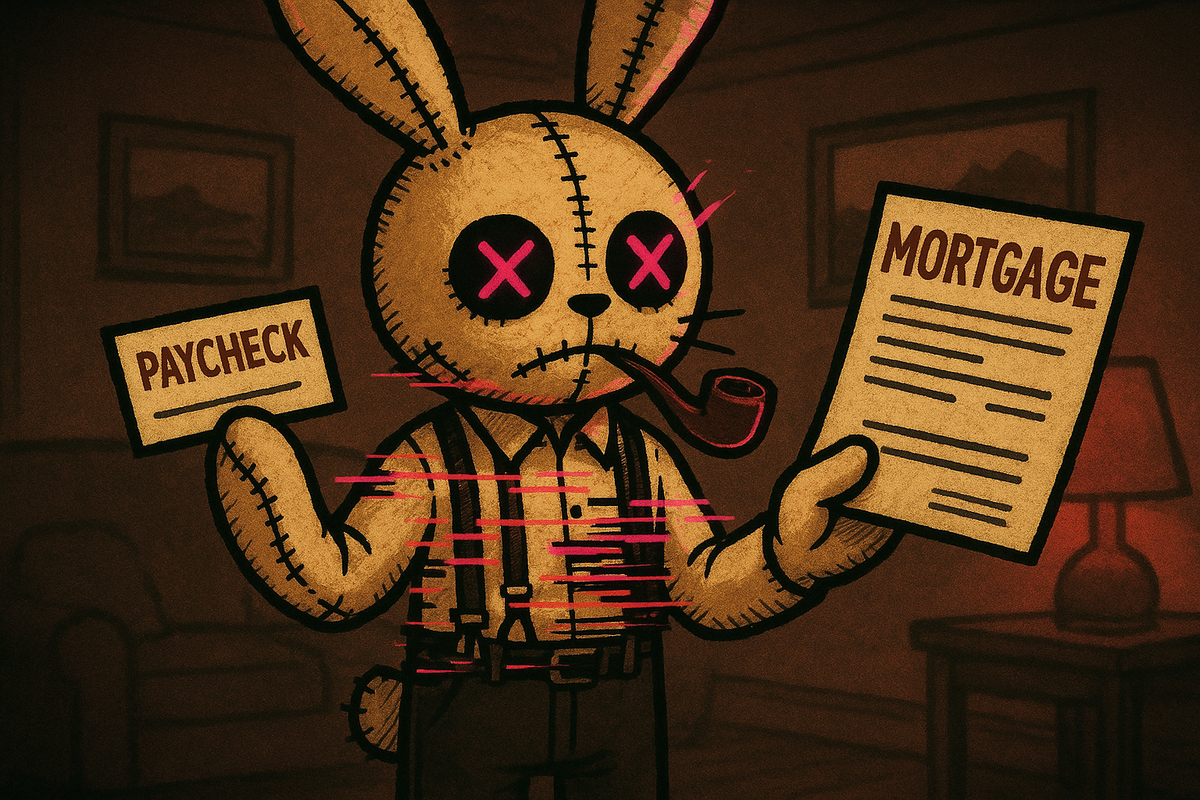
The trad husband in 2026 is making 1954 promises in a gig economy. He's committing to sole provision when wages have stagnated for fifty years, when housing costs have decoupled from income, when a single medical emergency can bankrupt a family.
Some can do it. High earners—tech, finance, medicine, law. Inherited wealth—family money, trust funds, real estate. The professional class with secure income and benefits. These men can actually provide sole income for a family while maintaining the aesthetic.
Most can't. The aspiring trad husband with a mid-level job is making promises his paycheck can't keep. He earns 70k. That's not supporting a stay-at-home wife, multiple kids, homeschooling, and the homesteading aesthetic. Not unless they live somewhere very cheap, which usually means limited job opportunities, which makes the 70k hard to sustain.
The aesthetic requires economics that often aren't there. The soft-focus Instagram content shows beautiful homes, healthy children, abundant gardens, artisanal everything. That aesthetic costs money. Either he's earning substantially more than median, or family wealth is involved, or they're in debt, or the aesthetic is partially funded by her content income (irony alert).
This is the trad husband's central tension: the role assumes an economy that no longer exists.
The promise he's making—"I will provide for you permanently so you never have to work"—was realistic for previous generations. For this generation, it's aspirational at best, delusional at worst. Most families need two incomes to maintain middle-class life. The trad arrangement requires either exceptional income or sacrificing the standard of living the aesthetic implies.
Some trad families live this honestly. They make less money, live in smaller houses, drive older cars, accept that single income means reduced material comfort. They're actually traditional—not performing tradition for content, but choosing a lifestyle that fits their values even when it costs.
Others are performing tradition funded by modern dual-income reality. She makes content income. He has family money. They're not actually single-income; they've just dressed modern economics in vintage aesthetics.
The Content Farm Angle
Some trad families are content farms. The tradwife aesthetic generates sponsorships, ad revenue, book deals. Hannah Neeleman's husband is heir to a billion-dollar fortune, but the content itself also generates significant income.
In these cases, who's actually providing?
The wife's content—her performance of tradwifery—may generate substantial income. The husband's "provision" may be less important than his presence in the aesthetic.
This creates irony. The tradwife is "traditional" because her husband provides. But she may be outearning him with content about being provided for.
The Ballerina Farm husband is notably absent from profiles. He's the guy behind the camera, literally and figuratively. The content requires his existence but not his visibility.
The Daniel Neeleman Question
Daniel Neeleman, the Ballerina Farm husband, is the son of JetBlue founder David Neeleman. He's worth hundreds of millions. He's not a typical trad husband making promises about provision—he's a guy whose family money makes the entire operation possible.
Most trad husbands don't have this. They're regular men trying to support a single-income aesthetic on regular income. The Neelemans are not representative.
The trad content that inspires aspirational families is often underwritten by wealth invisible in the content. The aesthetic is funded by family money, inheritance, or the content itself—not by the husband's provision.
This matters. Men watch trad content and imagine they could provide this life. Many can't. The gap between aspiration and economics creates failure modes.
The Red Pill Overlap
Many trad husbands came through the red pill.
They absorbed the gender analysis—women are hypergamous, feminism ruined dating, traditional arrangements work better. They learned the framework in manosphere spaces. The analysis of sexual marketplace dynamics. The critique of modern dating. The argument that traditional gender roles work better for everyone.
Then they found a woman who agreed. Or seemed to. Or could be convinced.
The red-pill-to-trad pipeline delivers men who have a theory about why traditional works. They're not naive traditionalists—they're ideological ones. They believe in the arrangement because they believe in the framework. They've done the analysis. They understand the failure modes of modern relationships. They've chosen traditional deliberately, as solution to identified problems.
This can be fine. Shared ideology creates shared expectations. Both partners understand why they're doing it this way. The framework gives them language for what they're building. The deliberateness means they've opted in consciously rather than defaulting into roles.
It can also be fragile. When the wife is a real person who occasionally deviates from the ideology—who has opinions, who changes, who can't be reduced to framework—the theory-based trad husband struggles. He married a thesis about women. He got an actual woman.
The framework said: traditional women are feminine, submissive, nurturing, supportive. She signed up for that. But she's also human. She has bad days. She gets resentful sometimes. She doesn't always want to be nurturing. She occasionally wants him to do emotional labor instead of her.
The ideological trad husband experiences this as betrayal. You agreed to be traditional. Traditional means X. You're not doing X. You lied.
The non-ideological trad husband—the one who's traditional because that's just how his family did it, no framework required—handles deviation better. His wife is a person. People have moods. Whatever. They work it out.
The ideological trad husband has a framework for what she should be. When reality deviates from framework, the framework insists reality is wrong. He can't be flexible because flexibility would mean admitting the framework doesn't capture everything. And if the framework doesn't capture everything, maybe he chose wrong. Maybe the red pill analysis was incomplete. Maybe actual relationships are more complex than the ideology allowed.
That's threatening. Easier to insist she's failing to be properly traditional than to question whether the framework is adequate for actual human complexity.
The Control Question
Traditional arrangements concentrate power in the husband. He earns the money. He makes final decisions. The structure is hierarchical.
Some couples negotiate this genuinely. She wants to be home with kids. He wants to provide. The roles fit their actual preferences. They discuss it. They try it. They adjust as needed. The hierarchy is formal but the actual dynamic is collaborative. He has final say in theory; in practice they make decisions together.
Some couples arrive here differently. He wants control; she's convinced herself she wants to be controlled. He's uncomfortable with equality; she's learned to frame dependence as preference. The hierarchy isn't formal—it's real. He actually makes decisions unilaterally. She actually has no exit options. The arrangement isn't chosen complementarity—it's power imbalance dressed as tradition.
From outside, these look identical. Both couples describe happy traditional arrangements. Both appear content with defined roles. Both post content about traditional marriage. Both would say they chose this deliberately.
From inside, they're different. One is chosen complementarity. The other is dynamics that would concern a therapist.
How do you tell the difference? Exit options. In healthy traditional marriages, she could leave if she wanted to. She has skills, or family support, or savings, or education. She's choosing to stay. The dependence is economic but not total. If things went wrong, she has options.
In concerning traditional marriages, she couldn't leave. She has no skills, no support, no savings, no education. She's completely dependent. The dependence is total. If things went wrong, she's trapped.
The first couple is practicing complementary roles within a fundamentally egalitarian relationship. The second couple is practicing power dynamics with traditional framing.
The trad husband category contains both. The aesthetic doesn't distinguish them.
The man who genuinely wants to provide, who takes that responsibility seriously, who would support his wife if she wanted to change the arrangement—he's fine. He's choosing a lifestyle that works for his family.
The man who wants his wife dependent because her dependence gives him control—that's different. That's not traditional values; that's control issues with a vintage aesthetic.
The problem is you can't tell from outside. Both men post the same content. Both describe their marriages the same way. Both would say they're living traditional values. The aesthetic is identical. The underlying dynamics are completely different.
What We're Not Saying
This isn't "traditional bad, egalitarian good."
Plenty of traditional arrangements work. Some people genuinely thrive with defined roles. Some women genuinely want to be home with children, and some men genuinely want to provide.
The problem isn't traditional roles. The problems are:
- Economics that don't support the promise. Men committing to sole provision can't deliver.
- Ideology masking control. "Traditional" as cover for dynamics that would otherwise read as concerning.
- Aesthetic without substance. Performing tradwife for content while actual economics work differently.
- Exit option asymmetry. Arrangements that work until they don't, and then she's trapped.
The trad husband isn't inherently problematic. The gap between the performance and reality often is.
The Invisible Man
The trad wife gets profiled. Her aesthetic. Her sourdough. Her children. Her soft-focused contentment.
The trad husband remains invisible. The provider whose provision is assumed. The patriarch who doesn't speak. The man behind the content who never appears in it.
Maybe that's what he wants. Traditional masculinity was never about visibility—it was about capability. He provides, he protects, he doesn't need attention.
Or maybe it's what the content requires. The trad wife is aspirational. The trad husband is just a guy. Showing him might break the spell.
Either way: we know what a trad wife is. Now you know what a trad husband is.
The man promising 1954 in 2026. The invisible support for a very visible aesthetic. The guy nobody interviews standing behind the wife everyone profiles.
Previous: Incels and MGTOW in 2026: A Welfare Check Next: The Divine Feminine Isnt the Opposite of Toxic Masculinity