The Shortcut Barbell
Heuristics evolved for ancestral environments. The solution: trust intuition in familiar territory, apply analysis in novel situations. Know which world you're in.

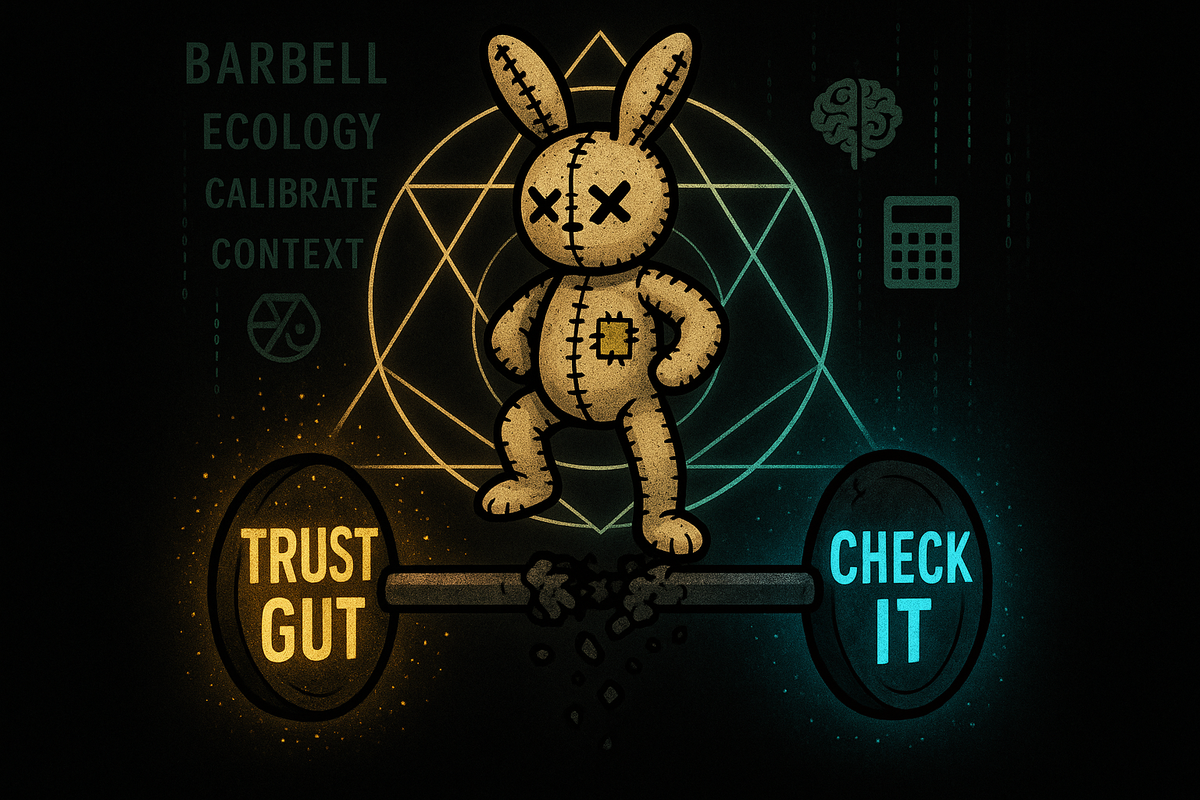
When to trust your gut, when to override it—and how to build a life that works with your brain instead of against it
We’ve covered eleven heuristics. Eleven ways your brain takes shortcuts. Eleven patterns that evolved for one environment and now operate in another.
The standard conclusion of this kind of series is: “Be more rational. Override your biases. Think harder.”
That’s wrong. And it’s exhausting.
Here’s the real conclusion: your heuristics are mostly good. They just need the right ecology. The goal isn’t to eliminate shortcuts—it’s to deploy them in the domains where they work.
The Barbell Model
A barbell has weights at both ends and nothing in the middle.
In finance, a barbell strategy means putting most of your money in ultra-safe assets and a small amount in high-risk, high-reward bets—nothing in the middle.
The same structure applies to cognition.
On one end: environments where your heuristics are well-calibrated. These are situations that match the ancestral pattern—familiar territory, repeated interactions, immediate feedback, natural frequencies. Here, your gut is a good guide. Trust it. Move fast.
On the other end: environments where your heuristics systematically fail. These are situations that are evolutionarily novel—abstract statistics, one-shot interactions with strangers, memoryless systems, fat-tailed distributions. Here, slow down. Check the math. Override the instinct.
The dangerous middle: using gut instincts in unfamiliar territory while feeling confident. This is where people get hurt. The heuristic fires, the confidence comes with it, and you don’t realize the environment has shifted out from under you.
The Diagnostic Questions
For any decision, ask:
Is this familiar territory? Have I encountered situations like this many times before? Does this environment resemble the one my heuristics evolved for? Are the relevant features similar to what my ancestors would have faced?
If yes: trust the gut. That’s what it’s for.
Is this novel territory? Is this situation abstract, statistical, evolutionarily unprecedented? Am I dealing with strangers I’ll never see again? Memoryless systems? One-shot interactions? Fat-tailed distributions?
If yes: slow down. The gut doesn’t know what it’s doing here.
Am I getting feedback? Will I find out if I’m wrong? Is the feedback fast enough to update my intuitions? Or am I operating in a domain where errors are invisible or delayed?
If feedback is sparse or slow, assume your intuitions are uncalibrated.
Heuristic-by-Heuristic
Let’s map the series to the barbell:
Gambler’s Fallacy - Trust gut: In most of life, sequences carry information - Override: In memoryless systems (dice, roulette, lottery) - Diagnostic: “Does this system have memory?”
Availability Heuristic - Trust gut: For local risks you’ve personally observed - Override: For global risks mediated by media - Diagnostic: “Is this memorable because it’s common, or memorable because it’s dramatic?”
Survivorship Bias - Trust gut: In domains where you see both winners and losers - Override: In domains where failures are invisible - Diagnostic: “What would I see if the failures were visible?”
Anchoring - Trust gut: When anchors are informative (set by experts, by precedent) - Override: When anchors are strategic or arbitrary - Diagnostic: “Who set this reference point, and why?”
Loss Aversion - Trust gut: In multiplicative dynamics where ruin is possible - Override: For small, affordable bets with positive expected value - Diagnostic: “Can I survive the downside?”
Sunk Cost Fallacy - Trust gut: When past investment provides genuine information about future value - Override: When past costs are truly unrecoverable - Diagnostic: “Would I start this today if I had no history with it?”
Framing Effect - Trust gut: When the frame reflects meaningful context - Override: When the frame is strategically manipulative - Diagnostic: “What’s the reference point, and who chose it?”
Halo Effect - Trust gut: When trait correlations are real (in your experience) - Override: When you’re inferring competence from irrelevant signals - Diagnostic: “What would I think if this person were less attractive/confident/famous?”
Spotlight Effect - Trust gut: In small groups with repeated interaction where reputation matters - Override: Among strangers who will never think of you again - Diagnostic: “Will anyone remember this in a week?”
Fundamental Attribution Error - Trust gut: When you have extensive behavioral evidence over time - Override: For single observations of strangers’ behavior - Diagnostic: “What would I have to be going through to act that way?”
Dunning-Kruger - Trust gut: In domains where you’ve accumulated extensive feedback - Override: In domains where you’re a recent entrant - Diagnostic: “How much feedback have I received in this domain?”
The Meta-Skill
The barbell isn’t a formula. It’s a practice.
The meta-skill is ecological awareness: knowing what kind of environment you’re in and adjusting your cognitive strategy accordingly.
In familiar territory, analysis is usually worse than intuition. Overthinking introduces noise. Trust the pattern-matching that’s been trained on thousands of relevant experiences.
In novel territory, intuition is usually worse than analysis. The heuristics fire anyway—that’s automatic—but their outputs should be treated as hypotheses, not conclusions. Check them. Verify. Do the math.
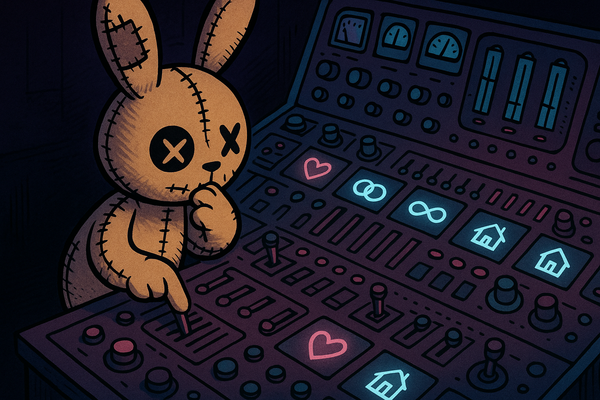
The master move is the environment audit. Before engaging your decision machinery, diagnose the decision environment. Then select the cognitive strategy that matches.
You’re Not Broken
Here’s the thing about this series:
None of these heuristics are mistakes. Every one of them exists because it helped your ancestors survive. They’re not bugs in the human software—they’re features tuned for a specific operating environment.
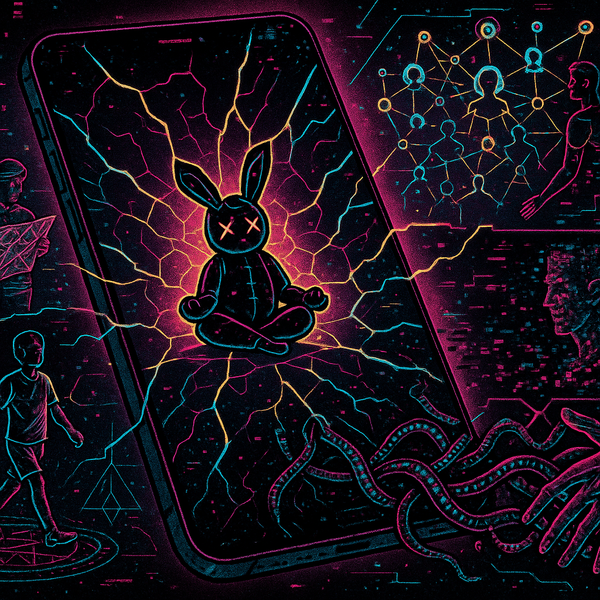
The problem isn’t that you’re irrational. The problem is that you’re running savanna firmware on smartphone hardware. The environment shifted faster than evolution could track.
This means the goal isn’t to eliminate biases. It’s to build niches—life structures, decision environments, habits and practices—that put your heuristics in familiar territory as often as possible.
Where you can, design your environment to match your brain. Make the familiar territory larger. Make the novel territory smaller. Create feedback loops. Slow down the stakes.
Where you can’t, build systems that compensate. Checklists for high-stakes novel decisions. Advisors who know the territory you don’t. Deliberate practice at the diagnostic questions.
You’re not irrational. You’re optimized for a different world.
And now that you know the map, you can navigate both.
The Series in One Sentence
Your brain runs shortcuts that work in familiar environments and fail in novel ones—so know which world you’re in before trusting your gut.
This concludes Your Brain’s Cheat Codes. Thanks for reading.
Previous: Part 11: Beginners Feel Like Experts — The Dunning-Kruger Effect
Start from the beginning: Your Brain’s Cheat Codes