The Relationship Escalator Is Optional
Dating, exclusive, cohabitation, marriage, kids — the script exists for structural reasons. It just doesn't have to be yours.

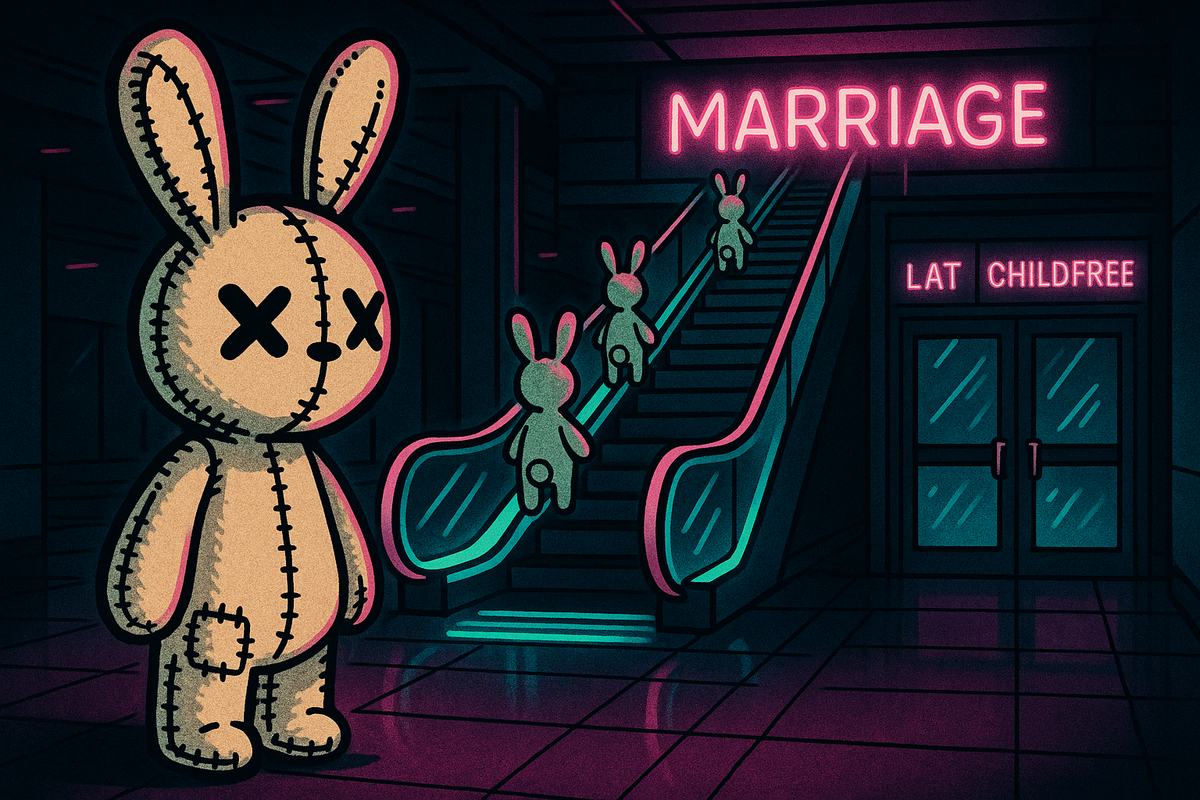
The relationship escalator is basically a child-production-and-raising algorithm. Dating, exclusivity, cohabitation, marriage, kids, death. You get on at the bottom and ride to the top. The only acceptable exit is dying.
Nobody tells you this is what you're signing up for. They call it "love" and "commitment" and "building a life together." But the escalator was designed when humans lived to 35 and property needed to pass to verified heirs. You're running reproductive optimization software from 10,000 BCE on a brain that expects to live to 80.
The exits have always been there. We just pretend they aren't.
What the Escalator Looks Like
Standard steps, roughly in order:
- Meeting/Attraction — You notice each other
- Dating — You spend time together, assess compatibility
- Exclusivity — You stop seeing other people
- Official relationship — Labels. "Boyfriend/girlfriend." Introducing to friends.
- Meeting families — The relationship becomes witnessed
- Moving in — Shared living space
- Engagement — Public commitment to marry
- Marriage — Legal binding. The peak of the escalator.
- Children — Biological or adopted. The point of the whole exercise, evolutionarily.
- Growing old — Till death do us part
Each step is expected to follow the previous. Staying on one step too long raises questions. Going backwards is failure. The only acceptable exit is death.
Why It Exists
The escalator isn't arbitrary. It evolved to solve real problems:
Paternity certainty. Exclusivity ensures a man knows which children are his. Property inheritance requires this answer.
Resource commitment. Each escalator step represents increasing resource entanglement. Moving in, marriage, kids—each one makes exit more costly, which makes commitment more credible.
Social legibility. "We're engaged" communicates your relationship status to everyone without explanation. The escalator provides shared vocabulary.
Child-rearing infrastructure. Two parents, committed for decades, pooling resources—this is the most reliable child-rearing structure humans have found. The escalator is basically a child-production-and-raising-optimization algorithm.
Network stability. Your family and friend networks can integrate your partner. The wedding is partly a ritual to merge social networks. "You're part of us now."
Institutionalized support. Marriage comes with legal benefits: tax breaks, hospital visitation rights, inheritance default, spousal insurance coverage. The state supports the escalator because stable families reduce social welfare burden.
The escalator solves problems. The question is whether those problems are still your problems.
The Hidden Costs
The escalator's benefits are advertised. The costs are discovered mid-ride.
Sunk cost acceleration. Each step makes leaving harder. After you've merged finances, bought a house, had kids—the exit cost is catastrophic. This can keep you in a dead relationship for years because starting over feels impossible. What was meant to signal commitment becomes a trap.
Timeline pressure. The escalator has expected pacing. Dating too long without moving in raises questions. Living together too long without engagement raises questions. Engaged too long without marriage raises questions. Married too long without kids raises questions. The timeline isn't yours—it's society's, and society is impatient.
Identity subsumption. As the relationship escalates, "we" increasingly replaces "I." Your individual identity gets absorbed into the couple identity. For some people this is beautiful fusion. For others it's slow erasure. You wake up at 40 and can't remember who you were before you became half of "we."
Spontaneity death. The escalator is planned. Proposal planning. Wedding planning. House hunting. Pregnancy planning. The relationship becomes a project to manage rather than an experience to live. Romance gets replaced by logistics.
Expectation lock-in. Once you're on the escalator, deviation looks like failure. If you move in together and then decide to live separately again, people ask what went wrong. Nothing went wrong—you tried something and adjusted. But the escalator doesn't allow for adjustment. Forward progress or failure, those are the options.
Who the Escalator Serves
People who want children. The escalator is optimized for reproduction. If you want kids, the escalator provides the most socially supported, resource-stable context to raise them.
People who want legibility. Explaining a non-escalator relationship constantly is exhausting. "This is my partner of seven years whom I love but don't live with" requires a conversation. "This is my husband" doesn't.
People who want social support structures. Marriage comes with legal benefits, family integration, institutional recognition. These are real resources.
People whose attachment styles need the security. For anxious attachment especially, the escalator's explicit progression provides reassurance. Each step is a demonstration of commitment.
Who the Escalator Fails
People who don't want children. The escalator assumes children as the destination. If you're childfree, you're riding an escalator designed for someone else's journey.
People who don't fit the timeline. Meeting "the one" at 22 and riding to death at 80 is different from meeting at 42 and wondering if cohabitation even makes sense. The escalator assumes a specific life stage.
People in incompatible circumstances. Long-distance careers. Care-giving obligations. Financial situations that make cohabitation impractical. The escalator doesn't accommodate real life complexity.
People with multiple loves. The escalator is explicitly monogamous. One person rides with you. Everyone else gets off.
Avoidant attachment. The escalator's inexorable progression toward total fusion can feel like watching a trap slowly close. Each step is another lock on the cage.
The Exits They Don't Advertise
Here's what they don't tell you: you can get off.
Exit 1: Permanent dating. Never move in. Maintain separate lives. Love each other fully without fusion. This preserves individual autonomy while maintaining romantic connection. Common among people who've been divorced and don't want to repeat the fusion-then-implosion pattern.
Exit 2: Living apart together (LAT). Long-term partnership without shared housing. Common in Europe. Barely acknowledged in America. You're committed, you see each other regularly, you might even consider yourselves married—but you maintain separate residences. This works especially well for people who need significant alone time to function.
Exit 3: Childless partnership. Take marriage but skip reproduction. Still a valid destination even if everyone keeps asking "when." The escalator assumes children as the destination, but a growing number of couples are rejecting that assumption entirely. Marriage without kids is a legitimate stopping point, not a failure to reach the top.
Exit 4: Non-escalating relationships. A relationship that stays at one level indefinitely. Not going anywhere—not because it's failing, but because it's arrived. Maybe you date for ten years without moving in because what you have works. The lack of escalation isn't a problem—it's the design.
Exit 5: Relationship fluidity. Moving up and down the escalator as circumstances change. Living together, then apart, then together again. Flexibility rather than linear progression. This requires partners who don't view backward movement as failure—just as adjustment to changing needs.
Exit 6: Parallel escalators. Multiple relationships, each on their own trajectory. Polyamory. The escalators don't merge—they run alongside. You might be married to one partner, dating another, cohabiting with a third. Each relationship operates at the level that suits it.
Exit 7: No escalator. Rejecting the frame entirely. Relationship anarchy. Each connection evaluated on its own terms, not on progress toward institutionalization. What you do with a partner isn't determined by the "level" of the relationship—it's determined by what both people actually want.
The De-Escalation Challenge
Getting off the escalator mid-ride is harder than never getting on.
If you're married and want to move to separate residences, society reads this as divorce-in-progress. If you're engaged and decide not to marry, people ask what went wrong. If you're living together and one person wants to move out, the other often experiences it as rejection.
De-escalation requires both partners to genuinely believe that relationship depth and escalator height aren't the same thing. This is hard because we've been conditioned to equate them. "We're moving backward" feels like "we're falling apart" even when the move is toward what you actually need.
Successful de-escalation happens when:
- Both partners want it (not one compromising)
- The reasons are about life circumstances or needs, not about relationship dissatisfaction
- Communication is constant and explicit
- Both people can tolerate others' judgment about the decision
- The relationship gets evaluated on its own terms, not on comparison to the cultural script
The Escalator and Attachment
Anxious attachment often clings to the escalator. Each step provides reassurance. "We moved in together—we're more committed now." The escalator soothes the abandonment fear. Lack of escalator progress triggers anxiety even when the relationship is healthy.
Avoidant attachment often drags feet on the escalator. Each step feels like lost independence. They may commit but constantly look for exits. Or they may find partners who don't want the escalator—compatible in avoidance.
Secure attachment can ride or not ride based on actual preference. They don't need the escalator for reassurance and don't fear it as a trap. They choose based on what serves the relationship.
Disorganized attachment may alternate between desperately wanting escalator progress (when craving security) and sabotaging it (when intimacy becomes threatening). The escalator becomes another arena for the push-pull pattern.
Why People Ride It Anyway
Even people who don't want the escalator often end up on it. Why?
Inertia. The escalator is default. Opting out requires active choice, explanation, and often conflict. It's easier to go along.
Partner pressure. One person wants the escalator; the other doesn't want to lose them. The reluctant partner compromises, hoping they'll grow into wanting it. They usually don't.
Social pressure. Family expectations, friend group norms, workplace assumptions about "serious" relationships. The pressure to perform normalcy is intense, especially for people whose identities already mark them as outside the norm in other ways.
Legal and financial benefits. Marriage provides real material advantages. Health insurance. Tax benefits. Hospital visitation. Inheritance defaults. Some people ride the escalator primarily for access to these resources, not for the romantic symbolism.
Fear of missing out. The escalator promises security and belonging. Opting out can feel like choosing loneliness, even when intellectually you know that's not true.
The Honest Assessment
The relationship escalator is a tool, not a law.
It's useful for people whose goals it serves: reproduction, social legibility, institutional support. It's constraining for people whose lives don't fit its assumptions.
The problem isn't the escalator. The problem is treating it as mandatory—believing that relationships not on the escalator are lesser, failed, or not "real."
Your attachment style shapes whether the escalator feels like security or suffocation. Your life circumstances shape whether it's practical. Your values shape whether it's desirable.
Know what you actually want. The escalator will be there if you choose it. The exits will be there if you don't.
And if you're already on it—mid-ride, questioning whether this is where you meant to go—remember that you can stop. You can step off. You can reverse direction. The escalator isn't a prison unless you believe it is.
The relationship you need might not look like the relationship you're supposed to have. That's fine. Build what works. Let the escalator carry someone else.