
Polygamy Polyandry and the Historical Record
Before the culture war version, there's the historical record: polygyny nearly universal, polyandry rare and resource-driven, and the indigenous models nobody talks about.

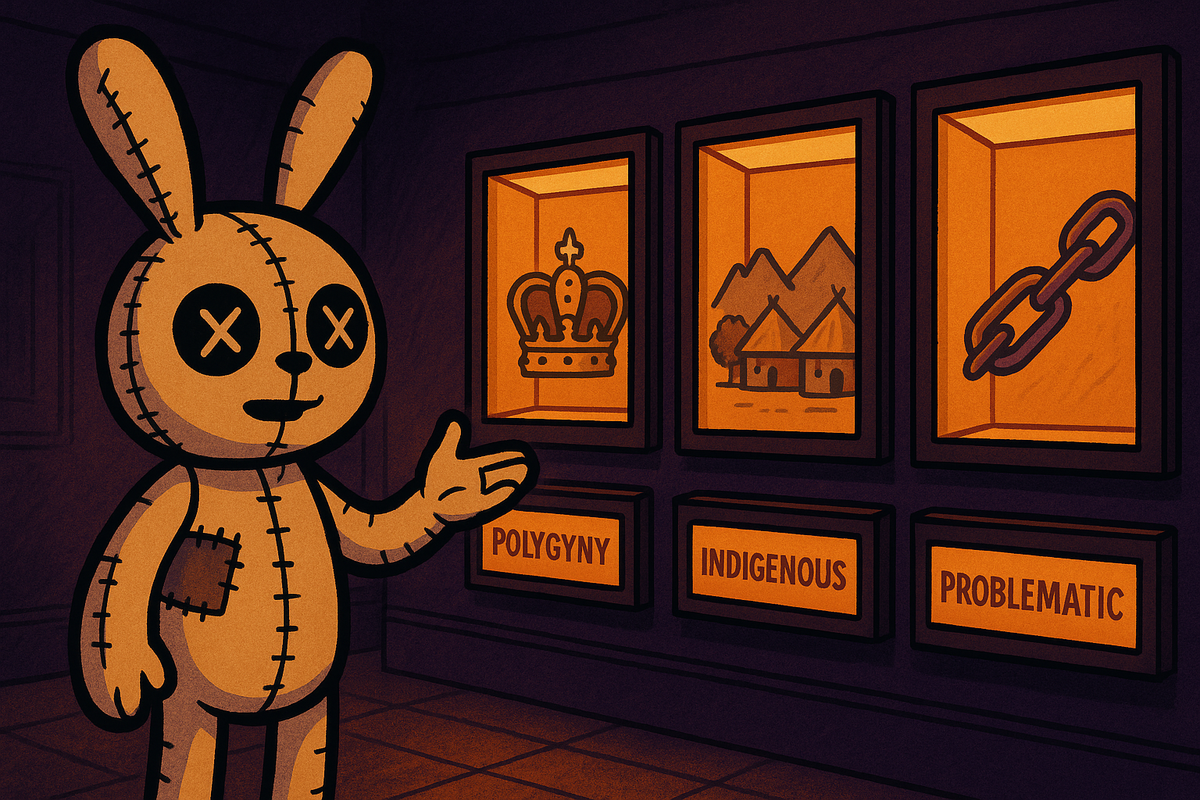
The modern polyamory movement loves historical legitimacy: "Humans weren't meant for monogamy—look at all the cultures that did it differently!"
Yes, many cultures practiced non-monogamy. No, it didn't look like your Brooklyn polycule. Most historical polygamy was rich men stockpiling women like grain reserves. When polyamory advocates say "our ancestors did this," they're technically correct in the way that saying "humans have always eaten meat" is technically correct about cannibalism.
The historical record is more complicated, more troubling, and more instructive than either side wants to admit.
Polygyny: The Default Non-Monogamy
When we say "polygamy" we usually mean polygyny—one man, multiple women. This was the most common alternative to monogamy across human cultures. The logic was brutal and simple: resource accumulation equals mate accumulation.
In societies without enforced monogamy, wealth and power naturally concentrated mating opportunities. A king could support a hundred wives. A poor man might not attract one. This wasn't romantic. It wasn't about love. It was an economic and reproductive strategy that benefited exactly one category of person: high-status men.
The costs were paid by everyone else.
The Economics of Mate Distribution
Polygyny creates a specific mathematical problem: if each high-status man has multiple wives, many low-status men have none.
In a population with roughly equal numbers of men and women, monogamy distributes mating opportunities more evenly. In polygyny, the distribution becomes winner-take-all.
The data from polygynous societies shows this clearly:
- Top 10% of men might have 30-40% of the wives
- Middle 40% of men might have one wife each
- Bottom 50% of men have none
This isn't a minor social issue. It's a stability crisis. Large populations of young men with no access to partners, no stake in the social order, and nothing to lose are societies waiting for violent upheaval.
Anthropologist Joseph Henrich traces the rise of Western monogamy partly to this problem: societies that enforced monogamy reduced male violence and intrasexual competition. More men had access to marriage, so more men had reasons to cooperate rather than destroy.
Polygyny isn't just bad for the excluded men. It's bad for social stability.
Low-status men got locked out of the mating market entirely. In polygynous societies, you can do the math: if top men have five wives each, bottom men have none. This creates a permanently angry underclass with nothing to lose. Anthropologists call this "mating market pressure." Societies call it "war."
Women in polygynous structures fared better than mateless men—at least they were chosen—but they were fundamentally interchangeable assets in a portfolio. Rivalry with co-wives was built into the structure. Your husband's attention was zero-sum. Every moment with her was a moment not with you.
The co-wife problem. Historical accounts from polygynous cultures document intense rivalry, jealousy, and sometimes violence between co-wives. They competed for resources, attention, and preferential treatment of their children. Some cultures developed elaborate hierarchy systems—first wife, senior wife, favorite wife—to manage the inevitable conflict. These hierarchies didn't eliminate rivalry; they institutionalized it.
The children's dilemma. In polygynous families, children had the same father but different mothers, and their mothers were in competition. This created half-sibling dynamics laden with loyalty conflicts. Your brother is also the son of your mother's rival. Inheritance often went to sons of the senior or favorite wife, regardless of birth order, creating lifelong resentment among siblings.
This is why monogamy eventually won. Not because it's natural—it isn't—but because it stabilizes societies by distributing mating opportunities more evenly. Fewer angry men with nothing to lose. More men invested in the social order because they have something to protect.
Polyandry: The Telling Exception
Polyandry—one woman, multiple husbands—is genuinely rare. The most documented cases come from Tibet and parts of the Himalayas.
The logic was environmental: when land can't be divided, brothers share a wife.
In Tibetan fraternal polyandry, brothers married a single woman. This kept family land intact instead of fragmenting it into unviable plots each generation. Children were raised collectively, paternity deliberately ambiguous. No one asked "whose kid is this?" because the question could destroy the system.
This wasn't feminist liberation. It was poverty management. Women in polyandrous systems had security and multiple providers, but they didn't choose this arrangement from a menu of options. They chose it because the alternative was starvation.
The telling part: polyandry emerges only under severe resource scarcity. Polygyny emerges whenever resource accumulation is possible. The pattern reveals whose interests each structure serves.
The Asymmetry Question
Why is polygyny so common and polyandry so rare?
Parental investment asymmetry. Women have a hard biological ceiling on reproduction—roughly one child per year, for maybe 20 fertile years. Men have no ceiling. A man can theoretically father hundreds of children. Polygyny lets high-status men maximize reproductive output. Polyandry doesn't offer women the same advantage—she still maxes out at one child per year regardless of how many husbands she has.
Paternity certainty. Polygyny with controlled female sexuality guarantees that children belong to the husband. Polyandry makes paternity uncertain, which historically mattered for inheritance and property transfer. Cultures that practiced polyandry either didn't care about paternity (fraternal systems where brothers shared everything) or had no significant property to inherit.
Male control of resources. In most historical societies, men controlled wealth and power. Polygyny served their interests. Polyandry served women's interests in contexts where women had no power to enforce their preferences.
The asymmetry isn't biological destiny. It's the interaction of biology (reproductive capacity differences) and social structure (male control of resources). Change the social structure and the patterns shift.
What We Romanticize
Modern non-monogamy advocates sometimes point to indigenous cultures as evidence that "natural" human sexuality is more fluid than Western norms. There's something to this. Many indigenous cultures had flexible pair bonding, sexual hospitality customs, and coming-of-age practices that didn't map onto Western exclusivity.
But romanticizing these practices ignores what made them possible:
Tiny scale. Bands of 30-150 people. Everyone knew everyone. Betrayal meant social death. Modern anonymity changes the game entirely—you can cheat on your partner and nobody in your apartment building knows your name.
Communal child-rearing. Non-monogamy is easy when the village raises children together. It's harder when you're two exhausted parents in a suburban house with no support network within fifty miles.
Short lives. "Till death do us part" meant 15-20 years of adulthood, not 60. The mismatch between pair-bonding duration and lifespan is a modern problem with no ancestral precedent.
Scarcity, not abundance. In a band of 30 people, your realistic partner options numbered in single digits. Flexibility wasn't about abundant choice. It was about making do with what was available.
The Patriarchal Versions
Not all historical non-monogamy was innocent variation. Some was straightforward exploitation:
Harem systems concentrated women as status symbols and reproductive resources. The women had no exit. The men had total control. Call this whatever you want—it was captivity with elaborate justifications.
Forced plural marriages in fundamentalist communities—Mormon splinter groups, some Islamic contexts—involve girls married to older men without meaningful consent. The religious framing doesn't change the power dynamics.
Concubinage across cultures gave men sexual access to lower-status women without marriage obligations. The women had no protection if abandoned. Their children often had no inheritance rights.
The common thread: asymmetric power. Men had choices. Women were chosen. The structure served male interests while draping itself in tradition, religion, or appeals to nature.
This is why "but historically..." arguments for non-monogamy can ring hollow. Yes, non-monogamy has always existed. Some forms were genuinely mutual. But many forms were oppressive, and pretending otherwise is either ignorant or dishonest.
What the Record Actually Shows
Monogamy isn't natural. Strict lifelong monogamy is culturally enforced, not biologically default. The historical variety proves this.
Non-monogamy isn't automatically better. Many alternatives were worse for women, children, and low-status men. The forms that worked required conditions modern societies don't have.
Structure follows incentives. Polygyny where male resource accumulation is unconstrained. Polyandry where scarcity makes fragmentation suicidal. Flexible bonding where communities are small enough for collective child-rearing.
Power asymmetry corrupts any structure. Monogamous or not, any arrangement becomes exploitation when one party has no exit, no voice, and no alternative.
What Modern Poly Gets Wrong About History
The polyamory movement sometimes points to historical polygamy as evidence that "humans have always done this." This is true but misleading.
Historical polygamy wasn't about love. It was about resource control, reproduction, and social status. Modern polyamory claims to be about love for multiple people. These are different projects.
Historical polygamy wasn't egalitarian. One person (usually a man) had multiple partners. Those partners rarely had their own additional partners. Modern poly often aims for symmetry—everyone can have multiple relationships. This is structurally different from historical models.
Historical polygamy often wasn't consensual. Women were married off, added to households, traded as political alliances. Modern ethical non-monogamy requires enthusiastic consent from all parties. This changes everything.
Historical polygamy served patriarchy. It concentrated female reproductive capacity among high-status men. Modern poly claims to reject hierarchy and power imbalance. Whether it succeeds is debatable, but the intent is opposite to historical polygamy.
The lesson: just because a structure existed historically doesn't make it good, and doesn't mean the modern version is the same thing. Historical polygamy and modern polyamory share surface similarities—multiple partners—but the underlying logic and ethics are often opposed.
The Modern Filter
If you're interested in non-monogamy, the history offers warnings, not blueprints:
Your attachment style will find expression in any structure. Anxious attachment in polygyny becomes hyper-competition for attention. Avoidant attachment uses multiple partners for emotional diffusion—close to no one, connected to several. Secure attachment can work in many configurations, but only if the structure is genuinely consensual and equitable.
The past isn't a guide to what you should do. It's a catalog of what humans have tried, what worked, what failed, and why. What works for you depends on who you are—not on what your ancestors did when they had no choice.
The historical record shows that relationship structures are always shaped by economic conditions, power dynamics, and survival needs. Modern non-monogamy happens in a context of relative abundance, legal equality (at least nominally), and birth control that decouples sex from reproduction.
That's a completely different game. Learn from history, but don't assume historical patterns determine what's possible now.