Polycule Architectures: Whos Connected to Whom
V, triad, quad, network — polycule structures have load-bearing points and failure modes. How to visualize yours and find the stress fractures.

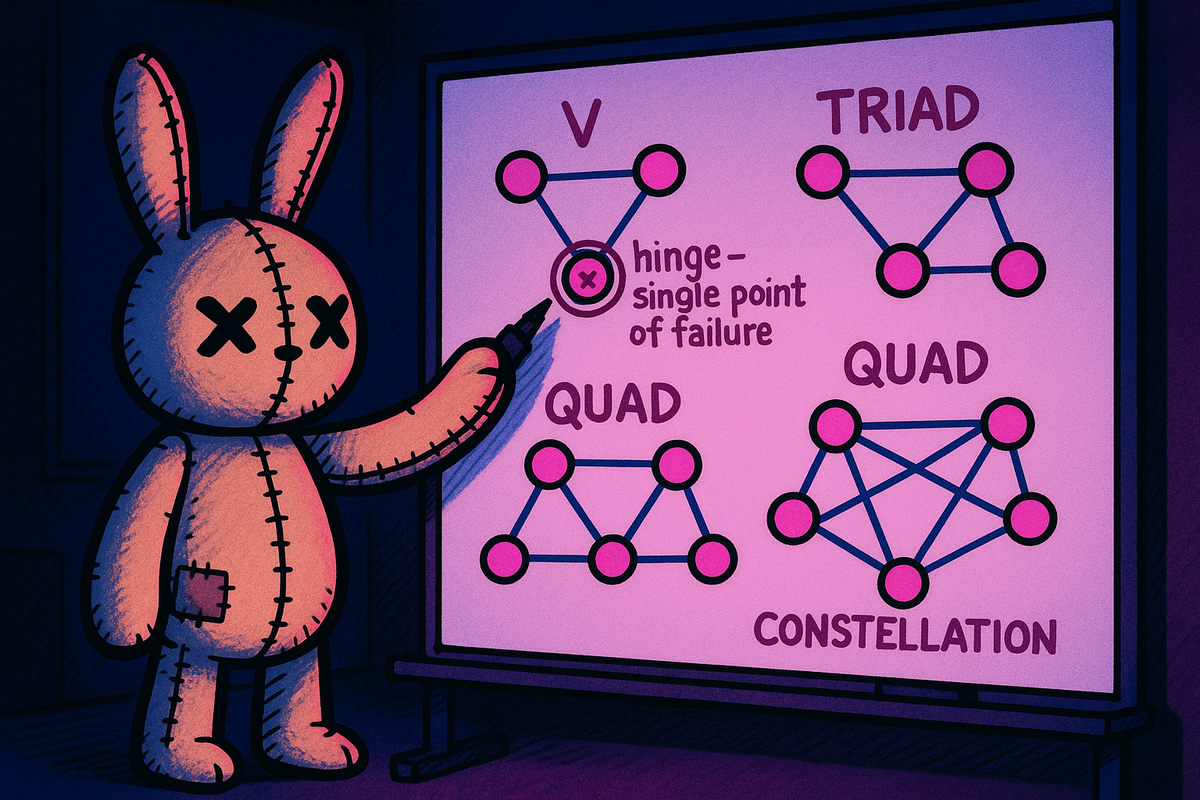
Every polycule has a single point of failure. The question is whether you know where it is.
A polycule is the network of people connected through polyamorous relationships—"poly" plus "molecule." And like actual molecules, polycules have structure: bonds, nodes, and stress points that determine whether the whole thing holds together or flies apart.
Understanding your structure matters because different architectures fail in different ways.
The Geometries
The V (Vee)
Three people: A dates B and C. B and C aren't dating each other.
A is the "hinge"—connecting two separate relationships. B and C are "metamours"—sharing a partner without having their own relationship.
The V is the most common starter configuration and the most hinge-dependent. A is maintaining two relationships. B and C are each maintaining one. A is doing twice the work and is also the single point of failure. If A leaves or burns out, there's no polycule anymore.
The Triad
Three people all dating each other. A dates B. B dates C. C dates A. Three relationships total.
The triad is what most people imagine when they think poly. It's also the hardest to form because it requires three people to all be attracted to each other simultaneously—which is much rarer than attraction in pairs.
When triads work, they have built-in redundancy. If one dyad struggles, two others provide stability. When triads fail, they often collapse completely because every relationship affects every other one. There's nowhere to contain damage.
The Quad
Four people, various configurations. The N-shape (A-B-C-D in a line, three relationships). The square (A-B-C-D-A in a loop, four relationships). The full mesh (everyone dates everyone, six relationships).
Full mesh quads are rare because they require all four people to be mutually attracted. Most quads are partial connections—and the question is always which connections are missing and why.
The Network
Five or more people connected through various relationships. At this scale, the structure is usually irregular—a web, not a shape.
Networks form when individual relationships extend. A triad where C starts dating D, who's already in a V with E and F. Now six people are connected, most of whom don't have direct relationships with most others.
In large networks, most connections are indirect. You're connected to someone through two or three intermediary nodes. Information passes through multiple people, distorting along the way.
The Hinge Problem
The hinge connects otherwise separate relationships. In a V, the hinge is essential. Without them, there's no polycule.
Hinge responsibilities: Time management across multiple relationships. Being fully present with each partner rather than splitting attention. Managing information flow—what to share, what stays private. Preventing one relationship from consuming resources needed by another. Emotional availability across multiple people simultaneously. Maintaining distinct relationship character so each partner feels seen as an individual, not as interchangeable.
Hinge failure modes: Being the bottleneck for all communication. Getting stretched thin and under-delivering everywhere. Getting caught between metamours who are in conflict. Decision fatigue about time allocation that leads to avoidance. Becoming so focused on managing the polycule structure that you stop being emotionally present in any individual relationship. Developing "hinge guilt"—constantly feeling like you're neglecting someone because you literally are.
Being a good hinge is a skill most people don't have naturally. Many polycule collapses trace directly to hinge failure—someone who couldn't manage the demands of being the connection point.
Hinge Attachment Patterns
Secure hinges can usually manage the role. They maintain distinct relationships without merging them. They can be present with one partner without anxiously thinking about the other. They communicate clearly about time and expectations. They're comfortable saying no when they're at capacity.
Anxious hinges often overextend. They say yes to both partners when they only have bandwidth for one. They try to be everything to everyone, which means being nothing to anyone. The fear of disappointing people leads to overpromising and underdelivering. They may also use one relationship to soothe anxiety about the other—seeking reassurance from B when feeling insecure about A.
Avoidant hinges may actually like the role because it prevents too much intimacy with any one person. "I can't see you tonight, I'm with my other partner" becomes a permanent escape hatch. They use the structural complexity to avoid going deeper with anyone. The polycule becomes a way to have connection without actual vulnerability.
Disorganized hinges create chaos. They overpromise, cancel last minute, pit partners against each other, blow up one relationship when the other gets too close. The hinge position amplifies their push-pull pattern across multiple people simultaneously.
Where Structures Break
Couple privilege. An existing couple adds a third who is structurally subordinate. The couple's relationship is primary; the third is expendable. When stress hits, the couple closes ranks. The third gets discarded. This pattern is common enough that experienced poly people avoid being "the third" added to an established couple. The couple makes decisions together, then informs the third. The third doesn't get veto power. The couple's needs trump the third's needs. Eventually the third realizes they're a recreational add-on, not an equal partner.
Unbalanced attention. One relationship gets most of the time, leaving others malnourished. Usually happens when new relationship energy captures attention away from established relationships. The new partner glows while the old partners starve. The hinge doesn't notice—or notices but rationalizes. "You're secure, you don't need as much attention." Meanwhile the neglected partner is withering.
Communication bottlenecks. Information has to pass through specific people. Things get lost or distorted. Metamours make assumptions about each other based on incomplete data. The hinge becomes a translator—and translations are never perfect. "They said this" becomes "they meant this" becomes "I think they want this." By the time the message arrives, it's unrecognizable.
Cascade collapse. One relationship ends badly. The emotional fallout destabilizes adjacent relationships. Like dominoes, the whole structure falls. This is especially common in triads where every relationship touches every other one. A breakup between A and B puts pressure on B-C and A-C. Those relationships were already strained by the A-B conflict. The whole triad implodes within weeks.
Resource exhaustion. The polycule demands more time, emotional energy, and logistical bandwidth than anyone actually has. Calendars are triple-booked. No one has alone time. Everyone is running on empty but nobody wants to be the one who says "this isn't sustainable." The structure grinds everyone down until someone collapses or leaves.
Values misalignment. People in the polycule have incompatible relationship philosophies. One person believes in hierarchy (primary/secondary partners). Another believes in relationship anarchy (all connections are equal). These philosophies conflict in practice. The hierarchical person prioritizes their primary partner. The RA person feels devalued. The tension becomes unresolvable.
Attachment in the Structure
Secure attachment can occupy any position. Hinge, leaf, highly connected hub—secure people adapt to structure.
Anxious attachment often struggles in leaf positions. Being the end node with only one connection to the polycule means your entire poly experience routes through one person. If they're busy with another partner, you're alone with your anxiety. Anxious types sometimes do better with multiple connections providing reassurance redundancy.
Avoidant attachment might prefer leaf positions—one connection, maximum independence. But avoidants often make terrible hinges because they'll neglect relationship maintenance. The very thing that makes leaf position appealing makes hinge position disastrous.
Disorganized attachment often creates chaotic structures—forming and breaking connections unpredictably, rippling instability through the network.
Built vs. Discovered
Some people design their polycule: "We're looking for a third." "We want to build a quad." This intentional approach sometimes works but often means trying to force people into roles they don't naturally fit.
The problem with designed polycules:
- You're casting for a role, not meeting a person
- The new person has to fit the existing structure, not vice versa
- Power imbalance is baked in—they're joining your thing, not building something mutual
- If it doesn't work, they're expelled and the original structure remains
- The "unicorn hunter" pattern—couple seeking a bisexual woman who will love both of them equally and never threaten the primary relationship—is a designed polycule at its worst
More commonly, structure emerges. Someone starts dating someone who already has connections. Over time, a network forms that nobody planned. Your partner's partner becomes your friend. That friend starts dating someone. That someone has other partners. Before you know it, you're in a network of eight people connected through various relationships, and nobody designed this—it grew.
The healthiest polycules usually emerge rather than being engineered. You can't force chemistry. You can only create conditions where connection might develop and see what actually grows.
Emergent polycules have their own challenges: nobody's in control, the structure might grow in ways that don't serve everyone, boundaries get fuzzy. But at least people are responding to actual connection rather than trying to fill a predetermined slot.
The Stability Question
What makes a polycule stable over years?
Secure attachment in most members. A polycule full of anxious and avoidant people will thrash itself apart. Secure people provide ballast.
Enough resources to go around. Time, money, emotional energy, housing space. If the polycule is constantly resource-constrained, competition and resentment build.
Compatible relationship philosophies. Everyone doesn't have to want the same thing, but the differences can't be mutually exclusive. Hierarchical poly and relationship anarchy can coexist if people negotiate thoughtfully. They can't coexist if people are rigid.
Direct communication norms. Metamours talk to each other directly rather than routing everything through hinges. This prevents bottlenecks and distortion.
Willingness to let relationships end. Not every connection needs to be forced to survive. Sometimes a relationship runs its course. In a healthy polycule, one relationship ending doesn't collapse the whole structure. The network absorbs the loss and continues.
Low drama tolerance. Polycules that survive are usually boring. People do the work—communication, time management, processing jealousy—before it becomes crisis. High-drama polycules burn bright and collapse fast.
The Map Problem
Polycule diagrams show who's connected but miss a lot:
How strong each connection is. Who's most important to whom. Who's struggling versus thriving. The history of each relationship.
A clean geometric diagram can hide a messy emotional reality. The V that looks stable might have a burned-out hinge barely holding it together. The triad that looks perfect might be two months from total collapse.
Don't confuse the map for the territory.
The Map Isn't the Relationship
Polycule diagrams are popular—charts showing who's connected to whom with lines and nodes. They're useful for explaining complex structures. They're also dangerously reductive.
What diagrams miss:
- Relationship depth. A line between two people doesn't show if they see each other daily or once a month, if they're deeply in love or casually dating, if the relationship is thriving or dying.
- Power dynamics. Who has more influence? Who gets priority? Who can veto whom? The diagram shows equal connections, but some connections are more equal than others.
- Emotional reality. One person might be deeply invested while the other is ambivalent. The line looks the same either way.
- Time dimension. Is this a new relationship in NRE, or a decade-long partnership? The diagram doesn't distinguish.
Diagrams can also create false expectations. People see a triad and assume it's balanced. People see a V and assume the hinge has equal feelings for both partners. People see a complex network and assume everyone's equally connected.
The map shows connections. It doesn't show what those connections mean or how they're lived.
Know Your Position
Your position in a polycule shapes your experience. Hinges have different challenges than leaves. Being in a triad is different from being the fourth person added to someone else's triad.
Structure creates stress points and dependencies. Knowing your structure helps you anticipate problems, understand where resources need to go, and see when your position is precarious.
Questions to ask yourself:
- Am I a hinge or a leaf? (Connecting multiple relationships or attached to one person who has others?)
- Is my position by choice or circumstance? (Did I want to be the hinge, or did it happen to me?)
- What does my position require of me? (Time management, emotional regulation, communication skill?)
- What does my position give me? (Community, variety, security, freedom?)
- Is this sustainable long-term, or am I running on temporary energy?
- If this structure collapsed tomorrow, would I be okay?
Know your structure. Know your position. Know what that position asks of you and what it gives you. Then decide if it's where you want to be.
And if your position isn't working—if you're a burned-out hinge, a neglected leaf, a third who's always expendable—you're allowed to renegotiate or leave. The polycule is a structure you inhabit, not a prison you're trapped in. Structure serves people, not the other way around.