PART 8: Nervous System Protocols
AI disruption triggers autonomic threat responses. Cognitive strategies fail without nervous system regulation. Learn breathing, grounding, and somatic practices to maintain your neuropolar stance.

The Body Knows First
Your body has been treating AI disruption like an attachment threat.
That’s not a metaphor. The nervous system responds to status uncertainty, competence threat, and social destabilization with the same circuitry it uses for physical and relational danger. Your body doesn’t know the difference between “a tiger might eat me” and “I might become irrelevant.” Both register as threat. Both activate defensive responses.
This is why the cognitive strategies haven’t been working.
You understand that AI is an opportunity. You believe that adaptation is possible. You know that panicking is counterproductive. And yet. The procrastination. The avoidance. The sudden urge to research more before acting. The way you start to engage and then find yourself somehow doing something else. The performative disdain or the anxious overclaiming or the withdrawal into what’s familiar.
These aren’t character flaws. They’re nervous system responses. And they won’t resolve through understanding alone.
The neuropolar stance isn’t just cognitive architecture. It’s somatic architecture. You can’t hold the barbell if your nervous system can’t regulate. You can’t extend the edge if touching uncertainty triggers collapse.
This part is about the protocols. The actual practices that build the nervous system capacity that neuropolarity requires.
Autonomic Architecture of Overwhelm
Let’s map what’s actually happening in your nervous system when AI-related content triggers avoidance.
The trigger: You see an article about AI capabilities. A colleague mentions a new tool. You think about your own adoption timeline. Something lands in the “I should deal with this” territory.
The neuroception: Before conscious processing, your nervous system evaluates threat level. Uncertainty about status? Threat. Potential competence challenge? Threat. Reminder of things you’ve been avoiding? Threat. The body reads the situation as dangerous—not consciously, but autonomically.
The sympathetic activation: Heart rate elevates slightly. Breathing shallows. Attention narrows. The body prepares for action—fight or flight. You feel this as agitation, restlessness, the urge to do something.
But there’s nothing to fight or flee. The threat isn’t a tiger. It’s abstract, diffuse, conceptual. The mobilization energy has nowhere to go.
The shame spiral: Parasympathetic activation mixes with the sympathetic. This is the physiological signature of shame—mobilized and collapsed at the same time. You feel frozen, stuck, unable to act despite wanting to. The energy is there but it can’t discharge.
The avoidance behavior: The system finds an exit. Switch tabs. Check something easier. Tell yourself you’ll deal with it later. The immediate threat is avoided. The underlying pattern continues.
This is the loop. Trigger → threat response → mobilization without outlet → shame → avoidance → temporary relief → trigger. Running this loop doesn’t process anything. It just grooves the pattern deeper.
Breaking the loop requires intervening at the autonomic level. Not just understanding the pattern—regulating the activation.
What Regulation Actually Means
“Regulate your nervous system” has become almost meaningless through overuse. Let me be specific about what it means functionally.
Regulation is flexibility: the capacity to move between autonomic states appropriately and return to baseline.
Not “always calm.” That’s not regulation—that’s flatness, suppression, or dissociation. Not “never activated.” That’s not regulation—that’s avoidance of anything that might activate.
Regulation is: you can get activated (sympathetic) when the situation calls for it, you can mobilize energy for action, you can engage with intensity—and then you can return to baseline. You can come back down. You don’t get stuck in activation or stuck in collapse. The system flexes.
The signature of good regulation is high heart rate variability (HRV): the variation in time between heartbeats. High HRV means the parasympathetic and sympathetic systems are both online and responding to conditions. Low HRV means the system is stuck—either locked in sympathetic activation or parasympathetic shutdown.
The neuropolar stance requires high regulation capacity. Because holding the barbell means:
Extending into uncertain, activating territory (edge)
While maintaining stability and return capacity (core)
And not collapsing into the frozen middle (dysregulation)
You can’t do this with a dysregulated nervous system. The edge becomes too scary to approach. The core becomes rigid rather than stable. The middle becomes the default because both poles feel unsafe.
Building regulation is building the hardware for neuropolarity.
The Protocols
These are the actual practices. Not self-care platitudes—nervous system interventions that build regulatory capacity.
Protocol 1: Breath as Regulation Lever
The breath is the one autonomic function you can consciously control. It’s the interface between voluntary and involuntary nervous system. This makes it the primary regulation tool.
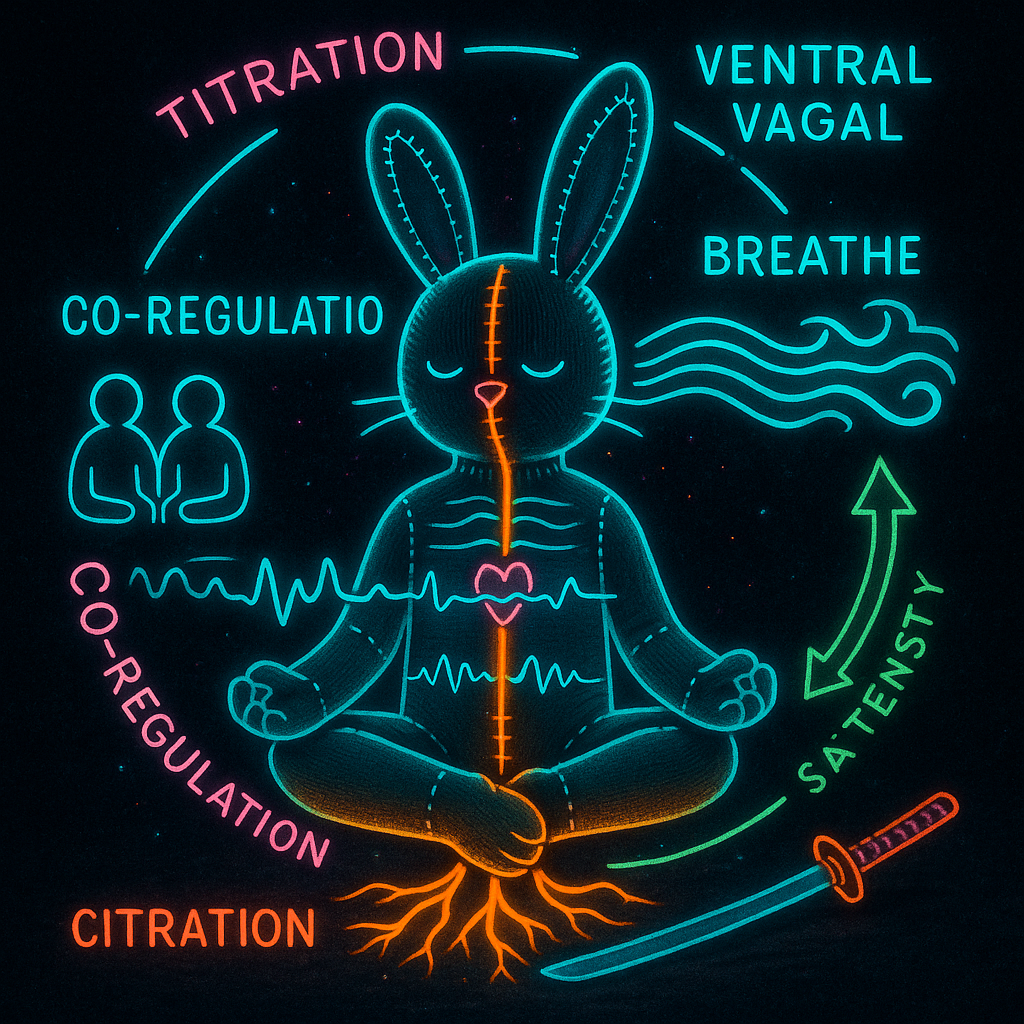
Extended exhale breathing: Inhale for 4 counts, exhale for 6-8 counts. The extended exhale directly activates the parasympathetic system via the vagus nerve. Do this for 2-3 minutes and your nervous system will shift.
Physiological sigh: A double inhale (inhale, then a second small inhale at the top) followed by a long exhale. This is the body’s natural reset—it’s what you do spontaneously after crying or when you’re finally safe after a scare. You can do it deliberately to signal safety to your nervous system.
When to use: Before engaging with activating content. When you notice the trigger-response starting. After a period of stress to return to baseline. Not as avoidance—as regulation that enables engagement.
Protocol 2: Somatic Grounding
The body in space, connected to the physical environment. This interrupts the cognitive spiral and brings attention to present-moment safety.
Feel the contact points: Your feet on the floor. Your seat on the chair. Your back against the surface behind you. Actively notice the physical sensations of support. You are here. You are held by physical reality. The threat in your mind is not a threat in your body’s immediate environment.
Orienting: Let your eyes move slowly around the space you’re in. Notice objects. Name them if you want. Let your visual system confirm: “I am in this physical space. It is safe here. Whatever I’m thinking about, I am physically okay right now.”
Movement: The mobilization energy from sympathetic activation needs somewhere to go. Small movements help—shake your hands, roll your shoulders, stand and stretch. You’re not suppressing the energy; you’re giving it an outlet.
When to use: When you notice freeze/collapse. When you’ve been in your head too long. When the abstract threat has become more real than your physical situation.
Protocol 3: Titration
Titration is the practice of small doses. Approach the activating thing briefly, then return to safety. Repeat. Build tolerance without overwhelming the system.
The principle: You don’t build distress tolerance by flooding yourself with distress. You build it by touching distress and returning to regulation. The oscillation is the training.
Applied to AI content: Spend 15 minutes engaging with the activating material. Then deliberately disengage and regulate (breath, grounding, something pleasant). Return when your system has settled. Repeat, gradually extending the engagement time as tolerance builds.
The key: Return to safety is not avoidance. It’s the second half of the training. You’re not running from the thing; you’re teaching your nervous system that it can touch this thing and survive.
Protocol 4: Pendulation
Pendulation is movement between poles—toward the difficult, then toward the resourced, then toward the difficult again.
The practice: Bring to mind something mildly activating (not the most intense thing—start small). Notice where in your body you feel the activation. Stay with that sensation for 10-20 seconds. Then shift attention to a part of your body that feels neutral or good. Stay there for 10-20 seconds. Then return to the activation. Swing between them.
What happens: The nervous system learns that it can hold activation and resource. They’re not mutually exclusive. You don’t have to be all-activated or all-resourced. The poles can coexist.
Applied to edge extension: When approaching something uncertain, pendulate between the uncertainty (edge) and your resources (core). Let your attention swing. You’re training the barbell at the somatic level.
Protocol 5: Co-Regulation
Your nervous system is a social organ. It regulates best in connection with other nervous systems. This is not weakness—it’s mammalian biology.
The mechanism: In the presence of a regulated nervous system, your nervous system entrains—synchronizes—toward regulation. Breathing patterns match. Heart rate variability correlates. This is measurable physiology, not metaphor.
Practical access: Whose presence is regulating for you? Spend time with them. When you’re activated, seek co-regulation (not dumping, not venting—actual presence with someone who’s regulated). If you don’t have humans available, even pets can provide co-regulation. The attuned presence is what matters.
The investment: Building co-regulation relationships is building regulatory infrastructure. It’s not a luxury or a nice-to-have. It’s one of the most important investments you can make in your capacity to hold the neuropolar stance.
The Practice Container
Individual protocols help. But the deeper work is building a practice container—a sustainable rhythm of regulation that compounds over time.
Daily minimum: Some form of nervous system practice every day. Even 5 minutes of extended exhale breathing. The consistency matters more than the duration.
Activation awareness: Develop the meta-skill of noticing when you’re activated. The earlier you catch the trigger-response sequence, the more options you have. Build the habit of checking in with your body, not just your thoughts.
Regulation stacking: Different practices for different situations. Know which tools work for which states. Breath for early-stage activation. Grounding for escalated activation. Movement for stuck energy. Co-regulation for deep dysregulation.
Recovery periods: Especially during intense engagement (learning new tools, building in public, navigating uncertainty), build in recovery. Not as luxury—as necessity. The edge work burns energy. The core needs restoration.
The Integration
Here’s how this connects to the broader neuropolar architecture:
Stable core = regulatory capacity. The core isn’t a set of beliefs or a list of values. It’s a felt sense of ground, a place your nervous system can return to. Building regulation is building core.
Adaptive edge = distress tolerance. The edge is where uncertainty lives. If uncertainty triggers collapse, you can’t extend the edge. Titration and pendulation build the tolerance that enables edge-extension.
Forbidden middle = chronic dysregulation. The middle isn’t just a strategic error. It’s often where dysregulation keeps you—not resourced enough to feel stable, not mobilized enough to act, frozen in the in-between.
Neuropolarity isn’t just a philosophy. It’s a practice. And the practice begins in the body.
The protocols aren’t about feeling better. They’re about building the capacity to hold the stance when conditions are difficult. They’re about making the neuropolar architecture livable rather than theoretical.
Your nervous system has been treating this transition as a threat. It’s not wrong—there is real uncertainty, real stakes, real change. But threat response isn’t navigation. To navigate, you need a regulated system that can approach uncertainty without collapsing.
Build the practice. The philosophy will be easier to hold.
This is Part 8 of Neuropolarity, a 10-part series on navigating the AI phase transition.
Previous: Part 7: The Neurodivergent Edge
Next: Part 9: The Barbell Deployment — Resource allocation for phase transitions