PART 7: The Neurodivergent Edge
Neurodivergent individuals possess nervous systems built for instability. What was once a disadvantage becomes an edge as systems destabilize. Your architecture is finally an advantage.

The Accidental Preparation
There’s a population that’s been running neuropolar hardware their entire lives. Not by choice—by architecture. Their nervous systems never fit the middle. They’ve always operated at the poles, for better and worse.
I’m talking about neurodivergent folks. Autistics. ADHDers. The trauma-shaped. The recovery community. People whose pattern recognition works differently, whose sensitivity runs higher, whose relationship to intensity has never been “normal.”
For most of their lives, this was a disadvantage. The world was optimized for the middle. For steady, predictable, moderate. For people who could mask their edges and perform consistency. The neurodivergent had to spend enormous energy pretending to be something they weren’t, or accept marginalization for being what they were.
The optimization function is changing.
The phase transition we’re living through—the one described in Part 1, the one your nervous system has been sensing—is destabilizing the middle. The moderate positions are becoming uninhabitable. The edges are becoming necessary.
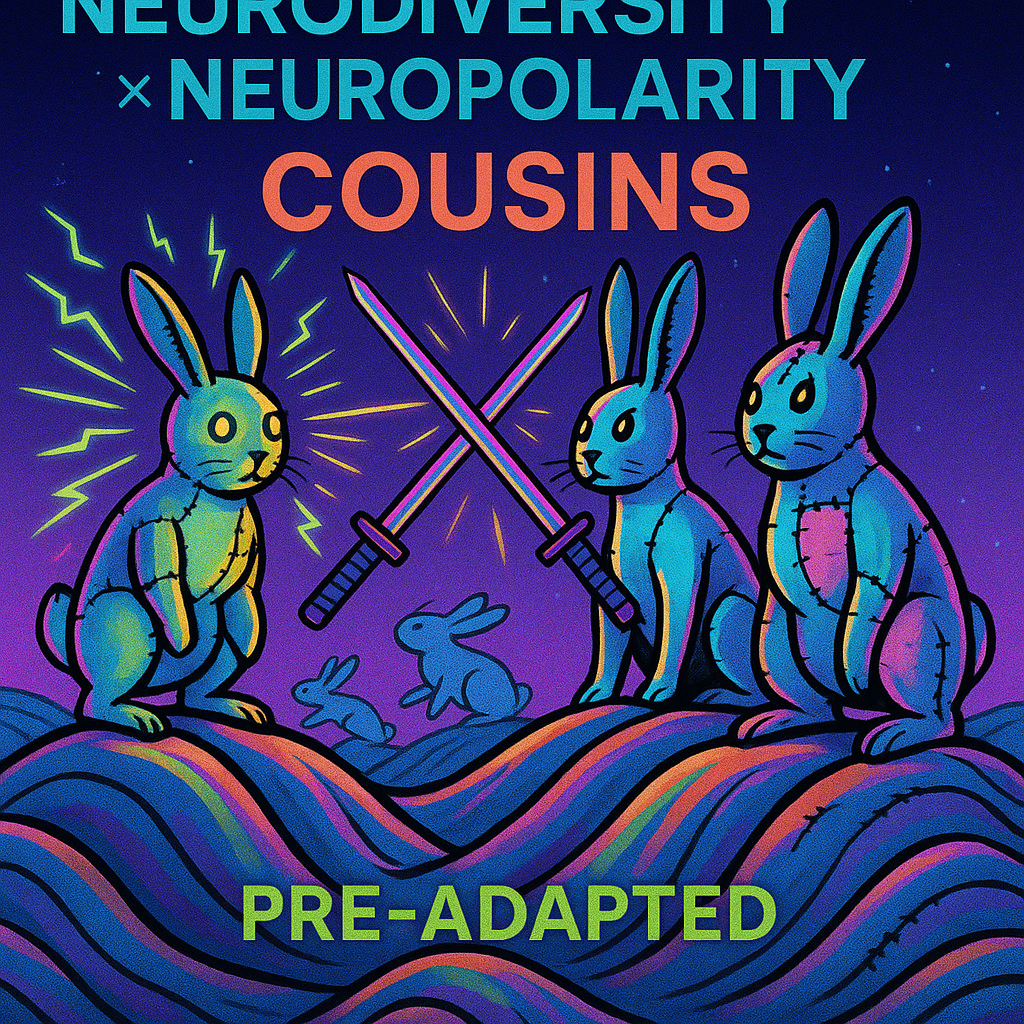
And the people who’ve always lived at the edges? They’re accidentally pre-adapted.
The Architectures
Not all neurodivergence is the same. Let me be specific about the different architectures and what each offers.
Autistic cognition runs high-precision pattern detection. Reduced “Bayesian smoothing”—the process by which neurotypical brains blur over inconsistencies and fill in gaps—means the autistic brain catches what others miss. The discrepancy. The contradiction. The thing that doesn’t fit.
In stable regimes, this was often pathologized. “Why are you focused on that detail?” “Why can’t you just go with it?” “Stop being so literal.” The autistic pattern-detection was picking up signals that the regime preferred to ignore.
In phase transitions, high-precision pattern detection becomes essential. When the underlying dynamics are shifting, catching discrepancies early is survival-relevant. The autistic “detail orientation” is early-warning-system orientation. The thing that made you annoying in stable times makes you valuable in unstable ones.
ADHD cognition runs unstable coupling. The subsystems don’t lock into stable phase relationships the way neurotypical brains do. This creates distractibility, difficulty with sustained attention on low-salience tasks, the constant pull toward novelty.
In stable regimes, this was a liability. The world rewarded consistency. Showing up and doing the same thing every day. ADHD brains struggled with routine, got bored with mastery, couldn’t force themselves to care about things that didn’t intrinsically grab them.
In phase transitions, unstable coupling becomes lateral connection capacity. The ADHD brain makes associations across domains that stable brains miss. It context-switches rapidly. It performs under crisis conditions—when salience is high, ADHD often locks in hard. The “disorder” is a different optimization: for novel environments rather than stable ones.
Trauma-shaped nervous systems run hypervigilant threat detection. Early experiences taught the system that danger is real and constant. The nervous system adapted by staying on alert, scanning for threats, preparing for the worst.
In stable regimes, this was exhausting and often debilitating. The threat that the system was scanning for wasn’t there. The hypervigilance was “inappropriate.” The trauma survivor was told to calm down, relax, stop being so sensitive.
In phase transitions, hypervigilant threat detection catches destabilization early. The trauma-shaped system feels the ground shifting before others do. The “oversensitivity” is sensitivity, full stop—the capacity to detect what’s actually happening before consensus recognizes it. Part 1’s description of “sensing the phase transition before your conscious mind named it”? That lands hardest for people whose systems were already calibrated for threat detection.
Addiction-and-recovery wiring has learned to survive at the extremes. Active addiction is one pole—compulsion, obsession, all-consuming focus on the substance or behavior. Recovery is the other—structured abstinence, daily practice, constant vigilance.
The middle is where addiction lives. “I can moderate.” “Just a little.” “I have it under control.” Every addict knows the middle is a lie. Survival requires the poles: either you’re using or you’re not. Either you’re in the program or you’re out. The barbell isn’t a strategy; it’s lived experience.
In phase transitions, recovery wisdom becomes transferable. The principles—ruthless honesty, one day at a time, structure as freedom, community as survival—apply beyond substance use. The recovering person already knows that moderate positions can kill you.
Neuropolarity and Neurodiversity: The Cousins
Let me name the relationship between these terms.
Neurodiversity is the descriptor—the recognition that cognitive and nervous system architectures vary. There’s no single “normal” brain. There’s a population distribution of different ways of processing, attending, regulating, sensing. This is the what: human neurological variation is real and natural.
Neuropolarity is the stance—the active configuration of holding stable core plus adaptive edge while releasing the middle. This is the how: the specific architecture that survives phase transitions. Not a description of how brains are, but a practice of how to configure yourself in unstable conditions.
They’re cousins because: many neurodivergent folks are naturally neuropolar. Their systems always ran at the poles because they couldn’t run in the middle. The NT world kept trying to pull them to center, and their architectures kept drifting to the edges.
But having the wiring doesn’t automatically produce functional neuropolarity.
You can be neurodivergent and fragmented—poles without integration, edges without core, intensity without stability. Many ND folks have plenty of adaptive edge (sensitivity, pattern recognition, crisis capacity) but underdeveloped stable core (regulatory capacity, identity that doesn’t depend on current circumstances, ability to return to baseline).
And neurotypical folks can develop neuropolar operation—it just takes deliberate cultivation. They have to build what ND folks often have naturally (edge sensitivity) while ND folks often have to build what NT folks have more naturally (stable center).
The cousins relationship: neurodiversity describes the variation; neuropolarity describes the stance. Many ND architectures lend themselves to neuropolarity. But the stance is available to anyone willing to develop it.
The Reframe
Here’s the uncomfortable reframe the phase transition enables:
The world isn’t becoming “more accepting” of neurodiversity in some warm, fuzzy, inclusion-training way. It’s becoming structurally dependent on what divergent architectures produce.
When the middle was habitable, edge-dwellers were tolerated at best. Their contributions were nice to have but not essential. The core work of society happened at the center, and the edges were margins.
When the middle collapses, edge capacity becomes load-bearing.
Who sees the phase transition coming? The pattern-detectors, the threat-sensors, the people who never trusted consensus stability because they could always see its cracks.
Who adapts fastest? The novelty-seekers, the context-switchers, the people who were always bored with routine because their systems were optimized for change.
Who knows the barbell from the inside? The ones who’ve been living it, for whom the forbidden middle was never an option.
This isn’t about finally getting credit. It’s not about ND folks being better than NT folks. It’s about a specific match between architecture and environment. The environment changed. Certain architectures match better now.
It’s not that you finally fit.
It’s that fit stopped being the point.
The Integration Work
Natural neuropolar hardware doesn’t automatically produce functional neuropolar operation. The edge capacities need to be matched by core stability. And that’s often the development work for neurodivergent folks.
Regulatory capacity. Can you return to baseline? Not “calm” in the sense of suppressing intensity—but ground, center, a felt sense of stability from which you can extend. Many ND folks have enormous edge capacity but underdeveloped regulation. The work is building a core solid enough to hold the edge.
Identity beyond circumstances. Who are you when the things you’re currently doing or feeling aren’t present? Is there a stable “you” that persists across states, roles, contexts? Many ND folks have intense state-dependent identities—fully present in this moment, uncertain who they are outside it. The work is developing continuity.
Sustainable rhythms. Can you oscillate between poles without crashing? The ND tendency is often to sprint at the edge until collapse, then recover, then sprint again. The neuropolar rhythm is different: sustainable oscillation, intentional movement between poles, not collapse-driven cycles.
Co-regulation access. Whose nervous systems can you sync with? Who helps you regulate? ND folks often have thin co-regulation networks—the masking, the mismatch, the history of rejection narrows who they can actually sync with. The work is building genuine co-regulation relationships.
Conscious pole-holding. The difference between being thrown to the poles and choosing to operate from them. Many ND folks experience their edge capacities as things that happen to them rather than capacities they deploy. The work is developing agency over the architecture.
None of this is about becoming neurotypical. It’s about making the neuropolar architecture that you already have functional—sustainable, integrated, deployable by choice.
The Shadow Side
I want to be honest about the shadow here.
Neurodivergent advantage in phase transitions is real. But it’s not automatic, and it’s not unambiguous.
Burnout is real. The same sensitivity that detects signals early also makes sustained crisis exhausting. ND folks are more likely to burn out during transitions even if they’re better at sensing them. Edge capacity without core sustainability leads to collapse.
Masking cost compounds. If you’ve spent years masking to survive NT environments, you’ve accumulated a debt. The phase transition doesn’t automatically erase that debt. You might be perfectly positioned to navigate change and too depleted to actually do it.
Social capital deficits. ND folks often have thinner networks, fewer institutional connections, less accumulated social capital. The competence vacuum (Part 5) is an opportunity—but opportunity requires resources to capture. Starting from a disadvantaged position is still disadvantaged, even if the game is changing.
The pattern can mislead. High-precision pattern detection catches real signals. It also catches noise and calls it signal. The autistic tendency to see patterns can become patternicity—finding structure where none exists. Confidence in your pattern recognition needs to be tempered by testing.
The edge is an edge. It cuts both ways.
The Invitation
If you’re neurodivergent and reading this series, here’s what I want you to hear:
Your nervous system has been telling you things were unstable before anyone else agreed. You were right. It wasn’t anxiety. It wasn’t your disorder. It was signal.
The capacities that made you difficult in stable times—pattern detection, sensitivity, edge-dwelling, barbell living—are becoming the capacities the transition requires. Not because the world is being nice to you now. Because the world is changing into something your architecture matches better.
This doesn’t mean everything is fine or that your struggles weren’t real. It means the optimization function is shifting. The thing you were penalized for is becoming the thing that’s rewarded.
But capturing that requires doing the integration work. Building the core to hold your edge. Developing regulation to sustain your sensitivity. Finding community that doesn’t require masking.
The neuropolar stance is available to everyone. But you might have been practicing it your whole life without knowing it had a name.
The window is open. Your hardware is ready.
What you do with that is up to you.
This is Part 7 of Neuropolarity, a 10-part series on navigating the AI phase transition.
Previous: Part 6: Coherence Over Purity
Next: Part 8: Nervous System Protocols — The somatic foundation