PART 6: Coherence Over Purity
AI has killed authenticity as a value signal. In an unverifiable world, coherence—whether your work actually integrates and solves problems—beats purity. Human-AI integration wins.

The Death of Authenticity Theater
There’s a question that used to matter: “Did you make this yourself?”
The answer carried weight. Authenticity—the traceable chain from creator to creation—was a proxy for quality, for effort, for value. The handmade commanded premium prices. The ghostwritten was faintly shameful. The authentic was real; the assisted was somehow less.
This framework made sense in a specific environment. When production was labor-intensive, authenticity signaled investment. When verification was possible, authenticity claims could be checked. When novelty was scarce, authentic voice was differentiating.
That environment is over.
AI collapses verification. You can’t tell anymore. The text could be human or machine or hybrid in proportions impossible to determine. The image could be photographed or generated or composited. The code could be written or prompted or pair-programmed with an AI. The line between “made” and “assisted” blurs to meaninglessness.
And something interesting happens when authenticity becomes unverifiable: it stops being a reliable value signal. The question “did you make this yourself?” loses its point when the answer is unknowable and, increasingly, irrelevant.
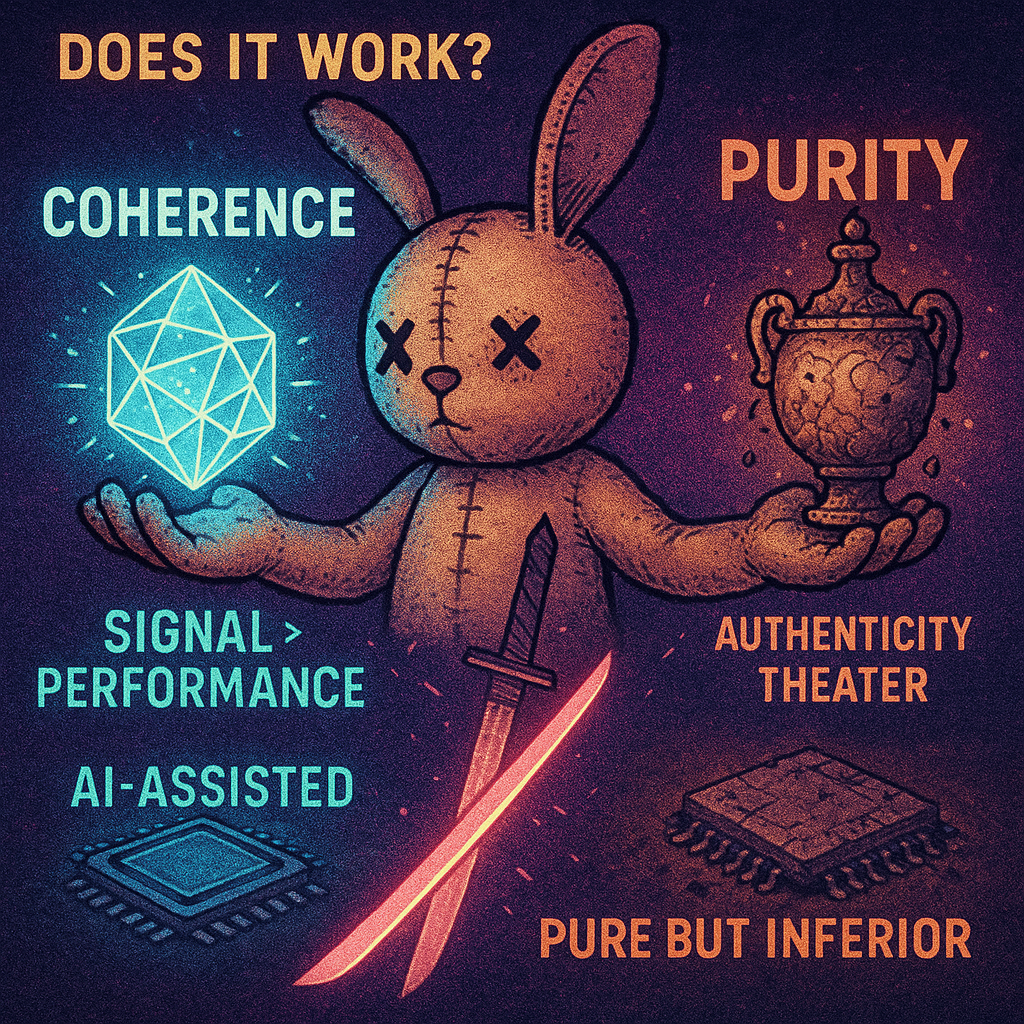
A different question rises: “Does this actually work?”
The Purity Premium Collapses
For a long time, purity commanded a premium in creative and knowledge work.
The writer who typed every word. The artist who sketched every line. The coder who wrote every function. The consultant who built every slide. Purity meant you’d put in the hours. Purity meant you had the skills. Purity meant you weren’t cheating.
But purity was always entangled with scarcity. The pure artifact was valuable partly because it was hard to produce. Someone had to do all that work. The effort created a moat.
AI removes the moat.
When anyone can produce text that reads professionally, professional-sounding text stops being a differentiator. When anyone can generate images that look polished, polished-looking images stop mattering. When anyone can scaffold code that works, working code becomes table stakes.
The things that used to be hard become easy. The purity premium collapses because purity no longer signals what it used to signal.
What remains when purity premiums collapse?
Judgment. Taste. Coherence. Integration. The things you do with the output, not the process by which the output was created.
Coherence as the New Signal
Here’s what I mean by coherence in this context: things hold together and actually work.
Coherence is the blog post that makes a real point and changes how the reader thinks. Not just grammatically correct—actually useful. Coherence is the design that solves the actual problem elegantly. Not just aesthetically polished—functionally integrated. Coherence is the code that handles edge cases and scales appropriately. Not just running—actually robust.
Coherence is what you can’t fake by prompting harder.
AI can generate text that sounds good. It takes human judgment to determine whether the text is true, useful, and worth reading. AI can generate designs that look good. It takes human taste to determine whether the design serves its purpose. AI can generate code that runs. It takes human understanding to determine whether the code will hold up under real conditions.
The shift: from valuing the process (did you do it purely?) to valuing the outcome (does it actually cohere?).
This is unsettling for people whose value proposition was the process itself. If you were the person who could write the professional-sounding text, and now anyone can produce professional-sounding text, your value doesn’t come from the writing anymore. It comes from knowing what’s worth saying, how to structure it, what it needs to accomplish, whether it actually does.
The value moves up the stack. From execution to judgment. From production to curation. From making to integrating.
The Authenticity Trap
There’s a tempting response to this shift: double down on authenticity.
“I do everything by hand.” “No AI was used in the creation of this content.” “Certified human-made.” The bet is that some audience will value purity enough to pay a premium for it.
This bet will work in some niches. There will be markets for demonstrably hand-made work. Some people will always prefer the artisanal.
But as a general strategy, the authenticity trap is a losing position. Here’s why:
Verification collapses. As AI improves, the ability to distinguish AI-assisted from pure-human approaches zero. Your claim of purity becomes unverifiable. You’re asking people to trust your claim precisely when trust in such claims is eroding.
The premium narrows. The audience willing to pay extra for unverifiable purity shrinks as the difference in output quality shrinks. If the AI-assisted version is as good or better, why pay more for the pure version?
Opportunity cost compounds. Every hour spent doing something the hard way (for purity) is an hour not spent on the things that AI can’t help with: judgment, integration, strategy, relationships. The purity strategy trades compounding advantages for a narrowing premium.
The frame itself is obsolete. “Did you make this yourself?” is the wrong question. The right question is “Does this work? Is this good? Does this help?” The authenticity frame is fighting the last war.
The neuropolar response isn’t to abandon standards or embrace slop. It’s to locate value accurately: in the judgment, not the execution.
Coherence Requires Integration
If coherence is the new signal, what produces coherence?
Not AI alone—AI produces plausible outputs that may or may not cohere. Not human alone—human produces limited outputs that may or may not scale. But integration: human judgment directing AI capability, AI capability extending human reach, the hybrid producing things neither could alone.
This is harder than it looks.
Bad integration: using AI as a content mill, pumping out volume without judgment. The result is plausible but hollow. It sounds right but isn’t. It’s the slop that floods every platform now—technically adequate, actually useless.
Bad integration: using AI as a servant, forcing it into processes designed for pure-human work. The result is inefficient and frustrating. You’re not capturing the capability. You’re using a power tool as a hammer.
Good integration: understanding what AI does well and what humans do well, and combining them at the right interfaces. AI for generation, drafting, exploration, variation. Human for judgment, selection, integration, direction. The loop between them tightening until the output is better than either could produce alone.
Good integration requires knowing your own value-add. What do you bring that the AI can’t? If you can’t answer that question clearly, you don’t know where you fit in the integration.
Judgment: Can you evaluate whether an output is good? Do you know what “good” means in context? Can you distinguish between plausible and true, polished and useful, impressive and valuable?
Taste: Can you select from among options? Do you have a sense for what fits, what’s elegant, what serves the purpose? Can you curate across possibility space that’s now vastly larger?
Domain depth: Do you understand the territory well enough to catch AI errors? Do you know what the output is supposed to accomplish? Can you verify correctness in ways that require expertise?
Relational capacity: Can you understand what other people actually need? Can you translate between human contexts and AI capabilities? Can you maintain trust and connection through the integration?
These are the human contributions to coherence. Without them, AI outputs are noise—plausible noise, but noise.
The Quality Migration
There’s a pattern I’ve been watching: quality is migrating.
Used to be, quality meant “well-executed.” A quality article was well-written. A quality design was well-crafted. A quality product was well-manufactured. Execution was the scarce resource, so execution was where quality lived.
Now, execution is cheap. The quality migration is pushing the definition of quality up the stack.
Quality article: makes a point worth making, changes how you think, is true in ways that matter. The writing is table stakes; the insight is the differentiator.
Quality design: solves the right problem elegantly, integrates into its context, serves its users. The polish is table stakes; the problem-solution fit is the differentiator.
Quality product: creates actual value, fits into real workflows, survives contact with reality. The functionality is table stakes; the judgment about what to build is the differentiator.
The pattern: quality is migrating from “how well was this made?” to “how good was the decision to make this thing this way?”
This is why coherence beats purity. Purity is about the how of making. Coherence is about the what and why. And the what and why are where the value is concentrating.
The Neuropolar Integration
How does this connect to neuropolarity?
Stable core is judgment. Your capacity to evaluate, select, and integrate. Your taste. Your domain understanding. Your values about what constitutes “good.” These are the stable foundation from which you can work with any tool, because they’re about the outcome, not the process.
Adaptive edge is capability extension. Aggressive use of new tools to amplify your judgment. Pushing into territory you couldn’t reach alone. Experimenting with integrations that might fail. The edge is where you discover what you can now do that you couldn’t before.
Forbidden middle is purity performance. Doing things the hard way to prove you can. Refusing tools to maintain imagined authenticity. Optimizing for the appearance of craft rather than the achievement of outcome. The middle is where you sacrifice capability for an increasingly worthless signal.
The neuropolar creator uses everything available to produce things that cohere. They’re not attached to the process. They’re attached to the outcome. And they’re ruthless about identifying where human judgment is essential versus where it’s just habit.
“But doesn’t this mean AI-assisted work might be better than pure-human work?”
Yes. That’s exactly what it means. And if your value was attached to pure-human execution rather than the judgment that directs execution, this transition is going to be difficult.
The invitation is to relocate your value. Find where your judgment adds what AI can’t. Then use AI to amplify that judgment as far as it will go. That’s neuropolar integration.
Practical Coherence
What does this look like in practice?
Judge everything. Don’t accept AI outputs uncritically. Run them against your quality standards. Ask: Is this true? Is this useful? Is this what’s needed? Your judgment is the filter that turns generation into value.
Iterate rapidly. Use AI’s speed to explore more options than you could manually. Then select with taste. The combination of AI breadth and human selection produces outcomes neither achieves alone.
Integrate at the right level. Don’t use AI for things that require your judgment. Don’t waste your judgment on things AI handles fine. Find the seam between them and work there.
Develop your judgment actively. Judgment isn’t static. It improves with practice. Every evaluation you make sharpens your sense of quality. Every selection develops your taste. The more you use AI, the more your judgment matters—and the better it needs to be.
Stop performing purity. If you catch yourself doing something inefficiently to maintain an image of authenticity, stop. Ask: “Does this serve the outcome or my ego?” The outcome doesn’t care about your process. It only cares about its own coherence.
The Cultural Shift
Underneath the practical advice, there’s a deeper shift happening.
For a long time, we valued makers. The people who could produce things—write, design, code, build. Production was scarce, so producers were valued.
We’re shifting to valuing integrators. The people who can combine capabilities—human and machine—to produce outcomes that cohere. Integration is the new scarce skill.
This is uncomfortable if your identity is attached to being a maker in the pure sense. It’s an opportunity if you can relocate your value to the judgment and integration that make things cohere.
Purity was the old game. Coherence is the new one.
The neuropolar response: play the new game. Bring your stable core of judgment, taste, and values. Extend your adaptive edge through every tool available. Let go of the middle where purity performances used to live.
The question isn’t “did you make this yourself?”
The question is “is this good, and did you have the judgment to make it so?”
This is Part 6 of Neuropolarity, a 10-part series on navigating the AI phase transition.
Previous: Part 5: The Competence Vacuum
Next: Part 7: The Neurodivergent Edge — Pre-adapted cognitive architectures