PART 5: The Competence Vacuum
Established experts' prediction failures created a guidance void during AI transition. Authority networks reorganize as credentialing loses influence to demonstrated competence and accuracy.

The Experts Got It Wrong
Remember the confident predictions?
“AI will never understand context.” “Creative work is safe.” “It’s just autocomplete.” “We’re decades away from anything meaningful.” “This is another crypto—all hype, no substance.”
The people saying this weren’t random commentators. They were experts. Credentialed, positioned, platformed experts. People whose job it was to understand technology trajectories. People with PhDs and institutional backing and decades of experience.
They were wrong. Not slightly wrong—fundamentally, directionally wrong. Not wrong about timeline or implementation details—wrong about the basic shape of what was happening.
And they were wrong publicly, in ways that are now archived and searchable.
This matters more than it might seem. Not because we should mock failed predictions—everyone gets things wrong. But because those failed predictions reveal something structural about how expertise and authority work during phase transitions.
The experts got it wrong because expertise is pattern-matching against historical data. When the underlying dynamics shift, the historical data stops being predictive. The expert pattern-matches confidently against a regime that no longer exists.
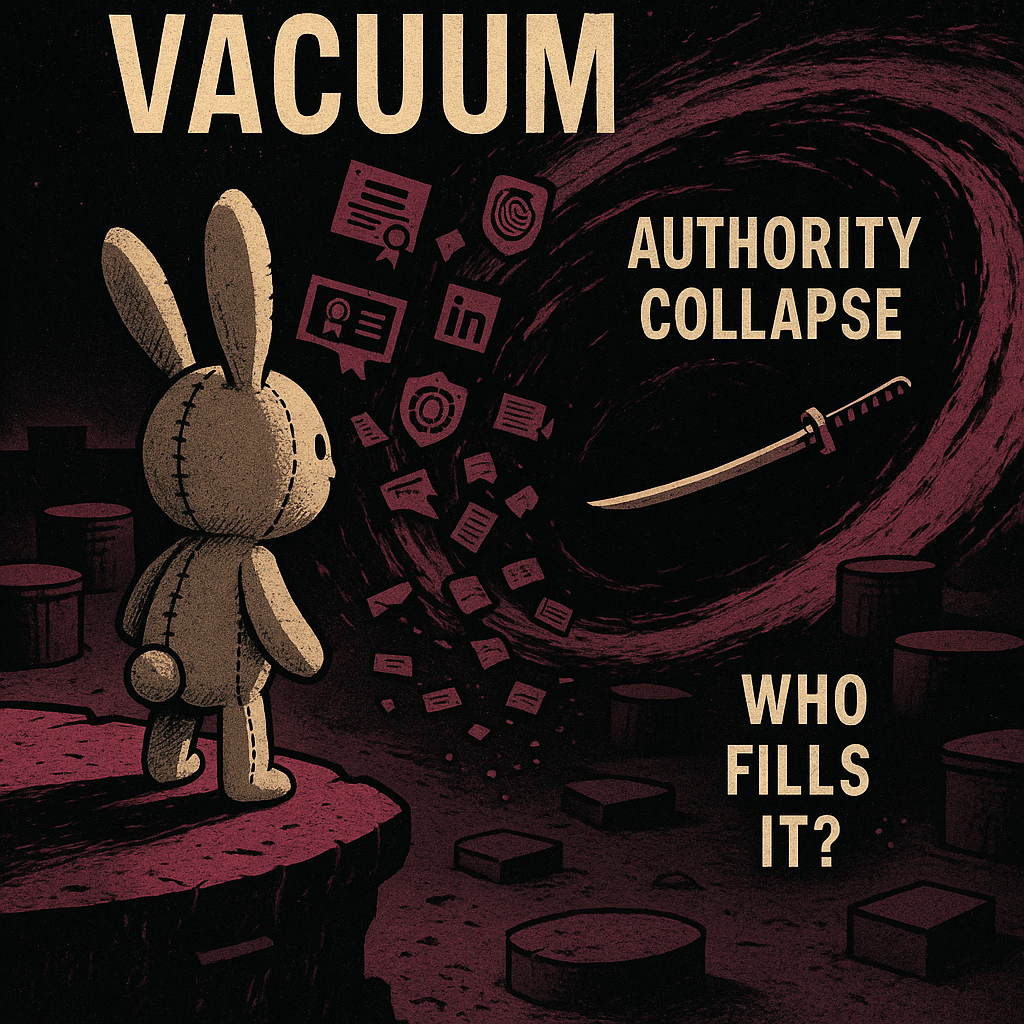
This creates a vacuum. And vacuums get filled.
The Network Topology of Authority
Authority—the kind that makes people listen, that shapes what others believe, that determines whose sense-making spreads—isn’t an inherent property. It’s a network phenomenon.
Think of it as a directed graph. Each node is a person. Edges point from “influenced by” to “influences.” Authority accumulates at nodes that have many incoming edges—people who many others look to for guidance.
In stable regimes, these high-authority nodes are predictable. They’re the people with credentials, institutional positions, platforms, track records. They got there through a process that made sense within the regime: demonstrate competence → gain recognition → accumulate platform → shape discourse.
The system is self-reinforcing. Credentials get you positions. Positions get you platforms. Platforms give you visibility. Visibility confirms authority. Authority grants more positions and larger platforms.
Until the regime shifts.
When the underlying dynamics change, the feedback loop breaks. The credentials were earned in the old regime. The positions were granted based on old-regime competence. The platforms were built on old-regime predictions. And suddenly, visibly, publicly—the predictions are wrong.
The network doesn’t immediately reorganize. There’s latency. People still look to the old nodes out of habit. The old nodes still have their platforms and positions. But the trust is degrading. Every wrong prediction, every failed forecast, every confident statement that aged poorly—it accumulates.
The authority graph is destabilizing. High-authority nodes are losing edges. And the edges have to go somewhere.
What Fills a Vacuum
Nature abhors a vacuum. So do networks.
When authority drains from established nodes, it flows toward new ones. But which ones? The vacuum doesn’t fill randomly. It fills according to specific dynamics that phase transitions make legible.
Prediction accuracy becomes visible. In stable regimes, it’s hard to distinguish genuine foresight from credentialed confidence. Everyone’s predictions are vague enough to claim vindication. But during rapid change, predictions get tested fast. The people who called it right become visible. The people who called it wrong become visible. The network can finally see who actually understands what’s happening.
Speed of adaptation signals capacity. Who pivoted first? Who integrated new capabilities while others were still debating whether the capabilities were real? Speed of adaptation is a costly signal—you can’t fake having been early. The network notices who was building while others were dismissing.
Usefulness compounds. During transitions, people are disoriented. They need help navigating. The nodes that provide useful navigation—not just commentary, but actual frameworks that help people act—accumulate edges fast. Usefulness is the new credentialing.
Coherence attracts. When everything is shifting, people are drawn to voices that seem stable without being rigid. The neuropolar voices—grounded enough to be trustworthy, adaptive enough to be relevant. Coherence in chaos is magnetic.
The vacuum fills with people who were right, who were early, who are useful, and who are coherent. Credentials and positions matter less. Demonstrated navigation capacity matters more.
The Competence Vacuum Specifically
What we’re watching isn’t just authority redistribution. It’s a specific phenomenon I’m calling the competence vacuum: the gap left when credentialed expertise fails to meet the moment.
The competence vacuum has characteristic features:
Institutional lag. Organizations move slowly. Their experts were hired under old criteria. Their processes were designed for old problems. Their incentive structures reward old behaviors. The institution is still credentialing the old competence while the market has moved on.
Platform inertia. Media platforms—traditional and social—have established relationships with established voices. Those voices still get the invitations, still write the columns, still appear on the podcasts. But their signal quality is degrading and audiences are noticing.
Credential skepticism. Every failed expert prediction erodes trust in credentials as such. “PhD in relevant field” used to be a strong authority signal. Now it’s met with “but did they see this coming?” The credentialing apparatus itself is losing credibility.
Search costs rising. If you can’t trust the established authorities, you have to find new ones. But how? The old filtering mechanisms—institutional affiliation, platform size, credential prestige—aren’t working. People are flailing, trying to find signal in noise.
This is the vacuum. It’s a gap in reliable sense-making. A shortage of trustworthy navigation. An undersupply of voices that are both competent and credible.
The vacuum will fill. The question is with whom.
Who Fills It
Let’s be direct about the possibilities.
Grifters. Every vacuum attracts people who are skilled at performing competence without having it. They were early not because they understood the technology but because they’re always early to whatever seems hot. They sound confident because they’re always confident. They’ll provide frameworks that feel useful but don’t actually help. They’ll extract attention and money and leave people more confused than before.
Ideologues. People with pre-existing agendas will use the transition to advance those agendas. “AI proves [thing I already believed].” They’ll provide certainty because they were already certain. Their navigation will consistently steer toward their ideology, regardless of whether it’s actually useful.
Genuine navigators. People who actually understand what’s happening, who were right for the right reasons, who provide frameworks that actually help people act effectively. They exist. They’re often less visible than grifters because they’re less interested in visibility than in accuracy.
The network can’t easily distinguish these in the early phase. The grifter and the genuine navigator both sound confident. Both were “early.” Both offer frameworks. The differences only become clear over time, as predictions get tested and frameworks prove useful or not.
This is why the window matters. The edges are flowing now. The new authority structure is crystallizing now. The people who fill the vacuum in the next 6-12 months become the reference nodes for the next era—whether or not they deserve to be.
The Neuropolar Navigator
What does a genuine navigator look like? What properties should you look for in others—and cultivate in yourself?
Right for the right reasons. Not just “called it early” but understood why. Can explain the mechanism, not just the prediction. Prediction accuracy plus explanatory depth. Anyone can be right once by luck. Right for the right reasons suggests repeatable insight.
Stable core, adaptive edge. The neuropolar stance itself. Grounded enough to provide consistent signal. Adaptive enough to update as the transition unfolds. Not rigidly attached to early predictions. Not frantically chasing every new development. The balance that survives.
Useful, not just interesting. Provides frameworks that actually help people act. Not just “here’s what’s happening” but “here’s what you can do about it.” The difference between commentary and navigation.
Appropriate uncertainty. Acknowledges what they don’t know. Updates publicly when wrong. Doesn’t perform omniscience. Confidence about the shape of things combined with humility about the details. This is the hardest to fake and the most important to find.
Builds rather than extracts. Focused on creating value, not just capturing attention. Leaves people more capable than before. The opposite of the grifter pattern.
These are the people to learn from. These are also the properties to cultivate.
Filling the Vacuum Yourself
Here’s the uncomfortable implication: the vacuum is an opportunity.
Not in the cynical sense of “exploit the chaos for personal gain.” In the structural sense of “the network needs new nodes, and you could be one.”
If you’ve been running pattern recognition that works—if you saw this transition coming, if your nervous system was signaling before your conscious mind caught up, if Part 1’s description of sensing the phase shift landed because you’d been sensing it—then you have something the network needs.
The competence vacuum isn’t just a problem to navigate. It’s a position to fill.
This doesn’t mean becoming an influencer or building a personal brand in the cringe sense. It means: if you have genuine insight, the network needs you to share it. If you’ve figured out something useful, others need to hear it. If you’re navigating well, your navigation becomes a resource.
The neuropolar stance applied to the vacuum:
Stable core: Ground your authority in actual competence. Don’t perform expertise you don’t have. Don’t claim certainty you don’t feel. The core is integrity—being the same person in public and private, saying what you actually believe, updating when you’re wrong.
Adaptive edge: Ship your thinking. Publish before you’re ready. Build in public. Share your frameworks while they’re still developing. The edge is visibility—putting your navigation out where it can help others and where it can be tested.
Forbidden middle: Waiting until you’re “ready” to share. Perfecting in private. Building expertise without building authority. The middle is invisible—competent but not positioned, insightful but not sharing.
You’re early enough to be the genuine navigator rather than the grifter. But the window is closing.
The Stakes
The competence vacuum will fill. It’s filling now.
If it fills with grifters and ideologues, a lot of people will be led badly during a transition that didn’t have to be so hard. The quality of collective sense-making will degrade precisely when it most needs to be sharp.
If it fills with genuine navigators—people running neuropolar architectures, people with real insight and appropriate uncertainty, people who build rather than extract—then the transition becomes more navigable for everyone.
This isn’t about becoming famous. It’s about the structure of who guides whom during a period of collective disorientation.
You’re reading this because you’re the kind of person who looks for sense-making in uncertain times. That means you’re also the kind of person who could provide it.
The vacuum is there. The edges are flowing. What you do with that is up to you.
This is Part 5 of Neuropolarity, a 10-part series on navigating the AI phase transition.
Previous: Part 4: Non-Ergodic Adoption
Next: Part 6: Coherence Over Purity — Integration beats ideology