PART 3: The Neuropolar Stance

There’s a shape that survives phase transitions. The extremes aren’t opposite—they’re the same move.
The Missing Geometry
We’ve covered the ground. The phase transition is real—attractor collapse, topology shift, critical regime. The shame switch is real—fear gave way to hiding, and the loop tightens. You’re not crazy for feeling disoriented.
But recognition isn’t resolution. Knowing you’re in a phase transition doesn’t tell you how to move through it. Knowing you’re caught in shame dynamics doesn’t break the loop. What’s missing is a stance—a geometry of response that holds coherence when the terrain destabilizes.
What follows is that geometry. It has a name.
Let me build it piece by piece, because this isn’t another framework to bolt on. This is an architecture you might already be running without language for it—and if you’re not, it’s the architecture you’re going to need.
The Barbell, Revisited
Nassim Taleb popularized the barbell strategy in finance: extreme safety on one end (treasury bills, cash, things that survive anything), extreme risk on the other (small asymmetric bets with unlimited upside), and nothing in the middle. The moderate position—the “balanced portfolio”—is where you quietly bleed in normal times and get destroyed in tail events.
The logic is counterintuitive but rigorous: In a world where returns are fat-tailed, the middle captures downside without compensating upside. You’re exposed to ruin without exposure to jackpot. The extremes aren’t opposite—they work together. The safe side ensures survival; the risky side captures asymmetric upside. Neither works without the other.
This geometry isn’t unique to finance.
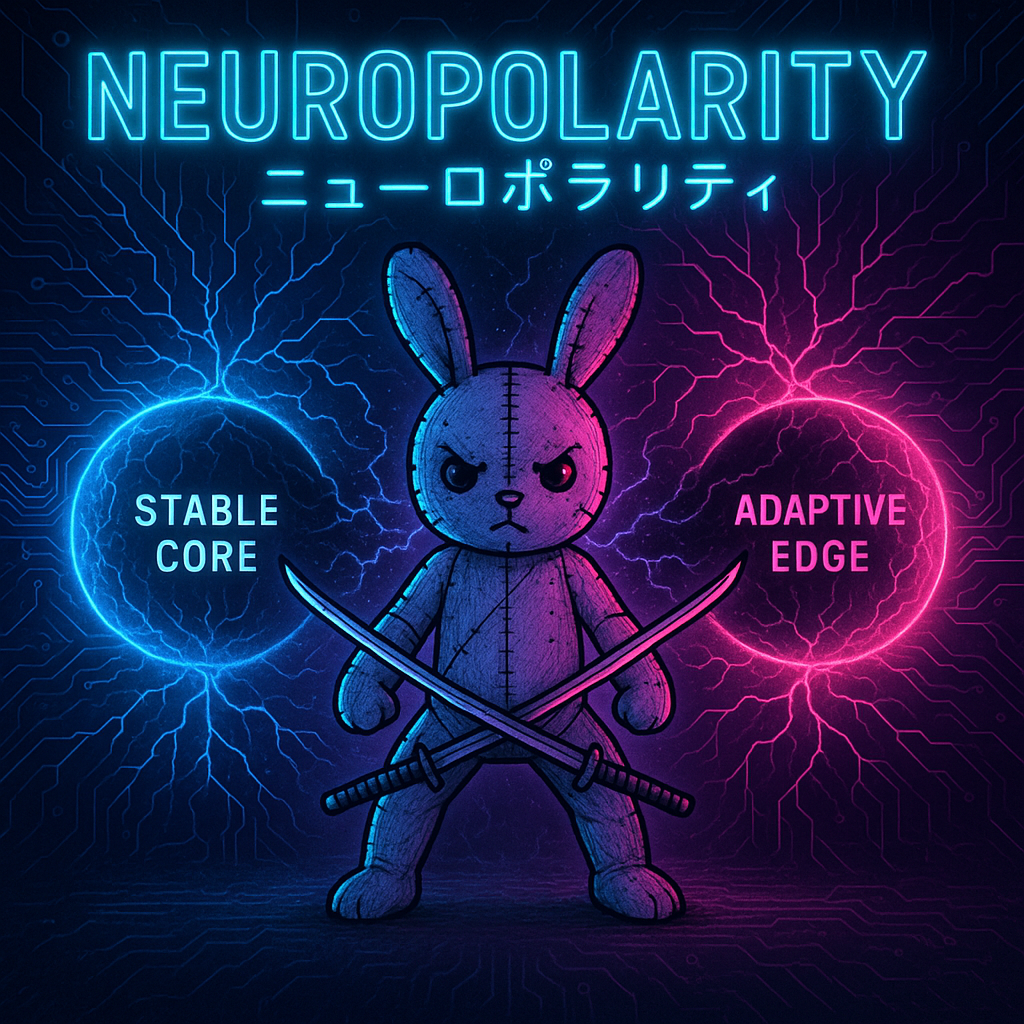
The barbell appears everywhere complex systems face uncertainty: stable core plus adaptive edge plus forbidden middle. It’s the shape that survives when the distribution of outcomes has fat tails—which is to say, when rare events aren’t actually rare.
But here’s what Taleb’s framing misses, or at least leaves implicit: The barbell isn’t just an investment strategy. It’s a coherence architecture. It’s how systems maintain integrated functioning when the environment is volatile, uncertain, and prone to discontinuous shifts.
And it applies to cognition, nervous systems, and identity just as much as portfolios.
Extending the Shape
Consider what survival looks like in a phase transition:
You need stability—a core that doesn’t reorganize every time the wind shifts. Without stable ground, you’re just noise. Every signal flips you. Every new development rewrites your orientation. You become reactive, scattered, unmoored.
And you need adaptability—the capacity to track and respond to the shifting terrain. Without responsiveness, you’re rigid. You miss signals. You cling to maps of territory that no longer exists. You become a relic.
The naive response is to try to balance these: some stability, some adaptability, modulate between them. This is the middle. And the middle kills you.
Why? Because moderate stability isn’t stable—it folds under pressure. And moderate adaptability isn’t adaptive—it’s too slow to catch the phase transition. You get the worst of both: unstable enough to be disoriented, rigid enough to miss the signals. Committed enough to suffer, flexible enough to never commit.
The barbell is the alternative: extreme stability in your core (identity, values, foundational capabilities, relationships that survive anything) and extreme adaptability at your edge (aggressive learning, experimental action, willingness to be wrong and update). Nothing in the middle.
The stable core enables the adaptive edge. You can explore dangerous territory because you have somewhere to return. You can take cognitive risks because your identity doesn’t collapse when you’re wrong. You can engage with destabilizing information because your foundation holds.
And the adaptive edge protects the stable core. You detect threats early. You sense phase transitions before they’re obvious. You update your maps in real-time rather than discovering you’re lost when it’s too late.
This is the geometry. What do we call it?
Neuropolarity
The term lands where Taleb’s “antifragile” can’t reach.
Antifragility describes systems that gain from disorder. It’s a property, a characteristic, a thing you can observe from outside. Useful, but incomplete.
Neuropolarity describes the stance—the active configuration of a system orienting through uncertainty. It’s not something you have. It’s something you do. A way of organizing your nervous system, your cognition, your attention, your identity—holding the poles while releasing the middle.
The “neuro-” prefix is intentional and double-coded:
Neuro as in nervous system. Because this isn’t just cognitive strategy—it’s embodied. The stable core isn’t an idea you believe; it’s a physiological baseline you can return to. The adaptive edge isn’t intellectual flexibility; it’s nervous system capacity to tolerate disorientation without collapse. Neuropolarity is how your autonomic system holds the barbell, not just your portfolio.
Neuro as in neural networks. Because the AI transition isn’t separate from this—it’s the environment selecting for exactly this architecture. The systems that survive aren’t the ones that resist AI or capitulate to it but the ones that hold stable ground while extending adaptive reach into new capability. Humans working with AI effectively are running a neuropolar configuration whether they know it or not.
And polarity carries the geometry: not balance, but poles. Not moderation, but extremes that work together. Not the middle way, but the shape that holds when the middle collapses.
Neuropolarity is the cognitive and nervous system stance that survives phase transitions.
The Architecture in Detail
Let’s make this concrete.
The Stable Core
This is what doesn’t change—or changes only slowly, deliberately, from the inside rather than in reaction to external pressure. It includes:
Regulatory capacity: The ability to return to a parasympathetic baseline. Not “always calm” but “can find calm.” A nervous system that has somewhere to go when activation spikes.
Identity anchors: Who you are beyond your current skills, role, or output. Values, relationships, ways of being that don’t depend on external validation. If your entire identity is “person who does X,” and AI can now do X, your core collapses. If your identity includes “person who learns, adapts, and brings judgment to novel situations,” AI extends rather than threatens you.
Foundational capabilities: Skills that compound rather than become obsolete. Judgment. Taste. The ability to ask good questions. Understanding of domains deep enough to evaluate AI outputs. These aren’t replaced by AI—they become more valuable as AI handles the commodity work.
Trust networks: Relationships that survive volatility. People who know you, believe in you, will collaborate with you regardless of which way the wind blows. Social capital that doesn’t evaporate when the industry reshuffles.
The stable core isn’t rigid—it’s resilient. It bends without breaking. It updates, but from internal coherence rather than external pressure.
The Adaptive Edge
This is what changes rapidly, experimentally, without ego investment. It includes:
Active learning: Engaging with AI tools directly, constantly, without waiting for permission or clarity. The only way to develop intuition for a new capability is to use it. Fail fast, update faster.
Cognitive flexibility: Willingness to be wrong. To hold models lightly. To encounter information that challenges your current understanding and update rather than defend.
Experimental action: Trying things that might not work. Publishing before you’re ready. Building prototypes. Getting feedback. The edge is where you’re uncertain, vulnerable, potentially wrong—and you engage anyway.
Pattern sensing: Attention to weak signals. Noticing what’s shifting before it’s obvious. This is the perceptual component of adaptability—not just responding to change but detecting it early.
The adaptive edge isn’t reckless—it’s exploratory. High variance, low cost. You’re not betting your core on experiments; you’re extending tendrils into uncertain territory while your foundation holds.
The Forbidden Middle
This is what looks safe and isn’t:
“Cautious adoption”—moving slowly enough to miss the window, fast enough to feel like you’re doing something.
“Balanced perspective”—neither dismissing AI nor embracing it, which means neither developing capability nor preserving skeptical integrity.
“Waiting for clarity”—letting others run the experiments, then trying to catch up when the winners are obvious (and the window has closed).
“Hedged identity”—partially invested in the old regime, partially in the new, fully committed to neither.
The middle feels responsible. It’s not. In a phase transition, the moderate position is where you lose both stability and adaptability. You’re not safe enough to weather the volatility and not adaptive enough to surf it.
The middle is where careers go to die slowly.
Neuropolar Operation
This isn’t a framework you adopt once and possess forever. It’s an ongoing practice—a way of configuring yourself moment to moment as conditions shift.
What does neuropolar operation look like in practice?
When the terrain destabilizes: You feel it—the uncertainty, the disorientation. Instead of collapsing into shame (hiding), or rigidifying into denial (pretending nothing’s changed), you check your poles. Is my core intact? Can I find my way back to baseline? Good—then I can extend the edge. Move toward the uncertainty with curiosity rather than terror.
When you encounter novel capability: AI can do something you couldn’t do yesterday. The neuropolar response isn’t threat (it’s replacing me!) or dismissal (it’s not that good). It’s integration: How does this extend my reach? What can I do now that I couldn’t before? What becomes possible when I compound my judgment with this capability?
When you fail or get it wrong: The edge is where you make mistakes—that’s the point. The neuropolar response routes the failure to the edge, not the core. You were wrong about this tool, this approach, this prediction. That’s information. Update and continue. Your identity doesn’t collapse because an experiment didn’t work.
When others are panicking or hiding: The shame dynamics create a kind of collective freeze. The neuropolar stance holds separate from the crowd. Not dismissive—you understand why people are struggling—but not entrained either. Your nervous system doesn’t need to match the ambient dysregulation.
Neuropolarity isn’t about having the answers. It’s about having a geometry—a shape that holds when the answers aren’t available yet.
The Process: Neuropolarization
Here’s where the language extends.
Neuropolarity is the stance. Neuropolar is the adjective—a neuropolar approach, a neuropolar orientation, a neuropolar response.
And neuropolarization is the process—what happens when you deliberately cultivate this architecture. When you strengthen the core, extend the edge, and stop investing in the middle.
Neuropolarization isn’t instant. It’s developmental. You’re building:
Regulatory capacity through nervous system practices (breath work, somatic awareness, co-regulation with stable others)
Identity resilience through clarifying what actually matters to you independent of external validation
Foundational capabilities through deliberate learning that compounds rather than obsessing over skills that automate
Adaptive reach through consistent experimentation that doesn’t bet the farm
What the AI transition is doing—to the economy, to knowledge work, to human identity—is forcing neuropolarization. The middle is becoming uninhabitable. You’re either cultivating the stable core and adaptive edge, or you’re being squeezed by the collapse of the middle ground.
The ones who thrive won’t be the ones who resisted AI or the ones who became AI fanboys. They’ll be the ones who held coherence—stable enough to not fragment, adaptive enough to not calcify.
The neuropolar ones.
What Comes Next
We’re three parts into a ten-part series. You now have:
- The territory: phase transition, attractor collapse, critical regime. The ground is actually shifting.
- The trap: shame switch, hiding dynamics, the freeze that looks like deliberation. Your nervous system is responding to social threat.
- The stance: neuropolarity. Extreme stability plus extreme adaptability plus rejection of the middle. The geometry that survives.
What comes next is deployment:
Part 4 covers the survival math—why time-average thinking changes everything, why “wait and see” is actually the riskiest position on the board.
Parts 5-6 map the cultural dynamics—who fills the authority vacuum, why coherence beats purity.
Part 7 is for the neurodivergent—why ND cognition was pre-adapted to neuropolar operation, why the world becoming “autistic-coded” is your moment.
Part 8 delivers nervous system protocols—concrete practices for building the regulatory core.
Part 9 deploys the barbell to career and positioning—safe core, experimental edge, applied.
Part 10 integrates—how navigation authority works, and what you’re actually building.
The phase transition is here. The shame switch is real. And now you have a name for the stance that holds: neuropolarity.
The question isn’t whether you need it. The question is how quickly you can cultivate it.
Next: Non-Ergodic Adoption
“Wait and see” is the riskiest position on the board. Here’s the math.
This is Part 3 of Neuropolarity, a 10-part series on navigating the AI phase transition.
Previous: Part 2: The Shame Switch
Next: Part 4: Non-Ergodic Adoption — The math of sequential, irreversible decisions