PART 2: The Shame Switch
Public AI discourse evolved from fear-based resistance to shame-based concealment. This neurological shift produces invisible isolation rather than collective action—demanding new support strategies.

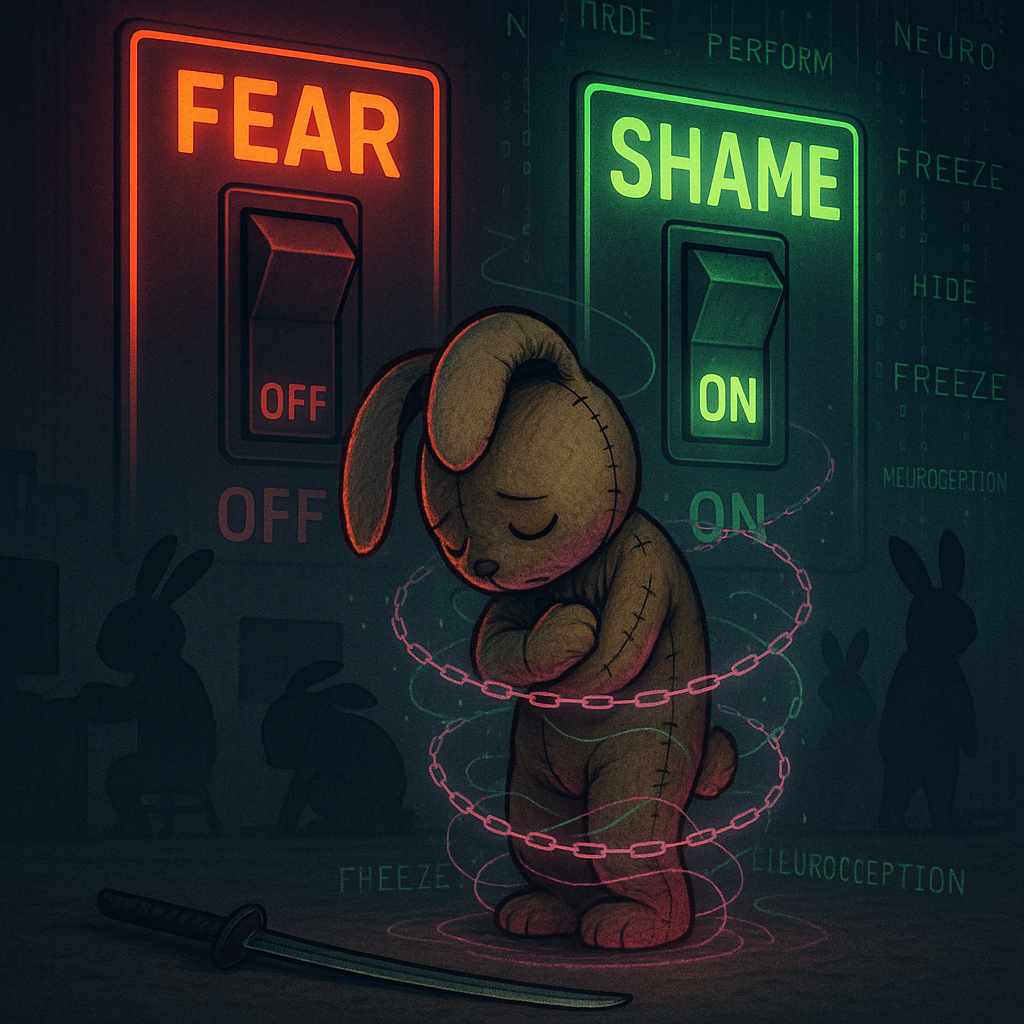
Fear and shame are different animals. One makes you fight. The other makes you hide.
The Emotion Nobody’s Naming
Watch the discourse carefully and you’ll notice the shift.
Eighteen months ago, the AI conversation was dominated by fear. Existential risk. Job displacement. The robots are coming. People argued passionately about whether AI would destroy humanity, replace workers, end creativity. The energy was high, oppositional, activated.
That’s not the dominant tone anymore.
Now it’s something quieter, more corrosive. People don’t rant about AI destroying civilization—they make self-deprecating jokes about not understanding it. They don’t argue that AI is dangerous—they perform casual dismissal while quietly wondering if they’re falling behind. They don’t attack AI evangelists—they avoid the topic at professional dinners because they’re not sure they can keep up.
The emotional register changed. What was fear has become something else.
Shame.
This isn’t semantics. Fear and shame are neurologically distinct. They produce different physiological states, different behavioral patterns, different strategic implications. The AI conversation shifted from one nervous system configuration to another, and almost nobody noticed because we don’t have good cultural vocabulary for distinguishing them.
But your body noticed. And the strategic landscape changed with it.
The Pattern: Two Different Animals
Fear is straightforward. Something threatens you, your sympathetic nervous system activates, you prepare to fight or flee. The threat is external. The response is mobilization. Energy goes out—toward confrontation, escape, or resistance.
Shame operates on a completely different architecture.
Shame isn’t about external threat. It’s about social evaluation—the perception that you’ve failed to meet standards that others can see. The threat isn’t to your body. It’s to your belonging. And because humans are fundamentally social mammals who evolved in contexts where exile meant death, shame activates some of the oldest, most powerful circuits we have.
The physiological signature is different too. Fear produces sympathetic arousal—elevated heart rate, blood to limbs, mobilization. Shame produces something more complex: a mix of sympathetic activation (you feel the threat) and dorsal vagal dampening (but you can’t run from social judgment, so the system starts shutting down). The result is that distinctive shame posture—the collapsed chest, the averted gaze, the impulse to disappear rather than fight.
Here’s why this matters for AI:
Fear-based responses to AI produced resistance. Manifestos. Strikes. Heated arguments. Whatever you think of those responses, they were active. People mobilized energy toward doing something about the perceived threat.
Shame-based responses produce something else entirely. Hiding. Performing confidence you don’t feel. Avoiding situations where your ignorance might be exposed. Privately struggling while publicly pretending everything’s fine.
The shift from “AI is threatening” to “being behind on AI is embarrassing” completely changed the behavioral dynamics. And it happened beneath the level of cultural discourse, in the nervous system responses of millions of people who would never articulate it this way.
The Mechanism: Neuroception and Social Threat
Polyvagal theory gives us the precision to understand what happened.
Your nervous system doesn’t wait for conscious evaluation to assess threat. Below the level of awareness, a process Stephen Porges called neuroception continuously scans the environment for safety and danger cues. This scanning is fast, automatic, and operates on signals you often can’t consciously identify—tone of voice, facial microexpressions, contextual patterns.
Neuroception has three basic outputs:
Safe: Ventral vagal activation. Social engagement system online. You can connect, play, create, collaborate. Parasympathetic with a twist—calm but alert.
Dangerous: Sympathetic activation. Fight or flight. Mobilization toward or away from threat. High energy, high arousal, action-oriented.
Life-threatening (inescapable): Dorsal vagal activation. Shutdown. Freeze. Dissociation. The ancient vertebrate response when fighting and fleeing both fail.
Here’s the key: Social evaluation threats—shame triggers—produce a weird hybrid. Your system detects danger (sympathetic activation starts), but the threat isn’t something you can fight or flee. You can’t punch your way out of “everyone thinks I’m incompetent.” You can’t run from your own inadequacy. So the system partially activates mobilization, then layers dorsal dampening on top.
The result: that uncomfortable activated-but-frozen state. Anxious but immobilized. Wanting to act but unable to move. Performing competence while internally spinning.
This is what the AI shame switch produces at scale.
Millions of people neurocepting social threat—“I don’t understand this thing everyone seems to be using, and that reveals something about me”—and responding with the shame architecture: partial activation, partial shutdown, hiding behavior, performance, avoidance.
The cultural conversation looks calm because shame makes people go quiet. Underneath, nervous systems are churning in a state that’s neither fight nor flight but something more insidious: hide.
Why Shame Is Strategically Worse Than Fear
Fear, for all its discomfort, produces adaptive responses. You assess the threat, mobilize resources, take action. Even if the action is retreat, you’re doing something. Fear is high-energy and moves you through time.
Shame traps you.
The shame response is fundamentally oriented toward concealment. Don’t let others see your inadequacy. Perform confidence. Avoid situations that might expose you. And critically—don’t seek help, because seeking help would require admitting you need it, which would trigger more shame.
This creates a doom loop: You feel behind on AI. Shame makes you hide that feeling. Hiding prevents you from learning. You fall further behind. More shame.
Meanwhile, the people who aren’t trapped in this loop—because they started earlier, because they have less shame sensitivity, because they found environments where asking questions is safe—accelerate away from you. The gap widens. The shame deepens.
This is why the shift from fear to shame changed everything strategically. Fear-based resistance was visible, collective, addressable. Shame-based hiding is invisible, isolating, and self-reinforcing.
The person suffering AI shame won’t tell you about it. They’ll make jokes. They’ll change the subject. They’ll privately feel like they’re the only one who doesn’t get it. And they’ll fall further behind while maintaining the performance of someone who has it handled.
The Shame Switch in the Wild
Once you see this pattern, you can’t unsee it:
The executive who publicly dismisses AI as “not ready for our industry” while privately terrified that her twenty years of expertise now fit in a prompt.
The creative who performs disdain for AI-generated content while wondering if anyone can tell the difference between their painstaking work and something produced in seconds.
The academic who writes papers about AI limitations while watching graduate students accomplish in days what took her years.
The professional who laughs about ChatGPT’s mistakes while avoiding any situation where someone might discover how little he actually uses it.
The job seeker who doesn’t mention AI skills on their resume because they’re not sure they have them, which means they can’t develop them, which means they fall further behind.
None of these people will describe their experience as shame. They’ll rationalize it as skepticism, standards, appropriate caution. But the behavioral signature is clear: hiding, performing, avoiding exposure, not asking for help.
The shame switch isn’t about AI capabilities. It’s about what AI reveals—or seems to reveal—about you.
Working With the Switch
The first move is recognition: What you might be calling “skepticism” or “resistance” or “being deliberate” might be shame in disguise. The test isn’t what you say but what you do. Are you actively engaging, experimenting, asking questions? Or are you performing engagement while actually hiding?
The second move is normalization: The shame response isn’t weakness. It’s the predictable output of a nervous system evolved for social survival encountering a status threat it can’t fight or flee. Millions of people are experiencing exactly this. You’re not uniquely inadequate. You’re having a universal neurological response to a novel situation.
The third move is environmental: Shame loops break when concealment becomes unnecessary. Find contexts—people, communities, learning environments—where not knowing is genuinely safe. Where questions are welcomed rather than judged. Where “I don’t understand this yet” is a starting point, not an admission of failure.
The shame switch isn’t about AI. It’s about your nervous system’s attempt to protect you from social death. Understanding that distinction—really feeling it, not just knowing it intellectually—is the first step toward working with the response rather than being controlled by it.
The ground is shifting. Fear of AI was one response. Shame about AI is another. Neither serves you.
What might serve you is something else entirely: a stance that holds steady while the topology reorganizes. That’s what we’re building toward.
Next: The Neuropolar Stance
Extreme safety plus extreme adaptation plus nothing in the middle. The barbell isn’t just for money.
This is Part 2 of Neuropolarity, a 10-part series on navigating the AI phase transition.
Previous: Part 1: The Phase Transition
Next: Part 3: The Neuropolar Stance — Stable core, adaptive edge