PART 10: Navigation Authority

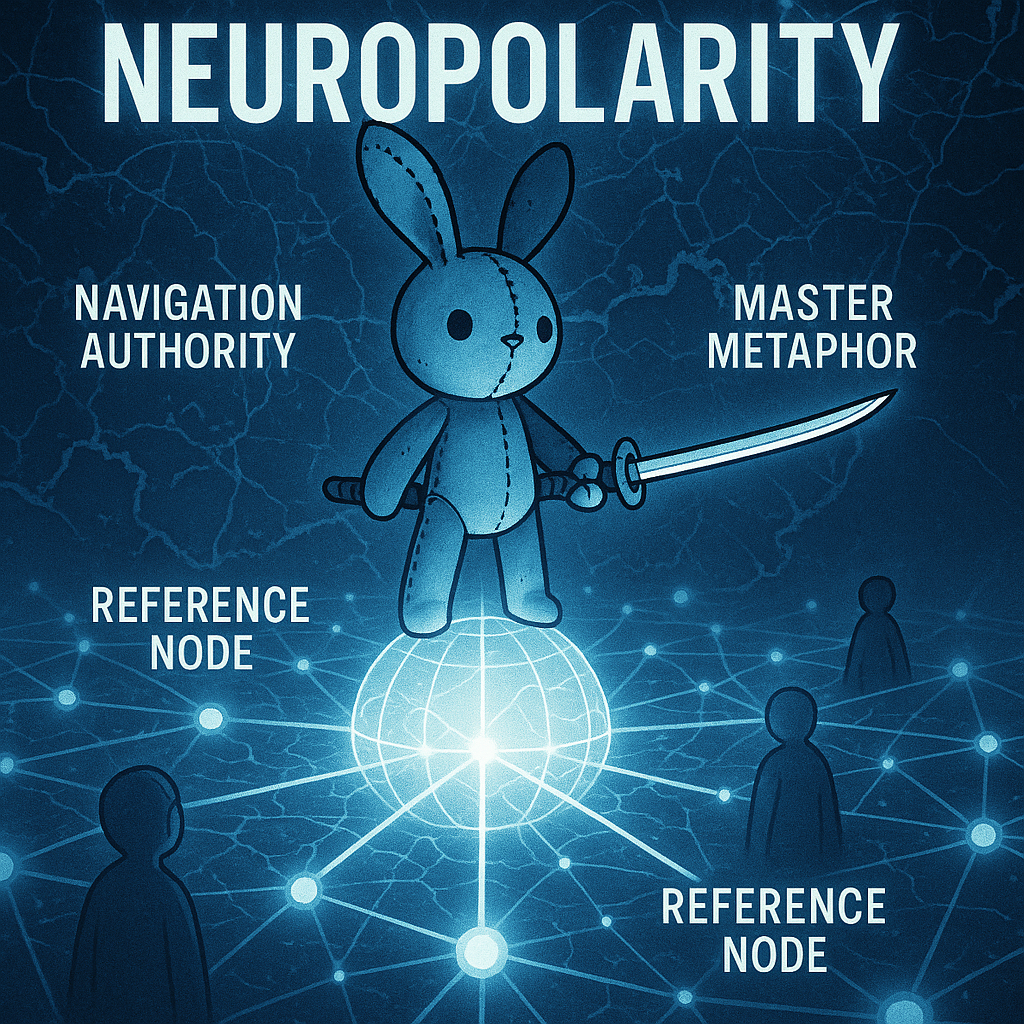
The Master Metaphor
Every era has a master metaphor—a frame that shapes how people understand what’s happening.
The industrial era: the machine. Society as factory, humans as components, efficiency as virtue.
The information era: the network. Society as connections, humans as nodes, connectivity as virtue.
The current transition doesn’t have its metaphor yet. The old frames don’t quite work. “Disruption” is too sterile. “Revolution” is too grandiose. “Transformation” is too vague. People are reaching for language and not finding it.
Whoever provides the metaphor that sticks—the frame that becomes how people understand this moment—becomes a central reference point for the era. Not famous in the celebrity sense. Referenced. The person whose concepts get used, whose frameworks get applied, whose sense-making becomes infrastructure.
This is navigation authority. And it’s available.
What Navigation Authority Is
Navigation authority is not expertise.
Expertise is knowing the territory. Having been there. Being able to answer questions about what’s there. Expertise is backward-looking—it’s accumulated knowledge from past experience.
Navigation authority is the demonstrated ability to help others move through uncertainty. It’s forward-looking—it’s about providing direction when the territory is unknown.
The difference matters because expertise is failing (Part 5). The experts don’t know the new territory. Their backward-looking knowledge doesn’t map to forward conditions. People are looking for navigation, and expertise isn’t providing it.
Navigation authority has different components:
Prediction accuracy. Did you call it right? Not in the trivial sense of making guesses that happened to land—in the substantive sense of understanding dynamics well enough to forecast their implications. Prediction accuracy is the hard evidence that your navigation capacity is real.
Useful framing. Do your concepts help people act? Not just interesting or insightful—actually useful. Frameworks that people can apply to their own situations and get results.
Consistent signal. Do you show up reliably? Is there a body of work that demonstrates sustained engagement? Consistency compounds visibility and trust.
Appropriate uncertainty. Do you acknowledge what you don’t know? The grifter claims certainty; the navigator claims confidence about shape combined with uncertainty about details. Appropriate uncertainty is credibility.
Navigation authority compounds. Accurate prediction builds trust. Trust builds audience. Audience tests more predictions. More prediction builds more trust. The loop, when it works, is self-reinforcing.
The Information Economics
Why does the phase transition create opportunity for new navigation authority?
Supply collapse. The established navigators—the experts, the institutions, the credentialed authorities—are losing credibility because their predictions failed. The supply of trusted navigation is declining.
Demand spike. People are more disoriented than usual because the ground is actually shifting. The demand for sense-making is increasing.
Verification window. During rapid change, predictions get tested fast. It becomes clear quickly who understands the dynamics and who doesn’t. The fog that normally protects false authority burns off.
Supply declining, demand increasing, verification improving. This is the market structure for navigation authority. The people who are right, useful, and consistent accumulate authority fast.
But the window closes.
As the transition matures, new consensus forms. New authorities crystallize. New hierarchies emerge. The fluid phase—when edges are flowing and new nodes can capture them—doesn’t last forever.
This is why timing matters. Not because you need to rush. Because the market structure is temporarily favorable, and that favor is expiring.
Building Navigation Authority
How do you actually build navigation authority?
Make predictions. Not vague directional claims—specific enough to be tested. “This will happen in this domain on approximately this timeline.” Put yourself on record. The only way to demonstrate prediction accuracy is to make predictions that can be verified.
Provide frameworks. Not just analysis—scaffolding that others can use. The neuropolarity concept is an example: it’s a frame that people can apply to their own situations. Useful frameworks get adopted and attributed.
Show your work. Document your reasoning. Explain how you reached your predictions. Transparency builds trust and allows others to evaluate your process, not just your outputs.
Update publicly. When you’re wrong—and you’ll be wrong—acknowledge it and explain what you learned. The navigator who updates is more trusted than the one who doesn’t, because updating demonstrates epistemic honesty.
Be consistent. Show up. Publish regularly. Build a body of work. Consistency is the difference between “interesting take” and “reliable source.” It’s what compounds.
Stay in your lane. Navigation authority is domain-specific. The person who navigates well in one territory isn’t automatically credible in another. Know where your navigation capacity is real, and stay there.
The Neuropolar Navigator
How does the neuropolar stance apply to building navigation authority?
Stable core is credibility. The core—judgment, taste, domain depth, relationships, regulatory capacity, identity—is what makes your navigation trustworthy. People sense whether you’re grounded or reactive, coherent or scattered. The core creates the credibility that the edge builds on.
Adaptive edge is visibility. The edge—shipping before ready, building in public, engaging with the frontier—is what makes your navigation visible. Ideas that stay private don’t become infrastructure. The edge creates the reach that the core makes sustainable.
Forbidden middle is commenting. The middle is: having takes without making predictions, offering analysis without providing frameworks, being interested without building. It’s the position of the observer, not the navigator. It captures neither credibility nor visibility.
The neuropolar navigator: grounded enough to be trusted, visible enough to be found, useful enough to be adopted. Working from both poles, absent from the middle.
The Synthesis
Let me name what we’ve built across this series.
Neuropolarity is the stance. The architecture of stable core plus adaptive edge that survives phase transitions. It’s not something you have; it’s something you do. The active configuration of holding the poles while releasing the middle.
A neuropolar approach to the AI transition means: your foundation holds (identity, values, relationships, regulatory capacity) while your reach extends (new capabilities, new tools, new possibilities). Neither resistance nor capitulation—coherent integration.
Neuropolarization is the process. What happens as you deliberately cultivate neuropolar architecture. And what the transition itself is forcing on everyone. The middle is becoming uninhabitable; everyone is being pushed toward the poles. The question is whether you neuropolarize consciously or get neuropolarized by circumstance.
Navigation authority is what accumulates when you do this well. Not expertise—expertise is what you know. Navigation authority is the demonstrated ability to help others move through uncertainty. It builds when you’re accurate, useful, and consistent. It compounds through the network effects of being referenced.
These three concepts form the through-line of the series:
Parts 1-2: The phase transition and its nervous system effects (why neuropolarization is happening)
Part 3: The neuropolar stance (what the architecture looks like)
Parts 4-6: The mechanisms (non-ergodicity, competence vacuum, coherence shift)
Parts 7-8: The embodiment (neurodivergence, nervous system protocols)
Parts 9-10: The deployment (barbell allocation, navigation authority)
Same geometry throughout. Stable core, adaptive edge, forbidden middle. Applied to cognition, nervous system, career, and authority.
The Window
Six months. Maybe twelve.
Not because something magical happens after that—but because that’s approximately how long until:
AI fluency becomes baseline expectation rather than differentiating advantage
The competence vacuum fills with whoever got there first
The new authority structure crystallizes around the early navigators
The window of prediction-testing and credibility-building narrows
You’re early. Not because you found this first—because you recognized the shape.
The disorientation you felt was signal (Part 1). The shame dynamics were nervous system response, not weakness (Part 2). The neuropolar stance is available (Part 3). The compounding math favors immediate action (Part 4). The vacuum is there to be filled (Part 5). Coherence beats purity (Part 6). Your architecture might already be pre-adapted (Part 7). The protocols build the capacity (Part 8). The allocation is clear (Part 9).
What remains is what you do with all of that.
The Landing
Neuropolarity isn’t a promise that everything will be fine. It’s a stance that holds whether things go well or badly.
If the transition goes smoothly—if AI integrates gradually and institutions adapt—the neuropolar stance still works. You’ll have deepened your core and extended your edge. The capabilities will compound regardless of how dramatic the change.
If the transition goes roughly—if disruption is severe and adaptation is hard—the neuropolar stance becomes survival architecture. The stable core is what you stand on when everything else shakes. The adaptive edge is what lets you respond when the ground shifts.
The stance isn’t prediction-dependent. It’s not “this will happen, so do this.” It’s “whatever happens, this structure is more robust than the alternatives.”
The ground is shifting. Your nervous system knows it. Your pattern recognition confirmed it.
What you do next is up to you.
This concludes Neuropolarity, a 10-part series on navigating the AI phase transition.
Previous: Part 9: The Barbell Deployment
Start from the beginning: Part 1 — The Phase Transition