Co-Regulation in Chaos: The Only Parenting Skill That Transfers
The only parenting skill that works in an unpredictable world is co-regulation — syncing your nervous system to your child's, not programming them for a future you can't see.

Co-Regulation in Chaos: The Only Parenting Skill That Transfers
We've established that you can't prepare your kids for a predictable future because there isn't one. That the skills you learned might not transfer. That the rules you want to pass down might be wrong.
So what's left?
What parenting capacity actually works when the terrain is illegible, the destination is unknown, and your expertise is increasingly irrelevant?
There's one thing: co-regulation.
The ability to stay connected and emotionally present while navigating uncertainty together.
What Co-Regulation Actually Is
Co-regulation is a nervous system phenomenon. It's what happens when two people's autonomic systems sync up—their breathing patterns align, their heart rate variability couples, their states influence each other.
You've experienced it:
- A baby calms down when held by a calm parent
- You feel anxious entering a room full of anxious people
- Being with someone grounded helps you feel grounded
- Someone else's panic can trigger your panic
This isn't metaphor. It's measurable physiology. Nervous systems are social organs. They're designed to influence and be influenced by the nervous systems around them.
Co-regulation in parenting means: your nervous system helps regulate your child's nervous system. When they're dysregulated—anxious, angry, overwhelmed—your regulated presence helps them return to baseline.
Why This Is the Skill That Transfers
Most parenting skills are content-dependent:
- Teaching them to ride a bike requires knowing how to ride a bike
- Helping them with homework requires understanding the material
- Guiding their career requires understanding the career landscape
- Passing on rules requires rules that still work
Co-regulation is content-independent. It doesn't require you to know what the problem is or have the answer. It requires you to be present and regulated while they figure it out.
When the future is uncertain:
- You can't tell them what to do
- You can be steady while they figure out what to do
When the terrain is illegible:
- You can't map it for them
- You can navigate it with them
When your expertise is outdated:
- You can't give them the answers
- You can help them stay regulated while they find answers
Co-regulation works regardless of content. It's the meta-skill that supports whatever specific skills they need to develop.
The Coupled Oscillator Model
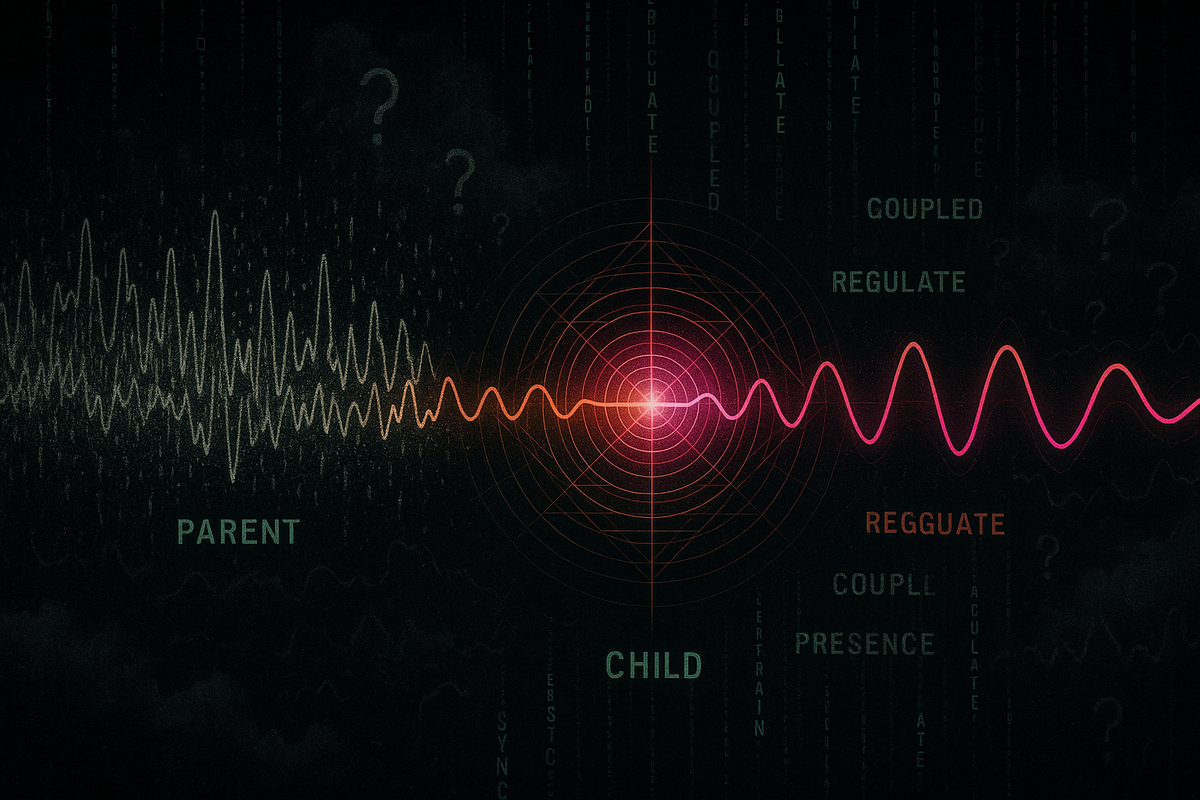
Physics has a concept called coupled oscillators. When two vibrating systems are connected, they tend to sync up—their rhythms entrain to each other.
Parent and child are coupled oscillators.
When a parent is regulated, calm, and present, the child's nervous system has something to entrain to. The parent's stability becomes a reference frequency that pulls the child toward regulation.
When a parent is dysregulated—anxious, reactive, chaotic—the child entrains to that instead. Or worse, they learn to disconnect entirely because the parent's nervous system isn't safe to couple with.
The parenting move isn't "fix the child's dysregulation." It's "offer a regulated system for them to couple with." You don't regulate them. You create conditions where regulation can emerge from the coupling.
What Co-Regulation Looks Like in Practice
It looks like staying calm when they're not.
Not fake calm. Not suppressed emotion. Genuine regulation—you've processed your own activation and you're present, not reactive.
When your kid comes home stressed about something you don't understand—some social dynamic on a platform you've never used, some anxiety about a future you can't see—the content doesn't matter. What matters is whether you're regulated enough to help them regulate.
It looks like being with them in uncertainty.
Not pretending you have answers. Not dismissing their concerns. Not rushing to fix it. Just... being present in the not-knowing.
"I don't know either. Let's figure this out together."
That sentence, delivered from a regulated nervous system, does more than any advice you could give.
It looks like tolerating their distress without catching it.
The parent's job isn't to make the distress go away. It's to demonstrate that distress can be tolerated without catastrophe. That big feelings can be felt without being destroyed by them.
When you stay regulated while they're dysregulated, you're showing them—in their body, not just their mind—that regulation is possible.
It looks like repair.
You won't always be regulated. You'll lose your shit sometimes. The skill isn't never dysregulating; it's coming back. Acknowledging the rupture. Reconnecting.
Repair teaches that relationships can survive conflict. That disconnection isn't permanent. That they're safe even when things get hard.
The Alternative: Disconnection
When parents can't co-regulate—because they're too dysregulated themselves, too checked out, or too anxious about the content—kids learn other strategies:
Self-isolation. Don't bring problems to the parent because they can't help and might make it worse.
Chronic self-regulation. Manage everything internally because external regulation isn't available.
Over-reliance on peers. Turn to friends who might also be dysregulated but at least are available.
Substance assistance. Find chemical ways to regulate because relational ways aren't accessible.
Dissociation. Just... leave. Go somewhere else mentally.
These aren't character flaws. They're adaptations to environments where co-regulation wasn't available. The kid learned to survive without it.
Building the Capacity
If this isn't your strength—and it isn't most people's, because most people weren't co-regulated well themselves—it can be developed.
Start with your own regulation. You can't offer what you don't have. If you're chronically dysregulated, that's the first thing to address. Therapy, somatic work, meditation, whatever helps you build a baseline of nervous system stability.
Practice presence without agenda. Be with your kid without trying to fix, teach, or improve them. Just be there. Notice what happens in your body. Notice what happens in theirs.
Slow down. Co-regulation requires time. If every interaction is rushed, there's no space for nervous systems to sync. Presence can't be microdosed.
Learn to recognize regulation and dysregulation. In yourself and in them. What does your body feel like when you're regulated? When you're activated? What does their activation look like?
Prioritize repair. You will fail. The question is what happens after. Get good at saying "I was dysregulated earlier. I'm sorry. Can we reconnect?"
The Reframe
When you don't know what to do—when the terrain is unfamiliar, when the problem is novel, when your expertise doesn't apply—you can still do something important.
You can be regulated.
You can offer your nervous system as a reference frequency.
You can stay connected while lost together.
This doesn't feel like enough. When your kid is struggling and you have no answers, being "calm and present" seems like failing to help.
But it is the help. Not the only help they'll need. But the foundation that makes everything else possible.
The content will change. The challenges will evolve. The skills they need will shift.
The need for a regulated nervous system to couple with? That's stable.
That's what transfers.
This is Part 9 of the Kids Are Alright series. Next: "Stop Optimizing for the Remembered World."