Blackjack: The Only Game Where Skill Actually Matters

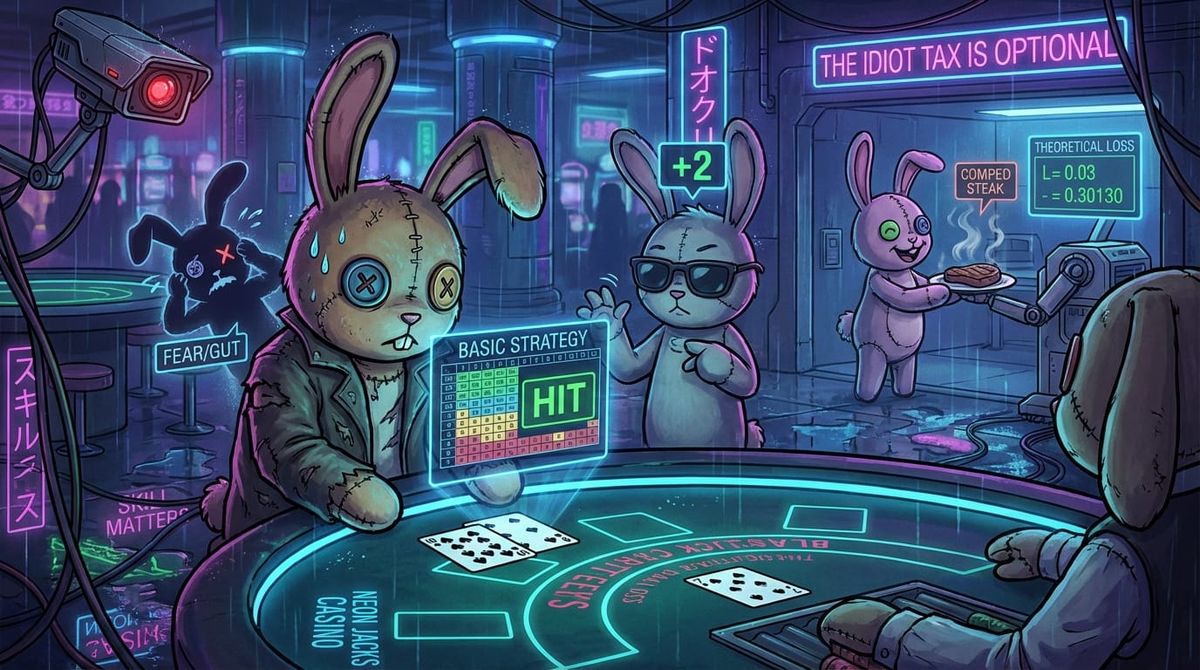
Somewhere around midnight in every casino in America, a man with a $15 bet and a 16 against a dealer’s 7 stares at his cards, takes a long breath, and waves his hand to stand. He feels good about the decision. He didn’t bust. He played it safe. He also just made the single most expensive mistake available in blackjack, a mistake the casino is counting on him to make; not occasionally but consistently, session after session, because human psychology and correct blackjack math point in opposite directions on this exact hand.
The average recreational blackjack player gives back somewhere between 2% and 4% of every dollar they wager. A player using basic strategy gives back about 0.5%. Over a four-hour session at $15 a hand with 80 hands per hour, that’s the difference between losing roughly $100 and losing roughly $24. Same table, same cards, same dealer, same cocktail waitress. The only variable is whether the player knows what to do and does it. Blackjack is the single game on the casino floor where your decisions materially change the price you pay to play, and almost nobody plays it correctly; not because the correct plays are secret, but because they feel wrong.
The Casino Is Pricing In Your Fear
Basic strategy is a complete set of mathematically optimal decisions for every possible combination of player hand and dealer upcard. It was first computed by Roger Baldwin, Wilbert Cantey, Herbert Maisel, and James McDermott in 1956, refined by Edward Thorp in Beat the Dealer in 1962, and has been verified by every computer simulation run in the six decades since. There is no debate about it. There is no room for personal style. For every hand, there is one correct play, and every other play costs money.
The logic underneath basic strategy is simpler than the strategy chart makes it look. The core assumption is this: any unseen card is more likely to be worth 10 than any other value. There are sixteen 10-value cards in a standard deck (tens, jacks, queens, kings) versus four of every other value. This means that whenever the dealer’s hole card is unknown, the mathematically sound assumption is that it’s a 10. Not that it’s always a 10. That it’s a 10 more often than anything else, and playing as though it’s a 10 produces the best results over time.
From that single assumption, most of basic strategy falls into place. Dealer shows a 7 or higher; assume they have 17 or more and play accordingly, which means hitting your own hand until you get there too or bust trying. Dealer shows a 6 or lower; assume they’re going to bust, which means you can stand on much weaker totals and let the math do the work. That’s the skeleton. The muscle and connective tissue involve knowing when to deviate; when a soft hand changes the calculation, when doubling or splitting turns a mediocre position into a profitable one. But the skeleton is just: what does the dealer probably have, and what does that mean for what I should do?
The man at midnight with 16 against a 7 waved his hand because busting felt worse than losing. This is textbook loss aversion; the phenomenon Daniel Kahneman and Amos Tversky documented in their prospect theory work, where the pain of a loss looms roughly twice as large as the pleasure of an equivalent gain. Hitting 16 means roughly a 62% chance of busting. That feels terrible. Standing on 16 against a dealer’s 7 means roughly a 74% chance of losing. That feels safer, because the bust is dramatic and immediate while the loss to the dealer’s made hand is slow and almost dignified. The player trades a 62% chance of immediate visible pain for a 74% chance of quiet, deferred pain, and walks away feeling like he made the conservative choice.
The casino loves this player. The casino has built its entire margin on this player. The house edge in blackjack comes almost entirely from the fact that the player has to act first; if both the player and dealer bust on the same hand, the player has already lost their money. Basic strategy reduces this edge to its mathematical floor. Every deviation from basic strategy gives the edge back. The casino is not pricing its blackjack tables on the assumption that players will play correctly. It’s pricing them on the documented, reliable fact that most players will follow their gut, and their gut is wrong about 15 to 20 critical decisions per hour.
Splitting and Doubling Are Where the Money Lives
Most players understand hitting and standing, at least roughly. Where basic strategy becomes genuinely counterintuitive; and where the real edge recovery happens; is in splitting pairs and doubling down.
Doubling down means putting up a second bet equal to your first and receiving exactly one more card. The math says to do this whenever the combination of your hand and the dealer’s upcard gives you a statistical advantage on the next card. When you have 11 and the dealer shows a 6, you are a favorite on the next card. Not a slight favorite; a significant one. The correct play is to double your money in the water, because the expected value of the doubled bet exceeds the expected value of just hitting. Most players double on 11. Fewer double on 10. Almost nobody doubles on soft hands like Ace-6 against a dealer’s 5 or 6, even though the math demands it; because doubling on what looks like a mediocre hand feels reckless. It is, in fact, the opposite of reckless. It is the precise application of math to an opportunity the table has given you.
Splitting pairs is where it gets truly uncomfortable. Always split aces and eights. Never split tens or fives. These are the easy ones, and most players get them right through cultural osmosis if nothing else. The hard ones are the pairs that feel wrong to split. Splitting eights against a dealer’s 10 looks like putting more money on the table when you’re already losing. Your 16 is terrible. But two separate hands starting with 8 are significantly less terrible, and the math says clearly that turning one bad hand into two mediocre hands reduces the overall loss. You are not trying to win when you split eights against a 10. You are trying to lose less. The player who doesn’t split keeps one hand with a roughly 77% chance of losing. The player who splits creates two hands that each have about a 55% chance of losing but with opportunities to double and improve along the way. The aggregate expected loss goes down. It just doesn’t feel that way, because you’re putting more chips on the felt.
This is the fundamental discomfort of basic strategy: the correct play frequently involves putting more money at risk, not less. Doubling and splitting increase your total wager on specific hands because those are the hands where the extra money has positive expected value. The player who never doubles and never splits plays “safe” blackjack and pays a premium for that safety in the form of an extra percent or two of house edge. Safety is expensive.
Card Counting Is Real, Overrated, and You Probably Won’t Do It
Card counting works. This is not disputed by anyone who understands the math, including the casinos, which is why they spend considerable resources detecting and removing counters. The basic concept is straightforward: when the remaining deck is rich in high cards (tens and aces), the player has an advantage; when it’s rich in low cards, the house advantage increases. A counter tracks this ratio and bets more when the deck favors the player, less when it doesn’t.
The practical reality is less cinematic than Rain Man or 21 might suggest. A card counter using the Hi-Lo system; the most common beginner system; assigns +1 to cards 2 through 6, 0 to cards 7 through 9, and -1 to 10-value cards and aces. They keep a running count, divide by the estimated number of remaining decks to get a “true count,” and adjust their bets accordingly. The edge a skilled counter gains is somewhere between 0.5% and 1.5%, depending on conditions. This means that over thousands of hands, a counter making $50 average bets might expect to earn $25 to $75 per hour. Before expenses. Before the emotional tax of sitting at a table for eight hours maintaining perfect concentration while pretending to be a casual tourist.
Casinos fight counting primarily through deck penetration (shuffling before the deck gets deep enough for the count to matter), automatic shuffling machines, and surveillance. A counter who gets caught doesn’t go to jail; counting is not illegal, because using your brain while playing a card game cannot be criminalized. But the casino is a private business, and it can and will ask you to leave or restrict you to flat betting, which eliminates the counter’s entire edge.
The reason to understand card counting is not to do it. The reason is to understand that the game is beatable in principle, which changes how you think about the casino’s relationship with the player. The casino has no problem with luck. It has a problem with knowledge. Its entire profit model depends on the player making suboptimal decisions, and a player who proves capable of making optimal decisions, consistently, is treated as a threat. That tells you something important about the nature of the game.
The Comp Angle Is the Smartest Play in the Casino
Here is the part that nobody talks about. Casinos rate players based on average bet size, hours played, and theoretical loss. The formula is simple: average bet times hands per hour times house edge times hours played equals your theoretical loss, and the casino returns a percentage of that theoretical loss in comps; free rooms, meals, show tickets, the whole hospitality apparatus.
The key word is theoretical. The casino rates you based on what you should lose, not what you actually lose. A player betting $25 per hand for four hours gets rated at roughly $100 in theoretical loss, assuming the casino uses its standard 2% house edge for average players. The casino might return 30% to 40% of that in comps; a $30 to $40 buffet credit, a discounted room, whatever the property offers.
But the basic strategy player is not losing at 2%. They’re losing at 0.5%. Their actual expected loss is $25, not $100. They’re getting $35 in comps against $25 in expected losses. The casino is, in effect, paying them $10 to play blackjack. Not through some loophole or scam; through the simple mathematical fact that the comp system is calibrated for the average player, and the basic strategy player is not average. They are dramatically better than average, and the comp system doesn’t adjust for it because adjusting would require tracking individual decision quality, which is expensive and impractical for the vast majority of players.
This is the cleanest arbitrage in the casino. Play correct basic strategy. Get rated. Accept the comps. The casino is subsidizing your entertainment because it has priced you as a worse player than you are. The gap between the theoretical loss they’re calculating and the actual loss you’re experiencing is free money; not at the table, but at the steakhouse.
The Idiot Tax Is Optional
The casino calls its edge “the price of the game.” Behavioral economists might call the gap between basic strategy and average play the idiot tax; the premium paid by players who follow their instincts instead of the math. The tax is not small. On a $15 table over a four-hour session, it’s roughly $75. Over a year of monthly casino visits, it’s nearly $1,000. Over a gambling lifetime, it’s the price of a decent car.
The thing about the idiot tax is that it’s entirely optional. Basic strategy is free. It’s printed on cards you can buy in the casino gift shop and use at the table; no casino will stop you, because almost nobody who buys the card actually follows it when the pressure’s on. The information is available. The math is settled. The only barrier between a 2% player and a 0.5% player is the willingness to do the thing that feels wrong when the cards say it’s right.
Hit 16 against a 7. Split those eights against the 10. Double on soft 17 against the dealer’s 6. It will feel wrong every single time. It will be right every single time. And the gap between feeling and rightness is where the casino makes its money; on every player who trusts their gut over the math, hand after hand after hand, midnight after midnight, forever.