What Would a Real Science of the Mind Look Like

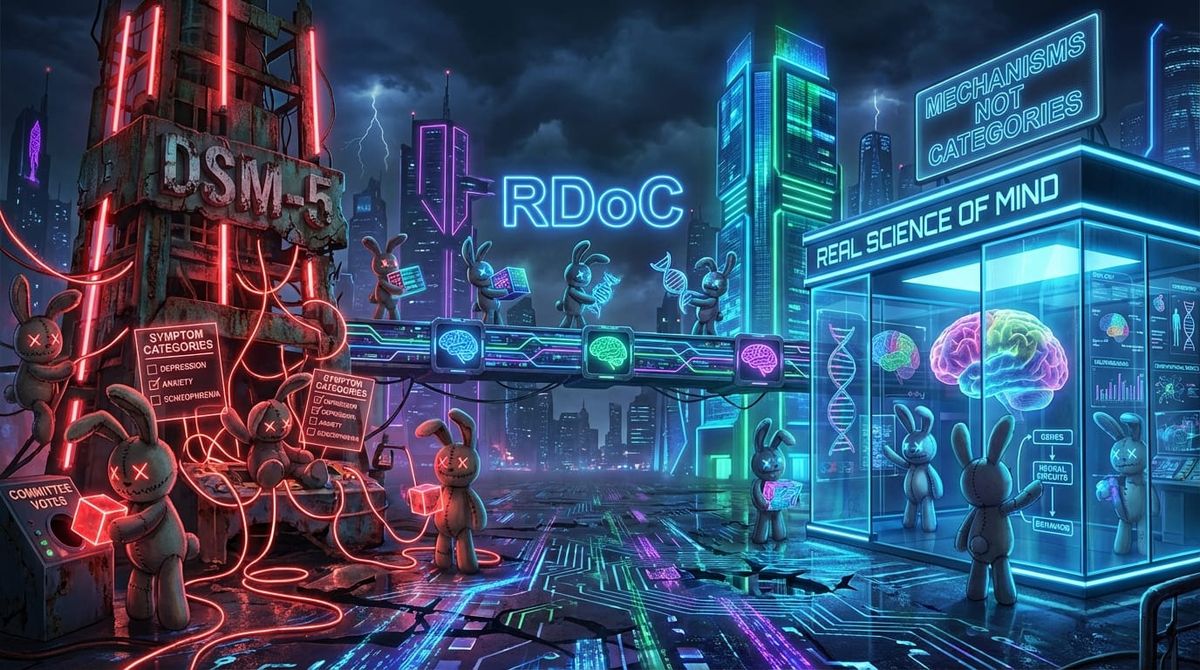
In 2013, two weeks before the American Psychiatric Association published DSM-5, the director of the National Institute of Mental Health did something extraordinary. Thomas Insel published a blog post announcing that the NIMH would be “re-orienting its research away from DSM categories.” The largest funder of mental health research in the world was, in effect, saying that the diagnostic system used by every clinician in America was not scientifically valid and that the NIMH would no longer organize its research around it.
The replacement was called the Research Domain Criteria, or RDoC. It has been running for over a decade now. It has not replaced the DSM in clinical practice. It has not yet produced the diagnostic revolution its architects envisioned. But it represents the most serious attempt in the history of psychiatry to build a science of mental suffering that starts with biology rather than committee votes, and understanding what it is trying to do; and where it is stuck; is essential for understanding what diagnosis might become.
The Problem RDoC Was Built to Solve
The DSM organizes mental disorders into categories: major depressive disorder, generalized anxiety disorder, bipolar disorder, schizophrenia. Each category is defined by a checklist of symptoms. Meet the threshold, get the diagnosis. The categories are treated as though they are distinct conditions, roughly analogous to distinct diseases in the rest of medicine.
The problem, which the field has known for decades and largely refused to confront in clinical practice, is that these categories do not carve nature at its joints. The evidence against them as natural kinds is overwhelming.
Comorbidity rates are absurdly high. A person diagnosed with major depression has a roughly 60% chance of also meeting criteria for an anxiety disorder. A person with ADHD has elevated rates of depression, anxiety, substance use disorders, and oppositional defiant disorder. If these were truly distinct diseases; the mental health equivalents of diabetes and pneumonia; they would co-occur at rates determined by their independent base rates. Instead, they cluster together in patterns that suggest the categories are drawing lines through a continuous space of dysfunction rather than identifying discrete entities.
The genetic evidence points in the same direction. Genome-wide association studies have found that the genetic variants associated with schizophrenia substantially overlap with those associated with bipolar disorder. Depression and anxiety share so much genetic architecture that some researchers have argued they are the same condition expressed differently depending on other variables. The biology does not respect the DSM’s category boundaries. Whatever is actually going wrong in the brains of people who suffer, it is not organized the way the manual says it is.
Treatment response tells the same story. SSRIs are prescribed for depression, but they also work for anxiety, OCD, PTSD, and some pain conditions. Antipsychotics are prescribed for schizophrenia, but they’re also used for bipolar mania, treatment-resistant depression, and irritability in autism. If the categories were distinct diseases, you would expect distinct treatments. Instead, the same drugs work across categories and different drugs work within the same category, suggesting that the categories are not tracking the biological mechanisms that the drugs are acting on.
RDoC was built to address this. Instead of starting with DSM categories and looking for their biological basis (a strategy that has failed for decades), RDoC starts with biological systems and asks how their dysfunction maps onto human suffering.
The Architecture of RDoC
RDoC is organized around domains of functioning rather than diagnostic categories. The original framework specified five domains: Negative Valence Systems (fear, anxiety, loss), Positive Valence Systems (reward, motivation, habit), Cognitive Systems (attention, perception, working memory), Systems for Social Processes (attachment, social communication, self-perception), and Arousal/Regulatory Systems (arousal, circadian rhythm, sleep-wakefulness). A sixth domain, Sensorimotor Systems, was added later.
Within each domain, RDoC specifies constructs; specific functions that can be studied at multiple levels of analysis. “Acute threat” is a construct within Negative Valence Systems. It can be studied at the level of genes (what genetic variants affect threat response?), molecules (what neurotransmitters are involved?), cells (what neural circuits fire?), physiology (what happens to heart rate and cortisol?), behavior (what do people do when threatened?), and self-report (what do they say they feel?).
The key move is that RDoC does not assume diagnostic categories. A researcher studying acute threat response does not start with “anxiety disorder patients versus healthy controls.” They study the threat response system across the full range of human variation, from people who show almost no threat reactivity to people who show extreme reactivity. The goal is to understand the dimension; the continuum of functioning; rather than to validate a category.
This is a genuinely different way of doing science. It means that a study of reward processing might include participants who carry diagnoses of depression, addiction, ADHD, and schizophrenia, because all of these conditions involve reward system dysfunction. In the DSM framework, these would be four separate studies of four separate disorders. In the RDoC framework, they are one study of one system, measured across people whose clinical presentations differ but whose underlying biology may share common features.
Where the Real Science Is Going
The RDoC framework has accelerated several lines of research that are producing genuinely new knowledge about how the brain generates suffering.
Polygenic risk scores represent one of the most concrete advances. Rather than looking for single “genes for depression” or “genes for schizophrenia” (which do not exist in any clinically useful form), researchers now calculate aggregate scores based on thousands of genetic variants, each contributing a tiny amount of risk. These scores can predict, at a population level, who is more likely to develop certain conditions. The prediction is statistical, not individual; a high polygenic risk score for schizophrenia does not mean you will develop schizophrenia, in the same way that a genetic predisposition toward height does not determine your exact height. But the scores are real, they are replicable, and they cut across DSM categories in ways that confirm the categories are not tracking biological reality. The polygenic risk score for schizophrenia also predicts bipolar disorder, creativity, and certain cognitive styles. The biology is not categorical. It is dimensional and pleiotropic; the same genetic variants influence multiple outcomes depending on the rest of the genome and the environment.
Neuroimaging has produced results that are real but less revolutionary than the headlines suggest. There are identifiable differences in brain structure and function between groups of people with psychiatric diagnoses and groups without them. But these are group-level statistical differences, not individual diagnostic markers. You cannot take a brain scan of an individual and diagnose depression in the way you can take an X-ray and diagnose a fracture. The overlap between “healthy” and “depressed” brain scans is enormous. The imaging findings are scientifically meaningful (they tell us something about what systems are involved) and clinically useless (they cannot be used to diagnose or treat individual patients).
Computational psychiatry is perhaps the most intellectually exciting frontier. It applies mathematical models of brain function; often drawn from Bayesian inference and predictive processing frameworks; to psychiatric symptoms. The idea is that many symptoms can be understood as failures of the brain’s predictive machinery. Hallucinations, in this framework, are not random sensory noise; they are the brain’s predictions overriding sensory input because the prediction system has been miscalibrated toward excessive certainty. Delusions are not irrational beliefs; they are the product of a belief-updating system that assigns too much weight to prior expectations and too little to new evidence. Depression, in some computational models, is a state where the brain’s predictions about future reward have been systematically biased downward, producing a learning system that has effectively given up on the possibility that actions will lead to positive outcomes.
These models are still being tested. They have not yet produced clinical applications that outperform existing treatments. But they represent a fundamentally different approach to understanding mental suffering; one that starts with mechanisms rather than categories, and that can potentially explain why the same biological dysfunction produces different symptoms in different people depending on what other systems are affected.
Where It’s Stuck
RDoC has been running for over a decade and has not produced a new diagnostic system. The gap between the research framework and clinical practice remains enormous.
The fundamental problem is that clinicians need categories. A therapist needs to know what they’re treating. An insurance company needs a billing code. A patient needs a name for what’s happening to them. RDoC explicitly refuses to provide categories because its architects recognized that premature categorization was exactly the mistake the DSM made. But “we’re studying dimensions of brain function and we’ll get back to you when we have something clinically useful” is not a workable message for the millions of people who need help now.
The research itself has been slower than hoped. Identifying the biological basis of mental suffering has turned out to be harder than mapping the genome; which itself turned out to be harder than the genome project’s architects predicted. The brain is the most complex object in the known universe. Its functioning depends on interactions between genes, neural circuits, hormones, gut microbiome, immune system, developmental history, current environment, and social context. Reducing this to clean dimensional measurements that predict clinical outcomes has proven extraordinarily difficult.
There is also a training problem. RDoC requires researchers to think across traditional diagnostic boundaries, which means training a generation of scientists who are comfortable with computational modeling, genomics, neuroimaging, and dimensional measurement simultaneously. The old model trained psychiatrists to recognize symptom patterns and match them to categories. The new model requires an entirely different skill set, and the pipeline for producing researchers with that skill set is still being built.
There is also a political problem. The DSM is controlled by the American Psychiatric Association. RDoC is funded by the NIMH. These are different institutions with different incentives. The APA has an enormous financial and institutional investment in the DSM. The manual generates direct revenue and, more importantly, provides the conceptual foundation for the entire profession. Abandoning it would require psychiatry to admit that its diagnostic system has been scientifically unsound for decades; a concession that has professional, legal, and financial implications the field is not prepared to absorb.
The Honest Picture
The honest picture is this: the science of mental suffering is in a transitional state that could last decades. The old categories are known to be flawed. The new framework has not yet produced anything that can replace them. Clinical practice continues to use the old categories because there is nothing else to use, and because the infrastructure of insurance, law, education, and social services is built around them.
This is not a comfortable position. It means that the diagnosis your psychiatrist gives you is based on a system that the field’s leading researchers have publicly acknowledged is not scientifically valid, and that the replacement system is still decades away from clinical application. It means the medication you’re prescribed was tested using those invalid categories, which means the clinical trials that demonstrated its efficacy were organized around groupings that do not correspond to biological reality.
None of this means the medication doesn’t help. Aspirin was used for a century before anyone understood its mechanism. Treatments can work even when the theory behind them is wrong. But the gap between the certainty of clinical practice (“you have major depressive disorder; this medication treats major depressive disorder”) and the uncertainty of the science (“major depressive disorder is not a coherent biological category and may represent several different conditions with different underlying mechanisms”) is real, and it matters. It matters because false certainty about what’s wrong leads to false certainty about what will fix it, and when the first medication doesn’t work, the system’s response is to try another medication within the same flawed categorical framework rather than to ask whether the category itself is pointing in the wrong direction.
The real science of the mind is being built. It is dimensional rather than categorical, biological rather than committee-driven, computational rather than checklist-based. It is also incomplete, expensive, slow, and decades away from transforming clinical practice. In the meantime, we are all living in the gap.