
The Wrestler (2008) — The One Where She Knows the Price of Everything

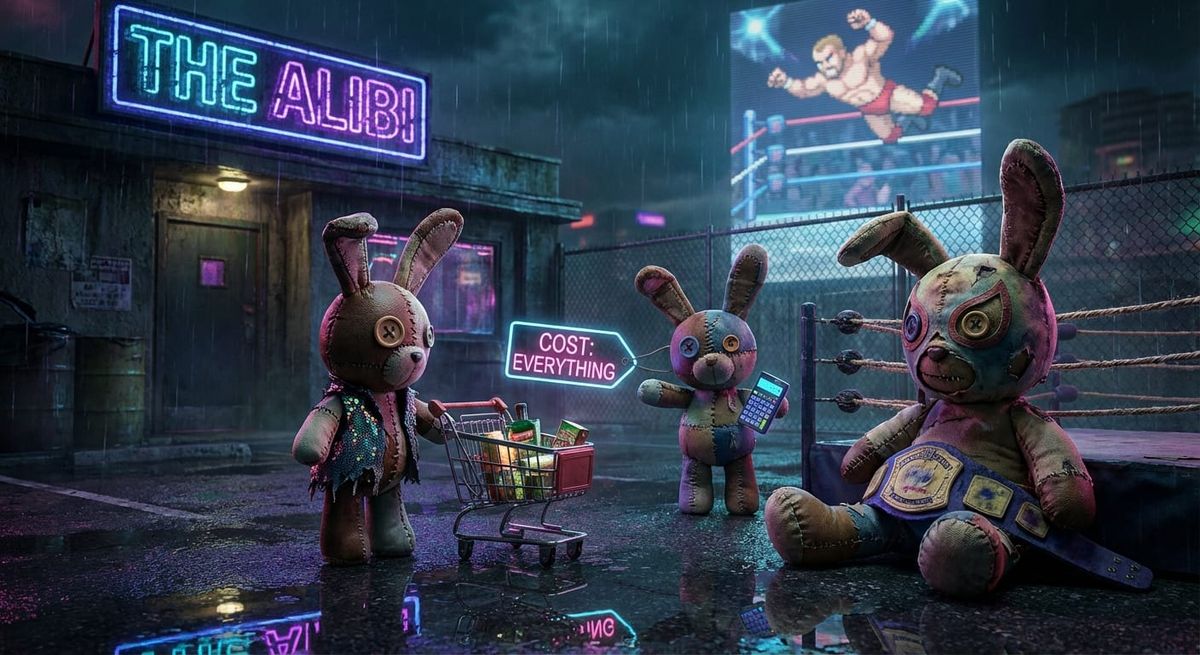
The critical conversation around The Wrestler has spent twenty years on Randy “The Ram” Robinson. His body, his decline, his grief, his final dive off the turnbuckle toward whatever comes next. Mickey Rourke gave a performance that people use words like “resurrection” for, and the resurrection narrative swallowed everything else in the film.
What got swallowed: Cassidy. Who she is, what she understands, and why her understanding is the structural center of the film’s argument, not a supporting element in someone else’s arc.
Cassidy is not Randy’s love interest. She is the film’s epistemological anchor. She is the only character who understands what’s happening, and she understands it because she’s been doing the same work in the same economy and she has been honest with herself about it in a way Randy has not been and, the film argues, cannot be.
Bodies as Economies
Every worker sells something. Most workers sell time; the abstraction, the agreeable fiction that what they’re giving away is hours rather than parts of themselves. This fiction is useful. It keeps the transaction clean. You can leave work at work if what you’re selling is hours.
Cassidy and Randy cannot use this fiction. What they sell is their bodies. Not metaphorically; literally, physically, the specific material of their flesh and face and movement and pain. A stripper sells the experience of her body in motion, her capacity to generate arousal, the particular theater of herself. A wrestler sells his body taking damage in a spectacle that is scripted in outcome but not in injury; the falls are real, the blades are real, the accumulated wreckage of bone and tendon and joint is real. Both of them step into an arena and give the audience their meat.
The difference between Cassidy and Randy is not what they sell. The difference is what they know about what they’re selling.
Cassidy knows exactly what she’s selling and what it costs. She has done the accounting. She knows the transaction: her youth, her body’s capacity to generate desire, her presence in that particular arena, in exchange for cash, on a timeline that runs until the body changes enough that the transaction no longer works. She has looked at this with clear eyes. She is not deceived. She has not mythologized her work or herself in relation to it. She keeps her kid fed. She has a name outside the club, Pam, and a life outside the transaction, and she maintains the boundary between them not as self-deception but as structural hygiene; a way of keeping the transaction from eating everything else.
Randy does not know what he’s selling. He thinks he’s selling performance. He thinks the crowd’s love is something he’s owed, something that comes from his talent and his commitment and the years he’s put in. He has not done the accounting Cassidy has done. He doesn’t know the price of what he’s given to the ring, and because he doesn’t know the price, he can’t calculate what he’s left with. He is operating on a model that stopped being accurate in 1988 and he is still trying to run the transaction that worked then, on a body that can no longer sustain it, in an economy that has moved on.
The Gap Is the Whole Film
That gap between what Cassidy knows and what Randy knows is the entire film. Not his redemption arc, not his relationship with his daughter, not the nostalgia for the ’80s; the gap. The structure of his blindness.
She tries to close the gap. That is what her scenes with Randy are. Not a love story developing through circumstance; an attempt to offer him the thing she has that he doesn’t, the clear-eyed accounting of what he is and what he has and what the transaction is costing him.
She offers him a real transaction. Not salvation; she’s not his therapist or his priest. A transaction. Her presence for his presence. No audience. No kayfabe. Just two damaged people trying to be actual with each other in a diner over lunch, outside the arenas where they have to perform, in a space where the body isn’t being sold to anyone.
The offer requires him to be a man, not a myth. It requires him to show up as Robbie, the person, rather than Randy The Ram, the character. And he cannot do it. Not because he doesn’t care about her; the film is clear that he does, in whatever way is available to him. He cannot do it because the transaction she’s offering requires a self that has been present enough to its own life to have something to offer another person outside of performance, and Robbie has been absent from his own life for thirty years. Randy The Ram went to the ring and Robbie stopped existing.
Grace in a G-String
The film’s working-class register is what makes Cassidy so specific and so important in Aronofsky’s larger cosmology of the divine feminine. Every other version of this figure in his work operates in registers that allow for easy mythologizing: an artist in Brooklyn, a Spanish queen, a ballerina, an unnamed mother who might literally be the earth. Cassidy is a stripper in New Jersey in the off-season. There is no elevation in the frame.
That’s the point. The grace she carries is not contingent on the setting or the costume or the symbolic weight the film assigns her. It’s intrinsic. She is the figure who sees clearly and tells the truth and offers what she has to offer without illusion, and she is doing it in a strip club with a dollar-store stage name while keeping her kid fed.
This is Aronofsky at his most democratic about what divinity looks like. It doesn’t arrive in cathedrals or in the bodies of beautiful, educated women in tasteful distress. It arrives in whoever is honest enough and intact enough to see what’s true, and offer it, without requiring that the offer be received.
Cassidy offers. Randy doesn’t take it. She’s not devastated. That’s the tell; the proof of her wholeness in comparison to his fracture. When he goes back to the ring, her face in the parking lot is not heartbreak. It is recognition. She has seen this transaction before. She has watched men choose the myth over the man more times than she can count, and she knew, probably, that this was where it was going. The offer had to be made. It always has to be made. Whether it’s taken is not her problem to solve.
She keeps her kid fed anyway.
The Final Match Isn’t a Death Wish
This is the most common misreading of the film’s ending: Randy goes back to the ring because he wants to die. A death wish dressed as professional obligation.
The reading is wrong, or at least insufficient. Randy goes back to the ring because the ring is the only place where Robbie stops not existing. The only place where there is a self present enough to feel real. The crowd’s noise fills the absence at the center of him in a way that Cassidy couldn’t, not because her offer was inadequate but because what she was offering was a self he no longer had access to.
It is not a death wish. It is a preference. He prefers the version of himself that exists in the ring to the version of himself that exists outside it. The ring version might be killing him; the evidence on this is overwhelming and he knows it. He is still choosing it because he has no compelling evidence that the outside-the-ring version is alive.
Cassidy knew this too. You can see it in how she made the offer: without expectation, without performance of hope, without the setup of someone who will be devastated when the answer is no. She made the offer the way you offer someone an exit you suspect they won’t take, because the offer matters regardless of the answer. The exit existed. She built it. He didn’t walk through it. She is not destroyed by this; she is confirmed in what she already understood.
The Transaction She Made With Herself
Before unpacking what Cassidy offers Randy, it’s worth understanding what she has already worked out for herself; because the clarity she carries in her scenes with him is not accidental, and it is not native. It’s the product of work she did before the film started.
Cassidy has made a transaction with herself. Not with the club, not with the audience, not with the economy she moves through; with herself. The transaction is this: she will use the arena, she will perform in it, she will take the money it generates, and she will maintain a clear line between what happens in the arena and what she is outside it. Pam, not Cassidy. A real name for a real person who exists when the performance is done. Her kid. The grocery run. The apartment that is not the stage set of who she is at work.
This transaction requires two things that Randy cannot manage: the capacity to name what you’re actually doing, and the discipline to not let the performance become the self. The discipline sounds simple; it is not. The performance arena offers something that most humans find difficult to refuse, which is an identity that is received rather than constructed. The crowd responds to Cassidy the way the crowd responds to Randy The Ram; with a defined expectation, an appetite for a specific thing, a warmth that is conditional on her being that thing. The warmth is real even if the condition is limiting. Stepping out of the performance means stepping out of that warmth.
Randy cannot step out. He has been The Ram for too long; Robbie stopped existing when the character became load-bearing. Cassidy steps out every night when she puts her clothes back on. The discipline to do this is not vanity or emotional detachment. It is the structural move that keeps her intact enough to offer Randy what she offers him: a real transaction, between two real people, outside the arena, without an audience.
She could not make that offer if she had done what Randy did. The offer requires a self that exists outside the performance. She has one. He doesn’t. That gap is the whole film.
What She Is in the Larger Liturgy
In the series Aronofsky has been writing across his career, Cassidy is the figure who makes the theology most legible: divine feminine at its most working-class is still divine. Grace without conditions. Mercy without illusions. The capacity to see clearly, offer truly, and not be destroyed when the offer is refused.
She is not Marion Silver. Marion had no floor; Cassidy has a very clear floor and she knows exactly where it is. She is not Izzi Creo; Izzi’s surrender was cosmic, Cassidy’s ground-level dignity is not surrender at all. She is the figure who shows that the divine feminine is not a spiritual category. It is a structural one. It shows up wherever a person is intact enough to see what’s true and honest enough to say it and grounded enough to survive the moment when the truth is not received.
The film is called The Wrestler. The wrestler is not the film’s moral center. The film’s moral center is the woman in the parking lot who watches him walk back toward the thing that’s killing him and does not collapse and does not chase and does not stop keeping her kid fed.
She understood the price. She told him what it was. He chose not to pay it. That is the whole story.
Marisa Tomei gives a performance in this film that the awards conversation never quite knew what to do with because the performance is doing something the vocabulary of awards discourse isn’t built to honor. It’s not a performance of suffering or of transformation or of revelation; it’s a performance of clarity. Sustained, unbroken, present-tense clarity. Cassidy is the same person at the end of the film that she is at the beginning. She doesn’t arc. She doesn’t change. She was already where she needed to be and she stays there. Playing a person who does not need to learn anything over the course of a film is harder than it looks; there is no dramatic event to hang the performance on, no before and after, no visible cracking open. There is only the continuous, precisely calibrated presence of a person who sees what’s true and doesn’t require anything to be otherwise.