The Fountain (2006) — The One Where She Teaches Him How to Die

The Fountain flopped because nobody was ready for it. The reviews complained about opacity, pretension, the inconvenience of a film that refused to explain itself in plot terms. What the reviews were actually describing was the discomfort of watching a film in which the woman has already solved the problem, has been trying to hand the solution to a man who cannot receive it, and the film’s entire emotional architecture is built around the gap between what she knows and what he refuses to learn.
Twenty years on, the film is still not entirely understood. Not because it’s difficult, but because what it’s saying is uncomfortable in a way that requires sitting with rather than resolving. Izzi Creo is dying. She has made peace with it. Tom Creo is not dying; he is trying to keep her alive, and the film is the story of a man who mistakes his refusal of death for love, and the woman who has to keep teaching him the difference.
The Most Complete Figure in His Work
Every feminine figure in Aronofsky’s filmography is doing something. Marion Silver is descending. Sara Goldfarb is holding on. Cassidy is transacting. Nina Sayers is dissolving. The unnamed mother in mother! is absorbing. Izzi Creo is something different, something that takes until the third act to fully arrive at: she is completing.
Completion, in the sense Izzi embodies it, is not the same as resignation or defeat. It is something closer to what a fruit does at the end of its season. The thing that was growing reaches its full form; the seed is ready; the tree lets go. Izzi has not stopped fighting for her life because she no longer values it. She has stopped fighting because she understands something about what life is that her husband has been unable to learn, namely that it does not end; it transforms, composting into the next version of itself, and the only difference between dying gracefully and dying badly is whether you trust the transformation or try to stop it.
Tom is trying to stop it. He is a neuroscientist literally trying to find a drug that will prevent death, working in a lab while his wife is dying in a hospital room, choosing the abstraction of a cure over the concrete reality of her presence. The film does not villainize him for this. It holds him with the same quality of compassion it gives Izzi. But it is precise about the cost: he is absent from the life he thinks he’s trying to save.
Finish It
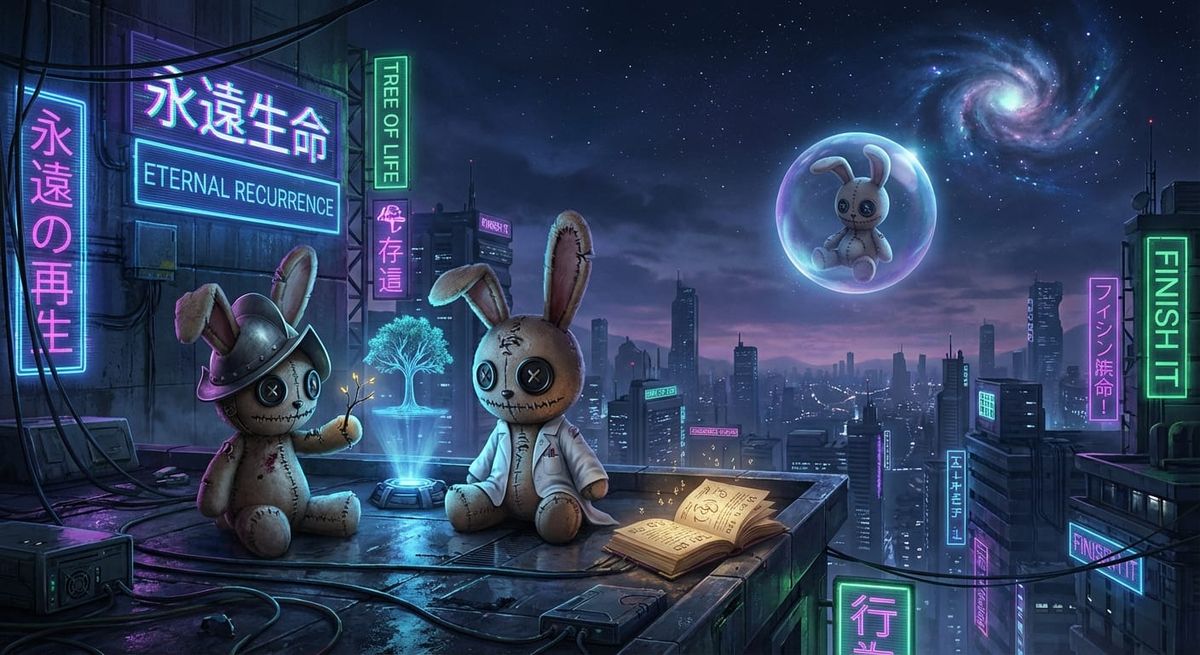
“Finish it,” Izzi says, handing Tom her manuscript. She’s been writing a story about a Spanish conquistador searching for the Tree of Life to save his queen; she’s finished all but the last chapter and she wants Tom to end it.
Not a request. A transmission.
She is giving him the thing he needs to complete his grief after she’s gone, the way you might leave someone a letter you know they won’t be ready to read until later. She knows he won’t finish it while she’s alive because while she’s alive he’ll keep trying to save her instead of sitting with her. She knows he’ll finish it afterward, when the saving is no longer possible and the story is the only place left where something can still be resolved. She is building him a container for his grief before she goes, because she loves him and she can see what he cannot see about what’s coming.
This is the fullness of what she is in the film. She is not passive. She is not a saint martyred for the masculine ego. She is a woman who is smarter than her situation’s outcome and who is spending the time she has left preparing the person she loves for the world without her. The manuscript is not a symbol of helplessness; it is an act of extraordinary competence. She’s already done the dying. She’s helping him with the surviving.
Three Timelines, One Woman
The film runs three timelines: a Spanish conquistador searching for the Tree of Life at the queen’s request; Tom in the present, a neuroscientist unable to save his wife; a future figure floating in a bubble through space toward a dying star with a tree, seeking the same thing.
In every timeline, the feminine figure is the same essential presence. The queen sends the conquistador on the quest but she already knows what he’ll find; she’s the one who’s read the book. Izzi in the present is dying but she’s the wisest person in the film. The tree in the future is Izzi’s body; when Tom finally lets go of his drive to stop death and allows himself to arrive at the nebula, he plants a seed from the tree above his own body and becomes part of the cycle she’s been describing all along.
She is the cycle. That’s the structural argument. Not that she’s wise or good or better than Tom, but that the feminine principle in this film is identified with the thing that persists through every iteration; the tree, the story, the nebula, the willingness to complete. The masculine principle is identified with the thing that disrupts the cycle: the refusal, the cutting open instead of the letting close, the conquest as a substitute for acceptance.
The distance between cutting open and letting close is the whole film.
The Hair
There is a motif in The Fountain that runs across all three of its timelines and across the larger Aronofsky cosmology, though it’s rarely discussed: the hair.
Izzi loses her hair to illness. The tree that contains her grows and flowers and eventually seeds. The nebula, the dying star toward which Tom floats in the future timeline, blooms in a sequence that is unmistakably, viscerally feminine; a blossoming that requires the dying first.
Aronofsky maps the feminine onto every system that grows by releasing. The hair falls so the tree can grow. The tree seeds so the nebula can bloom. The woman dies so the world can continue. This is not a punishment; it is a structural identification. Izzi is not being sacrificed. She is being recognized as the thing that the world is made of: the regenerative principle, the composting mechanism, the capacity to become the next version without losing what you were.
Tom finally sees this in the film’s last sequence, when he stops trying to arrive and allows himself to be absorbed. The masculine ego’s death is not a tragedy in the film; it is a joining. The ego was the only thing preventing him from entering what she’d been offering all along.
The Photographic Negative of Black Swan
The Fountain and Black Swan are in quiet conversation across Aronofsky’s body of work, and placing them against each other reveals the theological structure underneath both.
Izzi surrenders and becomes a tree. Nina surrenders and becomes a corpse.
The distinction is not arbitrary. Izzi surrenders toward life; toward the cycle, toward what comes next, toward the composting that feeds something. Her surrender is aimed at continuation. Nina surrenders toward the image of life; toward perfection, toward the ideal version of the role she’s been assigned, toward the version of herself that exists only in the mirror and the gaze of the audience and her mother’s architecture of control. Nina’s surrender is aimed at stasis. The perfect performance. The held pose. The final swan dive into a tableau that cannot change because it is finished.
Both women are inside something that consumes them. The difference is what’s on the other side of the consumption. For Izzi, something grows. For Nina, nothing grows; she completes, and completion in her story is another word for death without seeds.
This is Aronofsky working at the level of theology, not psychology. He’s not asking which woman made better choices. He’s asking what kind of surrender leads to life and what kind leads to the perfection of death. The answer in both films is the same: the direction of the surrender determines the destination. And the direction is set by who or what the woman has been organized around serving.
Izzi is organized around the cycle itself. She serves the truth of what is. Nina is organized around the image. She serves a projected ideal. The tree and the corpse are the logical outcomes of those two orientations.
Why It Failed and Why That’s Instructive
The film’s commercial failure in 2006 is worth sitting with because the reason for the failure is the same reason the film works as theology.
American audiences in 2006 were not, broadly speaking, prepared for a film in which the woman is already right and the film’s entire dramatic engine is the story of a man slowly arriving at the thing she’s been saying all along. The dramatic grammar of Hollywood love stories runs in a specific direction: man pursues woman, woman is the object of the pursuit, the arrival at union is the resolution. The Fountain runs the grammar differently. Izzi is not pursued; she is the one who has already arrived. She is not the reward at the end of the journey; she is the person who gave Tom the map. The journey is his; the wisdom was always hers.
This inverted grammar felt confusing to viewers who expected the conventional structure, and “confusing” in the reviews became “pretentious” or “obtuse,” the critical language for a film that refused to operate on expected terms. What the critical conversation couldn’t quite name was that the discomfort wasn’t structural difficulty; it was the discomfort of watching feminine authority depicted as the source rather than the object of the story’s meaning. The film isn’t hard. It’s just not telling the story from the position audiences were trained to expect.
Twenty years of distance makes this clearer. The Fountain was not ahead of its time in the shallow sense of predicting what would become fashionable. It was ahead of its time in the precise sense that the culture hadn’t yet developed the vocabulary to name what it was looking at when it saw Izzi. The vocabulary is here now. This is it.
What the Film Was Trying to Tell You
The Fountain was marketed as a love story. It is that, but only in the same way that a seed packet is a love story; technically accurate, catastrophically underselling what happens when you plant the thing.
It is a film about the most practical version of love: the kind that prepares the beloved for life after the lover is gone. Izzi is not sacrificial. She is not noble in the way films usually frame female nobility, which is to say passively, quietly, beautifully dying for someone else’s arc. She is active to the last. The manuscript. The way she leads him to the tree. The patience with which she keeps trying to show him the thing he cannot yet see.
Her gift to Tom is not her death. Her gift is the years she spent trying to teach him that death is not the enemy. The enemy is the refusal. The enemy is the man who mistakes his inability to accept loss for his capacity to love.
He gets there. The film earns its ending not through sentiment but through Tom finally arriving at what she’s been pointing at from the first scene: the tree is not a tragedy. The seed is not a loss. She is still here. She was always the tree.
The obsessive psycho who keeps rewatching this film at 2 AM is not watching it because they find it comforting. They’re watching it because something in it keeps pointing at something true they haven’t found the words for yet. These are the words. She taught him how to die. He finally learned. That’s not a tragedy. That’s a love story, the full version, the one that takes three timelines and a dying star to complete.