The House Always Wins (And That's Fine) — Understanding Expected Value Before You Bet a Dollar

A couple sits down at a roulette table in the Bellagio with $500. They’re celebrating an anniversary. She picks 17 because it was their wedding date; he puts $50 on black because he saw it in a movie once. The wheel spins. The ball bounces. They lose $100 in twelve minutes and don’t understand what happened, because nothing happened. The machine did exactly what the machine does. They just didn’t know what the machine does.
Most people walk into a casino running on what can only be called magical thinking. Not religious magical thinking; something more insidious, because it wears the costume of rationality. They know, on some level, that the house has an edge. They’ve heard the phrase. But they believe, also on some level, that the edge applies to other people. To the degenerate at the slot machine feeding twenties into a screen at 2 AM. To the guy who doesn’t know when to walk away. Not to them. They’re smart. They have a system. They have a feeling about tonight.
That belief; that you are somehow exempt from mathematics; is the most expensive cognitive error in the casino. Everything else follows from it.
The Subscription Model Nobody Talks About
Expected value is the concept that reframes everything. It’s not complicated, but the casino industry spends billions making sure you never think about it clearly.
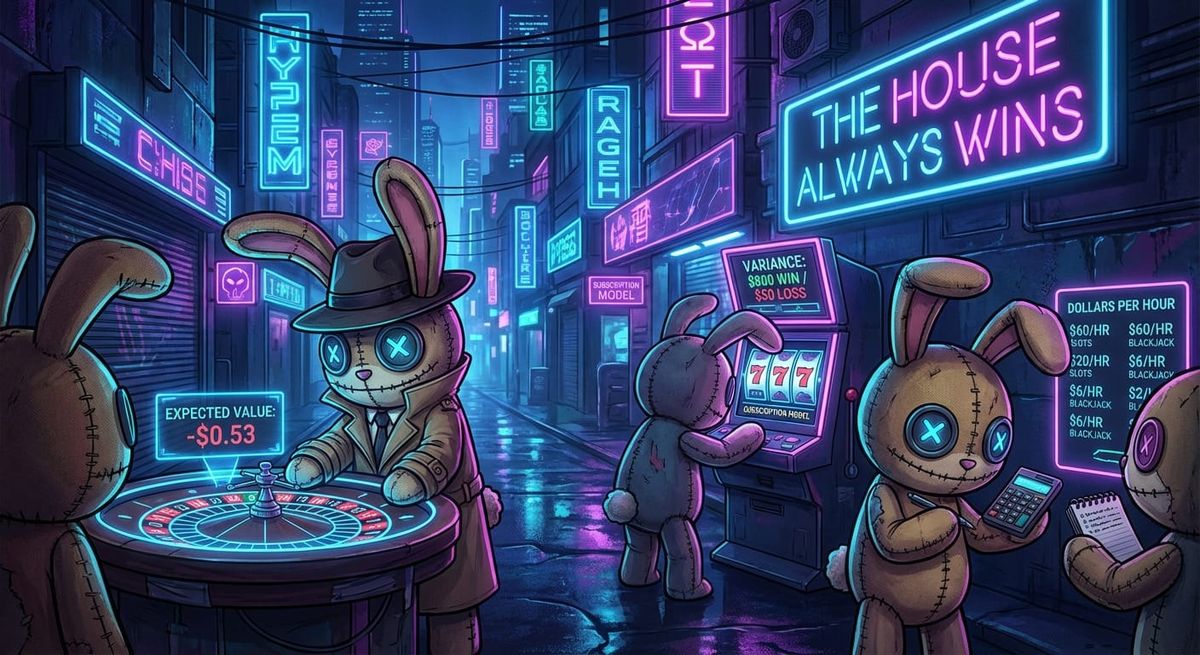
Take a standard American roulette wheel. Thirty-eight slots: eighteen red, eighteen black, two green. You bet $10 on red. If red hits, you win $10. If anything else hits, you lose $10. The probability of red is 18/38, which is 47.37%. The probability of not-red is 20/38, which is 52.63%. Your expected value on that bet is (0.4737 x $10) minus (0.5263 x $10), which comes out to negative $0.53.
That’s it. That’s the whole thing. Every time you put $10 on red, you are paying fifty-three cents for the experience. Not on average in some abstract statistical sense; that is the price of the bet, as fixed and real as the price of the drink the waitress just brought you. The fact that any individual spin might pay you $10 or cost you $10 is irrelevant to the economics. Over any meaningful number of spins, you will pay fifty-three cents per bet. The casino knows this. The casino’s entire business model is built on this. You are the only one at the table who doesn’t know the price of what you’re buying.
Now frame it differently. You’re at the roulette table for two hours. You’re betting $10 per spin, and the wheel spins roughly 35 times per hour. That’s 70 spins, 70 bets, $0.53 per bet. Your evening of roulette costs approximately $37. That’s the price. Not the amount you might lose; the expected cost of the entertainment, as predictable as a movie ticket.
This is the subscription model. You are not “trying to win money at roulette.” You are purchasing two hours of roulette entertainment for $37. The flashing lights, the social energy, the dopamine spike when the ball lands on your number; that’s the product. Thirty-seven dollars is the price. The question is whether that product is worth that price to you, and that question is no different from deciding whether a concert ticket or a dinner out is worth the sticker.
Once you see the casino this way, the whole experience changes. You stop asking “am I going to win tonight?” and start asking “what am I paying per hour, and is the entertainment worth it?” The first question has no useful answer. The second has a precise one.
Variance Is Not Edge (And This Confusion Keeps the Lights On)
The reason magical thinking survives contact with reality is variance. Variance is the short-term noise around the long-term signal, and it is the casino’s best friend.
Your friend goes to Vegas and comes back up $800 at blackjack. He tells you about it at brunch. What he’s describing is variance; a short-term deviation from expected value. Over 200 hands of blackjack at a 0.5% house edge, he should have lost roughly $50. Instead he won $800. This happens. It happens constantly. It’s supposed to happen, because the distribution of outcomes around the expected value is wide enough that any single session can land almost anywhere.
But your friend doesn’t describe it as variance. He describes it as winning. He might describe it as skill. He might describe it as the hot streak he caught at 1 AM when he moved to the $25 table. He has constructed a narrative around what was, mathematically, a random fluctuation. And that narrative will bring him back to the casino; because if skill or instinct or table selection produced the $800, then surely those same tools can produce it again.
The casino is not worried about your friend’s $800. The casino is thrilled about your friend’s $800. Because your friend just became a walking advertisement for the mathematically impossible proposition that you can beat the house through feel. He will come back. He will bring friends. Over time, the edge will do what the edge does, and the $800 will flow back across the felt plus interest. The casino’s entire marketing budget is outperformed by the simple fact that variance creates winners, and winners tell stories.
Richard Thaler, the behavioral economist, calls this the “house money effect.” Once people are up, they treat their winnings as somehow different from their own money; as the house’s money, free money, money they can afford to lose. This is why the casino gives you chips instead of cash. This is why the ATM is far from the exit and close to the floor. Every design decision in the building is calibrated to keep you from doing the one thing that would threaten the business model: clear-eyed arithmetic about what you’re actually spending.
The confusion between variance and edge is so profitable that the casino actively cultivates it. The big winner board in the lobby. The jackpot sirens on the slot floor. The comp upgrades for the guy who hit a heater at the craps table last weekend. None of this is celebrating the player’s skill. It’s celebrating the variance that will bring the player back, along with their friends, their optimism, and their wallets. The casino doesn’t need to lie about the odds. It just needs variance to tell stories on its behalf; and variance is an extremely reliable storyteller, because every session that deviates from expected value in the player’s favor becomes a memory, and every session that deviates against them becomes a lesson about “next time.”
The gambler’s fallacy lives here too. The roulette wheel has hit black eight times in a row, so red is “due.” This feels intuitively correct and is mathematically meaningless. The wheel has no memory. Each spin is independent. The probability of red on the ninth spin is exactly 47.37%, identical to every other spin, regardless of what came before. But the human brain is a pattern-matching engine, and it screams that eight blacks in a row is a pattern that must correct. Casinos know this. Some of them post the last twenty results on an electronic board next to the wheel; not as a service to the player, but as a trap. The board is there to activate the pattern-matching instinct that the math makes irrelevant.
The Dollars-Per-Hour Framework
Different games cost different amounts per hour. This is the single most useful piece of information a casino visitor can have, and almost nobody has it.
A slot machine with a 10% house edge, played at $1 per spin with 600 spins per hour, costs $60 per hour. A roulette wheel at $10 per spin with 35 spins per hour and a 5.26% edge costs about $18.50 per hour. A blackjack table played with basic strategy at a $15 minimum with 80 hands per hour and a 0.5% edge costs $6 per hour. A craps player on the pass line with full odds at a $10 base bet might be paying $2 to $3 per hour.
Read those numbers again. The difference between the worst seat in the casino and the best is a factor of twenty or more. The slot machine costs twenty times what the craps table costs. Both of them feel like “gambling.” Both of them are available on the same floor, ten feet apart. One is a reasonable entertainment expense. The other is an extraction machine operating at a rate that would make a payday lender blush.
The casino does not advertise these numbers. The casino puts the slot machines at the entrance and the craps tables in the back. The casino makes craps look complicated and intimidating and slots look welcoming and simple. This is not an accident. Every dollar you spend at a slot machine instead of a craps table is a dollar the casino gets to keep a larger percentage of. The layout of the building is a map of the house edge, and the games they want you to play are the ones that cost you the most.
What The Smart Player Actually Does
The smart player does not have a system. The smart player does not have a lucky table. The smart player has a budget and a calculator and a clear understanding that tonight’s session is an entertainment expense, not an investment.
The framework looks like this. Before you walk through the door, you know your hourly entertainment budget. You know which games fit inside that budget and which ones blow through it. You pick the games where your decisions actually matter; blackjack, craps, poker; not because they’re more exciting, but because they’re cheaper per hour and your choices affect the price. You play basic strategy. You take the odds bets. You don’t chase losses, because chasing losses is just paying more for the same entertainment.
You set a loss limit that corresponds to a specific number of hours at a specific game. If the limit is $100 and you’re playing $15 blackjack with basic strategy, that’s roughly sixteen hours of expected play. If you hit the limit in two hours, that’s variance; you ran cold. It doesn’t mean the strategy is wrong or the table is rigged. It means the distribution did what distributions do. You leave, the same way you’d leave a restaurant when you’ve eaten the meal you ordered. The meal being bad doesn’t mean you should order another one.
And when the session is over, you leave. Not because you’ve hit some mystical number. Not because you’re up or down a specific amount. Because the entertainment you budgeted for is complete, the same way you leave a concert when the last song ends.
The casino is designed to make this feel impossible. The absence of clocks, the free drinks, the absence of windows, the near-miss architecture of the slot machines; all of it is engineered to keep you in a state where the dollars-per-hour calculation never occurs to you. Knowing the design doesn’t make you immune to it. But it does make you harder to exploit. And in a building designed from the carpet pattern up to exploit you, harder is worth a lot.
The Rest of This Series Is a Price Sheet
What follows in the remaining articles is specific. Game by game, bet by bet, dollar by dollar. Blackjack and why your decisions actually change the math. Craps and why the most intimidating table has the best odds. Poker and why it’s the only game where you’re not playing against the house at all. Slots and why the math is so bad that the industry needs regulation to keep it from being classified as fraud. Sports betting and the new frontier of extraction. Bankroll management and the Kelly Criterion. The psychology of loss-chasing and tilt and why the same brain that can do calculus will throw good money after bad at 3 AM.
None of it requires you to stop gambling. All of it requires you to know what you’re paying. The difference between a sucker and a smart player is not luck or willpower or some mystical sense of when to walk away. It’s information. The sucker doesn’t know the price. The smart player does. Everything else follows from that.