Wolverine's Entire Arc Is What Happens When You Can't Form a Continuous Self

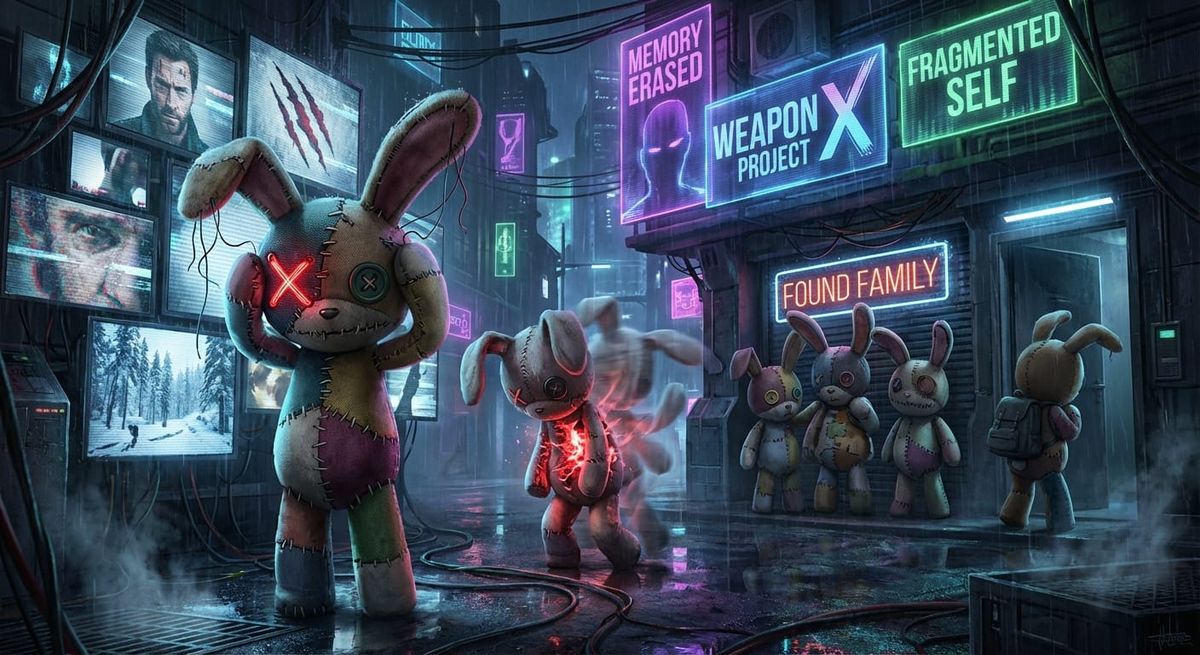
Logan doesn’t know how old he is. He knows it’s a lot. He has fragmentary evidence; a face in an old photograph, a name carved into a tree, a scar that should be there and isn’t. What he does not have is the thing that most people build their identity out of: a coherent narrative that runs from past to present, with enough continuity that you can say here is where I came from, here is what I’ve been through, here is who that made me. His history has been taken from him, repeatedly, by external forces and by his own biology. The adamantium in his skull is the most literal version of this: his skeleton was rewritten to suit someone else’s purposes, and the man who went into that tank did not fully survive the procedure.
The amnesia is not a plot device Wolverine has. It is what Wolverine is. Everything else follows from it.
The Healing Factor as the Cruelest Part
The healing factor is consistently read as a superpower, and it is, in the obvious sense. He survives things that would kill anyone else. The bones knit. The tissue regenerates. He walks away from fights that would leave other people in the ground.
What the healing factor also does is erase the evidence. Scars are memory. They are the body’s record of what it has been through. When you survive something, the mark it leaves is a form of proof; to yourself and to others; that the thing happened, that it was real, that you were there for it. Logan survives everything and carries none of the marks. His body resets. The physical record of his history is continuously deleted by the same process that keeps him alive.
This is not metaphorical. It is structural. He cannot accumulate the kind of embodied history that other people take for granted. His body is not an archive; it is a constantly clearing whiteboard. The immortality that looks like invulnerability is, underneath, a form of perpetual erasure. He cannot prove his history to himself. He cannot even use the standard shorthand of an aging body; the ache in the knee from an old injury, the way a scar tightens in cold weather; to locate himself in time.
His past, then, is always provisional. He has to take someone else’s word for it. The Weapon X facility gave him a history, but it was one they designed for operational purposes. Xavier gives him context but also has his own institutional interests. What Logan actually experienced, before the amnesia, before Weapon X, is a reconstruction at best and a fiction at worst. He lives in a permanent epistemic condition of not being able to trust his own account of himself.
The Berserker as Dissociation
The berserker state has been read as rage, as the animal breaking through the civilized surface, as the id overwhelming the ego. These readings are not wrong but they are incomplete. The berserker is more precisely a dissociation event: a moment where the continuous self is no longer available and the body runs on pattern.
Dissociation happens when threat exceeds the regulatory capacity of the conscious self. The conscious mind; the one that evaluates, that maintains narrative, that situates the present moment inside a history; goes offline. What’s left is something older and more automatic: the pattern response, the survival program, the thing that doesn’t need a coherent self to function. For most people, dissociation looks like going somewhere else in your head during a hard conversation, or driving a familiar route and not remembering the last ten minutes. For someone whose continuous self is already fragile, already dependent on fragmentary evidence and other people’s accounts, the threshold for dissociation is lower, and the fall when it happens is further.
The berserker is Logan’s body operating without Logan. It is effective; it keeps him alive; it does what it was designed to do. And then it stops, and he has to reconstruct what happened from the outside, from the bodies and the blood and the expressions on people’s faces. This is not a power. This is a man whose regulatory system fails under pressure in ways that frighten him and everyone around him, and whose only option when it happens is to wait it out.
The Found Family Compulsion
Logan’s relationship to groups is a pattern that is almost painfully consistent across decades of comics, films, and iterations: he encounters a group or a person, resists attachment fiercely, forms an intense bond anyway, and then either leaves before the relationship can be damaged or stays until something destroys it. The X-Men. The Alpha Flight people. Mariko. Itsu. Jubilee in various configurations. He gravitates toward belonging. He cannot maintain it.
The found family compulsion makes sense as an attachment pattern for someone who cannot build a continuous self. If you cannot locate yourself in your own history, you need external anchors. Other people who know you; who can say you were here, you did this, I remember; function as the external narrative continuity that your own memory can’t provide. The group is, among other things, a record-keeping function. Being known by other people is a substitute for being able to know yourself.
The problem is that the same wiring that drives the compulsion also sabotages it. When you have been through enough cycles of attachment and loss and betrayal; and Logan has been through enough cycles that he has lost count of them, literally, because he cannot remember them all; your attachment system calibrates accordingly. You develop what amounts to a preemptive exit: you leave before you can be left, or you create conditions that make departure feel inevitable, because the alternative is staying and being betrayed, and the body knows that betrayal is coming because the body has learned that betrayal is always coming. The hypervigilance that keeps Logan alive in combat becomes, in close relationships, a hair trigger for threat detection. He reads abandonment signals in neutral behavior. He pulls away from warmth because warmth has historically preceded loss.
His relationship to Mariko Yashida is the clearest example of the exit mechanism in action. He loves her genuinely, proposes to her, gets as close to a settled life as he is capable of imagining; and then the wedding is called off, circumstances intervene, the relationship stretches and strains and eventually Mariko is poisoned and dies. Wolverine mercy-kills her. He is the last thing she experiences. This pattern is not coincidence: the people Logan gets closest to tend to die, and he tends to be present for it. The attachment and the loss are structurally linked, which his nervous system records accurately, and which makes the next attachment harder to sustain at full intensity. He learns, at the somatic level, that closeness has a cost. He pursues it anyway because the alternative is worse. He pursues it with one foot already out the door because the part of him that is still a survival machine will not let him fully commit to something it has learned to expect to lose.
What Logan Wants in Every Arc
Strip every Wolverine story down to the thing driving it and you find the same thing: he wants to stop moving, to belong somewhere, to be known. Not famous. Not feared. Known, in the specific way that requires someone to have been paying attention to you over time, to have accumulated enough of you that they can anticipate you, argue with you, call you on your bullshit from a place of real familiarity.
Jean Grey is the recurring figure in this context, and the recurring figure is always out of reach. Jean sees him. She is a telepath; she gets past the performance, past the controlled exterior, past the hypervigilance to whatever is actually happening inside him. She does not appear to be frightened by what she finds. This is, for Logan, the rarest possible experience: to be perceived clearly and not rejected. The fact that she is with Scott, that she chooses Scott, is less important in the arc than the fact that she sees him. He loves her partly because loving her is an experience of being seen that he cannot find elsewhere.
The fact that he cannot stay; that he consistently removes himself from the situation rather than pursuing it; is the wiring in action. The attachment system reads the situation correctly: this is the person who sees me, this is what I want, and therefore this is the place where I am most vulnerable to loss. The body calculates: if you stay, you will lose her eventually, and that will be worse than leaving now. The man whose continuous self is already fragile does not take risks with the few things that feel like anchor points. He leaves instead. He goes somewhere else. He lets the thing he wants recede into the category of things he is protecting himself from wanting.
The Weight of Unrecorded History
There is a particular cruelty in Logan’s situation that distinguishes it from ordinary trauma or ordinary grief. When people lose their history to illness, or injury, or the ordinary attrition of time, there is usually a residue: documents, photographs, other people who remember. There is a version of you in the world that persists in external records even when internal access fails.
Logan’s history has been actively curated by institutions that did not have his interests in mind. Weapon X didn’t just take his memory; they built a replacement that suited their operational needs. The HYDRA and government affiliations across his timeline have repeatedly edited the record. The people who might have corroborated his history are either dead; often at his hands, in the berserker state, in ways he cannot fully account for; or compromised sources. The version of Logan that exists in the world’s external record is a construction. It may not bear much resemblance to the thing he actually is.
The House of M storyline gives him the entire suppressed history back at once; every memory, every death, every relationship, the full uncut version of his own life. The gift turns out to be devastating. Having access to all of it simultaneously, without the gradual processing that normal memory accumulation allows, doesn’t make him more whole. It makes him more desperate. He now knows what happened and cannot undo any of it. The memories are there but the relationships they encode are gone. He can remember Itsu clearly; she is still dead. The knowledge doesn’t build an identity. It itemizes a loss. This is the test case for the assumption that recovering suppressed history heals: Logan recovers his history and becomes, if anything, more driven to violence, more fixated on closure that cannot come. Memory without ongoing relationship is not self. It is inventory.
This is why the question of what Logan actually wants is so hard to answer even for him. You build your desires, your preferences, your sense of what you’re oriented toward, out of the accumulated record of what has mattered to you. When that record is fragmented, partial, and partially fictional, your desire itself becomes unreliable. He wants to belong somewhere: he knows this because the pull toward groups is undeniable, because Jean makes him feel something he can identify as important even when he can’t fully explain why. But the specific content of what belonging would look like, what it would feel like to have arrived, to stop moving: that he cannot access. He is trying to navigate toward a destination he cannot fully picture using a map with most of the landmarks removed.
The rage that everyone reads as the defining feature of Wolverine is the surface. Underneath it is a man trying to hold himself together without the materials most people take for granted. He is not the berserker. The berserker is what happens when the man fails to hold. The distinction matters because the man is worth understanding, and the berserker is just what the body does when understanding isn’t available anymore.