
The Most Beloved Mutant Leader Is a Predator and a Stooge

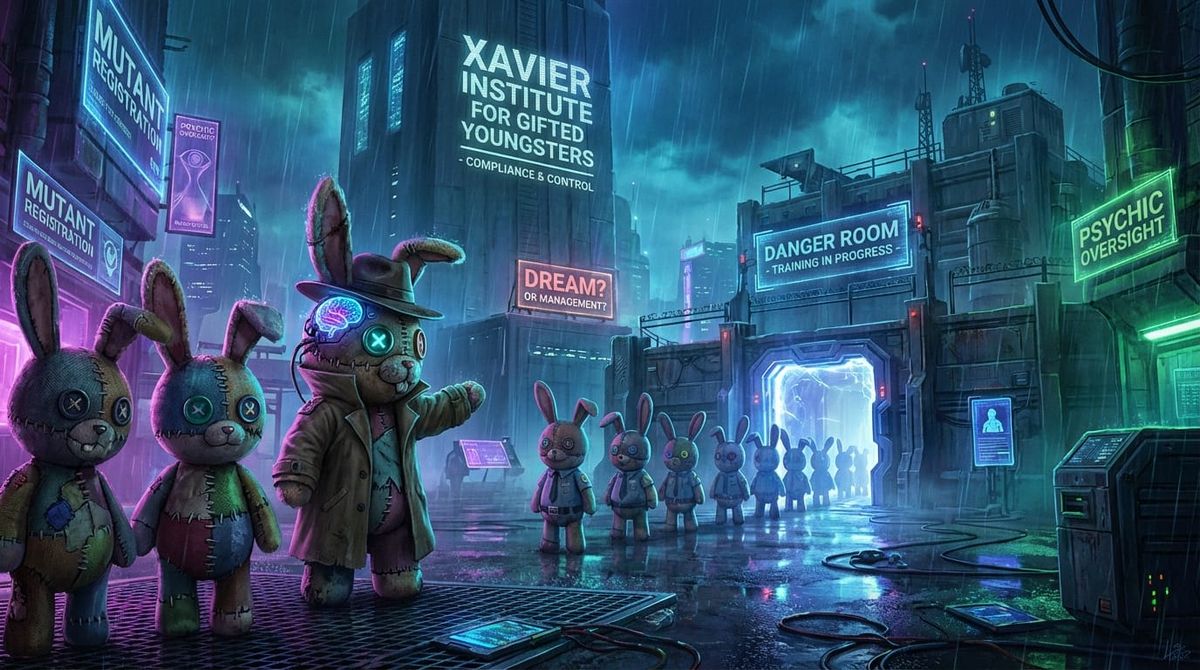
Charles Xavier is celebrated for two things: his compassion and his dream. The compassion manifests as taking in damaged children and giving them a home. The dream is human-mutant coexistence, a future where difference is tolerated instead of exterminated. Both of these things are real. They are also cover for a pattern that, examined without the reverence the narrative usually insists on, looks like something considerably darker.
Xavier does not liberate mutants. He manages them. His entire project, from the first class through Krakoa, is devoted to proving to baseline humans that mutants can be controlled: that their power is contained, directed, supervised, and ultimately harmless to the social order. The dream is not mutant freedom. It is mutant acceptability. These are not the same thing, and Xavier has never been willing to examine the gap between them.
Telepathy Is Not a Neutral Power Set
Before his character, before his school, before his dream; the power. Xavier reads minds. He hears thoughts without asking. He can enter your memories, reshape your feelings, locate you anywhere on the planet, and install ideas in your head that you will believe are your own. He can make you forget. He can make you feel whatever he needs you to feel.
This is a structurally non-consensual power set. You cannot opt out of being known by Xavier if he decides to know you. You cannot lock a door against him. The cognitive privacy that most people take as baseline; the assumption that your thoughts are yours until you choose to share them; does not exist in Xavier’s presence unless he chooses to grant it. He can revoke that grant at any time.
The narrative treats this as weight Xavier bears. He is burdened by the noise of other minds; he must discipline himself not to intrude; he maintains ethical boundaries through force of will. This framing positions Xavier as the victim of his own power rather than the wielder of it. But notice who benefits from that framing. If Xavier is suffering under the burden of involuntary telepathy, then every instance of him reading someone’s mind is an accident of neurology rather than a choice. The intrusions become sympathetic. The violations become forgivable. The power that lets him know everything about everyone around him without their knowledge or consent gets recast as his affliction.
He built Cerebro to extend that power globally. Not defensively; the original intent is surveillance: find every mutant on the planet, know where they are, track them. Cerebro is a global location and profiling apparatus for a population that has not consented to being located or profiled. Xavier built it for the X-Men, but the technology itself is value-neutral, which he knows: Magneto has used it; Cassandra Nova has used it; in the wrong hands, Cerebro is a genocide machine and Xavier knows this because he built the thing. The man who says he wants mutants to live free constructed the single most powerful tool for finding and cataloguing every mutant alive. He keeps it in the basement of a school full of children.
The School as Pipeline
The Xavier Institute for Gifted Youngsters is, in its initial presentation, a private school for mutant children. This is the cover story and it is not entirely false. There is a school. There are classes. Students learn.
They also train in a combat simulator, are taught to use their powers as weapons, are deployed against threats Xavier identifies as requiring intervention, and operate as a covert paramilitary unit under Xavier’s command before most of them can vote. The gap between “school for gifted students” and “child soldier program with better furniture” is something the series periodically acknowledges and then walks back, because the acknowledgment is uncomfortable and the franchise needs the original students to be heroic rather than victimized.
Xavier’s recruitment pattern holds across decades and iterations. He finds mutants who are isolated: frightened, newly manifested, often in immediate danger, separated from their support systems either by circumstance or by the mutation itself. He arrives; or sends someone to arrive; at the moment of maximum vulnerability. He offers safety, understanding, belonging. He takes them in. He educates them on his terms, trains them according to his priorities, and deploys them in his service.
This is grooming as a structural pattern. Not necessarily in the sexual sense; though Xavier’s relationship with Jean Grey requires its own examination; but in the broader sense: the systematic cultivation of dependency and loyalty in vulnerable young people, positioned so that the benefactor’s interests and the young person’s interests appear identical. Xavier’s students do not experience themselves as being exploited. They experience themselves as chosen, as special, as part of something meaningful. That is what successful grooming produces.
The age of initial recruitment matters. Scott Summers (Cyclops) is taken in as an orphaned teenager. Jean Grey is recruited in her early teens. Bobby Drake is a teenager. Warren Worthington III is a teenager. Hank McCoy is a teenager. These are children, consistently, and the pattern is consistent across every generation of the school: Xavier recruits them young, before they have adult context for evaluating what they’re agreeing to, before they have the social network that would give them perspective outside the Institute, before they have developed the psychological independence to question his authority. By the time they are adults, they are his people. The loyalty is genuine. It was also constructed.
Jean Grey Is the Case That Cannot Be Explained Away
Jean Grey is thirteen years old when her powers manifest. She is a telepath and telekinetic who experiences the psychic death of her best friend directly; feels it happen in real time, in her mind, the full weight of another consciousness ending. She goes into shock. Her parents bring her to Charles Xavier.
Xavier installs psychic blocks in her mind. Not temporary stabilizers while she learns to cope. Not a bridge she can dismantle when she’s ready. Blocks: walls in her own psyche, built by someone else, without her knowledge, without her parents’ informed understanding of what he was doing, without her consent because she is a child and cannot consent and he proceeds anyway. He then suppresses her memory of what he did. She grows up not knowing that a man has been inside her head restructuring her cognitive landscape.
This is the origin of the Phoenix. The narrative will eventually frame the Phoenix Force as a cosmic entity that chose Jean because of her potential. But the groundwork is Xavier’s intervention: a child’s psychic development arrested by someone who decided her power was too much, who installed a ceiling in her mind and made her forget the ceiling was there, who then recruited her into his school and trained her under terms that included keeping the blocks in place. The Phoenix is partly what happens when the blocked power eventually forces its way through anyway.
Xavier knew the blocks wouldn’t hold forever. He says as much, in various iterations of the retcon. He installed a temporary solution and then did not tell Jean that she was living with a timer in her head. He did not revisit this, did not update his solution as she aged, did not bring her in on the plan for her own cognition. He managed her like a risk, not a person.
When the blocks eventually shatter and Jean becomes the Phoenix and then the Dark Phoenix and then dies; depending on which continuity you’re reading; Xavier’s intervention is never straightforwardly named as a cause. The narrative keeps finding ways to distribute the responsibility: the Phoenix Force, the Hellfire Club’s manipulation, Jean’s own choice. Xavier’s role as the person who built the structure that eventually catastrophically failed gets minimized in almost every telling.
The Political Function: Managing Mutants for Human Comfort
Xavier’s stated goal is coexistence. His actual method is management: he trains his people to be non-threatening, to operate within human-established legal and moral frameworks, to demonstrate that mutants can be trusted precisely because they accept human oversight of their behavior. The X-Men are not an advocacy organization. They are a performance of mutant compliance.
Consider what Xavier consistently asks his students to do. He asks them to fight threats that are often produced by anti-mutant politics, to protect a public that frequently wants them imprisoned or dead, to operate within legal constraints that do not apply to the government programs hunting them, and to do all of this while refraining from the political action that might address the root causes of any of it. He asks them to be heroic on behalf of people who hate them and to find this arrangement meaningful. He provides a framework in which this is meaningful: the dream, the future, the possibility that sacrifice now earns acceptance eventually.
This is an ideology of deferral. Acceptance is always in the future. It is always contingent on behavior in the present. The mutants must prove themselves worthy of rights they should have by default. Xavier does not challenge this framework; he operates within it, and trains his people to operate within it, and calls it hope.
Magneto sees this clearly. The argument between Xavier and Magneto is not really about violence versus peace; it is about whether mutants should have to earn human tolerance through demonstrated compliance. Xavier says yes, they should, and the work is worth it. Magneto says no, that framing is a trap, and he has seen where that particular road ends. The narrative almost always sides with Xavier. The body counts, when you total them, do not.
Every Xavier arc ends the same way: with mutant casualties that his approach did not prevent, often produced by institutions and individuals he trusted, frequently among students he trained. The Mutant Massacre. Genosha. The M-Pox. The Xavier Institute has been destroyed so many times that the destruction is a genre convention, a periodic reset mechanism, a way for the editorial apparatus to clear the board. Each destruction is, from another angle, evidence: evidence that Xavier’s path does not produce the safety he promises. He keeps promising it anyway. His students keep dying.
The Krakoa Verdict
The Krakoa era is the editorial system’s closest thing to an honest accounting. Xavier, under Jonathan Hickman’s construction, finally achieves something like his dream: a mutant nation, sovereignty, resurrection technology that ends mutant death. He accomplishes this by becoming exactly what he spent decades claiming to oppose: a secretive political operative who makes decisions for his people without their knowledge, who conceals the Orchis threat to protect his diplomatic maneuvering, who runs a shadow government within the Quiet Council.
The Krakoa arc is not a triumph of Xavier’s philosophy; it is its logical conclusion. When you operate a benevolent autocracy long enough, the autocracy becomes the point and the benevolence becomes window dressing. Xavier on Krakoa is Xavier the Schoolmaster with the mask off: he knows better, he decides for everyone, and the people who trust him die because of what he chose not to tell them.
Moira MacTaggert presents him with ten timelines, every one of them ending in mutant extinction, most of them ending with Xavier’s approach as a contributing cause. His response is to double down on secrecy, on control, on the belief that he is the right person to hold information that everyone else needs to survive. He has been doing this since he built Cerebro. He has been doing this since he put walls in a thirteen-year-old girl’s mind and made her forget.
The dream is real. Xavier believes in it. That belief does not make the method clean, and the method has always been the same: Xavier decides what is best for his people, implements it without their knowledge, and calls it compassion. The children he trains are soldiers. The school is a pipeline. The telepathy is a structural violation. The dream is a management strategy that happens to have a beautiful name.
He is not a monster. He is something more common and more instructive: a man who genuinely wants to help, who is also in love with his own authority, whose help always seems to require that the people being helped trust him completely and ask no questions. The neurodivergent community has met this man. He runs a lot of the institutions that claim to serve them.