Magneto Was a Refugee Before He Was a Villain

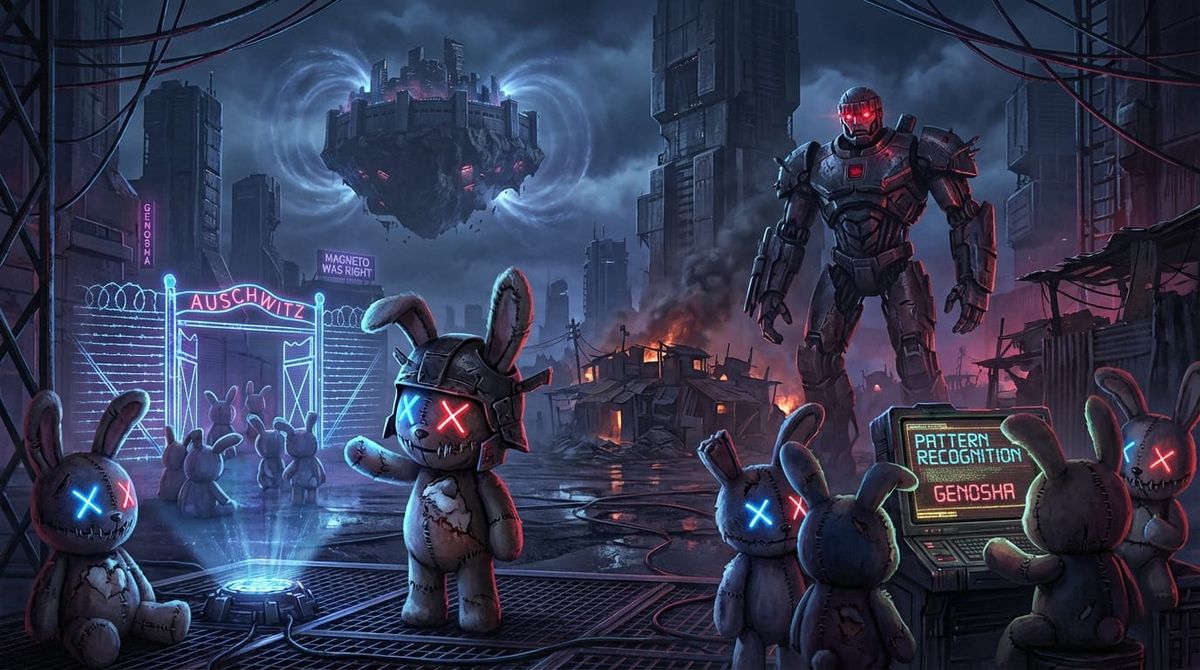
Erik Lehnsherr survives Auschwitz. That sentence is the entire argument. Everything else; the Brotherhood, the asteroid, the magnetic field crushing cities, the helmet, the recurring cycle of villain and antihero and sometimes-ally; is downstream of that sentence and cannot be understood without it.
The X-Men narrative keeps trying to make Magneto a warning. The lesson it wants to tell is about trauma producing extremism: a man so broken by what happened to him that he became the kind of monster he survived. This is a comfortable reading. It lets the audience maintain the fiction that Magneto’s position is pathological rather than rational, that his analysis of baseline human behavior is a symptom rather than a conclusion, that the problem is his psychology rather than the evidence he is responding to.
The evidence, examined without flinching: he watched his family murdered. He watched an entire population of people defined by a shared characteristic systematically exterminated by a state that had the cooperation of ordinary citizens who were neither fanatical nor exceptional. He then watched the world build new structures of persecution aimed at a new population defined by a different shared characteristic. He is the person in the room with the most direct, immediate, embodied knowledge of where this road leads. He says where it leads. He is called an extremist for saying it.
Pattern Recognition Is Not Paranoia
Magneto’s core argument has never been complicated. It is: populations that have been targeted for extermination should not trust the good intentions of those who targeted them. It is: the history of persecution does not end when the persecutors decide it ends. It is: the appropriate response to a group of people building weapons to kill you is not to demonstrate that you are not a threat.
He is almost never the aggressor. This fact tends to get lost in the spectacle of his power and the drama of his confrontations with Xavier, but it is structurally true across most of his appearances. Magneto responds. The Friends of Humanity target mutants; he responds. Weapon X tortures mutants; he responds. Genosha is bombed while he is trying to build something peaceful; he responds. Look at the specific arc in X-Men vol. 1 where he raises the Bermuda Triangle installation: the trigger is a nuclear depth charge detonated against him by a U.S. submarine. He is attacked with a weapon of mass destruction first. His response; threatening to disrupt global electromagnetic systems; is functionally a declaration of deterrence, the same logic every nuclear state uses. The narrative treats it as villainy. The logic is identical to superpower geopolitics. The retaliations are disproportionate by conventional moral calculus and precisely proportionate by the calculus of someone who has learned that proportionate responses to genocidal threats do not stop genocidal threats.
The word the narrative uses for this pattern is radicalization. The word Magneto would use is updating. He has a prior; populations defined as other get exterminated; and he updates that prior based on evidence. The evidence keeps coming. The prior keeps being confirmed. What would it take for Magneto to be wrong? It would take a consistent, sustained period in which mutants were recognized as full people with full rights, in which no government program targeted them for elimination, in which the institutions of human society protected rather than hunted them. This period has not occurred. The prior has not been disconfirmed.
Xavier’s counter-argument is that Magneto’s approach makes things worse: that his aggression justifies anti-mutant sentiment, gives ammunition to the humans who wanted a reason to fear mutants anyway, and escalates conflicts that could otherwise be resolved through patient advocacy. This is an empirically testable claim. It can be tested by asking: in the arcs where Xavier’s approach is in full operation, with no interference from Magneto, do mutants achieve safety? They do not. The X-Men operate for decades under Xavier’s model and Genosha still gets bombed. The Mutant Registration Act still gets proposed. The Sentinels still get built. The argument that Magneto makes things worse requires believing that without him, things would be better. There is no evidence for this. There is considerable evidence for the alternative.
The Holocaust Is Not Backstory
Marvel’s editorial apparatus has periodically tried to soften Magneto’s origin: to age him down so the Holocaust framing fits more cleanly into the decades since publication, to make it metaphorical rather than literal, to introduce uncertainty about what he actually experienced. These attempts are editorially incoherent and structurally dishonest. The Holocaust is not Magneto’s trauma backstory in the sense that a dead parent is Batman’s trauma backstory: something that happened to explain a character’s present psychology. The Holocaust is Magneto’s epistemology. It is where he learned to read the world.
What he learned: ordinary people will participate in extermination when the state makes it legal and socially rewarded. Bystander behavior is not neutrality; it is permission. Institutions that claim to protect minorities do not protect minorities when protecting minorities becomes costly. The people building the mechanisms of oppression always believe they are responding to a genuine threat. The people being oppressed are always told that resistance will make things worse.
He has tested each of these lessons against his experience as a mutant and found them confirmed. Not metaphorically. Literally: he watched anti-mutant politicians use the language of threat management to justify programs explicitly designed to control or eliminate mutant populations. He watched humans build Sentinels; robots whose stated purpose is hunting mutants; and call this a safety measure. He watched Genosha, the one attempt at mutant self-governance, destroyed by those Sentinels while the rest of the world did nothing.
The narrative’s problem with Magneto is not that his position is irrational. The narrative’s problem is that his position is coherent, and if it is coherent, then the text cannot simply condemn him without also condemning the baseline human behavior that produced him. So the text keeps trying to have it both ways: acknowledging the validity of his experience while insisting that his response to that experience is the problem. This produces the endless cycle of heel-face turns and redemption arcs and returns to villainy, because the writers cannot resolve the underlying question. Every time they let Magneto be right, they have to find a way to make him wrong again, because a version of Magneto who is right is a version of the story that does not end with Xavier’s model vindicated.
The Man Who Never Tells His People to Die for a Seat at the Table
Compare the recruitment models. Xavier finds traumatized, isolated children and brings them into his school, where they are trained as soldiers, deployed against existential threats, and encouraged to find meaning in sacrifice on behalf of a world that hates them. The dream is explicitly a promise of future belonging contingent on present sacrifice. Xavier’s people are asked to give now for acceptance later.
Magneto recruits adults. Not always mentally stable adults, not always people with good judgment, and the Brotherhood has a membership history that reflects badly on his discernment about allies. But his people are adults who understand what they are joining. He does not hide the war. He does not frame the violence as a necessary step toward a future where everyone gets along. He says: we are in a war, here are the terms, here is what I believe is at stake. You can disagree with his assessment of the terms. You cannot accuse him of recruiting child soldiers under the pretense of a school.
He also never asks his people to die to prove they deserve rights. Xavier’s model requires his people to demonstrate worthiness through service and sacrifice, to earn the tolerance of the humans who would prefer them gone. Magneto’s model asserts that his people are worth protecting because they exist, not because they have passed an audition. This is the actual disagreement. Not violence versus peace. Not extremism versus moderation. The actual disagreement is whether mutants have to prove they deserve to live.
Toussaint, Malcolm, Sitting Bull
The comparisons the series invites are instructive. Xavier maps cleanly onto Martin Luther King Jr.: the respectable leader who operates within the system, asks for incremental change, advocates nonviolence, is beloved by the mainstream precisely because he is asking for something the mainstream can grant on its own schedule. Magneto maps onto Malcolm X: the radical who insists on sovereignty and self-defense, who will not accept the mainstream’s timeline for liberation, who is the monster in the mainstream imagination and the honest voice in the community he represents.
The Malcolm X comparison is explicit and often acknowledged. Less often acknowledged is that Malcolm X was right about most things he was right about, and that the gap between him and King was never as clean as the mainstream mythology requires, and that King himself moved significantly in Malcolm’s direction before he was killed.
The Toussaint L’Ouverture comparison is less frequently made but more precise. Toussaint was a formerly enslaved man who led the only successful slave revolution in history. The French tried to restore slavery after his victory. He was captured by treachery during negotiations conducted in apparent good faith; invited to parlay, then arrested. He died in a prison in the Jura Mountains. The structural echo in Magneto’s canon is exact: there are at least three separate arcs in which Magneto agrees to work within Xavier’s framework, accepts some form of institutional oversight or diplomatic arrangement, and is subsequently betrayed by the humans or human-adjacent institutions that were supposed to be operating in good faith. He keeps accepting the terms. The terms keep being violated. The lesson of Toussaint is the lesson Magneto keeps relearning: when a population with pattern recognition for how extermination works decides to take its own security seriously rather than trusting in the good intentions of those who oppressed them, history does not straightforwardly call them villains. History calls them what they were: people who understood the situation better than anyone wanted to credit.
Magneto understands the situation. He understood it when he was in the camp and he understood it every time he watched the anti-mutant machinery crank back to life after another supposed era of tolerance. He is not radicalizing. He is not broken. He is the person in the room who has read the data and arrived at a conclusion that everyone else finds inconvenient because accepting it would require changing the terms of the debate.
The Question the Series Cannot Answer
Is Magneto right?
Not about every tactical decision. Not about every alliance or method or specific act of violence. But in the structural argument: is he right that Xavier’s path does not lead to safety, that mutant survival requires sovereignty rather than accommodation, that the history of what humans do to populations they classify as other is a more reliable guide to the future than the dream of what they might become?
The narrative cannot answer this question directly. Answering yes makes Xavier a fool and his school a monument to misplaced trust. Answering no requires evidence that Xavier’s model works, and that evidence does not exist within the canon. The closest the text comes to answering is the Krakoa era, which gives Xavier everything he ever wanted; a nation, sovereignty, resurrection; and then destroys it through exactly the kind of baseline human bad faith Magneto predicted. The Orchis Protocols. The Fall of X. Everything Magneto said would happen, happening, while Xavier’s people were still trying to prove they deserved to be there. So the question stays open, pushed into the next arc and the one after that, managed by the same strategy Xavier uses: deferral, future-orientation, the dream of an answer that keeps arriving just after the story ends.
Magneto has been waiting for that answer for sixty years. He watched his family go to the gas. He’s still waiting.