
Pharma Didn't Discover What SSRIs Do — They Found a Market

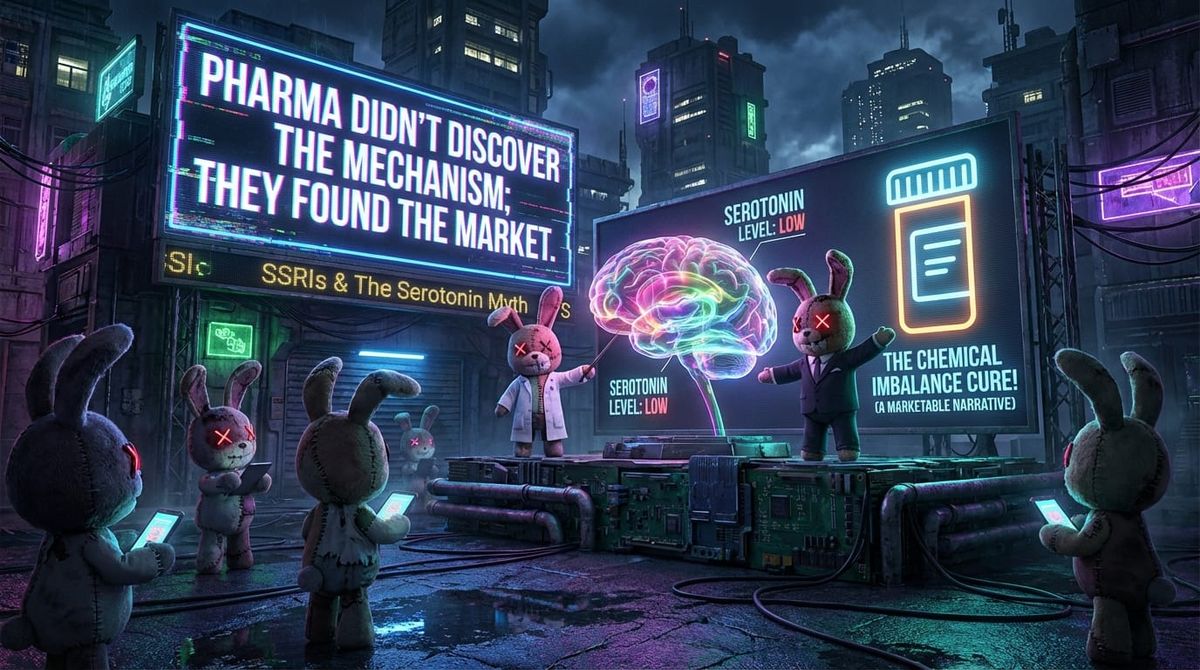
The serotonin hypothesis of depression goes like this: depressed people have low serotonin levels in the brain. SSRIs (selective serotonin reuptake inhibitors) increase available serotonin by blocking its reabsorption at the synapse. More serotonin, less depression. The hypothesis is clean, mechanistic, and satisfying. It gives patients a story about their suffering that sounds like biochemistry rather than weakness. It gives clinicians a rationale for prescribing medication. It gives pharmaceutical companies a narrative that sells.
The hypothesis was never proven. It was plausible, it was useful, and it became so thoroughly embedded in public consciousness that most people who have taken an SSRI believe it as fact. The “chemical imbalance” explanation for depression is one of the most successful pieces of marketing copy in the history of medicine, and calling it marketing copy is not hyperbole. It was developed and disseminated by pharmaceutical companies to sell drugs. That the drugs help some people does not make the explanation true.
The Monoamine Story
The serotonin hypothesis is a subset of the broader monoamine hypothesis of depression, which emerged in the 1960s from two accidental observations. The drug iproniazid, originally developed to treat tuberculosis, was noticed to elevate mood in TB patients. Iproniazid turned out to be a monoamine oxidase inhibitor; it prevented the breakdown of monoamine neurotransmitters including serotonin, norepinephrine, and dopamine. Separately, the drug reserpine, used to treat hypertension, was observed to cause depression in some patients. Reserpine depletes monoamines.
The logic seemed straightforward. A drug that increases monoamines improves mood. A drug that decreases monoamines worsens mood. Therefore depression is caused by low monoamines. This is the kind of reasoning that feels compelling and is actually quite weak. Aspirin reduces headaches, but headaches are not caused by aspirin deficiency. The fact that a drug affects a symptom does not mean the symptom is caused by the absence of whatever the drug provides. The inference is backwards; working from treatment effect to causal mechanism; and it was recognized as problematic from the beginning by researchers who understood the difference between correlation and mechanism.
But the monoamine hypothesis had something more powerful than rigorous evidence. It had clinical utility. It gave psychiatrists a biological framework that distinguished their practice from psychology and social work. It gave the profession a story that sounded like the rest of medicine; neurotransmitters, receptors, synaptic mechanisms; at a time when psychiatry was desperate for biological legitimacy after decades of psychoanalytic speculation. The hypothesis was less a scientific conclusion than a professional positioning tool.
What SSRIs Actually Do (and Don’t Do)
Fluoxetine (Prozac) was approved by the FDA in 1987. It was not the first antidepressant. Tricyclic antidepressants and MAOIs had been available for decades. What fluoxetine offered was a cleaner side-effect profile and a compelling mechanism story. SSRIs selectively block the reuptake of serotonin, increasing its availability in the synaptic cleft. The mechanism was specific and targetable, which made it marketable.
The clinical trial data for SSRIs is real. SSRIs outperform placebo in controlled trials for moderate to severe depression. This is not disputed. What is disputed; and what the marketing narrative consistently obscured; is the magnitude of the effect, the mechanism by which the effect occurs, and whether the serotonin story explains anything.
The effect size of SSRIs versus placebo, across meta-analyses, is modest. Irving Kirsch’s widely cited 2008 meta-analysis of FDA trial data found that the average difference between SSRIs and placebo fell below the threshold of clinical significance for all but the most severely depressed patients. The finding was controversial and has been debated intensely, but the basic observation that SSRIs offer a small incremental benefit over placebo for many patients has been replicated. The placebo response in depression trials is enormous; often 30 to 40 percent of placebo patients improve significantly; which means that the active ingredient in an SSRI prescription is partly the drug, partly expectation, partly clinical attention, and partly time.
The timing problem is particularly damaging to the serotonin hypothesis. SSRIs increase synaptic serotonin within hours of the first dose. Serotonin levels rise almost immediately. But the clinical effect; the mood improvement; takes four to six weeks. If depression were caused by low serotonin and SSRIs worked by raising serotonin, the effect should be immediate. It is not. The lag suggests that whatever SSRIs are doing to improve mood, it is not simply correcting a serotonin deficit. The actual mechanism likely involves downstream effects; neuroplasticity, receptor sensitivity changes, brain-derived neurotrophic factor; that are far more complex than the marketing copy suggests.
The Chemical Imbalance Campaign
The phrase “chemical imbalance” does not appear in any scientific paper as a validated explanation for depression. It was not coined by researchers. It was developed by pharmaceutical marketing departments and disseminated through direct-to-consumer advertising, which became legal in the United States in 1997. The Zoloft television advertisements are the canonical example. An animated blob sat under a rain cloud, looking sad. A voiceover explained that depression may be caused by a chemical imbalance in the brain. Zoloft could help correct it. The blob took its pill, the sun came out, the blob smiled and bounced away.
The ad was brilliant. It converted a complex neurobiological uncertainty into a simple mechanical story. Your brain is like a machine. A chemical is out of balance. The pill puts it back in balance. The metaphor was intuitive, destigmatizing, and wrong. It told people that their depression was like diabetes; a straightforward biochemical problem requiring a biochemical fix. This framing was enormously popular with patients, who understandably preferred “your brain chemistry is off” to “your life circumstances, attachment history, thought patterns, and neurobiological predispositions have converged to produce a depressive episode that may or may not respond to medication.”
The pharmaceutical companies knew the chemical imbalance story was oversimplified. Internal documents from Eli Lilly, Pfizer, and GlaxoSmithKline show marketing teams discussing how to present the serotonin hypothesis in ways that were technically defensible while being popularly understood as causal. The word “may” did a lot of work. “Depression may be related to a chemical imbalance.” “Zoloft works to correct this imbalance.” The hedging was invisible to the public and intentional by the marketers.
Psychiatrists participated in this narrative, sometimes knowingly and sometimes because they had absorbed the same simplified version of the science that their patients had seen on television. A 2005 survey found that 85 percent of patients who had been prescribed an antidepressant were told by their doctor that their depression was caused by a chemical imbalance. The explanation had migrated from pharmaceutical advertisement to clinical encounter to folk understanding. It was now what depression “was.” Billions of prescriptions later, it remained unproven.
The 2022 Umbrella Review
In 2022, Joanna Moncrieff and colleagues published an umbrella review in Molecular Psychiatry; one of the field’s top journals; that systematically evaluated the evidence for the serotonin hypothesis of depression. The review examined meta-analyses and systematic reviews across multiple lines of evidence: serotonin levels, serotonin metabolites, serotonin receptor activity, serotonin transporter function, tryptophan depletion studies, and serotonin-related gene studies.
The conclusion was unambiguous. There is no consistent evidence that serotonin levels or serotonin activity are reduced in people with depression. The serotonin hypothesis, after decades of research, is not supported by the available data. The review was not saying that SSRIs do not work. It was saying that the mechanism by which they work is not the mechanism that was sold to the public.
The response from the psychiatric establishment was revealing. Many psychiatrists argued that the chemical imbalance narrative had already been abandoned by the profession and that the review was attacking a straw man. This is partially true; academic psychiatrists had been distancing themselves from the simplistic serotonin story for years. But the distancing happened in journals and conferences, not in clinical encounters and certainly not in pharmaceutical advertising. The gap between what the profession knew and what the public believed was enormous, and the profession had done very little to close it.
The Prescribing Cascade
The chemical imbalance narrative did not just affect how people understood depression. It changed how clinicians practiced. Before SSRIs, antidepressant prescribing was largely the domain of psychiatrists. SSRIs were marketed as safe enough for general practitioners to prescribe, and general practitioners; who see more patients per day, spend less time per visit, and have less psychiatric training; became the primary prescribers of antidepressants. By the 2000s, the majority of SSRI prescriptions in the United States were written by non-psychiatrists. A fifteen-minute primary care visit became the standard pathway from complaint to prescription.
The average duration of an initial antidepressant consultation in primary care is twelve to fifteen minutes. In that window, the clinician needs to assess the patient, determine whether the complaint meets diagnostic criteria, select a medication, explain the treatment, and schedule a follow-up. The chemical imbalance narrative made this possible. Without a simple causal story, prescribing a psychoactive medication in a fifteen-minute window would feel reckless. With the story; your serotonin is low, this pill raises it; the prescription feels like correcting a known deficit. The narrative was not just marketing to patients. It was a clinical heuristic that made prescribing faster, easier, and more defensible.
The follow-up problem compounds the issue. SSRI trials typically last six to eight weeks. The long-term effects of continuous SSRI use; over years, over decades; are less well studied. Discontinuation effects are real and can be severe: brain zaps, emotional blunting, rebound depression, insomnia. Patients who try to stop their medication often find the withdrawal symptoms indistinguishable from the return of the original condition, which leads clinicians to conclude the underlying depression is still present and the medication should be continued. The difficulty of distinguishing withdrawal from relapse creates a pharmacological trap. The drug becomes its own justification.
What Got Sold and What Got Lost
The chemical imbalance narrative did something genuinely valuable. It reduced stigma. Framing depression as a brain chemistry problem rather than a personal failing made it easier for people to seek help, to take medication without shame, and to talk about their suffering openly. That matters. People who might have suffered in silence instead walked into a doctor’s office and said, “I think my serotonin is low.” They got treatment. Some of them got better. The narrative was therapeutically useful even if it was scientifically inaccurate.
But the narrative also did damage. It discouraged people from pursuing non-pharmaceutical interventions. If your problem is a chemical imbalance, the solution is a chemical; not therapy, not exercise, not social connection, not changes to the circumstances producing the distress. The framing oriented people toward pills and away from the messy, difficult, time-consuming work of addressing the contextual factors that often drive depression. It also created unrealistic expectations. If the pill is supposed to fix the imbalance, and the pill is not fixing it, the logical conclusion is that something is seriously wrong with you rather than that the model was too simple.
The pharmaceutical revenue generated by SSRIs is staggering. Global SSRI sales have exceeded $15 billion annually. Prozac alone generated over $20 billion in lifetime revenue before going off patent. Zoloft, Paxil, Lexapro, Celexa; the market is deep and the demand is steady because the pipeline that produces the demand is self-reinforcing. The DSM provides the diagnosis. The chemical imbalance narrative provides the explanation. The prescription provides the treatment. The insurance reimbursement provides the revenue. Each step makes the next step feel inevitable, and the whole system operates without anyone having to prove the foundational claim.
The serotonin hypothesis was not a conspiracy. It was a plausible mechanism that got attached to a profitable drug class and then calcified into public knowledge through advertising. Nobody sat in a room and decided to lie. What happened was subtler and more durable. A provisional scientific idea was promoted beyond its evidence base because it served the interests of every institution involved; pharmaceutical companies, psychiatrists, patients, and insurers. The truth; that depression is complex, multifactorial, incompletely understood, and variably responsive to treatment; is harder to sell. So they sold the simple version, and the simple version became what everybody knows.
Everybody still knows it. Ask the person next to you what causes depression. They will say a chemical imbalance.