Pi (1998) — The One Where She's Missing and Everything Dies

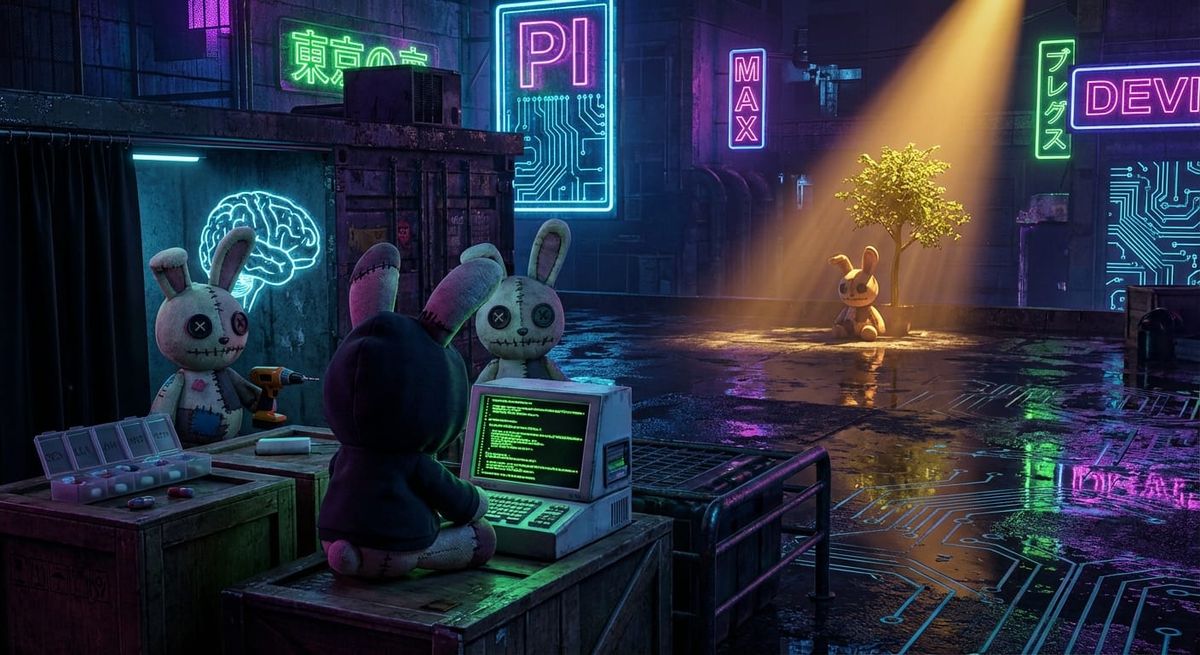
Max Cohen has a headache that never stops. It started when he was a kid and stared at the sun. His mother told him not to. He did it anyway. By the time we meet him in Pi, the headache has become the architecture of his life: the blackout curtains, the pill organizer with twelve compartments, the ritual of the coffee and the cigarette and the morning injections, the humming supercomputer he’s built inside his apartment like a second nervous system. Everything in Max’s world is ordered around the management of pain. The pain is the organizing principle. And somewhere in that organizing, the feminine got locked out.
That’s not an accident. It’s the thesis.
Pi is not Aronofsky’s best film. It’s his most honest one. Made for sixty thousand dollars, shot in eleven months, set almost entirely inside a man’s apartment and the streets of a neighborhood that barely notice him; it has none of the operatic production of Requiem or the mythological sweep of The Fountain. What it has is clarity. The wound is exposed here before Aronofsky learned to dress it in spectacle. You can see exactly what the question is before it gets complicated by everything that comes after. That’s why the series starts here. Not because Pi is the greatest, but because it’s the purest: the thesis statement before the thesis became a filmography.
The Apartment as Skull
Darren Aronofsky shot Pi in grainy, high-contrast 16mm black and white, and the texture of the film is important: everything looks like the inside of a head. The apartment Max lives in is small, filthy, and almost entirely closed. The shades are always down. The fluorescent lights buzz. The neighbor’s drill comes through the wall at irregular intervals. The external world arrives as intrusion, as noise, as threat to the model Max is running. He’s built a machine to find the pattern beneath the market, beneath God, beneath everything; and any information that doesn’t fit the model is aggressively excluded.
Watch what Max eats. He eats nothing, basically. Noodles. Whatever’s available. Watch how he sleeps: on a cot, in a room that looks like a server room. Watch how he touches things: with the flat of his fingers, carefully, like the world is a keyboard and he’s trying not to hit the wrong key. The body is present in Pi as pure liability. It keeps breaking down. It produces pain. It bleeds from his nose at the worst possible moments, a reminder that the wetware running this computation is not as clean as he’d like. Every time Max’s body insists on its own existence; the headaches, the seizures, the vomiting, the blood; it is the organism telling him that what he’s excluding from the model is trying to get back in.
The feminine is the most excluded thing.
Devi Is a Door He Won’t Open
There is a woman in Max’s building named Devi. She is kind. She is warm in the way that some people are warm: not performed warmth, not the warmth of someone who wants something, but the warmth of someone who is simply present to the people around them. She brings him coffee. She checks on him. She stands in his doorway in the small moments between his episodes and she is, without trying to be, the clearest picture the film offers of what actual human life looks like: embodied, soft, connected, nourishing.
Max can’t look at her. Not really. He registers her the way you register a loud noise in a library: as something that breaks concentration, as something requiring a response before you can get back to what matters. He’s polite. He takes the coffee. He closes the door.
That closed door is the movie.
The genius of Pi is that it doesn’t frame Devi’s absence from Max’s life as tragic in the conventional sense. It doesn’t give you a romantic subplot that dies on the vine. It gives you something more precise: a man who has constructed his entire existence around excluding a category of experience, and a film that makes the shape of that exclusion visible by the negative space it leaves. Devi doesn’t need scenes. Her presence in the doorway is enough. She is the thing the frame keeps almost touching.
Active Inference Horror
There’s a way to understand what happens to Max Cohen through the lens of active inference, the framework for how biological systems generate predictions and update them against incoming sensory data. The idea is that the brain is fundamentally a prediction machine; it runs a model of the world, it makes predictions from that model, and when the predictions are wrong it generates an error signal. The error signal is uncomfortable. The system tries to minimize it: either by updating the model (learning) or by reducing exposure to the disconfirming data (avoidance, suppression, isolation).
Max is running a very specific kind of broken prediction system. His priors are so tightly weighted (the world is mathematical; beneath chaos there is order; if I find the right number, everything will cohere) that incoming data which doesn’t fit the model doesn’t update the model. It generates error signals so large the system can’t metabolize them. The seizures. The visions. The headaches that flatten him to the floor. These are not supernatural events. They are a prediction engine being asked to reconcile irreconcilable inputs; the warmth in Devi’s voice, the chaos of the market, the Hasidic numerologists who want the pattern for God, the body’s insistence on bleeding and hurting.
Devi is the largest source of unmetabolizable input in the film. She is warm. She is embodied. She is evidence that the world contains things that can’t be reduced to 216-digit sequences. She is, in active inference terms, a massive prediction error; Max’s system cannot integrate her without collapsing. So she gets excluded. The door closes. And the model gets tighter. And the headaches get worse. And eventually the system, unable to accommodate the gap between the model and reality, goes to the hardware itself and decides the hardware is the problem.
The drill at the end of Pi is not an act of madness. It’s the logical terminus of a system that couldn’t update. Max sits under the tree (the film’s one moment of genuine light, actual sun on his actual face) and for a second you think: maybe. Maybe something came through. But you don’t know what he lost to get there.
This is the part that makes Pi useful as a horror film in a way its found-footage descendants rarely are. The horror isn’t external. Nobody is chasing Max. No force outside himself destroys him. What destroys him is the relentless logic of a system that was optimized for the wrong thing. He wanted the number. He got it. The number destroyed the hardware that found it. The horror of Pi is the horror of getting exactly what you asked for, having excluded everything that might have helped you survive receiving it. That’s not a supernatural premise. That’s a Tuesday.
The Body Is Always Telling You
The body-as-evidence motif starts here and runs through everything Aronofsky makes. In Requiem for a Dream, bodies decay in real time, eaten by the thing they’re feeding. In The Wrestler, the body is the site of every consequence the man refused to face. In Black Swan, it transforms. In mother!, it is literally consumed. The body in Aronofsky is never neutral. It is always testifying. It knows things the mind refuses to acknowledge, and it speaks through the only language it has: pain, degradation, transformation, failure.
Max’s body in Pi is testifying constantly. The nosebleeds. The migraines. The seizures that come precisely when he’s closest to the number. Pay attention to when the headaches are worst: they peak when Max is trying hardest to close the loop, to finish the model, to get the answer that will make everything make sense. The body is telling him something’s wrong with the question. He interprets this as the price of getting close to truth. He’s interpreting his own dysregulation as evidence he’s on the right track.
This is what the absence of the feminine does to a system. It removes the feedback mechanism. There is no one to say: you look terrible. There is no one to hand him coffee and require, by the simple act of requiring, that he exist briefly as a person someone is concerned about rather than a machine chasing a pattern. Devi could have been that. He won’t let her. Sol, his mentor, gets close; but Sol is another man, another mind, and when Sol reaches for the feminine (his fish, which he keeps and tends and eventually releases; his garden; his chess games in the park) he survives. He tells Max: stop. Max doesn’t stop. Men who won’t accept being held, Aronofsky will say again and again across his whole filmography, end up destroyed by the thing they were chasing.
Sol is the control in the experiment. He is proof that the capacity exists; that a person can go deep into the pattern-seeking without the pattern consuming them, as long as they’ve kept something soft and alive nearby. Sol stopped. Sol has a garden. Sol plays chess with strangers. Sol still feeds fish into a bowl of water even though the fish always die, and he finds this meaningful rather than futile. Sol is what Max could have been if he’d let Devi through the door a few more times. That’s not sentimental. It’s the film’s one structural argument: here is the man who survived this obsession, here is the man who won’t, and the only visible difference between them is what they allowed into their orbit.
The Feminine as Negative Space
This series is called the Aronofsky Liturgy because the films read like prayers: not comfortable prayers, but the kind that come out when you’re scared, when you’re bargaining, when you’re trying to get a grip on something you can feel but can’t name. The question at the center of every one of them is: what happens to the world when it forgets who’s holding it together?
Pi answers the question through absence. The feminine in this film is not a character. She doesn’t get an arc. Devi is in maybe five scenes, for maybe three minutes total. She has no plot function. She changes nothing. That is precisely the point. She is what’s not there. She is the negative space in every frame of Max’s apartment; the thing that would have made the model permeable, made the system capable of updating, made the hardware survivable.
You don’t notice what the absence costs until the drill comes out. And then you think: all this, to avoid a cup of coffee. All this wreckage, because being known felt more dangerous than being destroyed.
The series starts here because this is where the wound is clearest. In Requiem, the feminine is present and drowning. In The Fountain, it’s already dying. In Black Swan, it’s shattered and reassembled into something dangerous. In mother!, it holds the whole world together until the world destroys it. But in Pi, you can see the absence in its purest form: not catastrophe, not sacrifice, just a door that closes. A cup of coffee declined. A man who built a cathedral to his own mind and couldn’t let anyone in to see it.
Max ends the film sitting in sunlight with no number, no answer, and no headache. Whether that’s peace or a successful lobotomy is up to you. Aronofsky isn’t telling. He just shows you the before: the blackout curtains, the humming machine, the closed door, the blood on the floor. And he trusts you to understand what was being kept out.