The Flash Crash and What Quants Did to Markets

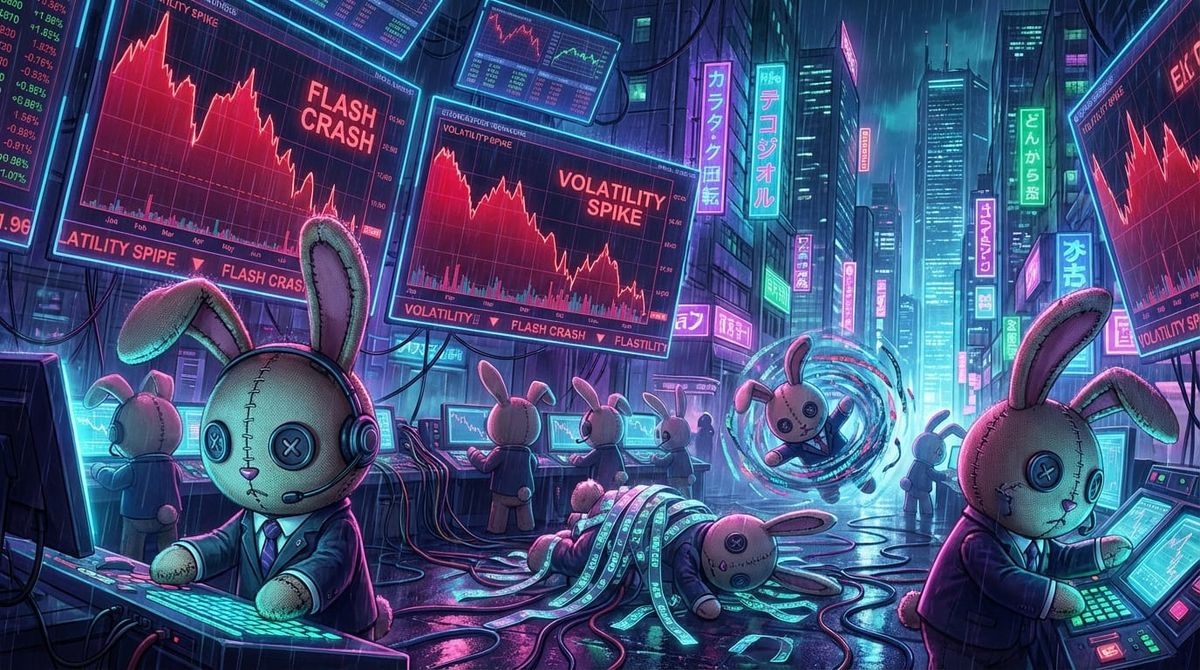
On May 6, 2010, at approximately 2:32 PM Eastern Time, the Dow Jones Industrial Average began falling. Within five minutes it had dropped nearly 600 points. Within the next five minutes it dropped another 400. At the nadir; a point reached at 2:47 PM; the Dow was down almost 1,000 points from its morning level, representing roughly a trillion dollars in evaporated market value. Blue chip stocks traded at absurd prices. Accenture briefly hit one penny per share. Procter & Gamble dropped 37% in minutes. Apple traded at $100,000 per share on some exchanges. Then, almost as quickly as it began, the market reversed. By 3:07 PM, most of the losses had been recovered. The whole event lasted about 36 minutes.
Nobody knew why it happened. Not in the moment, and not for a long time afterward. The SEC and CFTC spent five months investigating before publishing a joint report that attributed the crash to a single large sell order executed by a Kansas City mutual fund company using an algorithm that was, by the standards of the industry, unsophisticated. But that explanation never fully satisfied anyone, because a single sell order; even a large one; shouldn’t be able to do that to the entire market. Something structural had to be wrong for one order to cascade into a trillion-dollar rout.
That something was the architecture the quants built.
The Market Nobody Designed
The 2010 Flash Crash was not caused by quantitative trading firms. It is important to be precise about this. No single firm, no single algorithm, no single strategy produced the crash. What produced the crash was the interaction between thousands of algorithms operating simultaneously, each responding rationally to the same signals, each doing exactly what it was designed to do, and the collective effect of all those rational individual actions being a market that briefly went insane.
This is an emergent property problem. The individual components work correctly. The system they produce when combined does things none of the individual components intended. It is the same class of problem that produces traffic jams, bank runs, and stampedes; situations where every individual actor is behaving reasonably and the aggregate result is catastrophic.
The specific mechanism in the Flash Crash worked like this. The initial sell order; the one from the Kansas City fund; began pushing prices down. Algorithmic market makers, the firms that provide liquidity by standing ready to buy and sell, detected the selling pressure and began widening their spreads. Some pulled their quotes entirely, which is rational behavior for a market maker that detects abnormal conditions; when you can’t price the risk, you stop trading. But when the market makers withdrew, liquidity dried up. With less liquidity, the same selling pressure moved prices further. The further prices moved, the more algorithms detected abnormal conditions and withdrew. The withdrawal reduced liquidity further. Prices moved further still.
This is a feedback loop. It is not a feedback loop anyone designed. It is a feedback loop that emerges naturally when you have thousands of independent algorithms all programmed to respond to the same classes of signals. Falling prices trigger risk management protocols. Risk management protocols reduce liquidity. Reduced liquidity amplifies price movements. Amplified price movements trigger more risk management protocols. The loop accelerates until something breaks it; in this case, a brief trading halt imposed by the CME that gave the algorithms time to reset.
The people who built these systems are not stupid. They are, in fact, among the smartest quantitative minds on the planet. The problem is not that the algorithms are poorly designed. The problem is that each algorithm is designed to optimize for the performance of its own fund, and nobody is designing for the performance of the system as a whole. There is no system architect. There is no one looking at the interaction effects. Each firm builds its piece of the machine. The machine assembles itself. And sometimes the machine does things that none of its builders anticipated.
The Arms Race That Built the Bomb
To understand how markets arrived at this architecture, you have to understand the arms race that preceded it.
When electronic trading began replacing floor trading in the late 1990s and early 2000s, the initial advantage went to speed. If you could see a price change on one exchange and execute a trade on another exchange before anyone else reacted, you could capture the arbitrage. This was the first generation of high-frequency trading, and it was, in a meaningful sense, a simple extension of what floor traders had always done; exploiting information advantages; just executed at electronic speed instead of human speed.
But the arms race didn’t stop at speed. Once everyone had fast connections, the advantage shifted to smarter signals. Firms began building algorithms that could detect patterns in the order flow itself; that could read the sequence of bids and offers and infer what other market participants were about to do. This is the quant contribution to market structure. Not just faster execution, but deeper pattern recognition. The ability to see, in the noise of millions of daily transactions, the signal that tells you which direction the market is about to move.
The problem is that when everyone is reading the same signals, the signals themselves change. If a hundred algorithms all detect the same selling pattern and all respond by selling, the selling pattern gets amplified. If a hundred algorithms all detect the amplified pattern and respond again, the amplification compounds. The market becomes a hall of mirrors; algorithms reading each other’s behavior, reacting to each other’s reactions, creating patterns that exist only because the algorithms are looking for them.
This is not a theoretical concern. It is the actual structure of modern equity markets. The majority of trading volume on US exchanges is generated by algorithms. These algorithms respond to each other in real time. The patterns they create and respond to exist at timescales that are faster than human perception. Nobody is watching. Nobody can watch. The system operates below the threshold of human cognition, in a space where the only observers are other algorithms.
2015 and the Pattern Repeats
On August 24, 2015, the market opened with the Dow down over 1,000 points. The catalyst was concern about the Chinese economy; the Shanghai Composite had fallen sharply over the preceding weeks. But the catalyst doesn’t explain the magnitude. A bad day in China doesn’t justify a 1,000-point gap-down at the US open, followed by a further plunge that took the Dow down nearly 1,100 points at its worst before recovering most of the losses within the first hour.
What happened was structurally identical to 2010. The large opening gap triggered circuit breakers on individual stocks, which halted trading in those stocks, which made it impossible for ETF arbitrage algorithms to properly price the ETFs that contained those stocks, which caused ETF prices to disconnect from their underlying values, which triggered more selling by algorithms designed to sell when prices fall below model values, which triggered more circuit breakers, which created more pricing dislocations. The cascade was self-reinforcing in exactly the same way as the Flash Crash, and for exactly the same reason: thousands of algorithms, each behaving rationally, producing a collective outcome that was irrational.
The 2015 event was in some ways more alarming than 2010 because it happened at the open, not during regular trading, which meant it affected the entire first-hour experience for millions of retail investors. People opened their brokerage apps at 9:30 AM and saw their portfolios down 5% or more, with prices jumping wildly between refreshes. Many of them panicked and sold. The algorithms recovered within the hour. The retail investors who sold at the bottom did not.
This is the distributional problem that the quant-built market creates. The algorithms are fast enough to profit from the dislocation and fast enough to recover from it. Human participants are not. The same market structure that produces incredible efficiency for 99.9% of trading sessions produces occasional violent dislocations that disproportionately harm the slowest participants; which is to say, regular people.
The Volmageddon of 2018
February 5, 2018 added another data point to the pattern. The VIX; the market’s measure of expected volatility; spiked from around 17 to over 37 in a single day, its largest single-day percentage increase in history. The catalyst was a moderate stock market decline. The amplifier was a class of financial products that had been designed to short volatility; to bet that markets would remain calm; and that had attracted billions of dollars from retail investors who didn’t fully understand what they owned.
When volatility spiked, these products were forced to buy VIX futures to cover their positions. The buying pushed volatility higher. Higher volatility triggered more forced buying. The loop ran until two popular exchange-traded products; the XIV and the SVXY; lost virtually all of their value. The XIV was liquidated entirely. Investors who had been collecting steady, small gains for years lost everything in a single afternoon.
The quant angle here is not that algorithms caused the spike. It is that the products that amplified the spike; the inverse volatility ETNs; were themselves products of the quant ecosystem. They were engineered financial instruments whose risk profiles could only be understood through quantitative modeling, sold to retail investors through brokerage platforms that presented them as if they were ordinary investments. The sophistication of the engineering was not matched by the sophistication of the marketing. People bought instruments they couldn’t model because the instruments looked, from the outside, like any other ticker symbol.
March 2020 and the Stress Test
The COVID crash of March 2020 was the most severe market dislocation since 2008, and it stress-tested every part of the quant-built market simultaneously. The S&P 500 fell 34% in 23 trading days. The VIX hit 82. Corporate bond spreads blew out. Treasury market liquidity; the deepest, most liquid market in the world; dried up to the point where the Federal Reserve had to intervene to prevent a systemic failure.
What was revealing about March 2020 was how the quant infrastructure performed under extreme stress. The high-frequency market makers mostly stayed in the market, though with much wider spreads. The algorithms mostly continued to function. The market didn’t have a single Flash Crash event; instead, it had weeks of sustained, extreme volatility. The plumbing held, even as the water pressure was orders of magnitude beyond normal operating parameters.
But the holding was conditional. The Fed’s intervention; which included unlimited Treasury purchases and corporate bond buying programs; was what prevented the plumbing from failing. Without a lender of last resort willing to absorb unlimited risk, the algorithmic market makers would have pulled their liquidity just as they did in 2010 and 2015, and the cascading failure would have been far worse. The quant-built market survived the COVID crash, but it survived because the government backstopped it. Left to its own devices, the architecture that produces such elegant efficiency in normal times would have seized up under the pressure.
The Unintended Architecture
Nobody sat down and designed the modern market. That is the essential thing to understand about what the quants built. There was no blueprint. There was no committee. There was no moment where someone decided that the majority of price discovery should happen in server farms in New Jersey at microsecond timescales, invisible to the humans whose savings depend on it.
What happened instead was evolution. Thousands of firms, each pursuing edge, each building slightly better systems, each competing for slightly faster execution; and the aggregate effect of all that competition was the emergence of a market structure that nobody planned and nobody fully controls. It is brilliant in its efficiency. It is terrifying in its opacity. It rewards intelligence and punishes slowness; and most human beings, by the standards of this market, are very slow indeed.
The flash crashes and volatility events are not aberrations. They are features of the architecture. They are what happens when you build a system optimized for speed and efficiency and don’t build in the dampers, the circuit breakers, the structural safeguards that would prevent resonance cascades. The quant firms didn’t mean to build a market that could lose a trillion dollars in minutes. But they did. And the market they built is the one the rest of us live in.
The question is not whether it will happen again. It will. The question is whether the next time will be worse; whether the feedback loops will run longer, the cascades will go deeper, the recovery will take longer. Because the architecture hasn’t changed. It has gotten faster, more complex, more interconnected. The same structural vulnerability that produced the Flash Crash in 2010 exists today, amplified by fifteen years of additional optimization. The system is more efficient than ever. The floor trader is gone. The algorithms are in charge. And nobody is watching the whole machine.