The Morlocks Were Right

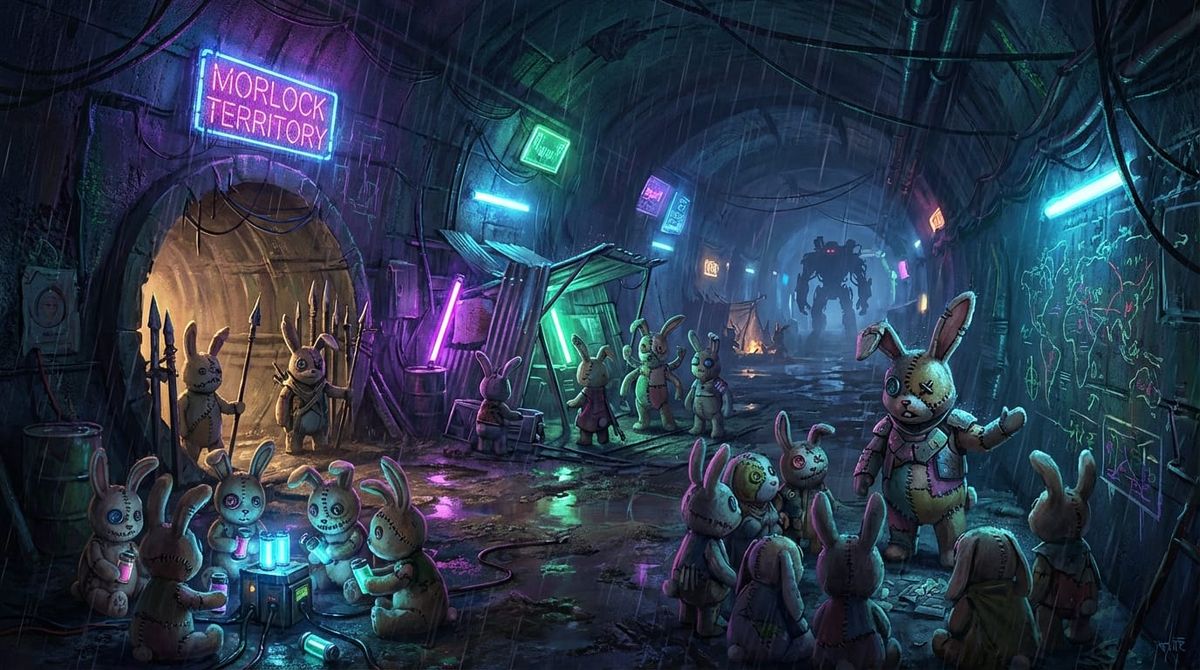
They went underground and built something. They found the tunnels beneath Manhattan, the abandoned infrastructure, the spaces that baseline society had no use for, and they made those spaces into a community. They built mutual aid networks. They developed internal governance. They created belonging for the mutants who couldn’t manufacture belonging anywhere else: the ones whose mutations were visible, uncontrollable, and unacceptable to a world that had a clear preference for mutants who could mostly pass. The Morlocks did not wait for the world to become hospitable. They made their own corner of it livable and they defended it.
Marvel’s writers framed this as tragedy. The sewers. The darkness. The isolation from the world above. Look at what they were reduced to, the framing says: they had to hide, they had to live like this, they had to give up. The framing is wrong, and it is wrong in a way that reveals exactly which mutants the narrative considers real protagonists and which ones it considers case studies in sadness. The Morlocks didn’t give up. They made a rational calculation about what was available to them and built accordingly. The tragedy is not that they went underground. The tragedy is what happened to them when they built something real.
Who the Morlocks Were and Weren’t
The selection principle for Morlock membership is the thing that gets glossed over in most discussions of the group, and it matters enormously. The Morlocks weren’t the mutants who preferred underground living or who were philosophically opposed to integration. They were, substantially, the mutants for whom integration was not on offer. Callisto has blue skin and cat eyes and tentacles in some continuities. Sunder is a giant. Masque can reshape flesh but can’t stop his own appearance from reading as monstrous. These are not mutations that can be hidden with a jacket and a prepared answer when someone asks about the scar. These are mutations that arrive first in every room.
This distinction matters because it maps onto a real and persistent divide within disability and neurodiversity movements: between the people who can pass, whose difference is invisible or manageable enough to navigate mainstream spaces with effort, and the people who cannot. The “high-functioning” framing in autism discourse is the clearest version of this in contemporary terms, though the same gradient exists throughout disability politics. The people who can pass have access to a strategy. The people who cannot have to build something different or go without.
Xavier’s school, which the narrative presents as the universal solution to the mutant problem, is available to a specific range of mutants. It works for Scott Summers, whose mutation is invisible when he keeps his eyes shut and becomes a pair of glasses that read as eccentricity. It works for Jean Grey, whose telepathy and telekinesis are entirely invisible at rest. It works, with effort, for several others. It does not work for Callisto. It does not work for the mutant whose face has been restructured by the mutation into something that the school’s neighbors, the school’s government liaisons, the school’s broader social environment would greet with fear. The integration strategy depends on a degree of passability that the Morlocks, structurally, did not have.
The Community as Rational Response
What they built was functional. The Alley, the main Morlock settlement in the Morlock tunnels beneath Manhattan, had internal social organization, conflict resolution, resource sharing, and most importantly: safety. Not perfect safety, not the kind of safety that comes from being powerful enough to deter attack, but the functional safety of numbers and concealment and community knowledge of a shared environment. People knew where to go. People knew who to ask. People who arrived damaged and isolated and lacking anywhere else had somewhere to arrive.
This is mutual aid, which is not a radical concept; it is the oldest human technology for surviving conditions that institutions won’t address. When the official options are inadequate or inaccessible, people build informal alternatives: the underground railroad, the disability community centers, the harm reduction programs that operate because the healthcare system won’t. The Morlocks built the mutant version of this. They built it for the mutants the X-Men’s formal academy wasn’t positioned to help, and they built it out of the materials available, which happened to be abandoned tunnels rather than a Westchester mansion. The address shouldn’t obscure the function.
The function was: these people have somewhere to be. They have people who know them. They have a social structure that is legible to them and that does not require them to suppress, hide, or perform around their mutations. A mutant in the Alley doesn’t have to manage anyone else’s reaction to their face. The labor of being illegible, the constant monitoring and adjusting and explaining that consumes enormous cognitive and emotional energy for anyone visibly different, is reduced to something survivable. That is not nothing. That is, in fact, the central thing.
The Mutant Massacre as Institutional Logic
The Marauders killed over two hundred Morlocks in the tunnels, on orders from Mister Sinister, in what is still the bloodiest single event in X-Men history. They went in systematically, with a target list and the specific intention of elimination rather than dispersal. The X-Men intervened and were nearly destroyed doing it. The Morlocks who survived were scattered, traumatized, and stripped of the community they’d built.
The Mutant Massacre does not sit comfortably in the narrative if you read it honestly. It is presented as a horror, as something that must be stopped and avenged, and the X-Men’s role as the ones who fight to stop it is treated as unambiguously heroic. All of that is true. But the massacre is also the answer to a specific question: what happens when a marginalized group builds something self-sufficient enough to be real? What happens when the people the powerful want contained stop waiting for containment and start building alternatives?
Sinister’s interest in the Morlocks was partly genetic; he wanted certain mutations under his control rather than loose. But the mechanics of the massacre, the systematic elimination of an established community, look less like genetic research and more like what happens to communities that make powerful institutions nervous by refusing to be absorbed or dispersed. The Morlocks weren’t bothering anyone. They were in the sewers. They had removed themselves from the situation that made them dangerous and inconvenient. The thing they were doing, building sustainable community outside the control of any existing power structure, was the problem.
This is not a subtle point. The history of attempts to build autonomous community outside mainstream institutions is a history of those communities being destroyed when they become real enough to threaten the assumption that the mainstream institutions are the only legitimate option. The Black Wall Street in Tulsa. The intentional communities of various marginalized groups that got burned down or legally dissolved when they looked too functional. The Morlocks were doing what people do when the doors are closed: they built their own house. And the response was to burn it down.
The Strategy Divide
The X-Men’s response to the massacre, which is grief and retaliation against the Marauders, is not wrong. But there is a conversation that doesn’t happen in the aftermath, a conversation about the strategic question the Morlocks had already answered by their existence: is integration the universal mutant strategy, or is it one strategy available to one subset of mutants, and should it be presented as the only legitimate option?
Xavier’s dream, as articulated across decades of comics, is coexistence: mutants and humans living openly alongside each other in a world that has learned to accommodate difference. It is a generous dream and in the abstract it is correct. The problem is that Xavier’s dream was designed by and for the mutants who have a viable path to it. The Morlocks didn’t have a path. They had mutations that made the “living openly alongside each other” part conditional on the humans around them being significantly better than humans have ever been shown to be. Xavier could ask them to wait for a world that didn’t exist yet. The sewers were available now.
The internal divide this maps onto in the neurodiversity movement is not comfortable to say directly, but it needs to be said: the loudest voices for integration are often the people for whom integration is most available. The people who can pass, whose difference is manageable with enough accommodation, are the ones most likely to be in the rooms where integration strategy is being discussed. The people who cannot pass are less likely to be in those rooms, partly because the rooms themselves tend to be hostile environments, and when they are absent from the conversation, the strategy gets built around the assumption that everyone has the same options.
The Morlocks are the X-Men universe’s clearest statement that not everyone has the same options. Their separatism was not ideological. It was practical. It was the decision that the people who refuse to die waiting for the world to get better have to make. And the narrative punished them for it, first with the massacre, and then with the ongoing framing of their community as evidence of failure rather than evidence of ingenuity.
What Separatism Actually Means
Separatism, as a political strategy, tends to get flattened into a single position: withdrawal from the world, refusal to engage, giving up on the possibility of change. The Morlocks don’t map onto that cleanly. They didn’t withdraw from the possibility of the world changing. They withdrew from the immediate, daily experience of a world that was actively harming them, in order to build something survivable in the meantime. These are not the same thing.
The question that the Morlock arc keeps posing to the X-Men universe, whether or not the writers intended it, is: what do you owe people who can’t wait? Xavier’s long game requires patience, requires people to absorb damage and keep showing up and keep making the case for mutant humanity in circumstances that keep trying to kill them. That patience is a form of sacrifice, and it is a sacrifice that falls differently on different bodies. The mutants who can manage the sacrifice, who can survive the exposure, who have enough power or enough passability to take the hits and keep going, can afford the long game. The Morlocks built the short game because the long game wasn’t available to them.
There is a version of the separatism argument that gets made in bad faith, as a way to avoid the harder political work of demanding structural change. The Morlocks were not making that version. They were not retreating from politics; they were acknowledging that they couldn’t afford to live in the gap between the politics they needed and the politics that existed. The community they built was not a renunciation of the broader struggle. It was a way to survive long enough to be part of one. The distinction matters, because the narrative collapses it: it treats them as people who gave up, when they were people who stayed alive by building something that didn’t require the world to change first. Survival is not the same as surrender. The X-Men’s own charter is supposed to understand this, and it consistently fails to apply the understanding to the people underground.
The narrative punished them for being pragmatic. It called their sewers sad and their community reduced and their strategy a failure. What it couldn’t explain is what, exactly, they were supposed to do instead. Xavier’s school wasn’t built for Callisto. The human world above wasn’t safe for them. The political process wasn’t going to move fast enough. The Morlocks looked at the available options and built what they could with what they had.
They were right to do it. The story they were given was wrong about what that meant. The sewers were not a symbol of defeat. They were a solution to a problem that the surface world refused to solve. Calling that defeat is a way of protecting the assumption that the only legitimate response to marginalization is to keep asking the people doing the marginalizing to stop. The Morlocks stopped asking. They built. The narrative’s discomfort with that choice is the most honest thing about it.