
Why We Mock Astrology But Forward MBTI Results

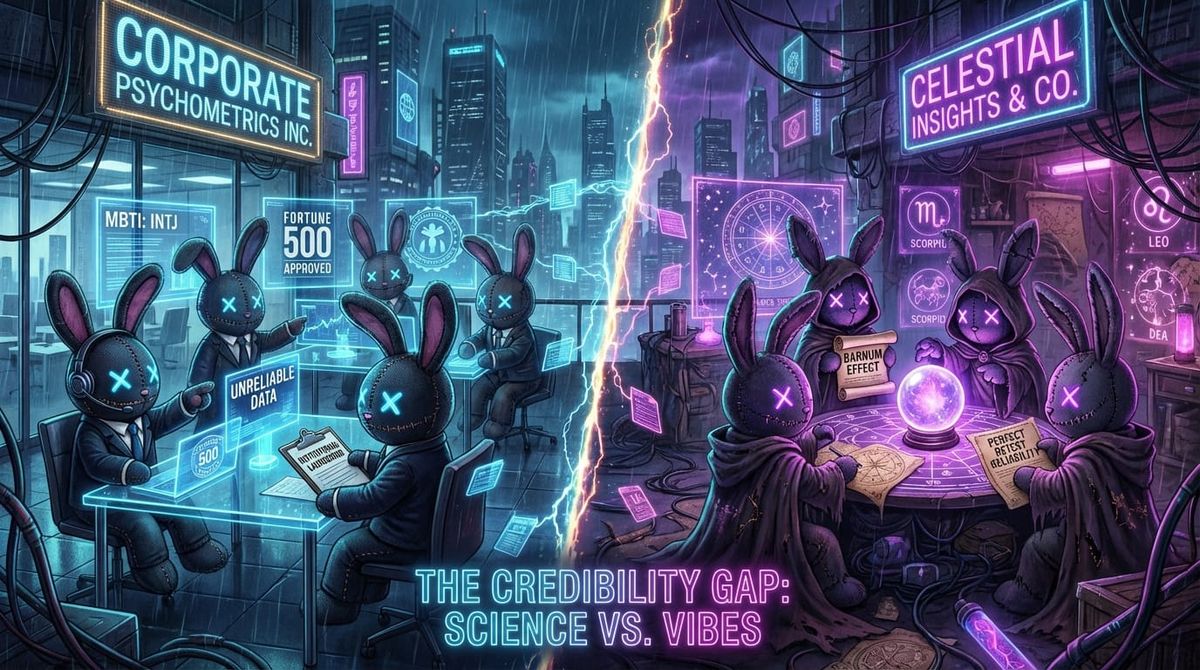
Somewhere in America right now, a hiring manager is looking at a candidate’s Myers-Briggs results and making a decision about fit. In the same building, someone is making fun of a coworker for checking their horoscope. The hiring manager believes they are being data-driven. The horoscope reader knows they are being unserious. Both of them are wrong about who is on firmer ground.
The Myers-Briggs Type Indicator is used by 88% of Fortune 500 companies. It generates an estimated $2 billion per year in revenue. It is administered in corporate retreats, executive coaching sessions, couples therapy, and career counseling offices. It sorts human beings into sixteen types based on four binary dimensions and assigns them labels that people carry for decades. INTJ. ENFP. It is treated, in practice, as a serious psychological instrument.
It is not a serious psychological instrument. And the comparison with astrology is not a joke. It is, on the actual psychometric evidence, embarrassingly apt.
The Retest Problem
A psychological assessment’s most basic requirement is test-retest reliability: if you take the test twice, you should get the same result. This is not a high bar. It is the minimum. If a thermometer gives you 98.6 one day and 104 the next when nothing has changed, you throw it out.
The MBTI’s test-retest reliability is poor enough that the instrument’s own manual acknowledges the issue without quite confronting its implications. Studies have consistently found that between 39% and 76% of test-takers receive a different type when retested after five weeks. Not a different score on a continuum; a different categorical type. The person who was an INTJ last month is an INFP this month. The four-letter code that was supposed to reveal something stable about their psychological makeup has changed because they happened to be in a slightly different mood, or slept differently the night before, or had coffee instead of tea.
The reason for this instability is structural, not accidental. The MBTI forces continuous distributions into binary categories. Most people score near the middle on most dimensions, which means a tiny shift in their responses flips them from one type to another. If you score 51% toward Introversion, you’re an I. Take the test on a day when you’re feeling slightly more social and score 51% toward Extraversion, you’re an E. The categorical system turns noise into signal. A meaningless fluctuation becomes a personality type change.
Astrology, for the record, has perfect test-retest reliability. You are always the same sign. This is not a point in astrology’s favor as a theory of personality, but it does highlight something absurd about the comparison: the system that the culture takes seriously is less consistent than the system it ridicules.
Predictive Validity, or the Lack of It
Test-retest reliability is about consistency. Predictive validity is about whether the test actually tells you anything useful. Does knowing someone’s MBTI type predict their job performance, relationship satisfaction, mental health outcomes, or any other real-world variable?
The answer, from decades of research, is: barely. The MBTI shows modest correlations with some outcome measures, but these correlations are consistently weaker than those produced by the Big Five personality model (also called the Five-Factor Model or OCEAN), which measures Openness, Conscientiousness, Extraversion, Agreeableness, and Neuroticism on continuous scales. The Big Five is the instrument that personality psychologists actually use. It has robust test-retest reliability. It predicts job performance, academic achievement, relationship stability, and health outcomes at modest but meaningful levels. It is the result of decades of factor-analytic research that asked what dimensions of personality actually emerge from the data, rather than starting with a theory and building a test around it.
The MBTI was not built this way. It was built by Katharine Briggs and Isabel Briggs Myers, neither of whom had formal training in psychology or psychometrics. They were enthusiasts of Carl Jung’s personality typology, and they designed the instrument to operationalize his theory. The theory came first; the test was built to serve it. This is the opposite of how valid psychological instruments are constructed. You don’t start with the categories and build the measurement to confirm them. You start with the data and see what categories emerge.
The result is an instrument that measures something; it is not entirely random; but what it measures is largely redundant with the Big Five, which does the job better. The MBTI’s Extraversion-Introversion dimension correlates with the Big Five’s Extraversion. Its Thinking-Feeling dimension correlates with Agreeableness. Its Judging-Perceiving dimension correlates with Conscientiousness. The only dimension that doesn’t map cleanly is Intuition-Sensing, which fractures across Openness and other factors. The MBTI is, in effect, a worse version of an instrument that already exists; less reliable, less valid, less precisely measured, and burdened with a categorical system that throws away useful information.
The Barnum Effect in a Corporate Wrapper
The type descriptions generated by the MBTI have a property that psychologists call the Barnum effect, after P.T. Barnum: they are vague enough to feel accurate to almost anyone. “INTJs are strategic thinkers who value competence and independence.” “ENFPs are enthusiastic, creative, and drawn to new possibilities.” These descriptions feel like they describe you specifically because they describe nearly everyone, or at least nearly everyone who would like to think of themselves in those terms.
Astrology operates on the same principle. “Scorpios are intense, passionate, and perceptive.” The description feels personal because it is designed to feel personal while being general enough to apply broadly. The mechanism is identical. The difference is packaging.
The MBTI’s descriptions feel more credible because they use psychological language, because they are delivered in professional settings, because the instrument has a test and a scoring system and a certification process for administrators. The scaffolding of science; the apparatus, the language, the institutional endorsement; creates a sense of validity that the underlying psychometrics do not support. This is what institutional laundering looks like. The same quality of claim, dressed in different clothes, assigned different levels of credibility based not on evidence but on the social context in which it appears.
A horoscope in a newspaper column is entertainment. A personality type delivered in a corporate training session with a certified facilitator is professional development. The evidentiary basis for both claims is comparably thin. But one of them can go on your LinkedIn profile without anyone laughing.
Bertram Forer demonstrated this effect in 1948 by giving students a personality test, ignoring their answers entirely, and handing everyone the same generic personality description. The students rated the description’s accuracy at 4.26 out of 5. The description was assembled from a newspaper astrology column. Forer’s experiment has been replicated dozens of times with virtually identical results. The human appetite for personalized-sounding feedback is so strong that the mechanism generating it barely matters. What matters is that someone with apparent authority hands it to you and says it’s about you specifically.
Why It Persists
If the MBTI is psychometrically indefensible, why does it dominate? The answer has nothing to do with science and everything to do with what people want from a personality system.
People want types. They want to be a thing. The Big Five gives you scores on five continuous dimensions, which is scientifically superior and experientially unsatisfying. Saying “I scored in the 73rd percentile on Openness and the 41st percentile on Conscientiousness” does not give you an identity. Saying “I’m an INFJ” does. The MBTI converts the messy continuity of personality into a discrete label that can be shared, compared, bonded over, and used as a shorthand for selfhood. It is a social technology, not a scientific one, and it is very good at the social function.
Corporations want types for different reasons. A system that sorts employees into categories creates the illusion of legibility. It suggests that the complex problem of putting the right person in the right role can be solved by matching types to functions. This is appealing to organizations that need to make personnel decisions at scale and want a framework that feels rigorous without requiring the statistical literacy to evaluate actual psychometric instruments. The MBTI is easy to administer, easy to understand, produces results that feel meaningful, and comes with a massive infrastructure of certified trainers and consulting firms. The Big Five has none of this commercial scaffolding because academic psychologists generally don’t build commercial empires around their instruments.
The CPP (formerly Consulting Psychologists Press, now rebranded as The Myers-Briggs Company) has been extraordinarily effective at creating a market for the instrument. They control the certification process, the official administration, the branding, and the training materials. They have built a business model around an instrument that the field of personality psychology largely regards as obsolete. This is not because the company is evil. It is because the market for personality typing is enormous, and the MBTI fills it in a way that scientifically superior instruments do not. People don’t want continuous dimensions. They want to be a type.
The Double Standard
Here is the comparison laid bare. Astrology assigns personality characteristics based on birth date. The MBTI assigns personality characteristics based on self-report responses to forced-choice questions. Astrology has no known mechanism by which celestial bodies could influence personality. The MBTI has no known mechanism by which forced-choice binary questions could capture stable personality types that the underlying data says do not exist as discrete categories.
Astrology’s test-retest reliability is perfect (your birthday doesn’t change). The MBTI’s is poor. Astrology’s predictive validity for real-world outcomes is approximately zero. The MBTI’s is marginally above zero, but lower than the Big Five on every measured outcome. Astrology’s type descriptions rely on the Barnum effect. So do the MBTI’s.
The difference is that astrology is culturally coded as superstition and the MBTI is culturally coded as science. Astrology is associated with women, with the internet, with casual social media sharing. The MBTI is associated with corporations, with executive coaches, with professional development budgets. The credibility gap between them is a product of institutional context, not evidentiary quality.
This is not an argument that astrology is good. It is an argument that the MBTI is treated as something it is not, and that the reason for the misplaced credibility is institutional laundering; the process by which a claim acquires authority not through evidence but through association with authoritative institutions. The MBTI is laundered through corporate America, through coaching certifications, through HR departments that have never read a psychometrics paper. The laundering is so complete that pointing out the MBTI’s psychometric deficiencies in a corporate setting is roughly as socially acceptable as pointing out that the emperor has no clothes at a fashion show. Everyone knows. Nobody says it. The system runs on consensus, not evidence.
What the Comparison Actually Reveals
The astrology-MBTI comparison is useful not because it debunks the MBTI (personality psychologists have been doing that for decades and nobody listens) but because it reveals something about how credibility works in the psychology-adjacent space. The public does not evaluate personality systems based on psychometric properties. It evaluates them based on vibes. Does the system feel scientific? Is it used by serious people in serious settings? Does it have a test you can take and a result you can share?
This is the same dynamic that operates across the entire diagnostic landscape discussed in this series. The credibility of a system; whether it’s the MBTI, the DSM, or a horoscope app; is determined less by its evidence base than by its institutional backing, its professional infrastructure, and its cultural associations. The DSM has more evidence behind it than the MBTI, but the dynamic is the same: the authority comes from the institution more than from the data, and questioning the authority feels like questioning the institution itself.
That should make anyone uncomfortable. Not because institutions are bad, or because evidence-free personality typing is secretly fine, but because the gap between the confidence of the system and the strength of its foundations is a problem wherever it appears. The MBTI is just the version of this problem where the gap is wide enough and the stakes are low enough that you can see it clearly. Once you see it there, you start seeing it everywhere.