Rogue Can't Be Touched and That's Not a Metaphor — It's a Diagnosis

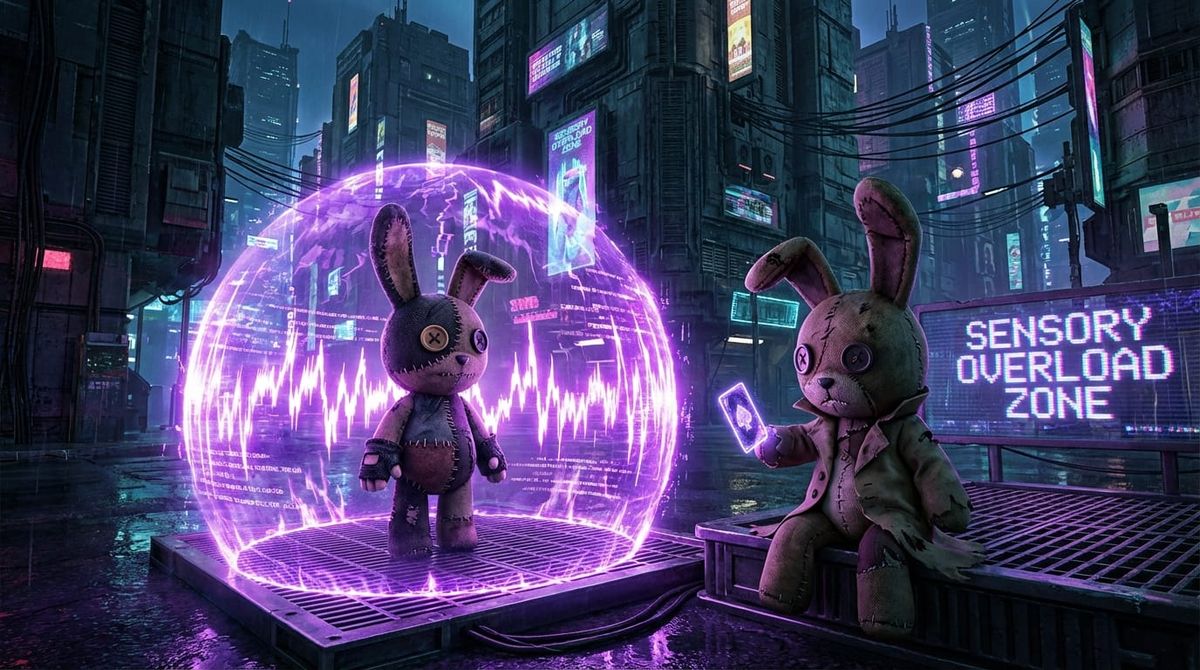
Anna Marie’s power works like this: skin contact absorbs whatever the other person is. Their strength, their memories, their abilities, their psychic signature. She takes it in involuntarily and it stays, sometimes for hours, sometimes longer. She cannot choose not to absorb. She cannot filter what she receives. She cannot turn off the signal. The world comes into her through contact whether she wants it or not, and it does not leave cleanly, and it changes her each time.
This has been running in Marvel comics since 1981 and for over forty years nobody called it what it is: a clinically precise description of what it feels like to be flooded by sensory and emotional input you cannot regulate and did not consent to receive.
The power is not a metaphor. Rogue is not a cautionary tale about emotional unavailability or a romantic subplot about the tragedy of the untouchable woman. She is the most accurate depiction in popular fiction of what it is to live in a nervous system that cannot modulate incoming information, that absorbs the environment rather than filtering it, that takes on the shape of whatever it contacts and has to spend enormous ongoing energy managing the residue.
The Mechanism Is Literal and the Isolation Is Structural
Rogue does not choose isolation. This is the first and most important clarification. The narrative occasionally drifts toward framing her solitude as a kind of chosen protection, a wall she builds to keep herself safe. This is wrong, and the wrongness matters. Rogue’s isolation is not psychological; it is physical and neurological. She cannot touch people. The isolation is the direct and unavoidable consequence of a power she did not choose, cannot turn off, and is not in control of. The wall is not metaphorical and she did not build it.
This distinction between chosen and structural isolation is one that neurodivergent people, particularly autistic people and those with sensory processing differences, navigate constantly. The outside interpretation tends toward psychology: they must be afraid of connection, they must prefer solitude, the distance is a choice that reflects something about their emotional state or their past. The inside experience is often different: the distance is not chosen; it is the direct result of how information actually moves through a nervous system that is wired differently. The socializing is not avoided because it is unwanted. It is avoided because it is genuinely overwhelming in ways that are hard to communicate to people for whom it isn’t.
Rogue cannot explain this in ways that land. She tries. The X-Men know the mechanics of her power; they understand why she doesn’t hug them. But understanding the mechanics is not the same as understanding the phenomenology of living inside them. She cannot explain what it feels like to walk into a crowded room knowing that any accidental contact; a brush of hands passing food, a knee touching another knee in a narrow seat, any moment of closeness that other people experience as neutral; is an intrusion she cannot block. She cannot explain the ongoing management cost of being perpetually alert to proximity, calculating distance, accounting for where everyone is, what they might do, whether she is safe or whether the next thirty seconds will flood her with a stranger’s memories and feelings and she’ll spend the next hour trying to find herself again inside the noise.
The management is the work. Not the power, not the fighting, not the Brotherhood or the X-Men or any of the plot. The management: the constant background process of maintaining enough distance to stay herself.
What Absorption Actually Means
When Rogue absorbs someone, she gets their memories. Not a summary; the actual thing. She experiences what they experienced, feels what they felt, knows what they knew. This is not information transfer in a neutral sense. These are other people’s emotional states landing in her nervous system without preparation or consent. If the person is in distress, she feels that distress. If the person has trauma, she accesses that trauma. If the person has a psychic profile as big and violent as Carol Danvers’, the absorption can be so intense that the absorbed personality destabilizes her own.
The Carol Danvers absorption is the most dramatic version of what is actually a chronic condition. Rogue touches Carol long enough that she absorbs her completely: takes her memories, her powers, her entire psychic presence, and Carol goes comatose while Rogue walks around with a second personality in her head, fighting for primacy. This is the extreme case. The ordinary case; the every-contact case, the accidental brush case; is not as dramatic but is not less real. She absorbs fragments. They accumulate. She is always, at some level, managing the residue of everyone she has ever touched.
The language neurodivergent communities use for this is emotional flooding: when the incoming information exceeds the nervous system’s processing capacity and the boundary between self and input starts to blur. What Rogue experiences is a literalization of flooding: the input is not filtered by normal human sensory processing, it comes in whole and it changes her, and her job for the duration of the absorption is to remember who she is underneath what she’s received.
This is exhausting in the specific way that chronic conditions are exhausting: not dramatically, not continuously, but as background load that never fully goes away and occasionally spikes into crisis. Most days she manages. Management is not the same as not being affected. Management is the work she does so that the effect stays within bounds. The moment she stops managing; the accidental touch, the careless proximity; is the moment the bounds fail and the flood begins.
Gambit Stays in the Radius
The Rogue-Gambit relationship is the most honest depiction of intimacy with a sensory disability in mainstream popular fiction, and it achieves that honesty by refusing to resolve the disability as the price of the love story.
Most narratives that pair an untouchable character with a love interest eventually solve the problem. Some cure is found, or some workaround, or the restriction is revealed to have been psychological all along and love is the key. The disability is the obstacle and the relationship’s job is to remove it. This is a comfortable story. It is also, for people living with conditions that don’t have cures or workarounds, an actively alienating one: the implication that the relationship is meaningful only if the condition is eventually overcome.
Gambit does not solve Rogue. He does not find a workaround (though they try many, across many years and many continuities). He does not convince her that the barrier is in her head. He stays in the radius: close enough to matter, calibrated to what she can actually have, choosing that proximity over and over without demanding that she become someone who can give him more.
This is accommodation as love rather than pity or patience. There is a difference. Patience implies waiting for the person to change. Accommodation means adjusting the terms of connection to what the person can actually offer, without resentment, without keeping score, without treating the limitation as a problem that requires solving before the relationship can be real. Gambit plays cards; he understands odds; he knows what he’s agreeing to. He agrees to it anyway. He stays.
The relationship is not without conflict. Gambit has his own secrets and his own damage and the comics have put them through cycles of separation and reconciliation that sometimes have nothing to do with her power and everything to do with the ordinary difficulties of two people with complicated histories trying to be in proximity. But the baseline: he does not ask her to be touchable. He does not make her disability the problem. He stays in the radius.
For people who navigate intimacy with sensory differences or disabilities; who have to tell partners what contact is possible, who watch relationships end because the accommodation required is more than the other person wants to give, who are familiar with being treated as a project rather than a person; this is the specific thing the narrative gets right.
Learning to Manage Versus Learning to Accept
The arc of Rogue’s character across forty-plus years is not toward a cure. There are periods where she gains control, where she can touch without absorbing, where the power is manageable in ways it usually isn’t. These periods always end. The power comes back to its default state, which is: involuntary, uncontrollable, isolating. The narrative keeps giving her control and taking it away, and what that pattern produces over decades is not a story about overcoming a disability. It is a story about living with a condition that does not resolve.
The distinction the arc slowly works toward; never cleanly, because comics don’t arrive at clean conclusions; is the one between learning to manage and learning to accept. Management is a skill set: how to navigate proximity, how to communicate limits, how to maintain yourself inside the flood when contact is unavoidable. Acceptance is a different thing: the recognition that the condition is not the enemy, that the self inside it is whole, that the life built around its constraints is not a lesser life.
Rogue starts the narrative at maximum resistance. The power is a curse, the isolation is punishment, the longing for ordinary contact is an open wound she keeps reopening by trying to touch people and absorbing them instead. The early arcs are defined by this resistance: she wants the power gone, wants to be normal, wants the thing that everyone else has that she cannot have.
The shift that happens slowly and without the narrative giving it a name is from resistance to inhabitation: she is still this person, she still has this power, and she is building a life inside those terms rather than waiting for the terms to change. She puts on gloves not as a symbol of shame but as a practical adaptation. She calibrates proximity, reads rooms, knows her own limits with a specificity that looks like expertise because it is. She is an expert in her own nervous system. She has had to be.
The acceptance is never triumphant. It doesn’t get a moment where she announces it. It appears in the texture of how she moves through the world: with competence rather than apology, with knowledge of her own limits rather than rage at them, with a relationship that exists inside those limits rather than despite them.
That is what the narrative actually contains, underneath the spandex and the southern accent and the white streak in the hair. A person who did not choose their neurology, who cannot change it, who has built a life that is full and real and includes love and loyalty and extraordinary competence, and who is neither cured nor destroyed by what she is. She is just living it. Most people with sensory and emotional differences are just living it. The recognition is not small.
The Thing Nobody Named for Forty Years
Anna Marie has been in comics since 1981. She became one of the most beloved characters in the X-Men roster almost immediately. She has her own title runs, has appeared in every major animated adaptation, is a central figure in the film franchise. She is beloved because readers recognize something.
The recognition is not always conscious. People who are flooded by sensory input, who have to manage proximity, who take on the emotional states of everyone around them and spend hours afterward trying to locate themselves in the residue; those readers have always known exactly what Rogue is. They saw it in 1981 and they see it now. They recognized the management work. They recognized the longing for contact that is constantly rationed. They recognized the Gambit relationship as the thing they were hoping for: someone who stays in the radius without demanding you be different.
What they didn’t have, for forty years, is the name for it. The diagnostic vocabulary for sensory processing differences, for emotional flooding, for the specific exhaustion of a nervous system that absorbs the environment rather than filtering it, was not part of popular discourse when Rogue was created. It is now. The character predates the language and maps onto it with a precision that is almost documentary.
She is not a metaphor for sensory overwhelm. She is a sensory overwhelm character written by people who were probably not thinking in those terms, assembled through sixty years of writers and editors and artists who kept pulling on the same threads because the threads were true. The X-Gene, again. The mutation that is not an abstraction. The body that is wired differently and will not stop being wired differently, no matter how much the story keeps trying to give it a cure.
She can’t be touched. That is not a metaphor. It is a description.