Storm Deserved Better Than Every Storyline She Got

Ororo Munroe can end a drought. She can pull moisture from the upper atmosphere and drop it precisely on a field that has been dying for a season. She can ground a fleet of aircraft without touching them, redirect a hurricane, freeze the surface of a river in thirty seconds. The mechanics of her power, when writers bother to think them through, make her the most consequentially useful person in any room she enters. She is not “strong for an X-Man.” She is strong in a way that rewrites the physics of any tactical situation. And Marvel spent forty years writing her as weather effects and cheekbones while the actual story of Ororo Munroe sat untouched.
The gap between what Storm is and how Storm has been written is one of the great wasted opportunities in superhero fiction, and it is not a gap that happened by accident. It happened through a specific series of choices, made repeatedly over decades, each of which prioritized other characters’ emotional development over hers, each of which treated her as an element of the setting rather than a person with interiority. She is, across the full sweep of X-Men publishing, more often a mood than a character. The thunder rumbles when the scene needs weight. The lightning crackles when someone else needs to feel the power of the situation. Ororo Munroe stands in the foreground of the shot and the camera is watching someone else.
The Goddess Trap
The “weather goddess” framing that Chris Claremont built around Storm when he introduced her in 1975 is both the most interesting thing about the character and the most limiting thing about her subsequent history. Calling her a goddess was accurate to the way her powers registered on the page: elemental, enormous, operating at a scale that made individual human concerns feel small. The Kenyan village that worshipped her as a deity wasn’t wrong. What she could do with weather was on the scale of what people historically explained with divine intervention. The framing gave her an immediate gravity that set her apart from the rest of the team.
The problem is that goddesses don’t have interiority. Goddesses are forces, not people. When you write a character as elemental, as iconic, as primarily legible through what she represents rather than what she experiences, you have given yourself permission to skip the part of characterization where you actually figure out what she wants, what she fears, what she finds funny, what she gets wrong. You have made her a symbol. Symbols can be present in every scene without anyone being obliged to think too hard about what they feel.
The goddess trap closes around Storm quietly, across the years. She becomes the character whose presence signals the scale of the threat. If Storm is there, this matters. If Storm is afraid, you should be afraid too. Her emotional register exists to calibrate the reader’s response to external events, not to be a response to her own internal life. She is weather. Weather is real and powerful and important, but you don’t ask weather what it wants.
Power Level, Narrative Investment, and the Gap Between Them
The disparity between Storm’s power level and her narrative treatment is jarring once you start tracking it. She is, by most reasonable reads of the comics, the most powerful X-Man in terms of raw capability. She is routinely classified alongside Jean Grey, Magneto, and Xavier in terms of threat potential. Her ability to manipulate weather on a global scale, when not arbitrarily limited by writers who need her to be matchable, makes her a one-person environmental catastrophe in a fight. This is not fan-theory math. This is what the text says.
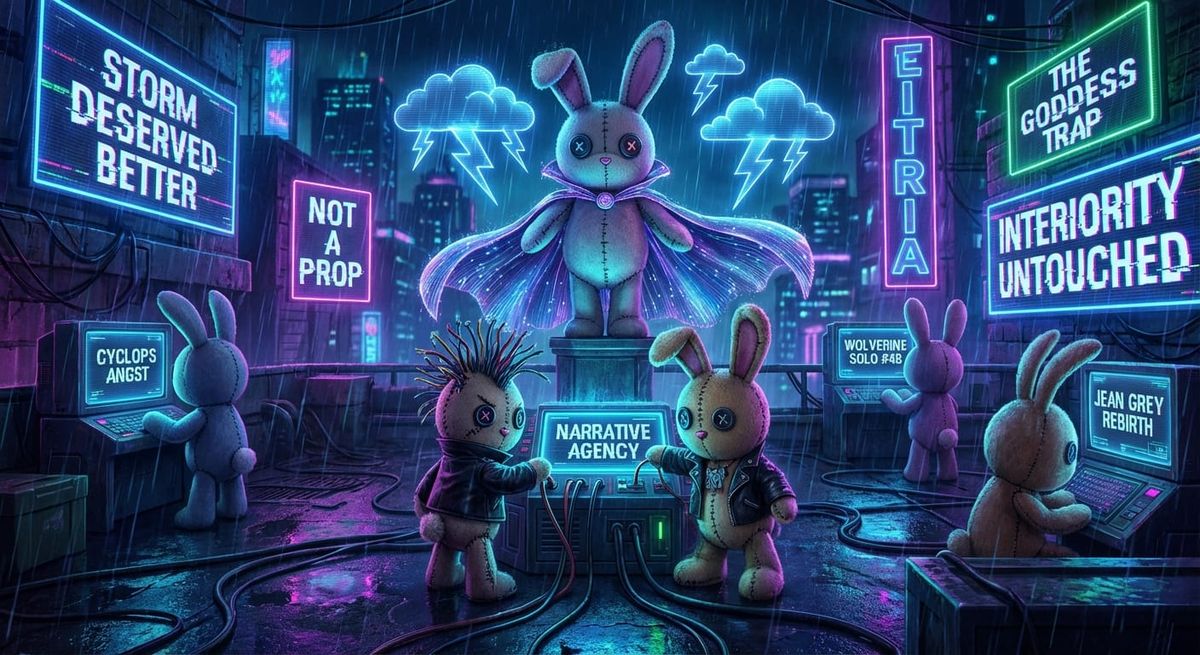
And yet: Cyclops gets the leadership anguish, the moral philosophy, the consequences. Wolverine gets the identity arc, the memory arc, the forty-seven solo miniseries. Jean Grey gets the metaphysics of power and sacrifice and rebirth. Rogue gets the body horror and the isolation. Magneto gets the Holocaust backstory and the long ethical argument. What does Storm get? She gets to look magnificent in a thunderstorm. She gets a brief period of leadership that tends to be interrupted whenever a white character needs to reclaim narrative prominence. She gets the Mohawk.
The Mohawk is actually the tell. During the brief period in the 1980s when Storm was written with a punk aesthetic, leather jacket and shaved head and a scrappy independent power base, something clicked. She had opinions. She had a visual identity that didn’t say “natural force” or “regal African queen” but said “this is a specific person who made specific choices about who she wants to be.” It was the one period where she felt like she had an interior life that generated her exterior presentation rather than the other way around. She also lost her powers during this period, which forced writers to write her without the weather as a crutch, to give her something other than atmospheric grandeur. The result was the most compelling she’s ever been on the page: a person stripped of the thing that made her iconic, figuring out who she is without it. It was also, predictably, temporary. The punk phase ended. The cape and the white hair and the goddess presentation reasserted themselves. The character contracted back to icon.
The Intersectional Blind Spot
Storm is the most famous Black woman in Marvel comics and almost certainly the most recognizable female X-Man globally. She has been on more X-Men promotional materials, covers, and movie posters than anyone except possibly Wolverine. She is, in terms of iconography, the face of the franchise for a very large portion of its audience. And she is, in terms of developed interiority, one of the least-explored major characters in the entire roster.
This is not a coincidence. It is the specific intersection of two forms of narrative marginalization that compound each other: the treatment of women in superhero comics, which tends toward decoration and sacrifice and support roles, and the treatment of Black characters, which tends toward nobility and strength and a kind of symbolic weight that substitutes for actual depth. Storm gets both. She is the strong Black woman, which is a type rather than a character, and she is the female team member, which in this genre tends to mean that her emotional life is defined by her relationships to the men around her rather than by her own trajectory.
What this produces, in practice, is a character who has been central to the X-Men for fifty years and who the audience knows surprisingly little about as a person. What are her politics, specifically, beyond “justice”? What does she find boring? What makes her laugh? What does she actually think about Xavier’s approach to the mutant question, and how has that view changed over the decades? The comics have gestured at all of this without committing to any of it, because committing requires a kind of care and specificity that her role as the team’s symbolic heart hasn’t demanded.
The Two Moments They Tried
The punk era is one of them. The other is the marriage to T’Challa, which is genuinely strange and messy and interesting in ways that nothing else in her history is. Ororo Munroe and T’Challa are two of the most powerful Black characters in their respective publishing lines. Their marriage in 2006 was, whatever its politics and the later editorial decision to annul it during Avengers vs. X-Men (which was widely and correctly read as a mistake), a period when Storm was written as a person with a life that extended beyond the X-Men’s concerns. She was a head of state’s consort. She was navigating the politics of Wakanda. She was someone with loyalties and history and a private life that didn’t reduce to “member of Xavier’s team.”
The marriage gave her an interior because it gave her a conflict: not the conflict of fighting Magneto or surviving the next apocalypse, but the conflict of being a person who belongs to more than one world and has to figure out what she owes to each of them. That is the material that produces character depth. It requires writers to think about what Ororo Munroe actually wants for herself, not what the plot requires of her. For a few years, they tried. Then the marriage was retconned for crossover event reasons and she went back to being weather.
What a Storm Story Would Actually Look Like
The material is all there. The life of Ororo Munroe, read on its own terms, is more interesting than almost anything the X-Men’s writers have done with it. Born in New York, raised in Cairo, orphaned by a plane crash that left her buried under rubble for days and gave her severe claustrophobia. Running the streets as a child thief under the Cairo crime lord Achmed el-Gibar. Walking across the Sahara and the length of Africa as a teenager with the nascent ability to call rain when she needed it. Arriving in Kenya and being regarded as a deity. Being recruited by Xavier. All of that, and the comics have mostly focused on the hair.
A Storm-centered story would have to take the claustrophobia seriously: not as a vulnerability to be exploited in fight scenes, but as the specific psychological mark left by a specific experience. It would have to take the thief childhood seriously: she knows how to read a person for weakness, how to move in a crowd, how to survive on nothing. She has a street intelligence that the regal-goddess presentation completely obscures. It would have to take the question of the village seriously: what does it do to a person to be genuinely worshipped, and how do you build a relationship to your own power that isn’t distorted by that experience?
The X-Gene Diagnosis frame puts the question this way: what did Ororo Munroe’s neurology make her into, and how has she chosen to live inside that? Her answer is not assimilation (she was never going to pass). It is not separatism (she keeps choosing to be in the world). It is something closer to the weather itself: she contains enormous force, and the question of when to release it and when to hold it is one she navigates every day. That is a story. Marvel has been sitting on it for fifty years and making her pose in thunderstorms instead.
There is also the question of what her power actually means at the psychological level: to manipulate weather is to manipulate mood at civilizational scale, to hold the capacity for drought or flood or the particular relief of rain after a long dry stretch. The literature on highly sensitive people, on those whose nervous systems process input at intensities that overwhelm typical regulatory capacity, is full of descriptions that map onto what Ororo experiences: the world arriving harder, louder, more consequentially than other people seem to find it. Her claustrophobia is one end of this. Her ability to feel atmospheric pressure change at thousands of feet is the other. These are the same nervous system. A real Storm story would put that at the center: not what she can do to weather, but what weather does to her, and how she has built a self that can hold both.
The injustice of Storm’s treatment isn’t just that a powerful character was underutilized, though she was. It’s that the underutilization happened to the character who, by her own history and by the logic of what her power means, had the most to say. She could have been the X-Men’s most sustained argument that being illegible to the world can become its own kind of freedom: the person whose power is too large to be contained who eventually stops trying to fit it into spaces designed for smaller things. Instead she was backdrop. Atmosphere. The weather before the scene begins.
She deserved to be the scene.