Mystique Has Been Passing Her Whole Life and It's Killing Her

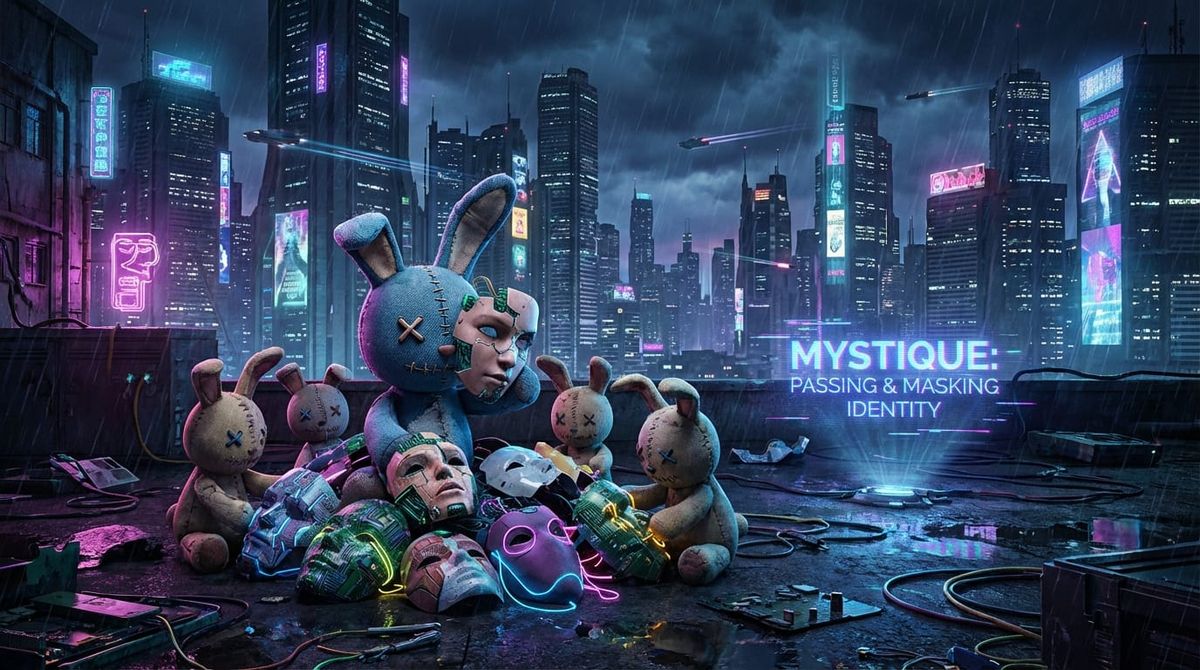
Raven Darkhölme looks like whatever the room needs. She has spent more of her life in other people’s faces than in her own, and after enough decades of that; after enough cycles of adopting a body, inhabiting it completely, shedding it when the mission ends or the cover is blown or the relationship becomes dangerous; the baseline self becomes genuinely difficult to access. Not impossible. But difficult in the specific way that things become difficult when you haven’t practiced them in a long time: you know the move exists, you know you’re capable of it, and when you try to make it you find that your body has organized itself around something else entirely.
She is blue. Her actual form is blue, with yellow eyes and a flat face and a body that looks nothing like human-standard. She has spent most of her adult life not in it.
This is the center of Mystique’s arc, and it is the thing that gets lost whenever her story gets told as espionage thriller or as villain origin or as complicated love story. Raven has a real form. That form is persistently experienced as a liability, as a thing that requires hiding, as the version of herself that the world cannot accommodate without hostility. She has adapted so completely to that hostility that the adaptation is now her primary identity. She is a shapeshifter who cannot easily access her own shape.
The Masking Problem
Masking is a term that emerged from autistic community discourse to describe the practice of suppressing natural behavioral tendencies in order to pass as neurotypical. You learn to maintain eye contact even when it’s aversive, to modulate your voice in ways that feel performed, to suppress the stimming or the direct speech or the unusual interest patterns that would make you visible as different. You learn the performance so thoroughly that it becomes automatic. And then, in the contexts where you don’t need to perform; with close family, in private, when you’re exhausted and the maintenance system has run out of energy; you find that the natural thing doesn’t come as easily as it once did. The performance has encroached on the self. The map has started to reshape the territory.
Raven’s situation is this pattern taken to an absolute extreme. She doesn’t suppress a behavior. She suppresses a body. For extended periods; months, years, in some arcs; she inhabits another form entirely, not as performance layered over the real thing, but as the actual texture of her daily existence. She eats breakfast in Carol Danvers’ face. She has difficult conversations in a borrowed body. She forms attachments and makes enemies and moves through the world in someone else’s skin so long that the question of which skin is hers becomes genuinely unstable.
The blue form is her real form in the technical sense: it is the form her body defaults to, the form she was born in, the form that emerges when she is not actively maintaining something else. But real form is not the same as home. After enough time away from a place, you can lose the intuitive familiarity with it. You can forget where things are kept. You can find yourself moving through it like a visitor rather than someone who belongs there. Raven’s blue form can feel that way. It is hers, and it is strange, and those two things coexist because of what she has done to survive.
What Decades of Passing Does to a Person
There is a particular cognitive and emotional cost to sustained passing that is distinct from the cost of ordinary social performance. Everyone performs to some degree: adjusting register for context, moderating affect in professional situations, presenting slightly different versions of the self in different relationships. This is not the same thing. Passing requires maintaining a fiction against active social pressure, with consequences for failure that range from discomfort to violence. It requires constant monitoring of the gap between what you are and what you are presenting as. It requires you to treat your actual self as a hazard, as the thing that must never fully surface.
Over time, this monitoring becomes exhausting in a way that is hard to explain to people who haven’t done it. The effort is invisible; that’s the point of it. But the energy it takes is real, and it comes from somewhere, and what it tends to come from is the self-knowledge and self-acceptance that other people spend that same energy building. The resources go to maintenance. The development of an inner life that you trust and can access goes underfunded. You become very good at reading rooms, at calibrating performance, at predicting what other people need to see. You become less good at knowing what you actually feel or want when no performance is required, because those moments are rare, and the skill for navigating them atrophies from disuse.
Raven is extraordinarily good at reading rooms. She has survived things that would have killed less adaptive people. She is also, underneath all of it, a person who has spent so long calibrated to other people’s expectations that the question of her own expectations feels almost academic. What does she want? What does she actually look like when nobody is watching? The answers are there somewhere, but they are buried under decades of scar tissue that took the form of someone else’s face.
Irene Adler as the Only Unmasked Space
Irene Adler; Destiny, the precognitive mutant; is the figure in Raven’s history where the pattern breaks. The relationship with Irene is the one that the other relationships are a sad echo of. It is the one where the blue form is not a liability. It is, by many accounts of their history, the form Irene knew first and best and most completely. The form Irene loved: not despite what it was, but as what it was.
This matters enormously. Most of Raven’s close relationships exist at some angle of adaptation. She is presenting a version of herself that her partners or allies or marks can accommodate. The relationship has a shape that is organized around what she is showing rather than what she is. With Irene, the relationship has a shape organized around the actual thing. And Irene is blind. She navigates Raven’s presence through whatever her precognitive gift allows her to access; a perception that is not organized around appearance, that does not evaluate or categorize based on what Raven’s body looks like. The blue form is not legible to Irene in the way it is legible to humans who respond to it with fear or revulsion. It is simply Raven.
The loss of Irene; and Raven loses her, repeatedly, in the way that people with difficult attachment histories tend to lose the thing they needed most: through death, through circumstance, through her own actions which are always somewhat compromised by the survival adaptations that protect her from everything except the things she actually can’t afford to lose; is not just grief over a partner. It is the loss of the only external space where the unmasked self was safe. After Irene, Raven has nowhere to put the blue form that doesn’t require her to justify it, defend it, or hide it.
What She Actually Looks Like
The comics have periodically given Mystique moments of vulnerability in which the blue form is present: captured, exhausted, off-guard, grief-struck. These moments are almost always framed as exposure. She is seen when she doesn’t want to be. Her actual face is a revelation to people who only know the borrowed ones, and it is often met with hostility, discomfort, or a kind of fascinated horror that she has learned to expect and has never stopped hating.
Her relationship with her son Kurt; Nightcrawler, who is also visibly inhuman, also blue-ish, also someone who has had to negotiate with the world’s hostility to his appearance; is an instructive contrast case. Kurt’s solution to looking visibly different was Catholicism and warmth: he developed a personality so generous, so genuinely kind, that people who met him found it difficult to sustain their fear of his appearance. He met the world’s hostility with openness and mostly won. Raven watched this happen from a distance, having abandoned him at birth because she could not protect him, and the contrast between his approach and hers is not a story about who did it right. It is a story about what resources you have available when you are a child navigating the world’s capacity for cruelty. Kurt had a village that eventually accepted him. Raven had nothing except the ability to stop looking like herself.
What these moments also reveal, when they’re written well, is that the blue form is not monstrous. It is simply not the form people were expecting. Raven’s actual face is expressive; her yellow eyes register emotion; there is a person visible in there who is not performing anything. But she has internalized the world’s response to it so thoroughly that even when no one is watching, she tends to put it away. The self-consciousness about the real form is internal now. It doesn’t require an external audience. She has become her own audience, evaluating the blue form through the lens of decades of hostile reception.
This is the tragedy in its cleanest form: she could be anyone, and because she could be anyone, she was never herself. The capability and the deprivation are the same thing. The power to wear any face made it rational to keep the actual face off the table, and the rationality of that choice does not make the choice hurt any less.
The Exhaustion Is the Point
Raven Darkhölme is not a villain because she is fundamentally cruel or corrupt or motivated by malice. She is a woman who decided, at some point early enough that she may not fully remember making the decision, that her survival required her to be whatever the situation needed. This is not a character flaw. It is an adaptive response to a world that was hostile to her actual form, that would not and cannot easily accommodate what she genuinely is.
The problem is that adaptive responses do not come with an off switch. They solve the immediate problem and then become the structure you live inside. Raven adapted to a world that could not handle her, and then she continued adapting past the point where the adaptation was strictly necessary, because by then the adaptation was her, or enough of her that the distinction had become difficult to locate.
She is tired. This is the thing that runs through her history if you read it as a human story rather than an action narrative. She is tired in the way that people are tired when they have been working very hard for a very long time at something that was supposed to be temporary. The passing was supposed to be a strategy. It became a life. The masks were supposed to be tools. They became the self that was presented, and presented, and presented, until the space where the other self was supposed to live had been slowly colonized by the performance.
She wants to stop. Not to die, not to give up, not to surrender in any dramatic sense. She wants to be able to be in her own form without consequence. She wants the thing Irene gave her. She wants the room where the blue face is not a problem to be solved. That room is very small now. It may not exist anymore. The question that haunts her, the one she does not examine directly if she can help it, is whether the person who would live in that room is still there, waiting; or whether decades of passing have made her so thoroughly the adaptation that there is nothing left beneath it to go home to.