Why the X-Men Metaphor Breaks Down (And What That Tells You)

The X-Men are the most sustained allegory for marginalization in popular fiction and they are wrong in ways that are more interesting than the ways they are right. The failure is not accidental. The specific points where the metaphor cracks open and stops working reveal something precise about how the culture that produced it thinks about difference: what it can imagine, what it keeps insisting on encoding, what it cannot bring itself to let go. If the series were simply a bad allegory, you could dismiss it. The fact that it’s a brilliant allegory that fails in particular directions is the thing worth studying.
The series launched in 1963 and has been read, with Stan Lee’s encouragement, as a metaphor for the civil rights movement, for Jewish persecution (most legibly through Magneto’s history), for queer experience, and increasingly for neurodiversity and disability. All of these readings find real purchase in the text. The experience of being visibly other in a hostile world; the institutional machinery that manages, surveils, and attempts to contain difference; the split between assimilation and separatism that maps almost perfectly onto every community navigating those choices: the X-Men get all of that right, and they get it right with enough specificity that the allegory has been genuinely useful to people trying to think through their own situations.
But the metaphor loads something into the story that none of those communities actually carries, and that loading has consequences.
The Dangerous-by-Nature Problem
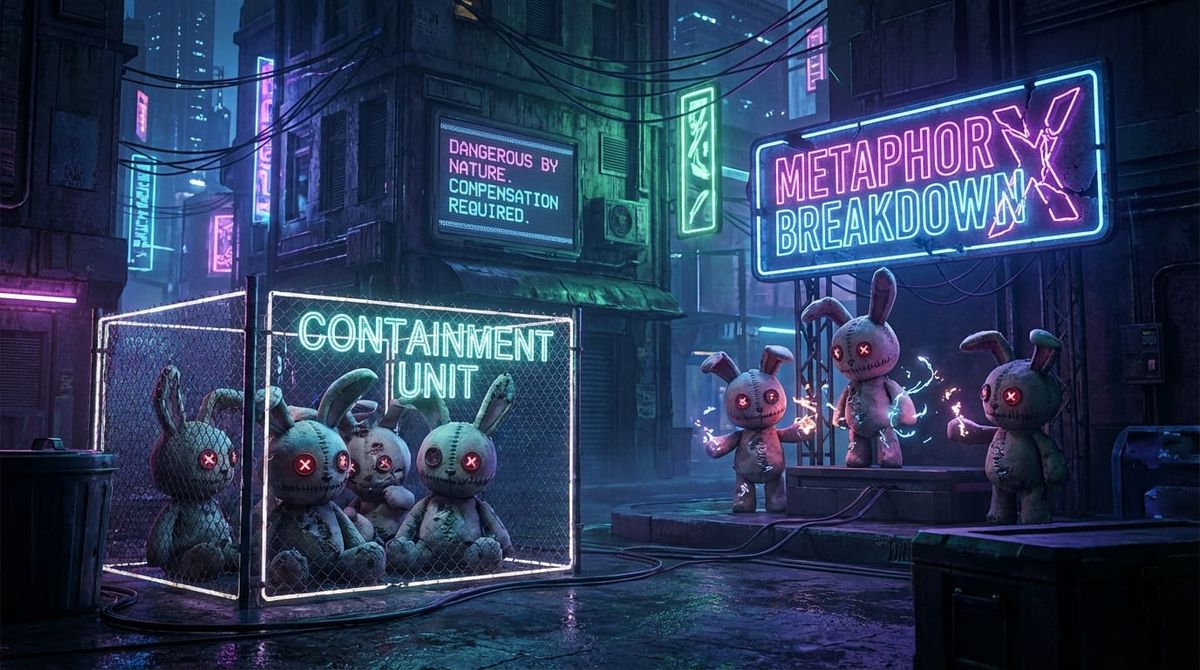
Mutants genuinely can hurt people. Not as a consequence of prejudice, not because an unjust system pushes them to violence, not as a metaphor for the way marginalized groups are falsely accused of danger: actually, physically, as a brute material fact of what mutation does in the Marvel universe. Cyclops’ optic blasts don’t care about his politics. Rogue absorbs life force on contact without intent or consent. Legion’s personalities contain powers that activate in ways he cannot control. The danger is not imputed. It’s intrinsic.
This is where every marginalization allegory the series attempts gets quietly sabotaged by its own premise. When the metaphor is race, the dangerous-by-nature encoding carries the exact resonance that centuries of white supremacist ideology has worked to establish: that Black people are inherently threatening, that the fear of them is rational rather than manufactured, that the violence directed at them is precautionary rather than predatory. The X-Men story says: we know you’re afraid, and your fear is actually not crazy, because some of these people can level buildings with their minds. That is not a metaphor for race. That is, structurally, an endorsement of the logic used to justify racial terror, dressed in the language of sympathy for the persecuted.
When the metaphor is queerness, the dangerous-by-nature encoding maps onto the pathologization of gay and trans people as threats to children, to social order, to the fabric of whatever institution wants to exclude them. Queer people are not dangerous. They were classified as dangerous by institutions that wanted to exclude them. The X-Men’s mutation is actually dangerous, in ways that queer identity is not and has never been. Running the allegory collapses the distinction between “classified as threatening by a hostile institution” and “genuinely capable of harm,” which is exactly the distinction that matters most when you’re trying to argue for the rights of people who have been falsely accused of posing a threat.
The neurodiversity mapping holds better than the others because it at least preserves the involuntary nature of the difference and doesn’t require the same category error about actual harm. But even there, the superpower framing introduces distortions: mutation in the X-Men universe means capability, power, enhancement alongside the costs. Neurodivergence is not like that. ADHD is not a superpower with a drawback. Autism is not a gift that makes you dangerous. The experience of being cognitively or neurologically atypical in a world built for a different kind of mind is not well served by a metaphor that keeps insisting difference comes packaged with extraordinary capability.
The Special Power Compensation
The culture is dramatically more comfortable with difference-as-gift than with difference-as-difference. The X-Men embody this preference structurally: every mutant has a power. The power is the point. The othering, the persecution, the institutional management: all of it gets framed around something that is, in its essence, an enhancement. Even the mutants whose powers seem purely negative (Rogue’s inability to touch; Cyclops’ inability to open his eyes safely) have those powers redeemed elsewhere as extraordinary capability. Rogue can absorb anyone’s abilities. Cyclops’ blasts could demolish a tank.
This is not how difference works for the people the metaphor is supposed to represent. The culture can imagine marginalized difference much more readily when it comes attached to compensation: a gift, a special insight, a superpower. The suffering is acceptable because it comes with something. The narrative metabolism requires a trade. Pure difference, difference that comes with costs and no compensatory enhancement, is much harder for the mainstream cultural imagination to hold with sympathy.
Look at how the culture talks about autism: the focus on “savant” abilities, on pattern recognition, on the tech industry’s framing of autism as a feature rather than a bug for certain applications. The narrative desire is always for the gift inside the disability, the special power that justifies the difference, the compensation that makes the whole package legible as worth accommodating. When the disability doesn’t come with a superpower, the cultural sympathy attenuates. The X-Men metaphor feeds this appetite rather than challenging it.
The series occasionally gestures toward mutants whose powers are purely negative, purely costly, with no redemptive capability attached. Those characters are almost never centered. The narrative keeps returning to the ones with extraordinary abilities because those are the characters around whom heroism can be organized. The result is an allegory that encodes, almost invisibly, the idea that difference worth defending is difference that brings something exceptional to the table. Difference that is simply different, simply present, simply requiring accommodation without offering anything back: the metaphor doesn’t have much room for that.
What the Allegory Gets Right Before It Fails
It’s worth being precise about where the metaphor holds before cataloging where it breaks, because the places it holds are the places it has done the most real cultural work.
The experience of being visibly marked as other in a world that has decided your kind is dangerous is rendered with genuine accuracy in the X-Men stories at their best. The moment of disclosure: will they know what I am, and what happens to me when they do. The calculation of passing: how much of myself do I suppress, and for how long, and what does the suppression cost. The community that forms among the persecuted: its internal politics, its debates between accommodation and resistance, its grief and rage and solidarity. All of this the series handles well, sometimes brilliantly, in ways that have genuinely mattered to readers who recognized their own experience in it.
The institutional analysis is particularly sharp. The Sentinel program, the Mutant Registration Act, the various government and corporate entities that spend decades trying to register, contain, and weaponize mutant bodies: these map with precision onto the bureaucratic management of disability, queerness, and race by institutions that frame surveillance and control as protection. The school itself is an institutional ambivalence: it shelters and it prepares mutants for service in a world that will never fully accept them, which is an accurate description of the position many special education programs and community organizations occupy relative to the communities they serve.
The Charles/Magneto split is the most durable and most analyzed element of the allegory, and it deserves to be: the assimilationist who believes in working within human society and the separatist who has decided human society is irredeemable are not caricatures. They are positions that real communities have actually occupied, with real intellectual content, and the series mostly respects both of them without declaring a clean winner.
The Allegory as a Ceiling
Here is the thing about allegory: it gets people to the conversation and then it shapes what they can think once they arrive. The X-Men have introduced millions of people to the basic structure of institutional discrimination, to the experience of being marked as other, to the political divide between assimilation and resistance. That is real and not nothing. The series has functioned as a gateway for political imagination that wouldn’t have been accessible to people who weren’t yet ready to engage with the direct version of those arguments.
But the gateway has a ceiling built into it. Once you’re inside the metaphor, you’re inside a story where the marginalized group actually is dangerous, where their difference actually is a superpower, where the culture’s fear of them has a material basis even when the institutional response to that fear is unjust. You have been educated into an analogy that preserves, at its structural core, the most damaging assumptions about the people it’s supposedly representing.
The ceiling is visible in how the stories handle the question of risk. When Professor X argues for coexistence, his argument is always partly about demonstrating that mutants can be trusted, that they can control their powers, that they are not the threat the fearful believe them to be. The argument for the rights of marginalized people should not depend on them demonstrating that they are not dangerous. Black people should not have to prove they are not a threat in order to deserve to not be shot. Queer people should not have to demonstrate they are not a danger to children in order to deserve civil rights. The X-Men metaphor keeps requiring this demonstration because the mutation actually can be a threat, and the stories keep needing to establish that these particular mutants have it under control.
This is the shape of the ceiling: the allegory trains its audience to understand civil rights as contingent on the marginalized group’s behavior, on their self-regulation, on their ability to suppress the dangerous aspects of their difference. That is not the argument for civil rights. That is the argument against them, dressed in sympathetic framing.
What the Breakdown Tells You
The specific ways the metaphor fails are data about the limits of the cultural imagination that produced it. The fact that the X-Men story cannot imagine marginalized difference without dangerous capability attached says something about what that culture believes, at a level below conscious politics, about the people it is trying to sympathize with. The sympathetic impulse is real. The structural encoding undermines it.
The series is not alone in this. Most mainstream representations of marginalized groups written by people outside those groups carry some version of this distortion: the sympathy is genuine and the structural assumptions are wrong, and the wrongness is usually located exactly where the creators didn’t think to look because it was too close to what they already believed.
What the X-Men allegory finally reveals, when you follow the breakdown far enough, is that the mainstream culture can hold the idea that persecuted groups deserve sympathy and protection. What it has a much harder time holding is the idea that the fear of those groups was never rational: not partly rational, not understandable given the context, not a reasonable response to genuine threat that simply required better management. Never rational. Built from nothing. That is the claim the metaphor cannot quite make, because the mutation is real and the powers are real and the danger is real, and somewhere in the narrative machinery, the culture kept needing that to be true.
The X-Men opened a door. The door has a frame around it, and the frame encodes assumptions that need to be seen clearly before they can be argued with. That is what the breakdown is for: not to dismiss the allegory, not to undo whatever it taught you, but to read its limits as carefully as its achievements. The series did real work. Now do the work the series couldn’t.