
Neurodiversity Did to the DSM What Darwin Did to Genesis

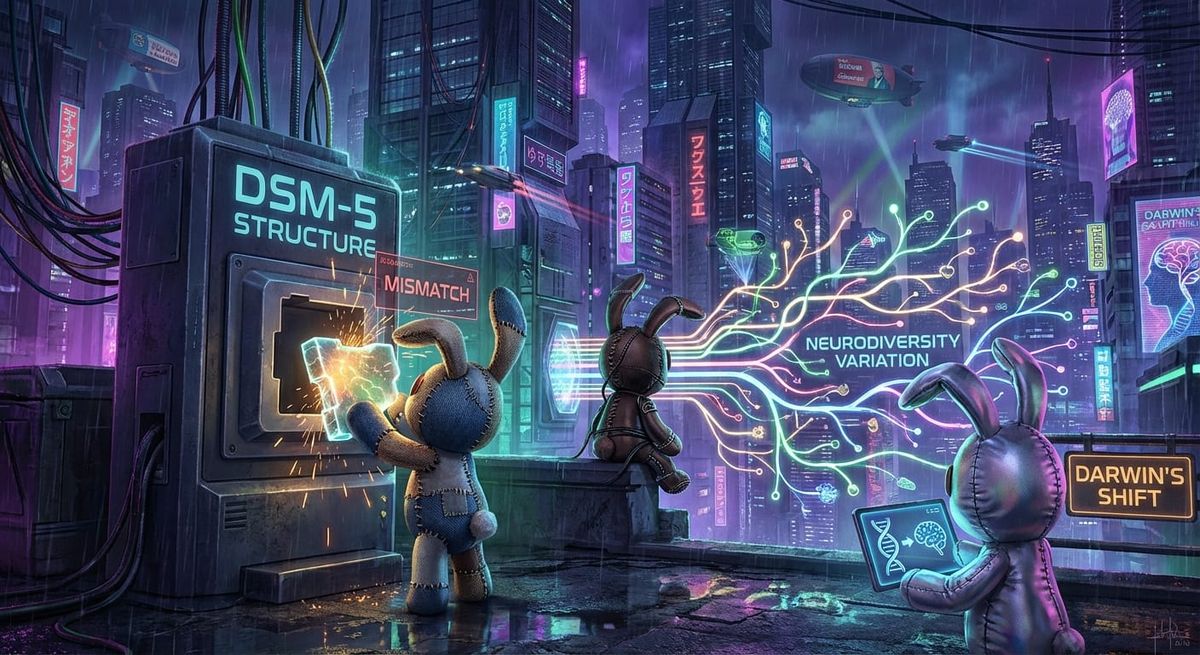
For most of the twentieth century, autism was a tragedy. It was a thing that happened to families, a developmental catastrophe, a life sentence spoken in clinical monotone across a desk. The child was broken. The parents were heartbroken. The system existed to minimize the damage and, if possible, make the child look more normal. The entire apparatus; the therapies, the interventions, the educational placements, the social scripts; was organized around a single assumption: there is a correct way for a brain to work, and this brain is not doing it.
Then the people with those brains grew up and got internet access. And they had a different account of what was happening.
The Claim That Changed Everything
The neurodiversity movement did not begin with a manifesto or a paper. It emerged in the late 1990s from autistic self-advocacy communities online, and its central claim was deceptively simple: neurological differences like autism and ADHD are natural variations in human cognition, not disorders to be cured. The word “neurodiversity” was coined by Judy Singer, an Australian sociologist who is herself autistic, in her 1998 honors thesis. The concept spread through forums, blogs, and eventually into academic discourse, and it carried an argument that the diagnostic establishment was not prepared to answer.
The argument goes like this. The DSM defines disorders by their deviation from a norm. To have a disorder, your cognition or behavior must differ from what the manual considers typical in ways that cause clinically significant distress or impairment. But “distress” and “impairment” are not properties of a brain in isolation. They are properties of a brain in an environment. An autistic person who struggles to maintain eye contact is “impaired” only in an environment that demands eye contact as a condition of social participation. An ADHD brain that cannot sustain attention on a quarterly earnings report may be exquisitely suited to environments that reward rapid context-switching, novelty-seeking, and hyperfocus on high-interest tasks. The “disorder” is not in the brain. It is in the fit between the brain and the world it was dropped into.
This is not a small point. It is a foundational challenge to the entire diagnostic framework. If disorder is context-dependent rather than brain-inherent, then the DSM is not describing objective pathology. It is describing the gap between neurological variation and social expectation. And that gap is a property of the social environment as much as it is a property of the individual brain.
Why This Is Like Darwin
The comparison is not casual. Before Darwin, the diversity of life was understood through a framework of design. Each species was created for a purpose. Deviation from the design was error, corruption, fall. The framework was teleological; everything existed to fulfill a function assigned by the designer, and things that didn’t fit were broken versions of things that should.
Darwin replaced this with a framework of variation. There is no design. There is no correct form. There is only variation, and selection pressures that make some variations more or less viable in specific environments. A trait that is maladaptive in one ecology is adaptive in another. The penguin’s wings are useless for flying and perfect for swimming. Calling them “disordered wings” would be absurd; the wings work fine, you’re just evaluating them against the wrong function in the wrong environment.
The neurodiversity movement makes precisely this move with respect to human cognition. The DSM operates within a framework that is, at its foundation, creationist about the mind. There is a correct way for a brain to develop, a normal trajectory, a healthy outcome. Deviations from this trajectory are disorders; failures of the developmental design. Neurodiversity says: there is no design. There is variation. And the question of whether a given variant is a disorder depends entirely on the environment in which it is being evaluated.
This is the argument that makes the diagnostic establishment uncomfortable, because it cannot be answered within the DSM’s own framework. The DSM assumes that disorders are real categories that exist in brains. Neurodiversity says that at least some of what the DSM calls disorder is variation that has been pathologized by a society organized around a narrow cognitive norm. These are not compatible positions, and no amount of revision to the manual’s specific criteria can resolve the incompatibility. The disagreement is at the level of the framework, not the details.
The Strong Version and the Weak Version
The neurodiversity argument comes in versions, and it matters which one you’re engaging with.
The weak version says: some conditions currently classified as disorders are better understood as cognitive variations that become disabling primarily because of environmental mismatch. Autism and ADHD are the paradigm cases. The appropriate response is not to cure the variation but to modify the environment; accommodations, inclusive design, social acceptance of different cognitive styles. This version is compatible with the existence of genuine neurological disorders. It just argues that the line between disorder and variation is drawn in the wrong place, and that some of what falls on the disorder side should be moved.
The strong version says: the entire concept of neurological disorder is a social construction. There is no principled way to distinguish pathology from variation, because all such distinctions rest on normative judgments about what brains should do. This version is more philosophically radical and more practically difficult. Taken to its logical conclusion, it implies that schizophrenia, severe intellectual disability, and progressive dementia are also “variations” rather than disorders, which is a position that very few neurodiversity advocates actually hold but that critics frequently attribute to them.
The interesting territory is between these two versions. The weak version is obviously true for at least some cases; the history of homosexuality as a psychiatric diagnosis proves that the line between disorder and variation can be badly drawn and that moving it is sometimes the correct response. The strong version captures something real about the social construction of diagnostic categories without providing a workable framework for distinguishing cases where the construction is doing real damage (pathologizing autism) from cases where the construction is tracking something genuine (identifying Huntington’s disease).
Most thoughtful neurodiversity advocates operate in this middle territory, and the sophistication of their position is routinely underestimated by both the clinical establishment and the popular press. The caricature, endlessly recycled by critics, is that neurodiversity advocates think all neurological conditions are fine and nobody needs treatment. This is roughly as accurate as saying that evolutionary biologists think all mutations are beneficial. The actual position is subtler and more interesting than the caricature, which is why the caricature persists; the subtle version is harder to dismiss. They are not saying that suffering isn’t real. They are saying that the causal story matters. If an autistic person is suffering because they can’t find employment, that suffering is real, but the cause is a labor market organized around neurotypical social performance, not a defect in the autistic person’s brain. Treating the brain (with medication, with behavioral compliance training) when the problem is the environment (rigid social norms, inflexible workplaces, sensory-hostile public spaces) is not just ineffective. It is a misdiagnosis at the structural level.
What Happens to the Edifice
If the neurodiversity argument is correct, even in its weak form, the implications for the DSM are substantial. The manual’s authority rests on the assumption that it is describing objective conditions; things that are wrong with people, discoverable through observation and measurement, existing independently of social context. If disorder is substantially context-dependent, the manual is not a catalog of diseases. It is a catalog of mismatches between brains and environments, with the mismatch attributed entirely to the brain side of the equation.
This reframing does not destroy the utility of diagnosis. It repositions it. A diagnosis of ADHD, understood through the neurodiversity lens, is not a statement about a broken brain. It is a statement about a brain whose operating parameters conflict with the demands of a specific environment; typically, the modern educational and corporate environment, which requires sustained attention to low-interest tasks, long periods of physical stillness, and deferred reward. The diagnosis identifies the mismatch. But the intervention should address both sides of the mismatch, not just the brain side.
Consider what this reframing means concretely. An autistic child who melts down in a fluorescent-lit, noise-saturated classroom is not displaying a symptom of their disorder. They are displaying a predictable response of their sensory system to an environment that was designed without their neurology in mind. The meltdown is as much a property of the classroom as it is a property of the child. Change the lighting, reduce the noise, allow movement breaks, and the “symptom” diminishes or disappears. The brain didn’t change. The fit changed.
The clinical establishment has partially absorbed this. Accommodations for ADHD and autism are now standard in educational settings in many countries. The language of “neurodivergent” has entered corporate HR departments, sometimes sincerely and sometimes as performance. The Americans with Disabilities Act, in its framework of “reasonable accommodations,” implicitly concedes the neurodiversity point; if the problem were entirely in the person, accommodation of the environment would be conceptually incoherent.
But the absorption is incomplete and sometimes contradictory. The same clinical system that provides accommodations also prescribes stimulant medication to make the ADHD brain conform to the environment that the accommodations are supposed to modify. The same educational system that offers extended test time also teaches to a standard that treats neurotypical attention spans as the default. The neurodiversity framework has been adopted as rhetoric while the underlying medical model continues to operate as infrastructure.
The Limits of Reframing
The neurodiversity argument is powerful, but it has limits that its strongest advocates sometimes understate. Not all neurological difference is benign variation in an unfriendly environment. Some conditions involve suffering that does not reduce to social mismatch. A person with severe, treatment-resistant depression who cannot experience pleasure, maintain relationships, or sustain the will to live is not experiencing an “environmental mismatch.” Something in the machinery of their affective system is malfunctioning in a way that would cause suffering in any environment.
The movement’s own internal debates reflect this tension. Many autistic advocates draw a distinction between autism (a cognitive style, a way of being in the world) and the co-occurring conditions that frequently accompany it (epilepsy, gastrointestinal problems, severe sensory processing difficulties). The former, they argue, is variation. The latter are medical conditions that deserve treatment. This distinction is reasonable, but it concedes the existence of genuine neurological disorder, which means the work of drawing the line cannot be avoided; it can only be done more carefully.
The harder question is whether the line can be drawn in a principled way, or whether every attempt to distinguish disorder from variation will ultimately rest on the same normative judgments that the neurodiversity movement criticizes. This is the question the field has not answered and may not be able to answer without abandoning the DSM framework entirely and building something new. The Research Domain Criteria initiative at the NIMH is one attempt. It has its own problems. But the recognition that the old categories are not working; that they are neither purely biological nor purely social, neither objectively discovered nor arbitrarily invented; is the beginning of an honest reckoning with what diagnosis actually is.
The autistic and ADHD communities did not set out to create an epistemological crisis in psychiatry. They set out to be treated with dignity, to have their experiences taken seriously, and to push back against a system that treated their brains as broken. In doing so, they raised questions about the nature of disorder that the field’s own researchers had been avoiding for decades. The questions are not going away. They are, if anything, getting sharper.
What Darwin did to Genesis was not to prove it wrong in every detail. It was to reveal that the framework itself could not accommodate the evidence. The species were not designed. They varied. And once you saw variation where you had seen design, you could not unsee it. The neurodiversity movement is doing the same thing to the DSM. Not proving every diagnosis wrong. Revealing that the framework of disorder cannot accommodate the reality of neurological variation without making normative judgments it claims not to be making. Once you see that, the manual reads differently. It doesn’t stop being useful. It stops being innocent.