Monogamy: The Default Nobody Chose
Monogamy became the default through property law, paternity certainty, and agricultural economics — not conscious choice. It has real benefits. It also arrived without a ballot.

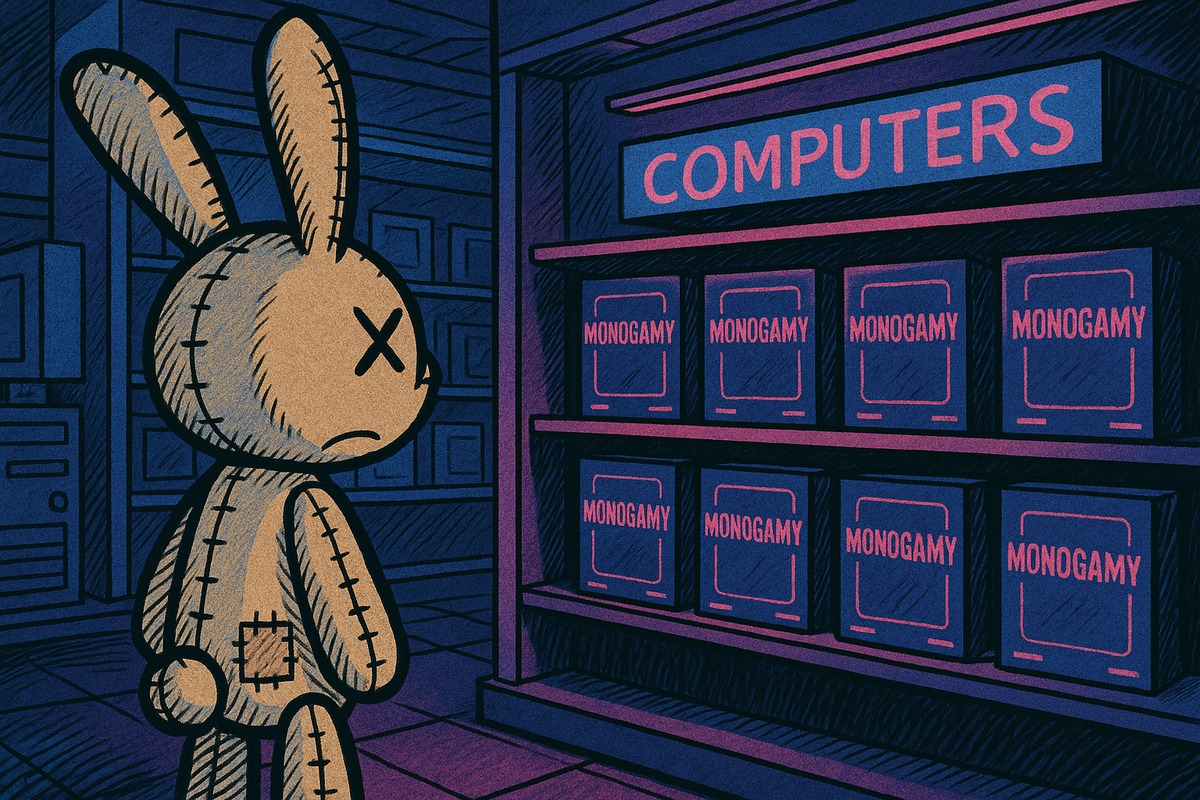
You didn't choose monogamy. It was installed before you were born, bundled with the operating system, presented as the only option. Like Internet Explorer in 1998—not because it was the best browser, but because it came with the machine.
This isn't an argument against monogamy. It's an argument for understanding what you're actually running and why.
The Agricultural Thesis
For most of human history—roughly 200,000 years—we lived in small bands where pair bonding was flexible, serial, and often overlapping. The anthropological record is messy, but the consensus is clear: strict lifelong monogamy wasn't the dominant pattern.
Then, about 10,000 years ago, agriculture happened.
Suddenly you had surplus. Stored grain. Heritable land. And with heritable assets came a question that didn't exist before: whose kid is this?
Paternity certainty became economically load-bearing. If you're passing down a farm, you need to know who inherits it. Monogamy—specifically, female sexual exclusivity enforced through social and legal structures—solved this problem.
The pair bond didn't evolve for love. It evolved for property rights.
The Deal
Here's what monogamy actually offers, stripped of romance:
Resource pooling. Two incomes, shared housing costs, combined labor for child-rearing. Economies of scale.
Paternity certainty. For men, confidence that offspring are genetically theirs. For women, guaranteed investment from the father.
Social stability. Fewer men locked out of the mating market means less male violence. (Polygyny concentrates women among high-status men, leaving low-status men with nothing to lose.)
Attachment repair. A long-term partner becomes a secure base. For those with insecure attachment styles, this can be genuinely healing—if you pick the right partner.
Predictability. You know what you're working with. The relationship escalator has defined stops. Society provides scripts.
The Trade-Offs
Nothing is free. Here's what monogamy costs:
Mate guarding. Jealousy isn't a bug—it's a feature. The system requires vigilance against defection. This vigilance is metabolically expensive and, for anxious attachment styles, often pathological.
Desire attenuation. Sexual novelty triggers dopamine. The same partner, year after year, triggers less. This isn't failure—it's neurochemistry. The system assumes you'll trade passion for stability. Many people didn't get that memo.
Opportunity cost. Every partnership forecloses others. The person you chose at 25 may not be who you'd choose at 45, but the switching costs are enormous—especially with kids, shared assets, and intertwined lives.
Trapped anxious types. If you have an anxious attachment style and pair with an avoidant, monogamy can become a prison. You're locked in with someone who can't meet your needs, and the structure prevents you from getting them met elsewhere.
Mismatch with modernity. We live 80 years now, not 35. Careers change. People change. "Till death do us part" meant something different when death showed up at 40.
Attachment Styles in Monogamy
Secure attachment does well in monogamy because they can tolerate intimacy without suffocation and independence without abandonment panic. They picked a compatible partner, they maintain connection, they're fine.
Anxious attachment often desperately wants monogamy because it promises the constant reassurance they crave. But the promise is false—no structure guarantees your partner will meet your needs. Anxious types in monogamy often become hyper-vigilant, jealous, and exhausting to their partners.
Avoidant attachment often accepts monogamy as the default but keeps emotional distance within it. They're "monogamous" in structure but absent in practice. The commitment is nominal; the intimacy is rationed.
Disorganized attachment may cycle between clinging to monogamy (the structure feels safe) and sabotaging it (the intimacy feels threatening). They want the security but can't tolerate it.
The Neurochemistry Nobody Mentions
Monogamy makes specific demands on your brain chemistry that aren't optional.
Phase 1: Eros (0-2 years). Dopamine floods. Intrusive thoughts about the partner. Obsessive checking for texts. This is limerence—a temporary psychotic state that evolution uses to bind you together long enough to reproduce.
Most people lock in their monogamous commitments during eros. They marry while high. This is like signing a mortgage while on MDMA.
Phase 2: Attachment (2-5 years). Dopamine drops. Oxytocin and vasopressin rise. The obsession fades. The bond deepens—or it doesn't, and you realize you committed to someone you don't actually know.
This is where most first marriages fail. The drug wore off. You're left with who they actually are. For some people, that's beautiful. For others, it's a stranger wearing your partner's face.
Phase 3: Companionate love (5+ years). If you make it here, you've built something real. The relationship is no longer driven by neurochemical flooding. It's driven by accumulated trust, shared history, mutual investment. This can be profoundly secure—or it can be dead intimacy held together by inertia and fear of starting over.
The question monogamy never asks: what happens when your brain chemistry changes but your legal contract doesn't?
The Economic Substrate
Strip away the romance and monogamy is fundamentally an economic arrangement.
Risk pooling. Two incomes against one unemployment. Two social networks. Two sets of skills. The couple as economic unit is more resilient than the individual.
Labor specialization. Historically: he earns, she raises children and maintains the home. Modern couples supposedly split this, but the data shows women still do more domestic labor even when both work full-time. The arrangement hasn't caught up to the equality rhetoric.
Asset accumulation. Shared housing, merged finances, combined credit. You can afford more together than apart. The 30-year mortgage assumes a 30-year relationship. The question is whether your relationship matches the timeline your debt requires.
Exit costs as commitment mechanism. The harder it is to leave, the more credible your commitment. Shared assets, children, intertwined friend groups—these aren't bugs, they're features. They make defection expensive, which makes the partnership stable. Until it becomes a prison.
The economic logic is sound. The problem is when economic necessity masquerades as romantic destiny. "We can't afford to break up" is a different proposition than "I choose you every day."
The Naturalness Fallacy (Both Directions)
Some people argue monogamy is "unnatural" because our ancestors weren't strictly monogamous. This is dumb. Agriculture is unnatural. Antibiotics are unnatural. "Natural" is not a moral category.
Other people argue monogamy is "natural" because pair bonding exists in nature. Also dumb. So does infanticide. So does cannibalism. Nature is not a moral guide.
The question isn't whether monogamy is natural. The question is whether it works for you, given your attachment style, your needs, your partner's capacity, and what you're actually trying to build.
The Practical Mechanics of Making It Work
If you're committed to monogamy—by choice, not default—here's what actually keeps it functional:
Maintenance sex. The neurochemical truth is that sexual novelty triggers dopamine and sexual familiarity doesn't. If you wait for spontaneous desire after year five, you'll be waiting forever. Maintenance sex means having sex even when you're not desperately horny—because the act of having sex generates the hormones that make you want to have sex. It's a feedback loop. Stop having sex and the loop breaks. Start having sex and it rebuilds. This is mechanics, not romance.
Explicit renegotiation. The relationship you built at 25 isn't the relationship you need at 40. Monogamy assumes "till death" but doesn't provide tools for adapting when life changes careers, health, desire, values. Couples who survive long-term revisit the terms every few years: What do we each need? What can we each give? Is this still working? Renegotiation isn't failure—it's maintenance.
External intimacy without sex. The anxious type needs to know they're allowed to have deep friendships that meet emotional needs their partner can't meet. The avoidant needs to know they're allowed to have space without it meaning abandonment. Monogamy that demands your partner be your only source of intimacy is monogamy destined for resentment. Sexual exclusivity doesn't require emotional totalitarianism.
Exit awareness. Paradoxically, relationships that acknowledge exit possibilities are often more stable than those that deny them. "You could leave, I could leave, and we're both choosing to stay" is healthier than "we can never leave so we're stuck with each other." The latter breeds resentment. The former breeds gratitude.
When Monogamy Is the Wrong Tool
Some people are structurally incompatible with monogamy, and no amount of willpower changes this.
High novelty seekers. If your dopamine system requires constant newness to feel alive, monogamy will feel like slow death. You can white-knuckle it, or you can acknowledge that your brain is asking for something the structure can't provide.
People with very high or very low libido partnered with the opposite. The high-libido partner will feel starved. The low-libido partner will feel pressured. Monogamy requires both partners to sexually match or for one to permanently compromise. This can work, but often doesn't.
Avoidants paired with anxious. The anxious-avoidant pairing is the most common dysfunctional dyad in monogamy. Anxious wants reassurance through closeness. Avoidant needs reassurance through distance. Monogamy locks them together, guaranteeing both will be perpetually unsatisfied. The anxious escalates bids for connection. The avoidant withdraws further. The cycle accelerates until someone leaves or everyone becomes miserable.
People whose identity requires external validation. If you need to be desired by multiple people to feel like yourself, monogamy asks you to kill part of your identity. Some people do this successfully. Others do it resentfully. Others cheat.
The Honest Assessment
Monogamy works when:
- Both partners have secure attachment or are actively working toward it
- Sexual compatibility is high or both partners have genuinely low libido
- The relationship provides what both people need without requiring either to abandon themselves
- Both people chose each other after the eros phase, with clear eyes
- Both people are willing to renegotiate terms as life changes
- Neither person requires novelty or external validation as a core need
Monogamy struggles when:
- One partner is anxiously attached and the other is avoidant
- Sexual compatibility is low but neither partner is willing to address it
- The relationship was locked in during eros before either person knew what they actually needed
- External validation or novelty is a core need for either partner
- Either partner believes "love should be enough" without doing the actual work
- The relationship has become economically entangled but emotionally dead
The Serial Monogamy Workaround
Most people aren't actually practicing lifelong monogamy. They're practicing serial monogamy—a series of monogamous relationships, each lasting a few years, with breakups in between.
This is monogamy adapted to modern lifespans. Instead of one person for 60 years, it's three or four people for 15-20 years each. Each relationship serves a different life stage. The person who was right at 22 isn't right at 42, so you switch.
Serial monogamy gets the benefits of pair bonding—intimacy, resource pooling, attachment security—without requiring the same person to meet your needs across six decades of radical life change.
The problem: serial monogamy has all the upheaval costs of breakups—dividing assets, custody battles, social network disruption, grief—without the cultural support that lifelong monogamy gets. You're doing breakups on repeat, and each one is treated as failure rather than as natural lifecycle completion.
The advantage: you're not trapped. Each relationship can be what it needs to be for as long as it works. When it stops working, you're allowed to leave. This is more honest than staying in a dead marriage for 30 years because you made a promise at 25.
The Point
Monogamy is a technology. Like any technology, it has use cases where it excels and use cases where it fails. The agricultural revolution needed it. Modern humans might need something different—or they might need exactly this, depending on who they are.
The problem isn't monogamy. The problem is installing it by default without checking whether it's compatible with the hardware.
Your attachment style is the hardware. Monogamy is the software. Before you commit to running it for the next fifty years, you might want to check the system requirements.
And if you're going to run it, run it consciously. Not because it's default, not because everyone else is doing it, not because you think you should want it. Run it because you've assessed what you actually need, what your partner can actually provide, and whether this structure serves those needs better than the alternatives.
Anything else is flying blind with a 50-year commitment.