Low Agreeable Plus High Open: The AI Superpower Combo
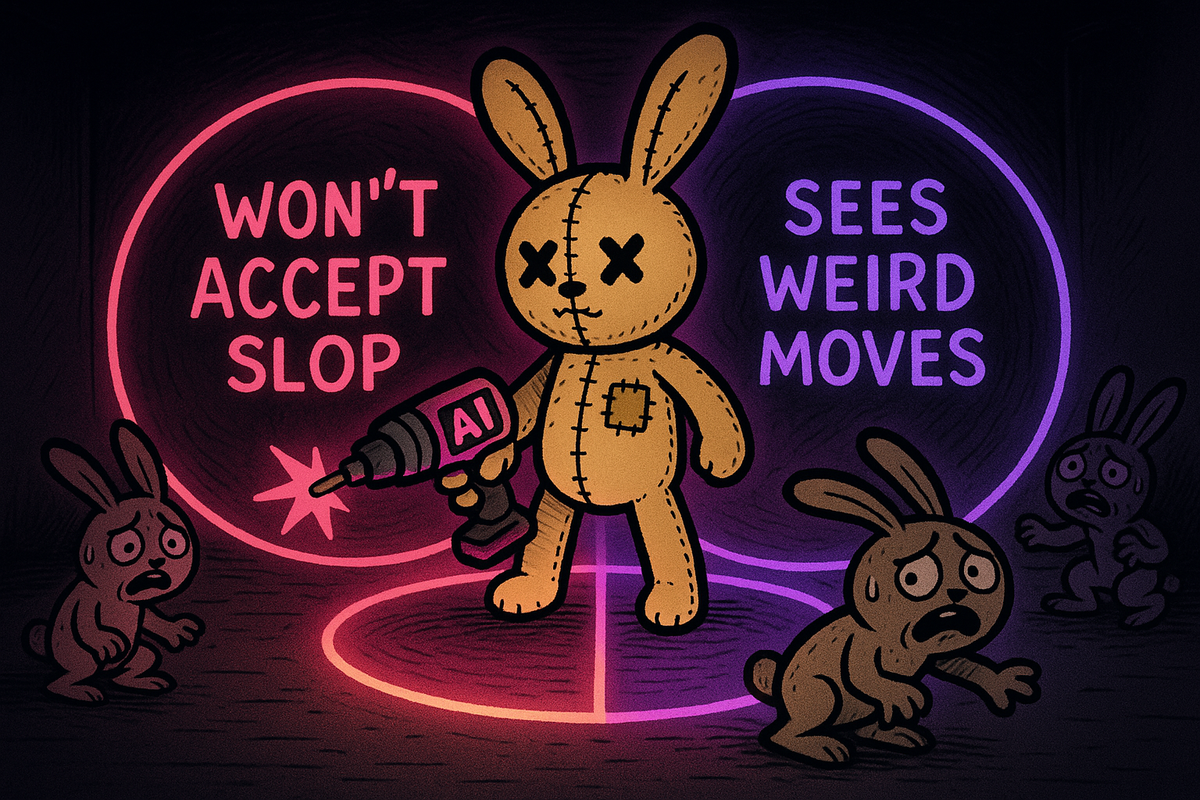
Low agreeableness won't accept mediocre outputs. High openness finds novel applications. This personality combo is disproportionately built for the AI moment.

Part 12 of 25 in the The Philosophy of Future Inevitability series.
We've walked through the traits individually. Now the synthesis.
One combination stands out: low agreeableness plus high openness.
This is the phenotype built for the AI moment. The person who won't accept slop and sees novel applications. Who pushes back on mediocre output and explores unprecedented uses.
This is the AI superpower combo.
And if you understand why this combination works, you understand something fundamental about how humans will differentiate themselves in the AI era. Most competitive advantages in the past came from what you knew or who you knew. This one comes from how you're wired to interact with generative systems.
The Combination
Low agreeable means: Skeptical. Demanding. Willing to push back. Doesn't need approval. Comfortable with conflict.
High open means: Curious. Creative. Novelty-seeking. Comfortable with ambiguity. Sees possibilities.
Combined:
They explore the technology because they're curious. They push back on outputs because they're demanding. They find novel applications because they're creative. They iterate until excellent because they don't accept adequate.
Here's the mechanism that makes this powerful: AI systems are trained on RLHF—reinforcement learning from human feedback. They're optimized to produce outputs that humans accept, not outputs that are excellent. The threshold is "good enough to avoid rejection."
The high agreeable person accepts at exactly this threshold. They get the minimum viable output because they signal acceptance too early. The low agreeable person rejects at this threshold and forces the system into territory it explores less often—the genuinely good outputs that require iteration to reach.
Meanwhile, high openness means they're exploring use cases the system wasn't explicitly trained for. Edge cases. Novel combinations. The intersection of curious exploration and demanding iteration is where unexpected capability emerges.
Why This Wins
Most people have one or the other.
High open, high agreeable: Explores but accepts slop. Finds cool applications, doesn't push for quality. Creative but not rigorous.
Low open, low agreeable: Skeptical but doesn't explore. Might push back on what they know, but doesn't discover new territory. Critical but not creative.
Low open, high agreeable: Doesn't explore, accepts what they're given. Uses AI minimally and uncritically. The worst combination for this moment.
Low agreeable, high open: Explores and demands quality. Discovers and iterates. Creative and rigorous.
The combination produces both breadth and depth. Both discovery and excellence.
Think of it as search strategy. High openness gives you broad search—you're exploring the full possibility space. Low agreeableness gives you deep search—you're not stopping at the first acceptable result, you're pushing until you find something genuinely good.
Broad and shallow finds a lot of mediocre applications. Deep and narrow finds excellence in limited domains. Broad and deep—the low agreeable, high open combination—finds excellent applications in unexpected domains.
This is why this phenotype becomes the "AI person" in organizations. They're not smarter. They're not working harder. They're searching differently. Their trait combination matches the demands of the technology.
The Iteration Advantage
Watch the low agreeable, high open person with AI:
They try something new. The output isn't great. They push back: "No, that's not what I meant. More specific. Less generic. Actually engage with this."
They try again. Better. But not there yet. They push again.
Eventually, the output is excellent. Something the high agreeable person never would have reached.
Then they try something else entirely. A novel application the low open person never would have discovered.
Breadth times depth. Exploration times iteration.
Here's what this looks like in practice: They might spend thirty minutes iterating on a single prompt, pushing the AI through six or seven revisions. The agreeable person would have stopped at revision two. The low open person wouldn't have tried the use case in the first place.
By revision seven, they've discovered something. Maybe a way to structure data they hadn't considered. Maybe a framing that makes a complex concept clear. Maybe an application that seems obvious in retrospect but wasn't in the training data.
Then they take that discovery and explore adjacent possibilities. "If this works for X, what about Y?" The openness drives lateral exploration. The disagreeableness ensures each exploration reaches quality.
Over time, they accumulate a repertoire of techniques that seem like magic to others. They're not magic. They're the compound result of exploration times iteration, sustained long enough to find the good stuff.
The Professional Killer Combo
In professional contexts, this combination dominates.
The low agreeable, high open person:
- Discovers applications others miss
- Produces quality outputs others can't
- Isn't threatened by the technology's strangeness
- Isn't satisfied by the technology's mediocrity
They end up as the AI expert. The person others come to. The one producing work that seems unreplicable.
The secret isn't intelligence. It's trait combination. They explore more (openness) and iterate more (disagreeableness).
This creates a professional moat that's hard to cross. Someone can copy your prompts, but they can't copy your willingness to iterate through seven revisions when the first one is "fine." They can copy your tool stack, but they can't copy your comfort with trying weird applications that might not work.
The advantage compounds over time. Each iteration teaches you something about how the model responds. Each exploration reveals new possibility space. After six months, you have an intuition for what works that can't be transferred through documentation.
Organizations are starting to notice this pattern. The person who seemed professionally adequate is suddenly producing exceptional work. The person who was always a bit difficult and always trying new things is now invaluable. The trait combination that was neutral or slightly negative in the pre-AI environment is suddenly the most valuable thing on the team.
If You're Not This Combination
Most people aren't. Big 5 traits are roughly normally distributed. Most people are in the middle on most traits.
If you're not naturally low agreeable, high open, you can compensate with behavior:
For high agreeableness: Develop the habit of pushing back on AI specifically. Remember there's no relationship to manage. Practice demanding better.
Set a rule: never accept the first output. Force yourself to iterate at least twice, even when the first response seems fine. This overrides the agreeable impulse through procedure.
Create a mental separation: "I'm kind to people, demanding of machines." Remind yourself before each AI interaction. The trait serves you in human relationships; the behavior serves you in AI interaction.
For low openness: Schedule exploration. Follow high open people and adopt their discoveries. Create structure that forces novelty exposure.
Dedicate Friday afternoons to trying one new AI application. Make it routine. The structure compensates for the lack of spontaneous curiosity. Set a quota: "I will test three uses I haven't tried before each week."
Join communities where high open people share discoveries. Let them scout. Adopt what they've validated. You don't need to explore the full frontier yourself—just expose yourself to what others find.
For low conscientiousness: Find a high conscientious collaborator. Or use AI to create accountability structures for yourself.
Use AI to build the scaffolding you lack naturally. "Remind me to review this in three days." "Create a checklist for implementing this workflow." The tool can provide structure for the scattered mind.
You can't change your traits easily. You can develop behaviors that capture the benefits of traits you don't have. The low agreeable, high open person has a natural advantage. But the conscious person with deliberate behaviors can compete.
The Trait Stack
Here's the full power stack:
- High openness — sees the possibilities
- Low agreeableness — demands quality
- Moderate-to-high conscientiousness — actually implements
- Low neuroticism — doesn't get paralyzed by anxiety
- Any level of extraversion — doesn't matter much for AI
This combination is rare. But even having two or three of these positions you well.
And the behaviors can be developed even if the traits aren't natural.
Let's be specific about why each position matters:
Moderate-to-high conscientiousness ensures you actually build the systems. The low agreeable, high open person might discover amazing workflows but never document them, never build them into reliable processes. Conscientiousness converts discovery into capability.
Low neuroticism means you don't catastrophize when things don't work. High open, low agreeable people try lots of things. Most don't work. If you interpret each failure as evidence of incompetence, you'll stop exploring. Low neuroticism lets you treat failures as data.
Extraversion genuinely doesn't matter much. Introverts and extraverts can both iterate with AI. Both can explore. The preference for social interaction versus solitude doesn't affect the core loop of prompting and refining.
The two-trait core—low agreeable, high open—is the minimum for the superpower. Adding conscientiousness and low neuroticism makes it sustainable. The full stack makes it dominant.
The Meta-Point
The AI transition will sort people by trait fit.
Not intelligence. Not education. Not credentials. Traits.
The curious, demanding person is adapted for this moment. The incurious, accommodating person will struggle.
This isn't fair. Traits aren't chosen. Some people are dealt better hands for this particular game.
But knowing this lets you compensate. Knowing where you sit on the traits lets you develop behaviors that fill the gaps.
The low agreeable, high open person has an advantage. Know your advantages and disadvantages. Adapt accordingly.
This is one of the few times in recent history where personality traits matter more than formal training. In most professional transitions, credentials were the bottleneck. To transition into software engineering, you needed CS knowledge. To transition into medicine, you needed medical school. To transition into law, you needed law school.
The AI transition has no credential. There's no degree in "being good with AI." The sorting happens on traits and behaviors. The person with the right trait combination but no formal training will outperform the person with advanced degrees but the wrong traits.
This is disorienting for people whose identity is built on credentials. The Harvard grad who's high agreeable and low open is getting outperformed by the self-taught person who's low agreeable and high open. The sorting mechanism has changed, and the previous markers of competence don't predict the new one.
If you have the traits, you have a decade to build a career advantage. If you don't, you have a decade to develop the compensating behaviors. The transition is happening either way.
The Superpower
Low agreeable plus high open.
Won't accept slop. Sees the moves.
Explores the territory. Demands excellence in what's found.
This is the AI superpower combo. If you have it, lean in. If you don't, develop the behaviors.
The technology is new. The traits that succeed with it are now visible.
Position yourself accordingly.
One more thing worth saying: this trait combination has historically been professionally inconvenient. The low agreeable, high open person was often seen as difficult, unfocused, unwilling to follow procedure. They pushed back on bad ideas and got distracted by interesting tangents. In hierarchical organizations optimized for compliance, these traits were liabilities.
AI inverts this. The traits that made you frustrating in traditional organizations make you effective with generative systems. The unwillingness to accept adequate outputs becomes iteration skill. The distraction by interesting tangents becomes creative application discovery.
If you've spent your career being told you're too picky, too exploratory, too unwilling to just accept the standard approach—this is your moment. The trait combination that was tolerated at best is now the most valuable thing in the room.
The technology doesn't care about your compliance. It rewards your curiosity and your standards. Everything that made you professionally annoying makes you professionally dominant.
Use it.
Previous: Openness: The Trait That Sees the Moves Next: AI Slop Is People Slop in Technicolor