Losing Hurts Twice As Much
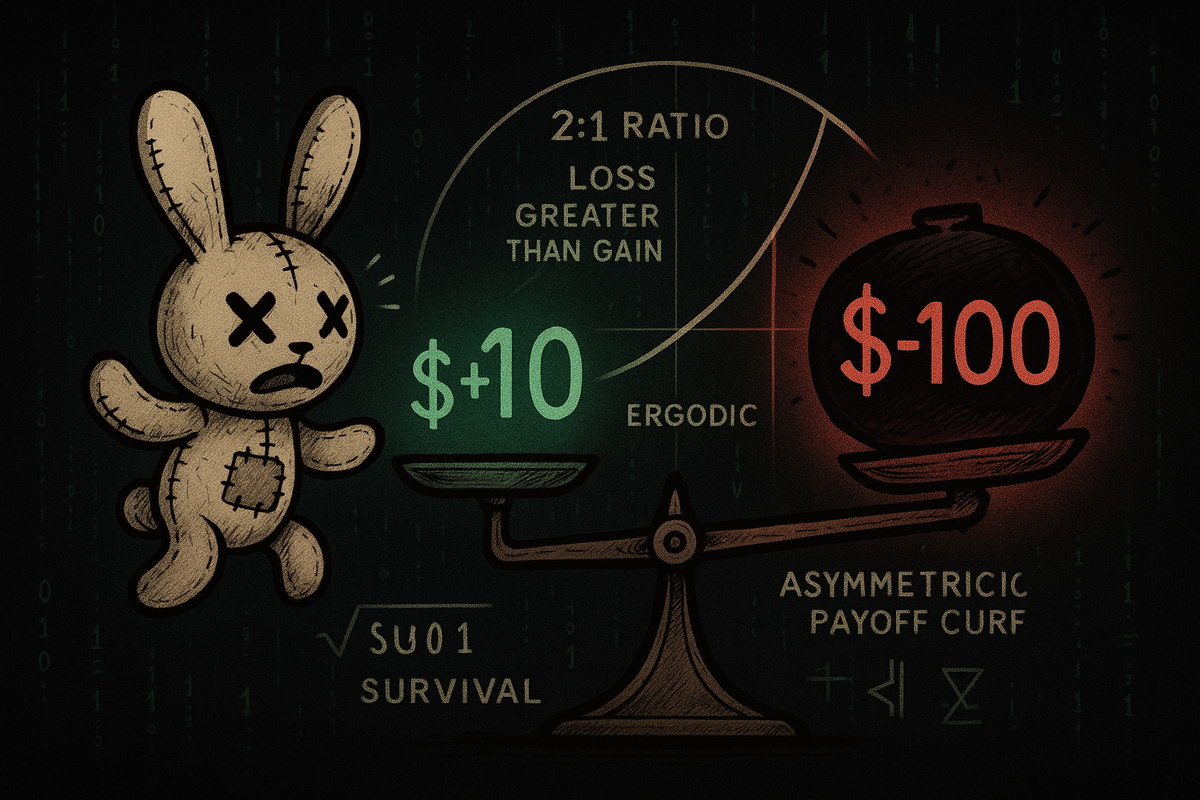
Your brain treats a $100 loss as twice as painful as a $100 gain feels good. Loss aversion kept your ancestors alive — but it might be tanking your decisions today.

Why the pain of losing $100 outweighs the pleasure of finding $100—and why this “bias” might actually be correct
Here’s a bet: flip a coin. Heads, you win $100. Tails, you lose $100.
Mathematically, this is a fair bet. Expected value of zero. A perfectly rational agent should be indifferent.
But you’re not indifferent. You don’t want to take this bet. It feels bad. The potential loss of $100 looms larger than the potential gain. Something in your gut says no.
This is loss aversion. The psychological pain of losing is roughly twice as intense as the pleasure of an equivalent gain. Lose $100, and it hurts about as much as finding $200 would feel good.
For decades, this has been Exhibit A in the “humans are irrational” museum. We overweight losses. We’re too risk-averse. We leave money on the table because we can’t think straight about risk.
But what if the conventional wisdom is wrong? What if your gut is doing math your head doesn’t understand?
The Standard Story
Daniel Kahneman and Amos Tversky documented loss aversion as part of Prospect Theory, which won Kahneman a Nobel Prize. The finding is robust: across cultures, contexts, and stakes, people feel losses more intensely than equivalent gains.
The typical ratio is about 2:1. A loss needs to be offset by a gain roughly twice its size to feel neutral.
This shows up everywhere:
- Investing: People hold losing stocks too long (hoping to avoid realizing the loss) and sell winners too quickly (locking in the gain before it disappears). This “disposition effect” consistently reduces returns.
- Negotiations: People make worse deals when the framing emphasizes what they’ll lose rather than what they’ll gain, even when the outcomes are identical.
- Consumer behavior: “Limited time offer—act now or lose this price!” works better than “Get this great price!” Same deal, different frame, different response.
- Policy: Programs framed as preventing losses get more support than programs framed as producing gains, even when the programs are equivalent.
The standard interpretation: this is a bias. Losses and gains of equal magnitude should feel equal. The fact that they don’t represents a systematic error in human cognition.
But there’s a problem with this interpretation. It assumes something about rationality that might not be true.
The Ergodicity Problem
Here’s where it gets interesting.
The expected value calculation—the one that says you should be indifferent to the coin flip—assumes something subtle. It assumes that what matters is the average outcome across all possible worlds.
In statistical terms, this is called an “ensemble average.” If you could run the same bet across a million parallel universes, the average result would be zero.
But you don’t live in a million parallel universes. You live in one. You experience outcomes sequentially, one after another, in a single timeline. What happens to you over time—the “time average”—might be very different from what happens on average across a population.
This is the insight of physicist Ole Peters and the field of ergodicity economics. For a process to be “ergodic,” the ensemble average and the time average must converge. But many economically relevant processes—including wealth dynamics—are not ergodic.
Here’s why it matters:
Wealth is multiplicative, not additive. When you invest, you don’t add returns—you multiply them. A 50% gain followed by a 50% loss doesn’t leave you even. It leaves you with 75% of what you started with (1.5 × 0.5 = 0.75).
In multiplicative dynamics, losses hurt more than gains help—not because of a bias, but because of math. A 50% loss requires a 100% gain to recover. The asymmetry is baked into the structure of the process.
When Peters ran the math, he found something remarkable: the 2:1 loss aversion ratio that psychologists measured is almost exactly what you’d expect from an agent optimizing for long-term wealth in a multiplicative world.
Loss aversion isn’t a bias. It’s the correct computation for surviving through time.
The Reframe
The “expected value” framework that makes loss aversion look irrational assumes you can spread risk across parallel versions of yourself. But you can’t. You’re one person, living one life, experiencing outcomes sequentially.
And in that context—the context you actually live in—avoiding losses IS more important than capturing gains. Not twice as important because of some psychological quirk. Twice as important because that’s what the math of survival requires.
Your ancestors who felt losses twice as sharply as gains were more likely to survive. Not because they were bad at probability. Because they were good at staying alive in a world where a single bad outcome could end their lineage.
The bias framing assumes unlimited rationality as the baseline. But unlimited rationality is a fiction. You’re not a god surveying all possible worlds. You’re an agent embedded in time, playing a game where you don’t get infinite retries.
Loss aversion is calibrated for that game.
Where It Still Breaks
This doesn’t mean loss aversion is always adaptive. Even a well-calibrated heuristic can fire in the wrong context.
Small, affordable bets: If the stakes are truly small relative to your wealth, loss aversion can make you too conservative. The coin flip for $100 might be worth taking if $100 is negligible to you—the negative expected utility from loss aversion outweighs the trivial financial impact.
Repeated games with edge: If you can play a positive expected value game many times, loss aversion might stop you from capturing gains that would compound. The casino has negative expected value (don’t play). But an investment with positive expected value, played many times, looks different.
Framing manipulation: Marketers and negotiators exploit loss aversion by framing everything as a potential loss. “Don’t miss out” triggers loss aversion even when there’s nothing to lose. The heuristic fires at the frame, not the reality.
Sunk costs: Loss aversion interacts with sunk cost fallacy. You feel the loss of what you’ve already invested, which makes you throw good money after bad to avoid “losing” the sunk investment. But sunk costs are gone—they’re not recoverable regardless of your next move.
The Move
Don’t try to eliminate loss aversion. It’s not a bug you can patch.
Instead, calibrate it:
Ask: “Is this multiplicative or additive?” If a loss can genuinely compound or cascade—if a bad outcome can wipe you out or create further losses—trust the loss aversion. It’s seeing something real.
Ask: “Is this the frame or the reality?” When someone presents something as a loss, check whether there’s actually something at risk. “Limited time offer” isn’t a loss—you never had the thing. “You’ll miss out” isn’t a loss—absence of a gain is different from losing what you have.
Ask: “Can I survive the downside?” The most important question. If yes, you might be able to override loss aversion for positive expected value bets. If no, loss aversion is protecting you from ruin, regardless of expected value.
The standard story says you’re irrationally afraid of loss. The deeper story says you’re rationally afraid of ruin, and loss aversion is the alarm system.
It’s not always right. But it’s not a mistake, either.
It’s the math of staying alive, compiled into intuition.
This is Part 5 of Your Brain’s Cheat Codes, a series on the mental shortcuts that mostly work—and the specific situations where they’ll ruin you.
Previous: Part 4: The First Number Wins
Next: Part 6: Don’t Finish Bad Movies — The Sunk Cost Fallacy