
Loch Ness and Cryptozoology: How Many Species We Haven't Found

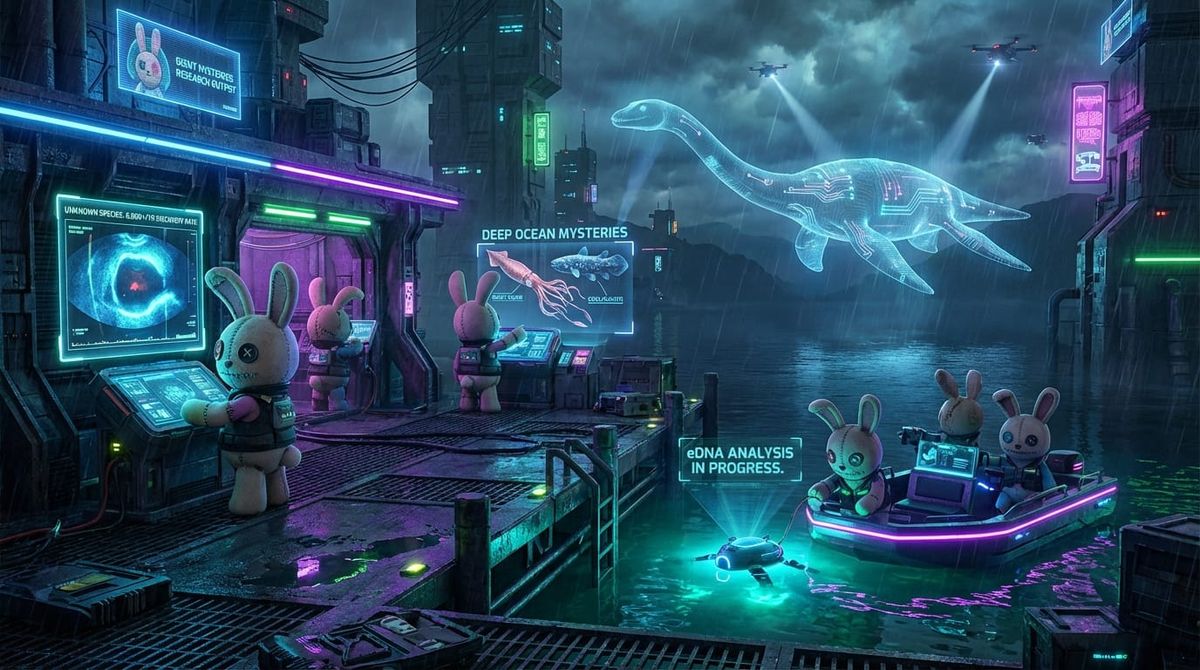
Loch Ness is 23 miles long, a mile wide, and 750 feet deep at its maximum. It contains more fresh water than all the lakes in England and Wales combined. It sits inside a fault line that runs diagonally across Scotland, which is why it’s long and narrow and why its walls drop nearly vertically. The water is cold, brown with peat, and essentially opaque below the first few meters. You cannot see across it. You cannot see into it.
The relevant question about Loch Ness is not whether a large plesiosaur-type creature survived the mass extinction event 65 million years ago, lived in a Scottish loch for geological ages without leaving a single fossil, and continues to evade detection in an area that has been inhabited by humans for millennia. That question has a clear answer: no. Plesiosaurs are gone. The timeline doesn’t work. The biology doesn’t work. The loch itself is geologically young, formed about 10,000 years ago as glaciers receded, which is about 64,990,000 years after the last plesiosaur died. Any cold-blooded reptile large enough to generate the reported sightings would die of hypothermia in Scottish waters. Any warm-blooded air-breather of that size would surface regularly enough to be photographed, many times a year, by the millions of tourists who visit the loch’s shores.
The interesting question about Loch Ness is the one the monster mythology accidentally points toward: how confident should we actually be that we know what’s in the world’s oceans, forests, and deep-water lakes? Because on that question, the historical record is clear, and the historical record is humbling.
The Discovery Rate Nobody Mentions
Between 1993 and 2020, scientists described approximately 8,000 to 10,000 new species per year across all taxa. Most are insects, fungi, and microorganisms; fair enough. But the large vertebrate discovery rate is more interesting than the dismissers of cryptozoology want to acknowledge.
The Saola (Pseudoryx nghetinhensis) was discovered in Vietnam in 1992; a large bovine the size of a deer, living in one of the most war-surveyed landscapes in 20th-century Asia, completely unknown to science until a survey team found horns in a hunter’s house. The Vu Quang ox, as it was initially called, was found in habitat that had been walked through by French colonizers, American soldiers, Vietnamese military, and local populations for generations. Nobody knew it was there.
The Olinguito (Bassaricyon neblina) was described in 2013. It’s a carnivorous mammal in the raccoon family, living in the Andean cloud forests of Colombia and Ecuador; some of the most biologically surveyed terrain in South America because of the extraordinary biodiversity research that’s been conducted there. It had been misidentified in museum collections for a century. It was sitting in specimen drawers labeled as a different species.
The Omura’s whale (Balaenoptera omurai) was formally described in 2003 from Japanese whaling records. It had been around long enough to get into whalers’ logbooks, but science didn’t formally characterize it until the 21st century. It’s a large whale; not a minnow, not a beetle, a large whale; and it was undescribed until 2003.
The Tapanuli orangutan (Pongo tapanuliensis) was confirmed as a distinct species in 2017. We had been studying orangutans for decades. There’s an entire conservation industry built around orangutan genetics. And a third species; geographically isolated, genetically distinct, behaviorally different; was sitting there undescribed. Fewer than 800 individuals. A great ape.
These are large animals. Mammals. The kind of thing that “we’d have found it by now” is supposed to apply to.
What’s Actually in the Ocean
The ocean covers 71 percent of the Earth’s surface. Humans have directly explored roughly 20 percent of it. The deep ocean; below 200 meters, which is where most of the volume is; is less thoroughly mapped than the surface of Mars.
The BBC’s Blue Planet II series, broadcast in 2017, documented the snailfish living at 8,000 meters in the Mariana Trench; bioluminescent organisms that were unknown before the filming expedition; a coral reef the size of Delaware off the coast of Australia that wasn’t formally documented until 2020. The Great Barrier Reef is the most studied reef system on the planet, and we found a new one, a big one, next to it.
The giant squid (Architeuthis dux) wasn’t photographed alive in its natural habitat until 2004. It’s the largest invertebrate on Earth. Specimens wash ashore occasionally; cachalot whales have sucker-scar evidence of wrestling with them regularly. They exist in sufficient numbers to leave scars on sperm whale skin across the Pacific. And we didn’t have a single photograph of a living specimen in deep water until 2004. That’s not ancient history. That’s two years before Twitter launched.
The colossal squid (Mesonychoteuthis hamiltoni) is larger than the giant squid and was known only from fragmentary specimens until the early 2000s. Complete specimens have only been recovered a handful of times. We don’t know how deep it goes. We don’t know its range. We don’t know its reproductive behavior. It’s bigger than a car and we know almost nothing about it.
The argument that “we’d have found it by now” has a clean rebuttal in everything we’ve found after we were supposed to have found everything.
The 2018 Loch Ness eDNA Study
In 2018, University of Otago researcher Neil Gemmell led a team that conducted an environmental DNA survey of Loch Ness. The methodology was solid: eDNA sampling captures genetic material shed by organisms into water; skin cells, feces, scales, mucus; and allows identification of species present in a body of water without direct observation. They took water samples at multiple depths, multiple locations, multiple seasons.
The results, announced in 2019, found no evidence of large reptiles, no evidence of plesiosaurs, and no evidence of sharks or other large fish that had been proposed as Nessie candidates. What they did find: the loch is full of eels. An extraordinary density of European eel (Anguilla anguilla), far higher than expected for a body of water this size. Gemmell couldn’t rule out the possibility that some of those eels are very large indeed; European eels can grow to several meters under unusual circumstances; most stay small, but the biology permits exceptions.
He was careful. He didn’t say giant eel. He said he couldn’t rule it out. The press ran with “Nessie could be a giant eel” and the internet cycled through it and moved on. But the actual methodological point was important: an eDNA survey of a famous body of water turned up a significant biological anomaly, and that anomaly happened to be in the category of organisms that generate large-object sightings from confused observers.
The Scale of What We Keep Finding
The numbers are worth sitting with. Between 1993 and 2020 alone, roughly 18,000 new fish species were described. The 21st century has seen confirmed discoveries of new large mammals on every inhabited continent except Australia. The okapi; a large, giraffe-relative animal in the Congo; wasn’t known to Western science until 1901. The giant peccary of Brazil was described in 2007. A new species of beaked whale, Ramari’s beaked whale (Mesoplodon eueu), was formally described in 2021, identified through analysis of stranded specimens that had previously been misidentified.
The deep ocean discovery rate is even more startling. The Census of Marine Life, which ran from 2000 to 2010, documented over 6,000 new ocean species. The 2020 discovery of a coral reef system taller than the Empire State Building off the coast of Australia; in one of the most studied ocean regions on Earth; is the clearest single example of how wrong our confidence in biological completeness actually is. If you can miss a reef larger than most buildings in a place people have been sailing for centuries, the “we’d have found it by now” argument requires some recalibration.
None of this argues for Nessie. A cold, nutrient-poor Scottish loch is not the deep Pacific. But it argues against the presumption that maps to territory cleanly.
Why Eyewitness Testimony Fails Here
The Loch Ness case rests on eyewitness reports, and eyewitness reports are terrible evidence for cryptids. Not because people are lying; most aren’t; but because human visual perception is not a camera. It’s an inference engine. The brain receives partial information and fills in the rest based on expectation and prior knowledge.
Loch Ness sits in a geological fault. The peat-dark water creates unusual visual conditions. Atmospheric inversions are common in the Scottish Highlands. Standing waves, known locally as seiches, occur in the loch and can create objects on the surface that move, rise, and subside in ways that don’t look like waves. A large swimming otter leaves a surface wake that’s disproportionate to its body size. A diving bird with a fish in its bill, photographed at distance in low light, looks like a long-necked creature emerging from the water.
None of that means all Nessie sightings are explicable. Some aren’t explained. But the general reliability of the evidentiary base is poor, and the photographic record is worse: the famous 1934 “surgeon’s photograph” was admitted as a hoax in 1994 by the son of one of the men who constructed it. The most iconic image in cryptozoology was a toy submarine with a sculpted head attached. This is the foundational document.
The Right Frame
The honest framing for Loch Ness is not “is there a monster in the loch?” The honest framing is “what does the Nessie mythology tell us about our confidence in biological completeness?”
And what it tells us is that our confidence is too high. The history of large-species discovery in the 20th and 21st centuries is a sustained argument against the presumption that we know what’s out there. Not because every cryptid is real, but because the assumption embedded in “we’d have found it by now” keeps getting falsified. The Saola was there. The Tapanuli orangutan was there. The Omura’s whale was there. The deep ocean reef was there. Nobody found them until someone looked carefully in the right way.
Loch Ness probably contains no large unknown creatures. The water is too cold for a reptile, too nutrient-poor for a large warm-blooded mammal, too thoroughly surveyed at this point for a confident “never confirmed” to mean anything but “not there.” The eDNA study was comprehensive. The sonar surveys; there have been several; have found no large objects behaving unexpectedly.
But the broader cryptozoology argument, the one that uses species discovery rates to undermine confident dismissal, is not crazy. It’s an argument with actual data behind it. New large species keep appearing. The ocean remains mostly unmapped. Our taxonomic confidence at any given moment has historically been overblown.
Verdict: Copper
Nessie specifically: almost certainly not there. The plesiosaur timeline is impossible. The eDNA survey found no large unknown organisms. The most famous piece of evidence was a hoax. The loch is cold, nutrient-poor, and geologically young. The specific claim doesn’t hold.
But the dismissal method; “we’d have found it by now”; keeps being falsified by actual zoology. We don’t know what’s in the deep ocean. We found a new great ape in 2017. We found a new beaked whale in 2021. We found a reef taller than the Empire State Building in a well-traveled stretch of the Pacific in 2020. The confident assertion that the inventory of large life on Earth is complete is not supported by the history of large-species discovery, and that gap between the specific claim (Nessie) and the general principle (we know everything big) is where the interesting conversation lives. The creatures that get dismissed as mythology have a track record of occasionally turning out to be real. The okapi was legend before it was zoology. The gorilla was folklore before it was taxonomy. Confidence about biological completeness has a history of being embarrassed. That history doesn’t prove Nessie. It proves the confidence is unearned.