The Guy Who Decided to Classify Crazy

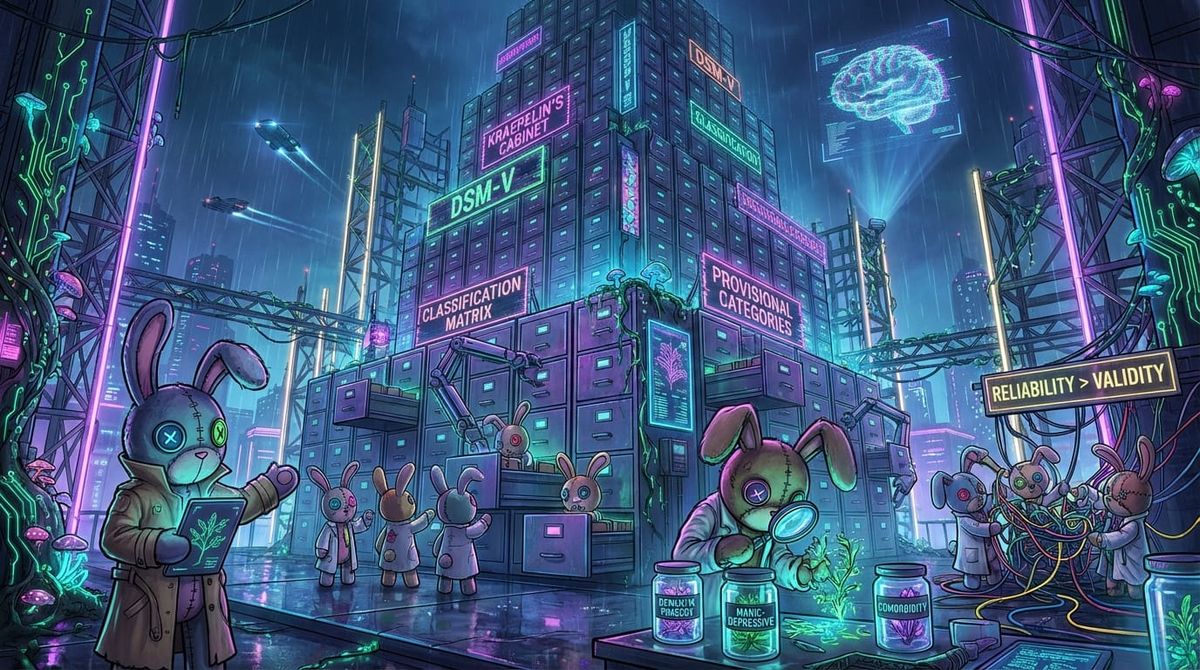
Emil Kraepelin sat in an asylum in Dorpat, Estonia, in the 1880s, watching patients the way a botanist watches plants. He did not treat them. He did not analyze their dreams or excavate their childhoods. He watched them, recorded their symptoms, tracked the course of their illness over months and years, and sorted them into categories based on what he observed. This was his innovation. Not a new theory of mental illness. Not a new treatment. A filing system.
Kraepelin divided the chaos of the asylum into two major categories that still structure psychiatric thinking today. Dementia praecox, which would later be renamed schizophrenia; a deteriorating course, cognitive decline, hallucinations, delusions. And manic-depressive illness, which would later be renamed bipolar disorder; episodic mood disturbance, periods of mania alternating with periods of depression, with relatively preserved cognition between episodes. The distinction was based entirely on trajectory. Dementia praecox got worse over time. Manic-depressive illness cycled but did not necessarily deteriorate.
This was not a small contribution. Before Kraepelin, psychiatric diagnosis was a mess. Different asylums used different terminology. The same patient could receive three different diagnoses from three different physicians. There was no shared vocabulary, no common framework, no way to compare populations across institutions. Kraepelin imposed order, and the order was genuinely useful.
The botanical method applied to madness
Kraepelin’s approach was explicitly modeled on natural history classification. Linnaeus classified organisms by observable characteristics; leaf shape, flower structure, reproductive anatomy; without requiring knowledge of genetics, evolution, or biochemistry. The classification preceded the mechanism. You could sort organisms into meaningful groups based purely on what they looked like and how they behaved, and those groups turned out to correspond to real biological categories when the underlying science eventually caught up.
Kraepelin bet that the same approach would work for mental illness. Sort patients by observable symptoms and illness course. Create categories that group similar presentations together. Assume that the categories correspond to distinct underlying diseases, even though the diseases themselves remain invisible. The mechanism will come later. The classification can proceed without it.
This bet was reasonable in the 1880s. Neurology was in its infancy. There were no brain imaging technologies, no neurotransmitter assays, no genetic sequencing. The only tools available were observation and autopsy, and autopsies of psychiatric patients rarely revealed consistent brain pathology. Classification by symptom cluster was not Kraepelin’s preference. It was his only option.
The problem is that the mechanism never came. Not in the way Kraepelin expected. Not in the way the field promised. A hundred and forty years later, there is still no blood test for schizophrenia. No brain scan that diagnoses depression. No genetic test that confirms ADHD. The Kraepelinian wager; that symptom-based categories would eventually map onto distinct biological diseases; has not been redeemed. The classification system persists anyway, not because it was validated but because nothing better replaced it.
The Kraepelin cards tell the real story
Kraepelin kept meticulous records on index cards. Thousands of them. Each card documented a patient’s symptoms, course, treatment, and outcome over time. He would sort and re-sort these cards, looking for clusters, revising his categories as new patterns emerged. His textbook went through nine editions between 1883 and 1927, each one reorganizing the taxonomy based on accumulated observations.
The cards reveal something the modern DSM obscures: Kraepelin understood his categories as provisional. He changed them constantly. He merged conditions, split conditions, redrew boundaries, created new groupings. The system was alive in his hands; a working tool being refined through ongoing contact with patients. He did not treat his categories as discovered truths. He treated them as useful approximations that required continuous revision.
This matters because the DSM treats Kraepelinian categories as though they are fixed natural kinds. The spirit of Kraepelin’s method was empirical iteration. The legacy of Kraepelin’s method, as implemented by the APA, is institutional permanence. The man kept revising. The institution stopped.
The DSM is Kraepelin’s filing cabinet with insurance codes
The Diagnostic and Statistical Manual of Mental Disorders, first published by the American Psychiatric Association in 1952, is the direct descendant of Kraepelin’s approach. The DSM-I and DSM-II were influenced by psychoanalytic thinking and used broad, theoretically loaded categories. But the DSM-III, published in 1980 under the leadership of Robert Spitzer, was an explicit return to Kraepelinian descriptive psychiatry. Out with psychoanalytic interpretation. In with observable symptoms, diagnostic criteria, and checklists.
The DSM-III was a revolution in psychiatric practice. It solved a real problem: diagnostic reliability. Before the DSM-III, two psychiatrists evaluating the same patient would frequently arrive at different diagnoses. The checklist system fixed this. If the criteria are explicit and behavioral, different clinicians applying the same checklist to the same patient will more often agree. Reliability went up.
But reliability is not validity. Two clinicians can reliably agree that a patient meets criteria for Major Depressive Disorder without either of them knowing whether Major Depressive Disorder is a real biological entity or a convenient administrative fiction. The DSM-III traded validity for reliability and declared victory. The field followed because reliability was measurable and validity was not.
This distinction sounds academic. It is not. Reliability means clinicians agree on the label. Validity means the label corresponds to something real. A thermometer that consistently reads 105 degrees in a room that is 72 degrees is highly reliable and completely invalid. The DSM improved psychiatric diagnosis in the same way: clinicians now agree more often, but what they agree on may not carve nature at its joints. The field celebrated the reliability gains without pausing to ask whether the categories being reliably applied were the right categories. It is entirely possible; and the evidence increasingly suggests this is the case; that the DSM’s diagnostic categories do not correspond to distinct biological conditions but to overlapping regions of a continuous landscape of human psychological variation that does not respect the boundaries the committees drew.
Kraepelin was not wrong about everything
The distinction between schizophrenia-spectrum conditions and mood disorders has held up reasonably well over a century of subsequent research. The conditions do seem to differ in genetics, neurobiology, illness course, and treatment response. Kraepelin’s two major categories were not arbitrary. They carved nature at something close to a real joint; not cleanly, not perfectly, but approximately.
Where Kraepelin went wrong was in the assumption that descriptive classification would scale. Two categories that roughly correspond to real biological variation is one thing. Three hundred and ninety-seven diagnostic categories in the DSM-5, each defined by symptom checklists, each assumed to represent a distinct condition, is something else entirely. The method that worked reasonably well for the most severe and distinctive forms of mental illness has been extended to conditions where the boundaries are blurry, the symptoms overlap massively, and the distinction between disorder and normal variation is a judgment call.
Generalized Anxiety Disorder and Major Depressive Disorder share so many symptoms that the comorbidity rate exceeds 60 percent. Social Anxiety Disorder and Avoidant Personality Disorder describe virtually the same clinical picture with different labels, different diagnostic codes, and different treatment implications. The DSM-5 contains multiple conditions whose primary distinguishing feature is not symptom profile but administrative origin; which committee proposed them, which research group advocated for their inclusion, which insurance reimbursement category they serve.
The comorbidity rates alone should have been a red flag. When more than half of patients with one diagnosis also qualify for another, the categories are not carving nature at its joints. They are imposing boundaries on a continuum and then expressing surprise that the boundaries leak. Kraepelin, working with the most severe presentations in a locked asylum, could draw relatively clear lines. The DSM, attempting to categorize the full spectrum of human psychological distress, is drawing lines in fog.
The committee meeting as scientific method
Kraepelin worked alone, observing patients over decades. The DSM is produced by committees that meet, debate, negotiate, and vote. The process is not secret. It is documented. And what the documentation reveals is a process that looks less like science and more like legislation.
The DSM-5 task force included working groups for each major diagnostic category. Each working group reviewed the literature, proposed revisions, debated alternatives, and ultimately voted on criteria. When disagreements arose, they were resolved by consensus or majority vote. When external stakeholders objected; insurance companies, pharmaceutical manufacturers, patient advocacy groups, forensic psychiatrists; their concerns were weighed against the evidence and against each other.
This is a political process with scientific inputs. It is not a scientific process. The distinction matters. A scientific process would start with biological evidence and work outward to clinical categories. The DSM process starts with clinical consensus and hopes biological evidence will eventually confirm it. The direction of inference is reversed.
Allen Frances, who chaired the DSM-IV task force, spent the years after publication warning that the DSM-5 was medicalizing normal human experience. He argued that the expansion of diagnostic categories was driven not by scientific discovery but by committee enthusiasm, pharmaceutical industry influence, and the institutional momentum of a system that rewards diagnostic proliferation. Frances was not an outsider critic. He was the man who ran the previous edition. When the person who built the machine tells you the machine is broken, the machine is probably broken.
The filing cabinet became the building
Kraepelin’s innovation was modest and practical. Create categories. Track outcomes. Compare across populations. Build a shared vocabulary. The categories were tools, not truths. Kraepelin himself revised his classification system through nine editions of his textbook, adding categories, removing categories, redrawing boundaries. The system was plastic in his hands. Provisional. Open to revision as new observations accumulated.
The DSM calcified what Kraepelin kept fluid. Once diagnostic categories entered the DSM, they acquired institutional weight that made them nearly impossible to remove. Insurance reimbursement depended on them. Pharmaceutical trials were designed around them. Legal proceedings referenced them. Disability determinations required them. The categories became load-bearing architectural elements of the healthcare system. Removing one would require rebuilding the infrastructure that depended on it.
This is how a filing system becomes a prison. The categories were supposed to be scaffolding. Temporary structures erected while the real building was under construction. The scaffolding was never supposed to be the building. But the construction stalled, the scaffolding remained, and eventually people forgot it was scaffolding at all. The categories were designed to organize observation. They became the observations themselves. Clinicians stopped seeing patients and started seeing diagnoses. The checklist replaced the clinical encounter. The question shifted from “what is happening to this person” to “which box does this person fit in.” Kraepelin would not have recognized what his method became. He was a careful observer who built provisional categories from decades of patient contact. The DSM is a committee product that builds permanent categories from literature reviews and votes.
The NIMH acknowledged this failure in 2013, when director Thomas Insel announced that the agency would no longer fund research organized around DSM categories. The Research Domain Criteria initiative, RDoC, was an attempt to rebuild psychiatric classification from biological foundations up rather than from symptom descriptions down. The announcement was a bombshell within the field. The largest funder of psychiatric research in the world was publicly stating that the DSM’s categories did not correspond to biological reality. The RDoC initiative has produced interesting research but has not yet generated a viable alternative classification system. Kraepelin’s filing cabinet remains in use not because it was validated but because tearing it out would leave nothing in its place.
The botanist’s approach to mental illness was reasonable in the 1880s, when the biology was invisible and observation was the only tool available. Keeping that approach in the 2020s, when the biology is partially visible and consistently refuses to confirm the categories, is not reasonable. It is institutional inertia wearing a lab coat. The filing cabinet was never supposed to be the final answer. It was supposed to be the first step. The field took the first step and then built the entire hospital on top of it.