The Kinsey Scale Is the Most Famous Scientific Instrument Nobody Understands
He didn't say everyone was bisexual. He said sexuality was a continuum and the binary was always fiction. The 0-6 scale. Behavior-based not identity-based.

Everybody knows the Kinsey Scale. Almost nobody knows what it actually measures. The scale has become a cultural shorthand for sexual fluidity, a meme format, a personality quiz result people share on social media. “I’m a Kinsey 2” has entered the lexicon the way “I’m a Virgo” entered it, as a statement of identity that sounds precise and means almost nothing without context.
Kinsey would have hated every part of this. The scale was not designed to measure identity. It was designed to measure behavior. The distinction matters enormously, and the fact that the culture has collapsed it tells you something important about how scientific instruments get absorbed into popular mythology and emerge as something the original researcher would not recognize.
The scale measures what people do, not what people are
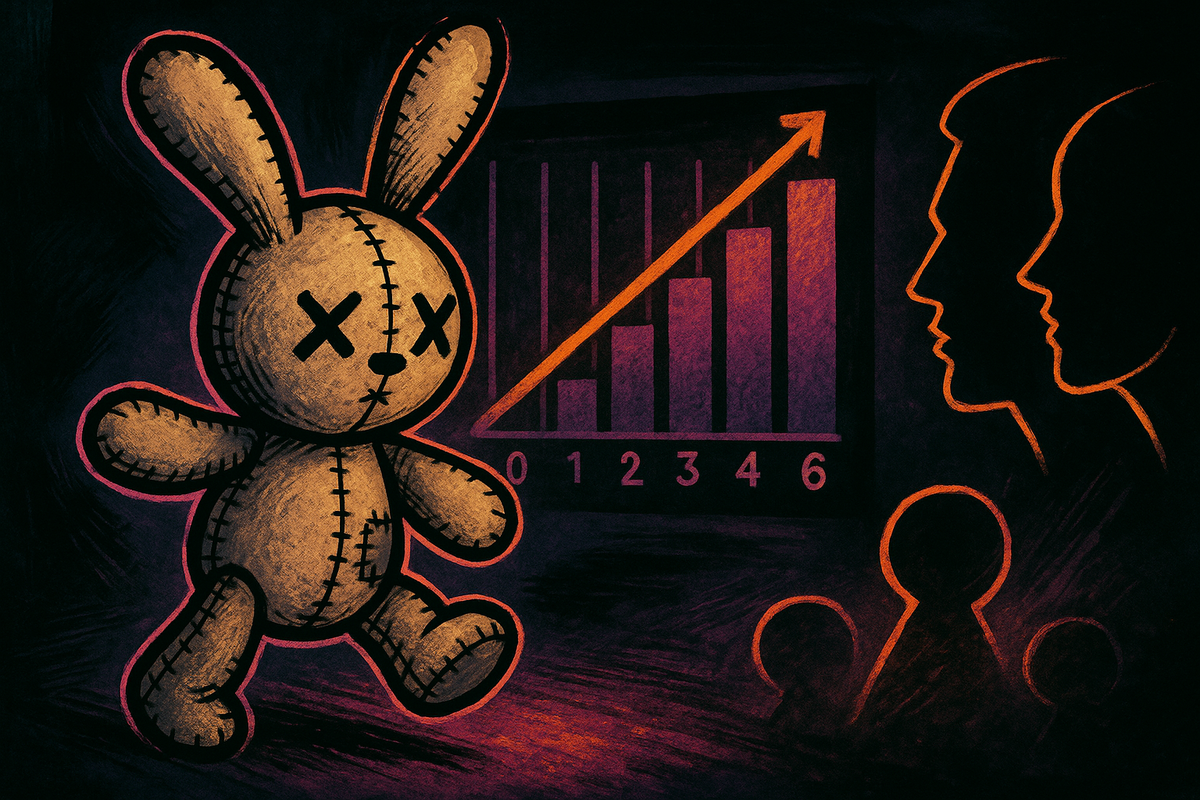
The Kinsey Scale runs from 0 to 6. Zero is exclusively heterosexual. Six is exclusively homosexual. The numbers in between represent increasing degrees of homosexual behavior and psychological response relative to heterosexual behavior and psychological response. A Kinsey 3 is someone whose sexual behavior and psychological responses are roughly equally directed toward both sexes.
The crucial word in that description is “behavior.” Kinsey was an empiricist. A taxonomist. He counted things. He did not count identities, orientations, essences, or inner truths. He counted what people did and what they reported being aroused by. The scale is a behavioral distribution tool, not a personality type.
This was radical in 1948 and it remains radical now, because the entire cultural apparatus around sexuality is organized around categories. You are straight or you are gay or, in more progressive frameworks, you are bisexual. These are identity categories. They describe what you are. Kinsey wasn’t interested in what people were. He was interested in what they did. And what they did, according to his data, did not sort neatly into the categories the culture provided.
The distinction between behavior and identity is not a philosophical nicety. It has concrete consequences for how the data is interpreted and what conclusions it supports. If you measure identity, you get the categories the culture provides; people sort themselves into the available boxes and the data reflects the sorting. If you measure behavior, you get the mess underneath the categories; the actual pattern of what people do, which has never respected the categories very well. Kinsey measured the mess. The mess was more interesting than the categories, and far more threatening to the institutions that depended on the categories being real.
The scale emerged from the data, not from theory. Kinsey didn’t sit down and decide that sexuality should be measured on a continuum. He interviewed thousands of people, recorded their sexual histories in granular behavioral detail, and discovered that the data didn’t fit into two boxes. Or three. It spread across a range. Some men who identified as heterosexual reported homosexual experiences. Some men who identified as homosexual reported heterosexual experiences. The boundaries that the culture insisted were firm were, in the data, porous.
What a Kinsey 3 actually means versus what people think it means
In popular usage, “Kinsey 3” has become synonymous with bisexuality. The person at the exact center of the scale, equally attracted to both sexes, perfectly balanced. This is a misunderstanding on multiple levels.
First, Kinsey 3 describes a behavioral and psychological pattern, not a stable identity. A person could be rated a Kinsey 3 at one point in their life and a Kinsey 1 or 5 at another, because the scale describes what a person has done and felt, not what a person fundamentally is. The rating can change because behavior changes. Identity categories resist change by design; that’s what makes them identity categories. Kinsey’s scale accommodates change because it’s measuring something fluid.
Second, the numbers are not evenly distributed across the population. The data didn’t produce a bell curve centered on 3. It produced a distribution heavily weighted toward the extremes, with most people clustering near 0 or 6, and smaller but significant numbers scattered across the middle range. The scale doesn’t say that most people are somewhat bisexual. It says that the boundary between exclusively heterosexual and exclusively homosexual is less absolute than the culture claims, and that a significant minority of people have behavioral histories that don’t fit cleanly on either end.
Third, the scale collapses multiple dimensions into a single number. Sexual behavior toward men versus women, sexual arousal patterns, romantic attachment, fantasy life; Kinsey rolled all of these into one composite rating. This was a simplification he was aware of and defended on practical grounds. You need a number if you’re going to do statistics. But the simplification means that two people with identical Kinsey ratings might have very different sexual lives. One might have extensive homosexual experience with minimal psychological response; another might have intense psychological response with minimal behavioral experience. Same number. Different realities.
The binary was always a political project masquerading as a natural category
This is the deeper point that gets lost in the meme versions of the scale. Kinsey wasn’t just proposing a measurement tool. He was challenging the categorical framework that the measurement tool was designed to replace.
Before Kinsey, the dominant model in Western science and culture was binary. Heterosexual or homosexual. Normal or deviant. Healthy or sick. These categories did enormous institutional work. They organized psychiatric diagnosis, criminal law, religious doctrine, social policy, and family structure. The binary was not just a description of reality. It was a technology of social control. If homosexuality is a category, a discrete thing that some people are and most people are not, then it can be pathologized, criminalized, treated, and contained. The deviant population is identifiable and manageable.
Kinsey’s continuum destroyed the containment. If sexuality is a gradient, if the boundary between straight and gay is a matter of degree rather than kind, then the entire apparatus built on the binary collapses. The deviant population is no longer identifiable because it doesn’t exist as a discrete population. It’s everyone, in different proportions, at different times, to different degrees. You can’t pathologize a continuum. You can’t criminalize a spectrum. You can’t draw a clean line between the normal population and the deviant one if the data says no such line exists.
This is why the scale was politically explosive in a way that went far beyond the specific numbers. The numbers were shocking, certainly. But the framework was the real threat. Kinsey wasn’t just reporting that homosexual behavior was common. He was arguing that the categories used to sort human sexuality into normal and abnormal were scientifically indefensible. The binary was a political project masquerading as a natural category, and the data exposed the masquerade.
The vocabulary problem Kinsey created and couldn’t solve
There is an irony embedded in the scale’s cultural afterlife that Kinsey probably didn’t anticipate. By creating a numerical system to describe sexual behavior on a continuum, he inadvertently created a new set of categories. The numbers became identities. “I’m a Kinsey 2” functions in conversation exactly the way “I’m bisexual” functions; as a categorical self-description, a fixed label, a thing you are rather than a thing you do. The instrument designed to dissolve categories became a category generator.
This happened because cultures need labels. People need words to describe themselves to other people, and a number on a scale turns out to be just as usable as a word in a dictionary for that purpose. Kinsey built a tool for researchers. The culture turned it into a tool for identity construction. The scale’s simplicity, the very feature that made it scientifically limited, is what made it culturally sticky. Six numbers. Easy to remember. Easy to share. Easy to turn into a social media post.
The tension between the scale as a research instrument and the scale as an identity label has never been resolved, and probably cannot be, because the two uses serve different purposes. Researchers need precision, nuance, multiple dimensions. People need shorthand. The Kinsey Scale is bad shorthand for a real phenomenon, and it persists because no better shorthand has emerged.
The contemporary critiques are real and they don’t invalidate the thing they critique
The Kinsey Scale has real limitations that modern researchers have spent decades trying to address. The most serious is its one-dimensionality. Sexual orientation is not one variable. It involves at least three that don’t always correlate: sexual behavior, sexual attraction, and sexual identity. A person can engage in homosexual behavior without experiencing homosexual attraction (situational homosexuality in prisons, for example). A person can experience intense homosexual attraction without ever acting on it. A person can identify as bisexual while having an exclusively heterosexual behavioral history. Kinsey’s scale collapses all of these into a single number, which means it sacrifices specificity for simplicity.
Fritz Klein developed the Klein Sexual Orientation Grid in 1978, expanding Kinsey’s single dimension into seven variables measured across three time periods. It’s more precise. It’s also more cumbersome, which is why nobody outside academic sexology has ever heard of it while everyone has heard of the Kinsey Scale. Scientific instruments compete not just on accuracy but on usability, and the Kinsey Scale wins the usability contest by a mile.
The scale also doesn’t capture asexuality. Kinsey added a category “X” for individuals with “no socio-sexual contacts or reactions,” but it was an afterthought, not an integrated part of the framework. The asexuality community has pointed out, correctly, that a scale built entirely around the direction of sexual attraction has nothing to say about the intensity of sexual attraction, and that zero-to-low attraction is as legitimate a variation as any direction on the scale.
The gender binary embedded in the scale is another limitation that has become more visible. The scale assumes two sexes as the poles of attraction. For nonbinary and gender-diverse populations, a scale that asks “how much toward men versus how much toward women” doesn’t capture the relevant variation. The Storms model (1980) addressed this by using two independent axes rather than a single bipolar one, but again, the Kinsey Scale’s simplicity has kept it dominant in popular culture long after more sophisticated models were available.
The scale survives because the insight survives
None of the critiques have replaced the core insight. The specific measurement tool can be improved. The underlying observation cannot be overturned: human sexual behavior does not sort into two categories; it distributes across a range; and the boundaries that cultures draw within that range are political decisions, not natural facts.
That’s what Kinsey saw in the data. That’s what the scale, for all its limitations, makes visible. The meme version of the Kinsey Scale is a personality quiz. The actual Kinsey Scale is an empirical argument against categorical thinking about human sexuality. The argument has held for seventy-eight years. The categories it challenged are still being defended, still being legislated, still being used to organize who gets rights and who gets pathologized.
Kinsey was a taxonomist. He knew that the categories you choose to sort organisms into tell you more about the sorter than about the organisms. The Kinsey Scale is the most famous scientific instrument nobody understands because understanding it requires accepting something the culture still resists: the categories were never real. The variation was always there. The scale just made it impossible to pretend otherwise.
Every time someone takes the Kinsey Scale as a fun internet quiz and shares their number, they are participating in an act of normalization that Kinsey’s critics spent decades trying to prevent. The instrument survived not because of its scientific precision but because it names something that people recognize in their own experience; the messiness, the fluidity, the refusal of lived sexuality to sort itself into the clean categories the culture demands. The scale is imperfect. The thing it points at is real. That’s enough to keep it alive, and enough to keep the people who need it to be wrong attacking it for another seventy-eight years.