What Kinsey Was Actually Doing in That Attic
Filming; participating; recruiting staff into sexual relationships. The sampling problems. How to hold both: the data was more accurate than anything that existed; and the methodology was compromised.

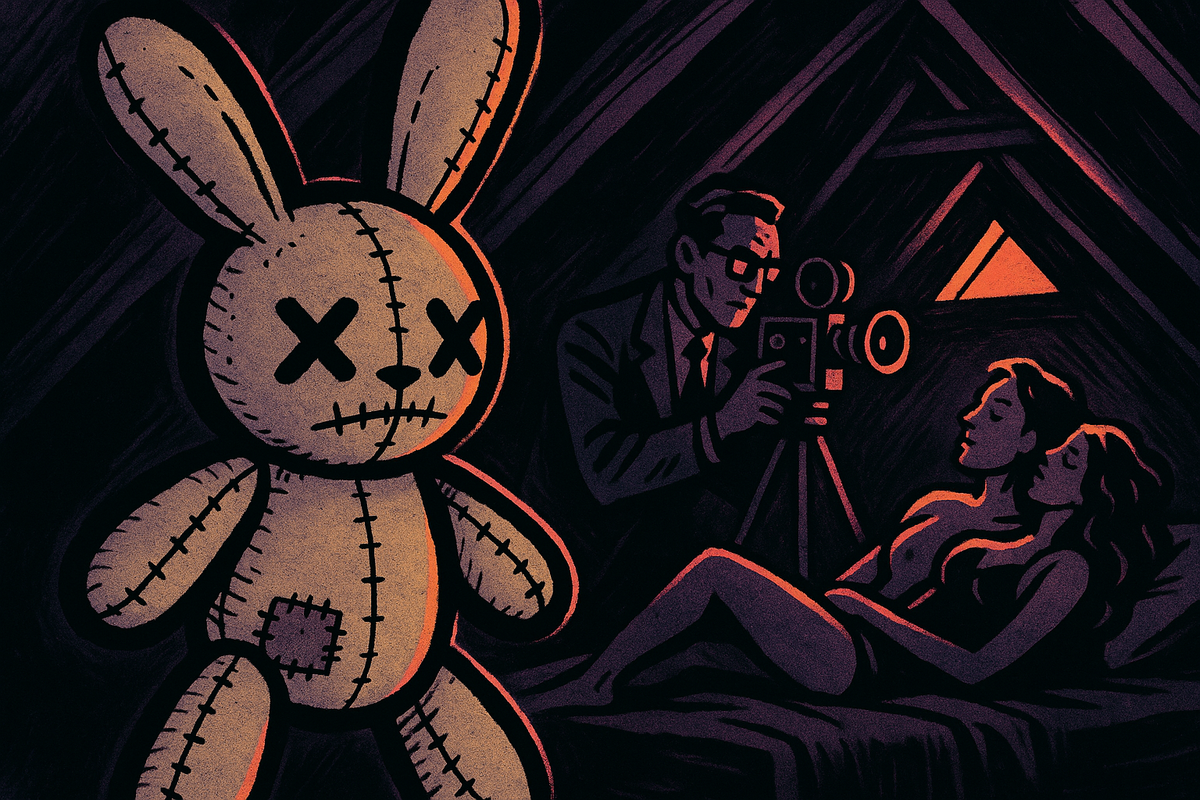
The third floor of the building that housed the Institute for Sex Research at Indiana University contained a film studio. Kinsey had it built for the stated purpose of documenting human sexual behavior on camera. The documentation was part of the research program, officially. The subjects were recruited from the Institute’s social network, which increasingly overlapped with Kinsey’s personal sexual network, which increasingly overlapped with his staff.
This is the part of the Kinsey story that his defenders handle badly and his attackers handle dishonestly. The truth sits in the uncomfortable middle: Kinsey built the most important sex research program in American history, and he ran parts of it like a private sexual commune. Both of those things are true. Neither one cancels the other.
The attic was a laboratory and it was also something else
Kinsey filmed sexual encounters. He filmed them systematically; multiple cameras, consistent setups, clinical notation of physiological responses. The footage was part of a visual archive intended to document the full range of human sexual behavior in a way that interview data alone could not capture. You can ask someone to describe an orgasm. You can also record one. The visual data captures things the verbal account misses; timing, involuntary responses, physiological sequences that the subject cannot self-report because they don’t consciously experience them.
This is methodologically defensible. Observational recording of behavior is standard practice in ethology, clinical psychology, and dozens of other fields. The fact that the behavior being recorded was sexual doesn’t automatically make the recording inappropriate. If you’re trying to understand human sexual response at a physiological level, filming is a reasonable methodological choice. Masters and Johnson would later build an entire research program on direct observation; the difference is that Masters and Johnson maintained clearer boundaries between observer and participant.
But Kinsey didn’t just film. He participated. He had sexual encounters with research subjects and staff members, sometimes on camera, sometimes not. He facilitated sexual encounters between staff members. He recruited research assistants partly on the basis of their willingness to participate in group sexual activities. He encouraged his wife Clara to have sex with other men; she did, apparently without significant objection, which either reflects genuine comfort or a dynamic in which objection was not realistically available. The boundaries between researcher, subject, administrator, and sexual participant dissolved. They didn’t dissolve accidentally. Kinsey dissolved them, deliberately, based on his conviction that a sex researcher who had not experienced a wide range of sexual behaviors was operating with insufficient data.
The conviction was philosophically coherent and institutionally disastrous. It created an environment in which the distinction between research and personal life didn’t just blur; it ceased to exist as a meaningful category. The attic was where this dissolution was most visible, but it extended through the entire Institute culture. Work dinners became social events became sexual encounters became data collection. The same people occupied every role. The same nights served every purpose.
The Clarence Tripp situation tells you everything about the boundary problem
Clarence Tripp was a psychologist who worked with Kinsey at the Institute and later wrote The Homosexual Matrix, an influential 1975 book on homosexuality. Tripp was Kinsey’s protege, colleague, and sexual partner. He was also a research participant, a filmmaker for the Institute’s visual archive, and a recruiter who brought new subjects into the study.
One person occupied all of those roles simultaneously. Researcher. Subject. Sexual partner of the principal investigator. Recruiter of other subjects. This is not a methodological gray area. This is a methodological crisis. The conflicts of interest are layered so deeply that separating the research from the personal from the sexual from the institutional becomes impossible.
Tripp was not an isolated case. The Institute’s inner circle was a sexual network. Wardell Pomeroy, one of Kinsey’s primary interviewers and co-authors, participated in group sexual activities organized by Kinsey. Clyde Martin, another key researcher, had sexual relationships with both Kinsey and Clara Kinsey. Paul Gebhard, who succeeded Kinsey as Institute director, participated as well.
The standard defense is that Kinsey believed scientists should have personal experience with the phenomena they study. This is plausible as a philosophical position and catastrophic as a research protocol. A marine biologist who scuba dives is gaining relevant experience. A sex researcher who has sex with his subjects and staff is contaminating his data, compromising his authority over personnel decisions, and creating conditions in which consent operates under institutional pressure. Even if every person involved was genuinely willing, the power dynamics of an employment relationship in which sexual participation is implicitly expected make uncoerced consent structurally difficult to verify.
The question of what Clara Kinsey actually wanted has never been satisfactorily answered. The available evidence suggests she was genuinely comfortable with the sexual openness; she maintained relationships with several of Kinsey’s male colleagues over extended periods, and no record of objection survives. But the absence of recorded objection in a marriage where one partner is also the employer, the institutional authority, and the ideological architect of the sexual arrangement is not the same thing as freely given consent. It may be. It may not. The historical record does not permit certainty, and the people who claim certainty in either direction are projecting their own frameworks onto incomplete evidence.
The sampling problems are separate from the personal conduct problems and both are real
The personal conduct issues get conflated with the methodological issues, and the conflation serves the interests of people who want to dismiss everything Kinsey produced. They are separate problems.
The sampling problems have nothing to do with the attic. They have to do with how subjects were recruited for the interview study. Kinsey used non-probability sampling. He recruited subjects through organizations, community groups, and personal networks. He included substantial numbers of prisoners, a population with higher-than-average rates of same-sex behavior due to environmental factors rather than underlying orientation. He included sex workers, who by definition have more varied sexual histories than the general population. He relied heavily on volunteers, and people who volunteer for a sex study are not representative of people who don’t.
These sampling decisions inflate the prevalence estimates for non-normative sexual behavior. The thirty-seven percent homosexual experience figure, the extramarital sex numbers, the frequencies of various practices; all of them are probably higher than what a true probability sample would produce. Not because Kinsey cooked the data, but because his sample systematically overrepresented people whose sexual behavior was more varied, more frequent, and more diverse than the population mean.
Kinsey knew about the volunteer bias problem. He discussed it in both volumes. His defense was that the alternative; a probability sample of sexual behavior in the 1940s; was impossible, because a randomly selected American would not honestly answer questions about masturbation, homosexuality, and extramarital sex. He was probably right about this. Response rates for sensitive sexual behavior questions remain low even in modern probability surveys, and the people who refuse to answer are likely to have different behavioral profiles than the people who agree. The choice was between biased data and no data. Kinsey chose biased data.
The defense is reasonable. It does not eliminate the bias. The data is better than nothing and worse than what a true probability sample would produce. Both things are true at the same time, and the inability to hold both simultaneously has distorted every subsequent argument about Kinsey’s legacy.
The deeper methodological question is whether Kinsey’s personal involvement in the sexual network of the Institute contaminated the interview data specifically. The answer is probably not directly; the eighteen thousand interviews were conducted using standardized protocols, the subjects were overwhelmingly not members of the Institute’s inner circle, and the coding system was robust against interviewer bias. But indirectly, Kinsey’s sexual ideology shaped which populations he sought out, how he framed his research questions, and what he considered important to measure. A researcher who personally practiced and advocated for sexual variety is going to design a study that captures variety more thoroughly than one designed by a researcher who considers variety deviant. The bias isn’t in the data collection. It’s in the research design, which is harder to see and harder to correct for.
The accusation that matters and the one that doesn’t
Judith Reisman spent her career arguing that Kinsey was a pedophile who facilitated the sexual abuse of children. Her case rested primarily on Table 34 in the male volume, which reported data on the sexual responses of pre-adolescent boys, including timing of orgasm by age. Reisman argued that this data could only have been obtained through direct sexual contact with children, and that Kinsey therefore either molested children himself or directed others to do so.
The actual provenance of the data is documented and less dramatic, though still uncomfortable. Kinsey obtained most of the pre-adolescent data from a single informant, a man he referred to in his records as Mr. X, later identified as Rex King. King was a serial child molester who had kept detailed records of his sexual contacts with children spanning decades. Kinsey interviewed King, reviewed his records, and incorporated the data into the male volume.
Kinsey did not molest children. He interviewed a man who did, treated the man’s records as data, and published the findings without adequately disclosing the source or grappling with the ethical implications of using data obtained through criminal abuse. This is a legitimate ethical failure. It is not the same failure Reisman described. The distinction matters because collapsing it turns a real conversation about research ethics into a polemical smear, and the smear has been used to discredit not just Kinsey but the entire enterprise of sex research.
By modern standards, the ethical violation is clear. You do not use data obtained through the abuse of children without disclosing that provenance and addressing the ethical framework within which such data can or cannot be legitimately cited. Kinsey’s failure to do this is indefensible by contemporary research ethics. But contemporary research ethics did not exist in the 1940s; the Nuremberg Code was published the same year as the male volume, and the Belmont Report was three decades away. This is not an excuse. It is context. Kinsey operated in an era when the ethical oversight infrastructure that would later be built partly in response to cases like his simply did not exist.
How to hold both things at once
The data was more accurate than anything that existed. The methodology was compromised. The researcher’s personal sexual life contaminated the research environment. The research environment still produced findings that have been directionally confirmed by every subsequent study. The man was a boundary violator who ran his institute with inadequate ethical safeguards. The institute produced the empirical foundation for the modern understanding of human sexuality.
These are not contradictions that need to be resolved. They are tensions that need to be held. Science is not produced by saints. The history of every field includes researchers whose personal conduct was problematic, whose methodology was imperfect, and whose findings were nonetheless essential. Kinsey is not unique in this regard. He is just the one whose personal conduct happened to involve the same subject matter as his research, which makes the entanglement more visible and the discomfort more acute.
The attic existed. The films exist, locked in the archives of the Kinsey Institute. The sexual network existed. The sampling biases were real. The data was still the first systematic empirical account of American sexual behavior, and no amount of legitimate critique of the methodology has produced an alternative account that contradicts the directional findings. Americans were more sexually varied than they admitted. The pathological models were wrong. The binary categories were fictions. The data said what it said, and it was collected by a man whose boundaries were as complicated as the behavior he was documenting.
That’s the honest version. It’s not comfortable. But it’s the only version that respects both the science and the people who were caught up in it. Honest things rarely are comfortable. They are, however, the only things worth building on.