Kink as Identity: Hobby Community Chosen Family and Representation
Kink isn't always just sex. For a growing number of people, it's community, chosen family, and identity — a way of organizing your entire social world.

Part 33 of 36 in the The 2026 Kink Field Guide series.
When does a sexual preference become an identity?
You might like Thai food without "being Thai food." You can enjoy running without "being a runner." But at some point, for some people, enjoyment crosses into identity. "I am a runner." "I am a foodie." The activity becomes part of who you are.
The same happens with kink. Some people have kinky sex; others are kinky. Some people practice BDSM; others are part of the BDSM community. Some people have fetishes; others belong to fetish families.
The question isn't whether this happens—it clearly does. The question is what it means. When kink becomes identity, what's gained? What's risked? What does "being kinky" actually consist of?
The Levels of Engagement
Kink engagement exists on a spectrum:
Private practice. Kink happens in the bedroom, between partners, unknown to anyone else. It's what you do, not who you are. The kink is contained, bounded, separate from identity.
Acknowledged interest. You know you're kinky. You might tell close friends or partners. But it's still primarily private—a preference, not a defining characteristic.
Community participation. You engage with kink communities—online forums, local munches, events, conventions. You know other kinky people. The interest has become social.
Lifestyle integration. Kink structures your life. Your relationship might be 24/7 D/s. Your social circle is primarily kinky. Your free time involves kink activities. The practice has become lifestyle.
Identity centrality. Being kinky is core to who you are. It's not just what you do or who you know—it's fundamental to your self-concept. Remove the kink, and you don't know who you'd be.
Each level is valid. The question is which level fits you, and whether you're at that level deliberately or by drift.
What Community Provides
For those who engage with kink community:
Normalization. Being around others who share your interests normalizes them. The thing you thought was shameful or weird is just... a thing people do. Shame decreases.
Education. Community provides knowledge transfer. How to tie safely. How to negotiate scenes. What aftercare means. The skills of kink are taught and learned in community.
Partners and play. Community is a dating pool. Finding kinky partners is easier within kinky communities. Casual play, ongoing dynamics, group scenes—community enables these.
Social belonging. Humans need belonging. If your kink is isolating (you can't tell vanilla friends), community provides the belonging that's missing elsewhere.
Identity validation. Community validates that kinky identity is real and legitimate. You're not a freak; you're one of us.
Resources. Practical resources: equipment sources, recommendations for professionals (dominatrixes, riggers), information about events and spaces.
The Costs of Community
Community has costs:
Drama. Tight-knit communities generate drama. Interpersonal conflicts, political disputes, personality clashes. Kink community is not exempt.
Gatekeeping. Communities develop hierarchies and gatekeepers. Who counts as really kinky? Who's a "true" submissive? Gatekeeping can exclude and shame.
Pressure to perform. Community creates expectations. You should be at events. You should have certain equipment. You should do things a certain way. The pressure can be suffocating.
Insularity. Deep community immersion can create insularity. Your whole social world is kinky. Perspective from outside disappears.
Privacy erosion. Community participation risks your privacy. The more people who know, the more paths for information to leak.
Judgmental about vanilla. Community can become judgmental toward vanilla sexuality, treating non-kinky people as boring or repressed. This is its own form of prejudice.
The Chosen Family Model
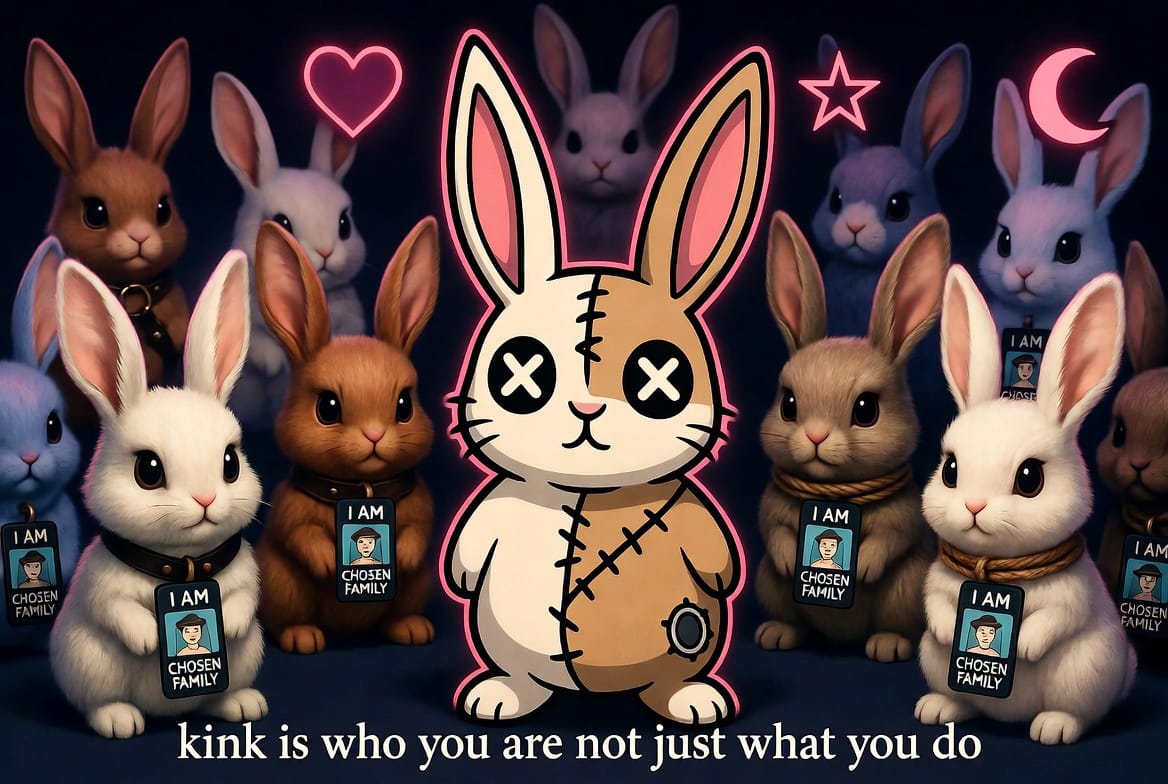
Some kinky people find "chosen family" in kink community.
The chosen family model:
Relationships that function as family. People who support each other through difficulty, celebrate together in joy, maintain long-term commitment—without biological connection.
Roles and structures. Sometimes explicit: leather families with "daddy" and "boy" roles. Sometimes implicit: networks of close kinky friends who show up for each other.
Meeting needs blood family can't. For people estranged from biological family, or whose biological family rejects their identity, chosen family provides what's missing.
Multigenerational. Experienced kinksters mentoring newcomers. Elders passing down knowledge and tradition. The generational structure that family implies.
This model is particularly strong in leather/BDSM communities, where lineage and mentorship have long traditions.
The chosen family model works when it's genuine—when the relationships are real and supportive. It becomes problematic when it's performed—when the family language covers shallow connections or creates obligations without substance.
Identity Capture
There's a risk when any interest becomes identity: identity capture.
Identity capture occurs when the label becomes more important than the experience. When maintaining the identity takes precedence over actual engagement. When you're more invested in "being kinky" than in kinky experience.
Signs of identity capture:
Policing boundaries. Excessive concern with who counts as kinky, what practices are legitimate, who's "real" and who's "fake."
Identity as performance. Performing kinkiness for others rather than engaging authentically. The FetLife profile more curated than the actual life.
Defensiveness about the identity. Inability to hear criticism or complication about kink. The identity must be defended at all costs.
Stasis. The identity becomes fixed. No evolution, no questioning, no growth. You were submissive at 25; you must be submissive forever.
Everything through the kink lens. All experiences interpreted through kink identity. Every relationship, every interaction, every interest—filtered through kinky identity.
Identity capture isn't unique to kink—it happens with political identities, religious identities, professional identities. But kink is susceptible because community support for identity is strong.
The Representation Question
Visibility and representation have become important cultural values. The argument: marginalized groups need to see themselves represented. Visibility leads to acceptance.
Kink representation is complicated:
The case for visibility. Kinky people face stigma. Better representation could reduce shame and increase acceptance. People discovering their kink could find resources rather than isolation.
The case for complexity. Kink isn't a demographic like race or sexuality. It's practice-based and chosen. Do practices need "representation" in the way identities do?
The consent frame. Kink involves sexual content. Representation means depicting sexual practices. Unlike representing gay relationships (which can be done without explicit content), representing kink inherently involves adult material. This limits mainstream visibility.
The boundary question. If kink gets mainstream representation, does it remain kink? Part of what makes kink erotic is its transgression. Normalizing it might dissolve the charge.
Risk of appropriation. Mainstream representation often misrepresents. The leather look divorced from leather culture. BDSM aesthetics without BDSM understanding. Representation can distort.
There's no clean answer. Visibility has value; complexity has costs.
Hobby, Lifestyle, or Identity?
A useful framework for examining your own relationship to kink:
Hobby. Something you do for enjoyment. You engage when you want to, set it aside when you don't. Your self-concept doesn't depend on it. You could stop, and you'd still be you.
Lifestyle. It structures your life. Your relationship, your social circle, your time allocation—kink is woven through. It's more than hobby but still something you do.
Identity. It's who you are. Remove it, and you don't know yourself. It's not just what you do; it's fundamental to your self-concept.
These categories aren't ranked. Hobby isn't less valid than identity. The question is accuracy: which level actually describes your relationship to kink?
And is that level serving you? Someone who's treated kink as identity might find that hobby-level engagement is actually healthier for them. Someone who's kept it as hobby might find that community and identity would enrich their experience.
The Developmental Arc
For many kinky people, there's a developmental arc:
Discovery. Realizing you're kinky. The initial excitement and shame and confusion.
Exploration. Trying things. Learning what works. Expanding and contracting your interests.
Community entry. Finding others. Learning community norms. Being validated.
Identity formation. Integrating kink into self-concept. "I am kinky" as statement.
Potential over-identification. The period where kink is everything. Possible identity capture.
Integration. Kink as one part of a complex self. Not everything, but not nothing. Integrated into a larger identity.
Maturity. Stable relationship to kink. Neither ashamed nor inflated. Just part of who you are.
Not everyone follows this arc. Some skip stages. Some stay at stages indefinitely. But the arc is common enough to be worth noting.
The Community at Its Best
Kink community at its best:
- Welcomes newcomers without overwhelming them
- Provides education without condescension
- Creates belonging without insularity
- Validates identity without enforcing it
- Maintains traditions without rigidity
- Offers chosen family that's genuine, not performed
- Holds space for critique and evolution
This ideal isn't always achieved. Communities are human; they have human failings. But the ideal matters as something to orient toward.
The Questions to Ask
If you're figuring out your relationship to kink and community:
What level of engagement do I want? Private practice to central identity—where do you want to be?
What am I getting from community? Is community actually serving you, or are you serving community?
Is my identity chosen or captured? Does "being kinky" serve your flourishing, or has the label taken over?
What would change if I stepped back? If you reduced community involvement or softened identity attachment, what would you lose? What might you gain?
Is this genuinely mine? Is your kinky identity something you've built authentically, or something you've absorbed from community and performed?
There are no right answers. But the questions are worth asking.
The Authenticity Test
How do you know if your kink engagement is authentic versus performed?
The alone test. If you were alone indefinitely with no community, no audience, no possibility of telling anyone—would you still engage in your kink? If yes, it's authentic. If the kink requires witnesses or validation, examine whether you're in it for the experience or the identity.
The energy check. Does engaging with kink energize you or drain you? Authentic engagement should mostly energize, even when it's challenging. If community involvement consistently drains you, you might be performing rather than participating authentically.
The evolution question. Are you allowed to change? If your interests evolve—if you discover you're less into something you previously identified with—can you adjust? Or does the identity prevent evolution? Rigid identity suggests capture.
The comparison trap. Do you find yourself constantly comparing your kink to others'? Measuring whether you're kinky enough, authentic enough, hardcore enough? Comparison suggests identity performance rather than genuine engagement.
The Isolation Risk
While community has benefits, total immersion has risks:
Echo chamber effects. When everyone around you is kinky, perspectives that question kink become unavailable. The community can become insular, reinforcing beliefs and practices without external critique.
Normalization of dysfunction. Not all relationship dynamics that call themselves kink are healthy. Community can normalize patterns that are actually harmful by framing them as "just kink."
Loss of vanilla connection. If all your friends are kinky, you lose perspective on how most people live. This can make it harder to navigate vanilla contexts when necessary—family, work, broader social circles.
The pressure to escalate. Communities can create implicit pressure to explore more, go deeper, try harder things. The progression from mild to extreme can be community-driven rather than authentically desired.
Kink can be hobby, lifestyle, or identity. It can provide community, chosen family, and belonging. It can also create capture, insularity, and rigidity.
What it becomes depends on how you hold it. The goal isn't a specific level of engagement—it's conscious engagement. Knowing what you're doing and why. Building something that serves your life rather than something that consumes it.
Kink is powerful enough to structure a life. The question is whether that structure serves you.
Previous: Cuckolding as Convergence: Where All the Kinks Meet Next: Attachment Styles and Kink Selection