From Gay to Queer: How the Margins Invented the Future
When the standard relationship model refuses you, you build a better one. Queer communities did exactly that — and the structures they invented are now mainstream relationship innovation.

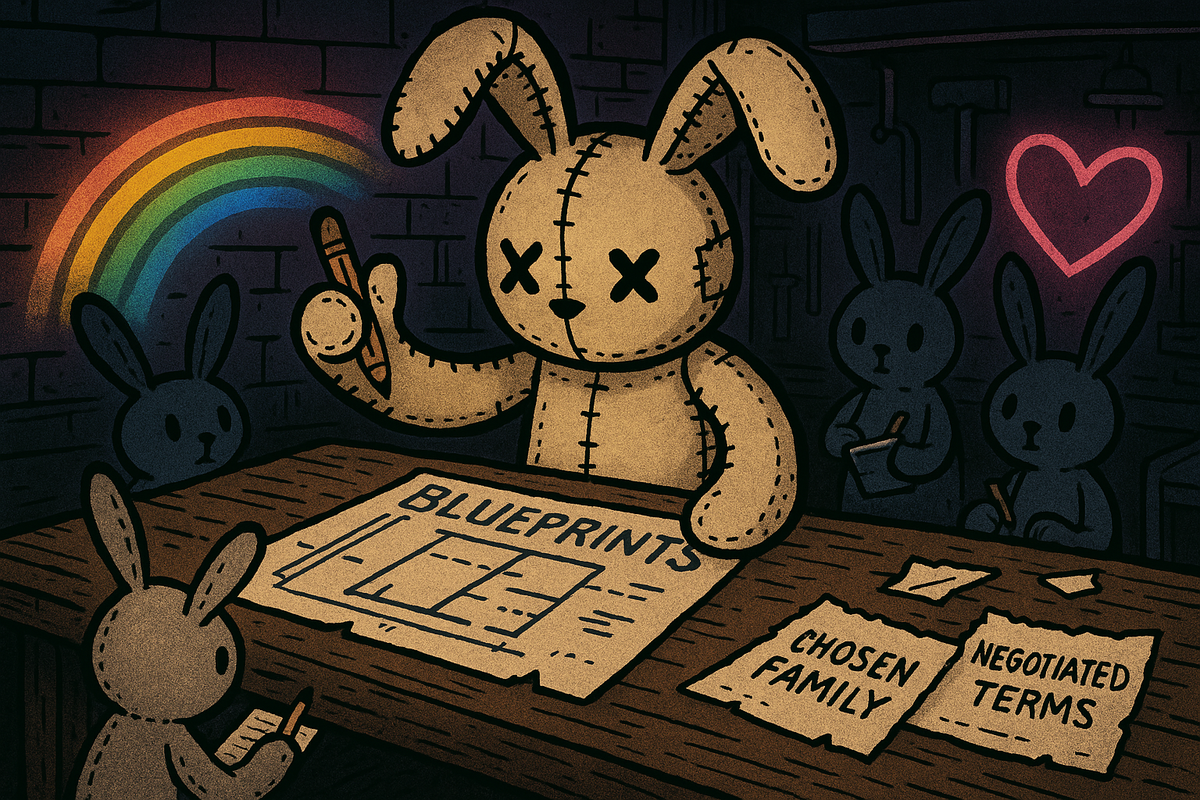
When marriage was illegal for you, you had to invent something else.
Straight people got scripts. The relationship escalator: dating, exclusive, engaged, married, kids, death. Every step mapped. Every milestone celebrated. Society provided the template and the infrastructure to support it.
Queer people got nothing—or worse, active hostility. No legal marriage. No social recognition. Families that disowned. Communities that criminalized. If you wanted a relationship, you had to build it from scratch with no blueprints and no safety net.
This wasn't just hardship. It was a forced innovation lab. And the relationship models that emerged are now available to everyone—if they're willing to learn from the people who had no choice but to invent them.
The Chosen Family
When your biological family rejects you, you build a new one.
The "chosen family" concept didn't come from therapy or self-help books. It came from necessity. Young queer people kicked out of their homes. AIDS patients abandoned by blood relatives. Entire communities criminalized and forced underground.
The chosen family answered a specific need: who will take care of me when the default systems won't?
The historical context: in the 1980s AIDS crisis, gay men were dying in hospitals where their biological families banned their partners from visiting. Blood relatives who'd rejected them for being gay suddenly showed up to claim the body and exclude the people who'd actually cared for them. Legal marriage didn't exist as protection.
Chosen family became the structure that provided what blood family wouldn't: someone to hold medical power of attorney, someone to show up at the hospital every day, someone to handle the funeral, someone to inherit the apartment and the belongings. These weren't symbolic bonds. They were life-or-death infrastructure.
This isn't just friendship. Friendship has exit costs approaching zero—you can walk away anytime. Chosen family has the weight of actual family: obligation, commitment, showing up when it's hard, being there for the hospital visit and the funeral and the 3am crisis call.
The practical difference: your friend might help you move. Your chosen family cosigns your lease when your biological family won't. Your friend might visit you in the hospital. Your chosen family fights the doctors for your right to make medical decisions. Your friend grieves when you die. Your chosen family plans the funeral your blood relatives try to take over.
The emotional difference: friends are people you enjoy. Chosen family are people you depend on. The stakes are different. The commitment is different. You're building kinship bonds intentionally that most people inherit passively.
The innovation: you can build kinship structures from scratch, based on mutual commitment rather than genetic accident. Blood is not required. Choice is enough.
This was radical when queer communities formalized it. It's now spreading to everyone: people estranged from abusive families, people whose biological families are geographically distant or emotionally unavailable, people who never fit the nuclear family model.
But queer people were forced to prove it worked first. Straight people are now adopting a structure that queer people built out of survival necessity.
Attachment style implications: Chosen families often became the first secure base for people whose biological families were sources of trauma. For disorganized attachment especially—where the original caregivers were simultaneously source of fear and comfort—chosen family offered a chance at earned secure attachment with people who actually showed up consistently.
The mechanism: your original attachment figures taught your nervous system that intimacy comes with danger. Your biological family might have been the source of both your deepest need for connection and your deepest experiences of rejection or harm. This creates the disorganized pattern—approach and avoid simultaneously.
Chosen family offers a chance to build new attachment bonds with people who don't carry that history. They're not trying to parent you. They're offering consistent, adult relationship where showing up is chosen, not obligated. This can slowly teach the nervous system that intimate connection doesn't have to include threat.
It doesn't automatically heal attachment wounds—you bring your patterns with you. But it provides a different relational environment where earning secure attachment becomes possible. Many queer people report that their chosen family gave them the first experience of reliable, safe intimacy they'd ever known.
The Relationship Kaleidoscope
Without the escalator, everything became negotiable.
Queer relationships developed in a space where "what are we?" couldn't be answered with default categories. Two men living together in the 1970s might be:
- Romantic partners presenting as roommates
- Sexual partners without romantic commitment
- Romantic partners without sexual exclusivity
- Life partners with separate sexual lives
- Co-parents through various arrangements
- Some combination that had no name
This ambiguity was exhausting. It was also liberating. Every relationship had to be defined on its own terms because there were no terms provided.
The vocabulary we now have—primary, secondary, metamour, nesting partner, anchor partner, relationship anarchy—emerged from queer communities working out in real time what their relationships actually were.
The innovation: relationships don't have to follow a single template. You can take what works and leave what doesn't. Sexual exclusivity, romantic exclusivity, domestic partnership, financial entanglement, co-parenting—these are separate variables, not a bundled package.
The Leather Community's Contribution
BDSM and leather communities—heavily overlapping with gay male culture—developed some of the most sophisticated relationship negotiation practices that exist.
When your sexuality is already transgressive, you develop tools for:
- Explicit consent negotiation (because "normal" doesn't exist to fall back on)
- Discussing desires that mainstream culture won't name
- Creating containers for intensity that don't collapse into chaos
- Maintaining relationships across power differentials
The leather community's protocols—negotiation, safewords, aftercare, the separation of scene from daily life—are now standard in kink communities across all orientations. But they were developed by people for whom "just do what feels natural" was never an option.
Attachment style implications: The structure of D/s relationships can actually support secure attachment when done well. The explicit negotiation removes ambiguity. The dominant partner provides consistent container. The protocols create predictability. For anxious attachment, this can be more regulating than conventional relationships where everything is implicit and uncertain.
What the Mainstream Inherited
The queer relationship laboratory produced tools that straight people now use without knowing where they came from:
"The talk." Explicitly defining the relationship instead of assuming. Queer couples couldn't assume anything; they had to ask. Now everyone's expected to DTR (define the relationship).
Non-escalator relationships. The idea that you can be committed without following the dating-to-marriage path. Long-term partnerships without cohabitation. Deep intimacy without exclusivity. Life partners without legal marriage.
Chosen family. The friendsgiving. The "aunt" who isn't related to you. The support network built from choice rather than obligation. Mainstream culture now celebrates this, forgetting it was invented by people whose real families failed them.
Relationship anarchy concepts. Even people who've never heard the term practice elements of it: prioritizing friendship, rejecting hierarchy among relationships, designing their own rules.
Compersion. The word literally didn't exist in English before polyamorous communities (heavily influenced by queer culture) coined it. Now there's a word for feeling joy at your partner's joy with someone else.
The Privilege of Theft
Here's the uncomfortable part: straight people can now adopt these innovations while queer people still face discrimination for practicing them.
A straight couple doing relationship anarchy is "modern" and "evolved." A queer person doing the same thing is "unable to commit" or "confused."
The pattern repeats across innovations: Straight people can have chosen family and it's celebrated as enlightened modern kinship. Queer people need chosen family and it's treated as evidence they're damaged or unable to maintain normal family ties.
Straight couples can negotiate open relationships and it's progressive. Queer people—especially gay men—have open relationships and it confirms stereotypes about inability to be monogamous.
Straight people can explore kink and power exchange and it's adventurous. Queer people practice the same dynamics and it's pathologized as acting out trauma or confused about healthy relationships.
The frameworks get legitimized when straight people adopt them. When queer people practice them—when they invented them—they're treated as deviant.
The mainstream takes the tools and leaves the people who built them behind.
This happens with explicit credit erasure: mainstream relationship advice books teach concepts developed in queer communities without acknowledgment. Therapists recommend chosen family without mentioning it came from queer survival strategies. Relationship coaches sell courses on non-traditional structures without crediting the communities that pioneered them.
It also happens through selective adoption: take the fun innovations (chosen family, explicit negotiation, expanded relationship models) while continuing to discriminate against the people who developed them (housing discrimination, employment discrimination, family court bias, ongoing social stigma).
This isn't an argument against straight people using these frameworks—they're useful regardless of who uses them. It's a reminder that the debt exists. The freedom to design your own relationship was purchased by people who had no other choice, often at enormous personal cost.
The cost included: being disowned by families, losing jobs, being criminalized, dying of AIDS while the government ignored the crisis, being denied hospital visitation, having children taken away by family courts, being beaten or killed for being visibly queer.
Straight people now get to practice relationship structures that queer people were punished for creating. The least that's owed is acknowledgment: you're using tools built by people who suffered for them. Credit the source. Support the people who made this possible. Don't pretend you invented something that's been practiced in queer communities for decades.
What Your Attachment Style Can Learn
Secure attachment: You have the flexibility to adopt these models consciously. The queer innovation that might serve you best is chosen family—building a support network beyond the nuclear unit, reducing pressure on any single relationship to meet all needs.
Anxious attachment: The explicit negotiation practices from leather/kink community might help more than you'd expect. When everything is discussed explicitly, there's less room for the ambiguity that triggers your anxiety. You know where you stand.
Avoidant attachment: Be careful not to use these frameworks as avoidance strategies. "I'm doing relationship anarchy" can be cover for "I refuse to commit to anyone." The queer communities that built these models were creating more intimacy, not less—just in different configurations.
Disorganized attachment: Chosen family might offer what your biological family couldn't—consistent, safe relationships where you can develop earned security. But you'll bring your patterns with you. The structure helps; it doesn't do the work for you.
The Ongoing Laboratory
The innovation hasn't stopped. Current edges being explored:
- Relationship structures for non-binary and genderqueer people, where even "gay" and "straight" don't apply
- Asexual and aromantic relationship models that separate different types of intimacy entirely
- Polycules and extended networks as family structures
- Digital-first relationships and how they create intimacy
- Intergenerational queer community as alternative to nuclear family isolation
The margins are still inventing. The mainstream is still, eventually, adopting.
If you want to see where relationship structures are going, look at what queer communities are building right now. In twenty years, everyone will be doing it and forgetting where it came from.