The Evolutionary Psychology of Kink

Part 35 of 36 in the The 2026 Kink Field Guide series.
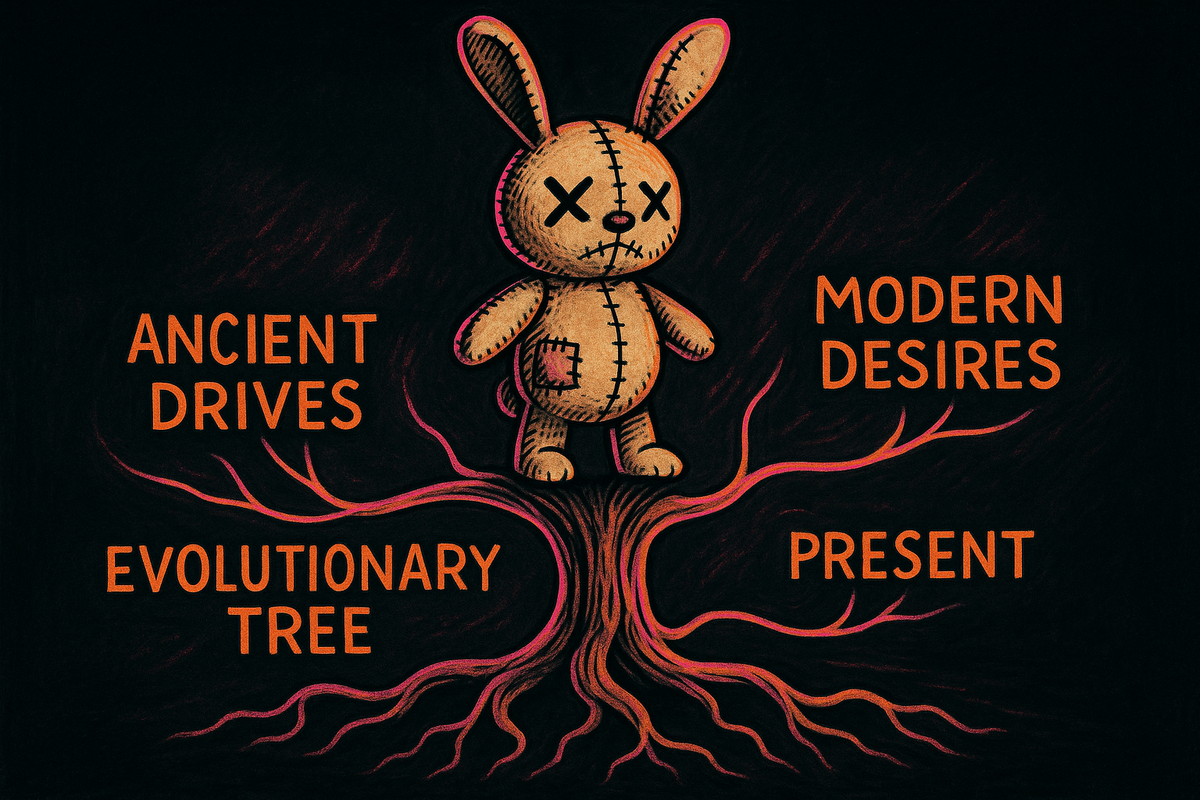
Throughout this guide, we've touched on evolutionary explanations for various kinks—sperm competition, mate guarding, dominance hierarchies, signaling systems. Now let's pull that thread completely.
The evolutionary psychology of kink is contested territory. Some researchers see kink as byproduct of other adaptations. Others see it as adaptation itself. Others reject evolutionary explanations entirely, seeing kink as culturally constructed with no biological substrate.
The honest answer: probably some of each, varying by kink.
The Framework
Evolutionary psychology asks: what problem did this solve in the ancestral environment? What selection pressure made this tendency survive?
For standard sexuality, the answers are obvious. Sexual desire produces reproduction. Attraction cues (youth indicators, health markers, resource signals) predict reproductive success. Jealousy protects investment. Pair bonding supports offspring survival.
But kink? What reproductive problem does foot fetishism solve? What selection pressure favors consensual non-consent? Why would evolution produce an interest in leather and chains?
Several frameworks help:
Byproduct hypothesis. The adaptation is something else; the kink is side effect. The brain systems for dominance, submission, pain, pleasure, bonding—these evolved for other purposes. Kink is what happens when these systems combine in novel ways.
Exaptation hypothesis. A feature evolved for one purpose gets co-opted for another. Bird feathers evolved for temperature regulation, then got exapted for flight. Maybe some kinks are exaptations—systems evolved for one function, now serving erotic pleasure.
Signal hypothesis. Some kinks might function as costly signals. Engaging in BDSM demonstrates trust, pain tolerance, commitment to the partner. These are hard-to-fake signals of mate quality.
Spandrel hypothesis. Stephen Jay Gould's spandrels—features that exist not because they're adaptive but because they're structurally inevitable given other adaptations. Some kinks might be psychological spandrels.
Dominance and Submission: The Clearest Case
Of all kinks, D/s has the clearest evolutionary story.
Humans are hierarchical primates. Every human society has status hierarchies. Every primate troop has dominance structures. The neural systems for processing rank—who's above you, who's below, where you fit—are ancient.
These systems affect everything. Serotonin levels correlate with status. Testosterone responds to dominance contests. The brain literally computes social rank and adjusts neurochemistry accordingly.
D/s kink taps these systems directly.
For dominants: The neurochemistry of being in charge—elevated testosterone, serotonin boost, the cocktail that accompanies high status. Dominance in the bedroom may activate the same reward pathways as dominance in other contexts.
For submissives: The relief of low-rank position can be its own reward. In ancestral environments, correctly reading your place in the hierarchy and submitting appropriately was survival-critical. The submissive position isn't just losing—it's the safety of knowing your place.
The dynamic together: D/s creates a clear hierarchy in a world where hierarchies are otherwise ambiguous. Modern life has flattened status structures; we're not sure where we stand. D/s provides clarity.
This doesn't mean D/s is directly adaptive. It means D/s piggybacks on systems that are adaptive—the hierarchy-processing machinery that evolution built for social navigation.
Pain and Pleasure: The Crosswire
Masochism seems like an evolutionary puzzle. Pain signals damage. Avoiding damage is survival-critical. Why would anyone eroticize pain?
Several mechanisms:
Endorphin release. Pain triggers endorphin release—the body's painkiller. After the initial pain, the endorphin wash produces euphoria. Masochists may be people whose endorphin response is particularly strong or whose pain threshold allows them to reach the euphoria without excessive damage.
Submission signal. Accepting pain from a partner signals submission—willingness to be low in the hierarchy. This connects to D/s dynamics. The pain isn't the point; the submission demonstration is.
Bonding mechanism. Shared intense experience—including shared pain—produces bonding. Soldiers bond through combat. Athletes bond through training suffering. Masochism might tap the circuitry that bonds people through shared intensity.
Contrast enhancement. Pleasure feels more pleasurable after pain. The contrast amplifies sensation. Masochists might be seeking not pain itself but the enhanced pleasure that follows.
Trust demonstration. Allowing someone to hurt you demonstrates trust. Hurting someone carefully demonstrates care. The exchange is a costly signal—hard to fake—of mutual investment.
None of these require masochism to be directly adaptive. They require only that masochism is possible given other adaptations—that the systems for pain processing, submission, bonding, and pleasure can combine in this way.
Sperm Competition and Cuckolding
The evolutionary psychology of cuckolding is fascinating and well-documented.
Sperm competition theory: In species where females mate with multiple males, males evolved mechanisms to compete at the sperm level. Larger testicles. More sperm per ejaculation. Sperm designed to block other sperm. And psychological adaptations that increase sexual urgency when facing competition.
Humans show sperm competition signatures. The shape of the penis appears designed to displace competing sperm. Ejaculate volume increases after periods of separation (when cuckoldry risk is higher). Sexual urgency increases when the male suspects his partner has been with others.
Cuckolding as trigger: The cuckold's arousal may be sperm competition response. The awareness that his partner has been with another man triggers the psychological systems that evolved to respond to mating competition—increased arousal, urgency to mate, larger ejaculation.
The cuckold's conscious experience may be shame and humiliation. His evolutionary systems are screaming: mate NOW, compete with that sperm.
This doesn't make cuckolding adaptive. A man who was consistently cuckolded in ancestral environments had lower reproductive success. But the arousal response to cuckoldry risk—the system that says "mate immediately when you suspect competition"—that's adaptive. Cuckolding kink may be what happens when that system gets triggered deliberately.
Breeding Kink: The Obvious One
Breeding kink seems like it needs no evolutionary explanation. Of course people are aroused by reproduction—that's the whole point of sexual desire.
But breeding kink is specifically about the moment of potential conception—the ejaculation inside, the risk of pregnancy, the "putting a baby in her." This is more specific than general sexual desire.
Several layers:
Reproductive certainty. Internal ejaculation was the only route to reproduction for millions of years. The male desire to ejaculate inside, and the female desire to receive it, are foundational. Breeding kink may simply be the conscious experience of this ancient drive.
Mate guarding. Impregnating a woman is the ultimate mate guard. She carries your genes; she's invested for nine months; she's less likely to be impregnated by competitors. The "putting a baby in her" framing is mate guarding made explicit.
Pair bonding. Pregnancy creates bonding. The shared investment in offspring bonds partners. Breeding kink may tap the circuitry that associates conception with deepened bonding.
Taboo in modern context. Breeding kink gets extra charge from its modern inappropriateness. We're supposed to avoid pregnancy, use contraception, plan reproduction carefully. Breeding kink violates this modern norm, adding transgression to the evolutionary foundation.
The evolution is obvious. The modern kink-ification of it—the specific eroticization of conception risk—adds cultural overlay to biological foundation.
Primal Play: The Deepest Ancestry
Primal play—growling, biting, chasing, wrestling, animal energy—reaches into pre-human ancestry.
Mammalian rough play is universal. Puppies wrestle. Kittens pounce. Young primates chase and tumble. This play serves developmental functions: practicing fighting, learning limits, building social bonds.
Human rough play doesn't stop in childhood for everyone. Some adults retain the urge to wrestle, chase, bite. Primal kink provides a container for this.
The predator-prey frame: The chase dynamic—one pursuing, one fleeing—is ancient. Predators chased prey. Sometimes males chased females. The chase activated adrenaline, focus, physical intensity. Primal play reactivates these circuits.
Non-verbal communication: Primal play drops language. Communication happens through growls, body position, physical cues. This is how communication worked before language—and the brain still knows how to do it.
Limbic override: Primal play hands control to the limbic system—the emotional brain, the animal brain. The prefrontal cortex, with its planning and language and social rules, quiets. This might be the appeal: a vacation from human consciousness into something older.
Primal play is probably byproduct—the circuits for animal physicality still exist in humans; kink provides context to activate them.
Foot Fetishism: The Curious Case
Foot fetishism is one of the most common fetishes, yet has no obvious evolutionary explanation. Feet aren't reproductive organs. They don't signal fertility or genetic quality (at least not obviously).
Several theories:
Neural adjacency. In the brain's sensory map, the representation of feet is adjacent to the representation of genitals. Neural cross-activation could explain why feet become eroticized—the signals get mixed.
Submission association. Feet are low on the body. Attending to someone's feet is a submissive posture. Foot fetishism might tap D/s dynamics rather than being about feet per se.
Smell and pheromones. Feet produce strong scent. Scent is closely linked to attraction and arousal. Foot fetishism might be pheromone response—the feet as scent source.
Learned association. Fetishes might be conditioned—early experiences pair feet with arousal, and the association sticks. This is less evolutionary and more developmental.
Foot fetishism may be one case where "byproduct plus learning" is the best explanation. The brain has the capacity to eroticize non-genital body parts; which parts get eroticized might be somewhat random or learned.
Consensual Non-Consent: The Paradox
CNC poses an evolutionary puzzle. Women are aroused by scenarios of forced sex—surveys show this fantasy is common—despite the horror of actual assault.
Several explanations:
Fantasy as processing. Rape is an ancestral threat that women faced. Fantasizing about threats is a way to process them, prepare for them, reduce their emotional impact. CNC fantasy might be the mind working through danger in a safe context.
Blame removal. In many cultures, female sexual desire is policed. Women who want sex are judged. CNC fantasy removes responsibility—"I didn't want it, I was forced." The fantasy allows desire without blame.
Desire demonstration. In CNC, the "attacker" is overwhelmed by desire for the "victim." This demonstrates desirability. The woman is so attractive that control is lost. CNC might be a roundabout way of feeling desired.
Male investment signal. If he pursues despite obstacles, if he risks consequences for access to her, it signals investment. She's worth pursuing. CNC frames the man as willing to do anything to have her.
Control inversion. CNC is controlled. The "victim" has the safeword. The scenario is pre-negotiated. The fantasy of losing control happens within a structure of actual control. This might be the point—exploring powerlessness from a position of power.
CNC is probably a convergence of multiple factors—threat processing, desire signaling, blame removal—none of which require it to be adaptive.
The Taboo Hypothesis
Some theorists argue that kink specifically eroticizes the forbidden.
The logic: Sexual arousal increases when something is taboo. The taboo heightens attention, creates tension, adds charge. Remove the taboo, and the arousal diminishes.
The evidence: Many kinks focus on violations—of consent frames, of social norms, of bodily boundaries. The violation is the point. When society normalizes something, its erotic charge often decreases.
The evolutionary angle: Taboos exist for reasons—usually to prevent behavior that's costly to the group even if tempting to the individual. The temptation proves the behavior has some appeal. Kink might be the erotic experience of yielding to temptation while the taboo still stands.
This explains why kink often involves things that are "wrong"—incest play, ageplay, CNC. The wrongness is load-bearing. The taboo creates the charge.
The Signaling Theory
Another framework: kinks as costly signals.
Costly signaling: To be credible, a signal must be hard to fake. A peacock's tail is a costly signal—only healthy peacocks can grow and maintain it. The cost proves the quality.
Kink as signal: BDSM involves risk—physical risk in impact play, emotional risk in submission, trust risk in any power exchange. Engaging successfully signals qualities: pain tolerance, emotional regulation, trustworthiness, commitment to the partner.
What's signaled:
- Pain tolerance → physical fitness, toughness
- Submission → trust, pair-bond commitment
- Dominance → competence, control, protective capacity
- Following through on negotiated scenes → reliability, honesty
Why in sex: Sexual selection often involves signaling. The bedroom is where mates assess each other. Costly signals there are particularly powerful because they happen in intimate context, hard to observe otherwise.
This theory suggests some kink serves mate evaluation—demonstrating qualities through demanding performance.
The Mismatch Perspective
A final framework: evolutionary mismatch.
Our brains evolved for ancestral environments. Modern environments differ radically. Many psychological phenomena can be understood as mismatch—systems that worked in ancestral contexts behaving oddly in modern ones.
Kink as mismatch:
- We evolved for small, hierarchical groups. Modern life provides diffuse status signals. D/s creates the clear hierarchy our brains expect.
- We evolved with near-constant pregnancy risk. Modern contraception removes that. Breeding kink artificially creates what was once default.
- We evolved with physical danger. Modern life is safe. BDSM reintroduces controlled danger.
- We evolved with intimate knowledge of our partners' other relationships. Modern privacy hides them. Cuckolding reveals them.
Mismatch theory suggests kink might be attempts to recreate evolutionarily expected conditions in an environment that no longer provides them.
What Evolution Doesn't Explain
Evolutionary psychology has limits.
Individual variation. Why does one person develop one kink and another person a different one? Evolution explains species-typical tendencies, not individual differences. The question of why you have your specific kinks requires developmental and psychological explanations, not just evolutionary ones.
Cultural variation. Kinks vary across cultures. Some practices are common in one culture and rare in another. Evolution can't explain cultural specificity.
Historical change. Kink practices change over time. The leather scene emerged in specific historical conditions. Findom emerged with the internet. Evolution doesn't explain historical contingency.
Novelty. New kinks emerge. They often incorporate new technologies (latex, the internet, etc.). Strict evolutionary accounts struggle with genuine novelty.
Meaning-making. People have complex, idiosyncratic reasons for their kinks. The meaning someone makes of their submission or dominance can't be read off evolutionary function.
Evolutionary psychology provides a substrate—the neural systems that kink builds on. It doesn't provide the full account.
The Integration
A mature view integrates multiple levels:
Evolutionary level: The neural systems exist because they solved ancestral problems. Dominance hierarchies, pain processing, sperm competition, bonding mechanisms—these evolved.
Byproduct level: Kink emerges when these systems combine in ways that weren't directly selected for. The combination is possible given the components; evolution didn't specifically design it.
Developmental level: Individual development shapes which kinks emerge. Early experiences, learning, random variation—these determine individual trajectories.
Cultural level: Culture provides frames, practices, communities. Kink takes different forms in different cultural contexts.
Personal level: The individual makes meaning. The kink isn't just evolutionary reflex or cultural form—it's something the person engages with, interprets, integrates into identity.
No single level explains kink. All levels contribute.
Implications
If evolutionary psychology of kink is partially true:
Normalization. Kinks aren't arbitrary perversions—they're expressions of neural systems that exist for reasons. This normalizes kink without pathologizing it.
Not determinism. Evolution provides possibility, not necessity. Having the neural systems doesn't mean you must engage the kink. Culture and choice still operate.
Variation is expected. Different people combine the systems differently. Universal substrates produce individual variety.
Consciousness matters. Knowing the evolutionary dynamics gives choice. You can engage a sperm-competition response deliberately or not. Understanding doesn't eliminate, but allows more informed engagement.
Integration possible. Kink can serve growth if engaged consciously. The evolutionary drives can be channeled, explored, integrated—not just acted out.
The evolutionary psychology of kink offers explanations, not justifications. Understanding why humans developed the capacity for D/s, for pain processing, for taboo arousal—this is interesting and useful. It doesn't tell you what to do with these capacities.
The human inheritance includes dominance systems, submission responses, pain-pleasure crosswires, sperm competition psychology, taboo sensitivity, and more. These are tools, substrates, possibilities.
What you build with them is still your choice.
Previous: Attachment Styles and Kink Selection Next: The Ascension of the Slut and the Domme: Inversion of Patriarchy