So What Is All This ENM?
ENM is a spectrum, not a single arrangement. The consent infrastructure is what makes it ethical — and your attachment style is what determines whether any of it actually holds.

Everyone thinks ethical non-monogamy is about wanting more sex with more people. It's not. It's about wanting different—different needs met, different structures possible, different ways of being honest.
The people who try ENM for more sex usually fail. The people who try it for more honesty sometimes succeed.
What "Ethical" Actually Means
Strip away the progressive branding and "ethical" just means: everyone knows and everyone consents.
That's it. Cheating becomes ENM the moment you stop hiding it. The behavior might be identical—you're still sleeping with someone who isn't your primary partner. But the context transforms everything.
Cheating corrodes trust. ENM, done right, builds it. Not because the sex is different, but because the honesty is.
This is why the "ethical" isn't decoration. It's load-bearing. Every other aspect of ENM—whether you're swinging or poly or monogamish—is just detail. The ethics is the thing.
The Real Spectrum
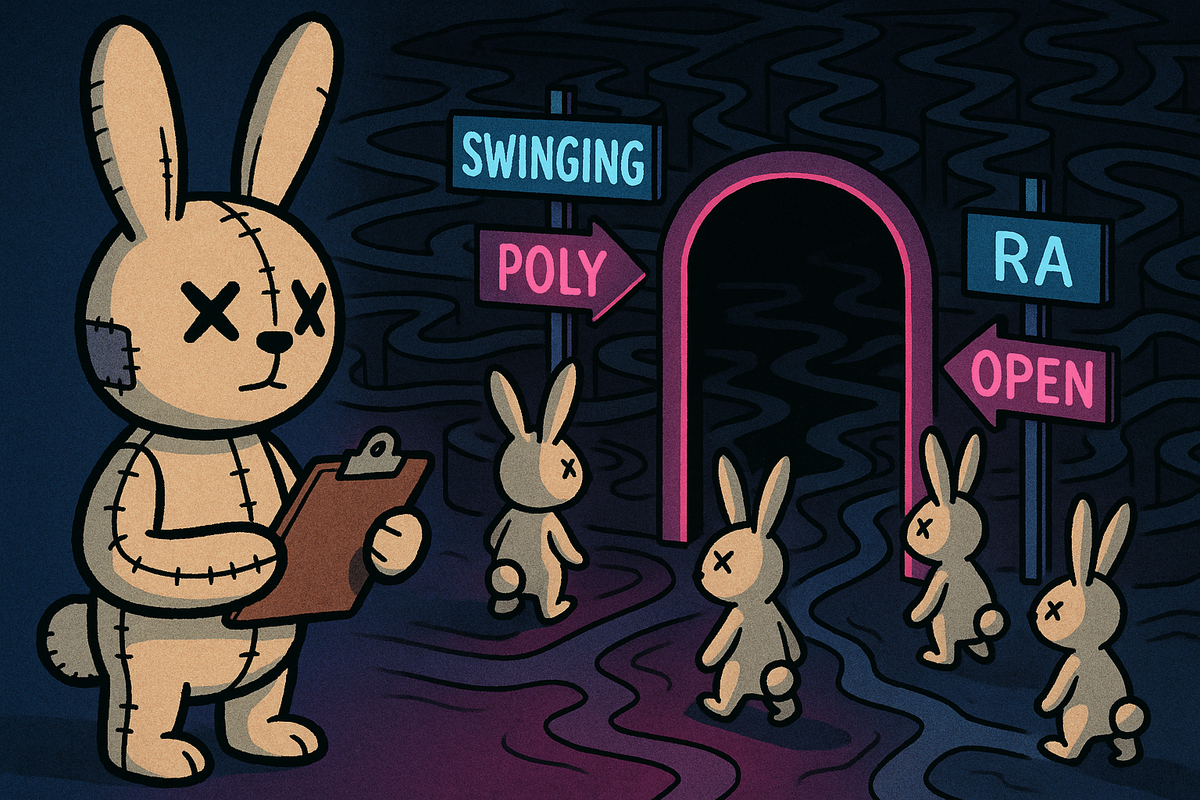
People slice ENM into categories: swinging, poly, open relationships, relationship anarchy. These distinctions matter less than you think. What actually varies is the answer to three questions:
How much do you share your heart? Swinging says: bodies only. Polyamory says: bodies and hearts. The spectrum runs from "sex is recreational" to "love is plural."
How much do you know? Some couples run Don't Ask Don't Tell—what happens outside stays outside. Others want every detail. Most land somewhere in between: enough to feel safe, not so much that imagination takes over.
Who has power? Some ENM is radically egalitarian—no relationship is more important than any other. Some is explicitly hierarchical—primary partners have veto power, secondaries know their place. Most is somewhere messy in between.
That's the actual taxonomy. Not which community you identify with. Not which apps you're on. How much heart, how much knowledge, how much hierarchy.
Why Most People Fail
Here's what doesn't get said in the ENM-positive discourse: most people who try it, quit.
Not because ENM is wrong. Because they tried it for the wrong reasons, with the wrong nervous system, at the wrong time.
The "poly bomb" opener. One partner wants to open the relationship—often because they've already caught feelings for someone specific. The other partner gets a gun to their head: agree to ENM or lose the relationship. This isn't ethical non-monogamy. It's coercion with informed consent language sprinkled on top. It almost always fails.
The mechanism of failure: the reluctant partner agrees under duress, never fully consents emotionally, and spends every interaction with the new person in a state of threat activation. Their nervous system treats the other partner as an invader, the primary partner as a traitor, and the whole situation as an emergency. They're performing agreement while experiencing abandonment.
Meanwhile, the initiating partner gets exactly what they wanted—the freedom they demanded—but in a context poisoned by the other's resentment. The new relationship exists under a cloud. The primary relationship deteriorates under strain. Within months, either the reluctant partner leaves or the structure collapses. Nobody wins.
The ethical alternative: "I'm realizing I want ENM, and I need to tell you that, but I'm not giving you an ultimatum. You get to decide if this is compatible with what you want, and I'll respect that answer." This version allows genuine consent. Most people skip it because they want the outcome guaranteed.
The jealousy underestimate. People think jealousy is about insecurity, and if they just work on themselves, it'll fade. Sometimes it does. Sometimes it doesn't. Some nervous systems are wired for mate-guarding. All the compersion theory in the world won't rewire your brainstem.
Jealousy has multiple components: the threat detection system (ancient, automatic, not under conscious control), the attachment anxiety system (trainable but slow to change), and the cognitive appraisal system (where therapy and reframing actually work). Most ENM advice targets the third system. The first two don't care about your ideology.
You can intellectually believe that love is abundant while your amygdala is screaming that your partner is being stolen. You can rationally understand that your worth isn't determined by monogamous possession while your nervous system floods you with cortisol every time they text someone else. The mismatch between what you believe and what you feel creates cognitive dissonance that's exhausting to maintain.
Some people do the work—meditation, therapy, somatic experiencing, slowly expanding their window of tolerance—and their jealousy genuinely decreases. Others do the same work and discover their jealousy is structural, not just conditioned. Knowing the difference early saves years of suffering.
The time blindness. One relationship is a part-time job. Two is full-time. Three requires management skills. People with demanding careers, young children, or limited energy try ENM and discover that the logistical overhead alone is crushing—before you even get to the emotional labor.
The math is unforgiving: each relationship needs dates, processing conversations, conflict resolution, emotional check-ins, sexual intimacy, quality time. A single relationship might need ten hours a week. Two relationships need twenty. Add metamour management, calendar coordination, and the cognitive load of tracking multiple people's needs, and you're at thirty hours before you count your job, kids, or sleep.
People enter ENM imagining the fun parts—new relationship energy, variety, abundance. They don't imagine the spreadsheet managing four people's availability for a group dinner. They don't imagine the two-hour processing conversation at midnight because someone's feelings got hurt. They don't imagine the exhaustion of being emotionally present for multiple people when you're already running on empty.
The people who sustain ENM long-term either have unusual amounts of free time, exceptional energy, or very carefully bounded relationships where not everyone gets full access. The people who flame out are usually the ones trying to give 100% to everyone while working full-time and parenting.
The wrong solution. If your primary relationship is broken, adding more relationships doesn't fix it. It just gives you somewhere to escape to while the original situation decays. ENM isn't couple's therapy. It's not even a band-aid. It's a distraction that lets you avoid the conversation you actually need to have.
The pattern: couple is struggling, communication has deteriorated, sex is infrequent or unsatisfying, emotional intimacy is gone. One person suggests opening up. The logic sounds plausible—maybe the pressure of monogamy is the problem, maybe they need outside connection to feel fulfilled, maybe this will take stress off the primary relationship.
What actually happens: the struggling relationship now has even less time and energy directed at it. The person who opened things up invests in new relationships where things are still exciting. The partner left behind feels abandoned but can't complain because they agreed to this. The original problems don't get addressed—they get buried under new complexity.
Six months later, the primary relationship ends. The person who wanted ENM is happily involved elsewhere. The person who agreed to keep them is single and wondering what happened. ENM didn't cause the breakup, but it accelerated the decay while preventing the repair work that might have saved things.
Why Some People Succeed
The people who make ENM work long-term tend to share some characteristics:
Secure attachment—or close to it. If you need the structure to regulate your emotions, you'll be regulated by the structure. Secure people choose ENM because they want it, not because they need it to feel okay.
High communication tolerance. ENM requires more processing than monogamy. If a two-hour relationship conversation drains you for a week, you might not have the bandwidth. The people who sustain ENM usually genuinely enjoy processing—or at least don't hate it.
Practical reasons, not just theoretical ones. "Love is abundant" sounds nice but doesn't sustain you through jealousy at 2 AM. "My partner has a kink I can't provide" is a practical reason. "We have mismatched libidos and this solves it" is a practical reason. Theory fades. Practical fit endures.
Realistic about their nervous system. They know their attachment style, know their triggers, know what activates them. They've chosen the specific flavor of ENM that accommodates their wiring instead of fighting it.
The Attachment Filter
Not everyone can do every type of ENM. Your attachment style is the first filter.
Anxious attachment does worst with ambiguity. Don't Ask Don't Tell sounds like it would reduce jealousy, but for anxious types it often amplifies it—the imagination fills information voids with worst-case scenarios. Anxious attachment does better with ENM structures that provide lots of communication, lots of reassurance, explicit hierarchy.
Avoidant attachment is often drawn to ENM—multiple partners means built-in distance from any single one. This can work. It can also be a sophisticated avoidance strategy disguised as lifestyle choice. The question isn't whether you want ENM. It's whether you want it because it fits you, or because it lets you never fully commit to anyone.
Secure attachment has the most options. If you're genuinely secure, you can probably navigate most ENM configurations. You're not using the structure for emotional regulation. You're choosing based on what you want, not what your wounds need.
Disorganized attachment faces the hardest road. Multiple relationships means multiple triggers. The push-pull dynamic that destabilizes one relationship now destabilizes several. Without significant attachment healing first, ENM usually makes things worse.
The Permission and the Warning
You're allowed to want this. Plenty of people thrive in ENM. It's not deviant, it's not immature, it's not a phase. For some people, it's simply how they're built.
The people who thrive are often: naturally low-jealousy, high in compersion, comfortable with ambiguity, energized by variety, drawn to distributed attachment, or philosophically opposed to possessiveness. They're not better people. They're not more evolved. They're people whose wiring fits this structure.
Some discover this about themselves early. Others spend decades in monogamy wondering why it always felt slightly wrong, then try ENM and experience the relief of finally wearing clothes that fit. The "this is how I'm built" realization isn't always available in your twenties. Sometimes it takes lived experience to know.
And you're allowed to not want this. Monogamy isn't settling. It's not limited. For some people, it's simply how they're built.
The people who thrive in monogamy are often: naturally possessive (not pathologically, just preferentially), energized by depth over breadth, needing simplicity to feel secure, or finding meaning in the exclusivity itself. They're not less evolved. They're not constrained. They're people whose wiring fits this structure.
The cultural narrative that treats monogamy as default and ENM as upgrade is backwards. They're different operating systems. Neither is inherently better. The question is which one your hardware runs smoothly.
The question isn't which structure is more evolved. The question is which structure you can actually sustain with your actual nervous system and your actual life.
Try ENM because you've examined your needs and this looks like the fit. Don't try it because it sounds enlightened. Don't try it because your partner is pressuring you. Don't try it because you're bored and hoping novelty will fix something.
The worst reason to try ENM: you think it will solve problems in your existing relationship. It won't. It will reveal them in higher definition.
The second-worst reason: you're trying to keep a partner who wants it when you don't. You'll stay and suffer, or you'll leave and resent them. The suffering-while-staying version just delays the leaving while adding trauma.
The best reason: you've noticed that your happiest, most authentic self involves multiple intimate connections, and you've found partners who genuinely want this too. Not partners who tolerate it for you. Partners who want it for themselves.
The people who succeed at ENM are honest—with themselves first, with their partners second. That honesty is the ethics. Everything else is logistics.
And that honesty includes admitting when it's not working. ENM isn't a commitment you make once and endure forever. It's a structure you choose and re-choose based on whether it's serving you. Leaving ENM isn't failure. Staying in ENM that's destroying you is.