
Edging Isn't Tease. It's Autonomic Wave-Riding
Sexual edging isn't teasing—it's autonomic nervous system mastery. Explore how tantric wave-riding builds neurochemicals, alters consciousness, and intensifies sensation through breath control.

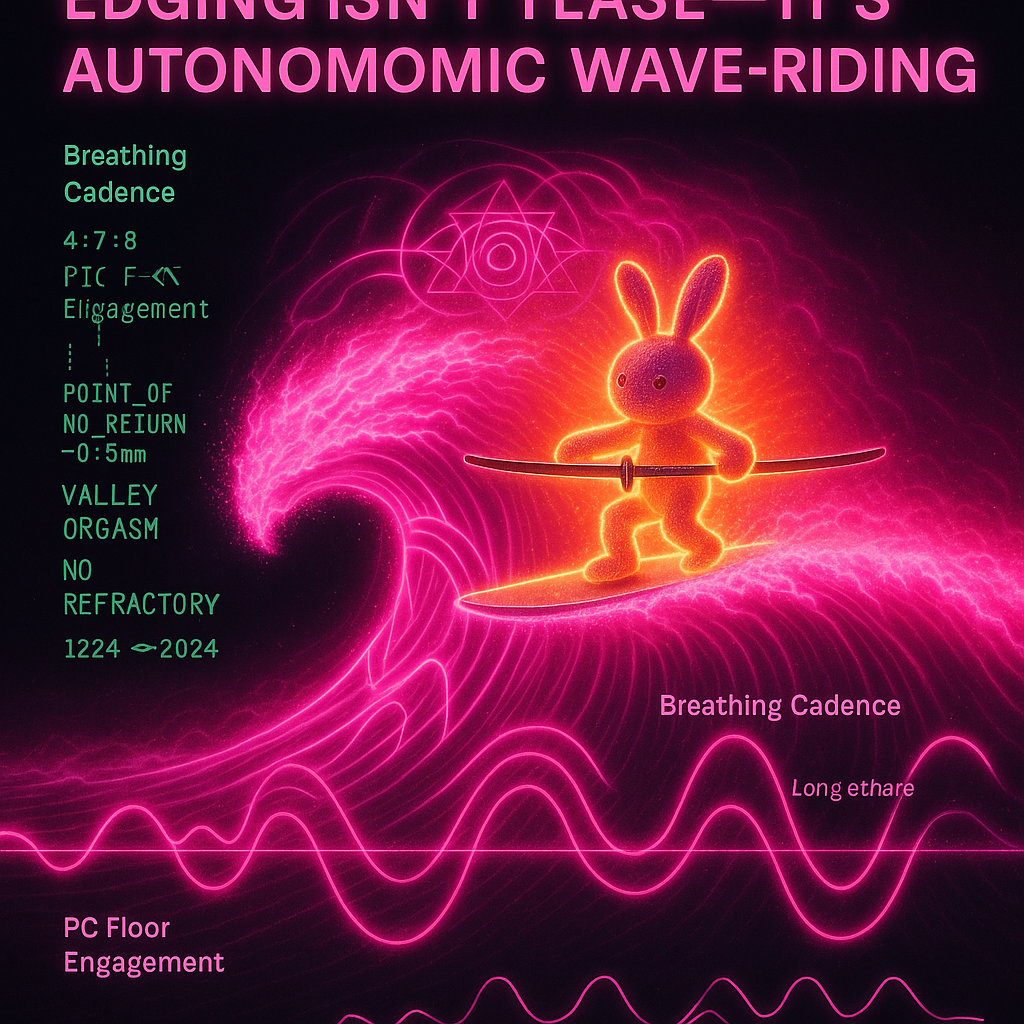
Edging Isn't Tease—It's Autonomic Wave-Riding
Why the tantrikas were doing neuroscience before we had the words for it
Pillar: SEX | Type: Pattern Explainer | Read time: 9 min
The Wave You've Been Fighting
Most people treat arousal like a race to the finish. Build pressure, chase the peak, discharge, done. Linear. Goal-oriented. Over in minutes.
Then there's another approach—one the tantrikas mapped centuries ago, that BDSM practitioners rediscovered empirically, and that neuroscience can now explain mechanistically. Instead of racing to the peak, you ride the wave. Approach the edge. Back off. Let the arousal crest and recede. Build again. Higher this time. Back off. The experience stretches from minutes to hours, the sensations intensify beyond what the sprint can access, and something shifts in consciousness itself.
This isn't tease. It isn't delayed gratification in the willpower sense. It's a fundamentally different relationship with your autonomic nervous system—one where you stop fighting the wave and start surfing it.
The tantrikas called it "riding shakti." We can call it what it actually is: deliberate autonomic cycling.
The Pattern: Arousal as Oscillation
The standard model treats arousal as a pressure gauge. Stimulation adds pressure. Orgasm releases it. More pressure = better release. Simple hydraulics.
The wave model treats arousal as oscillation. The nervous system naturally cycles between activation (sympathetic) and recovery (parasympathetic). Arousal isn't a straight line to discharge—it's a wave that builds, crests, and if you don't force it over the edge, recedes and builds again. Each cycle can go higher than the last.
Edging is the practice of deliberately surfing these cycles instead of immediately crashing through them. You approach the point of no return—the edge—then ease off, letting the wave recede. The arousal doesn't disappear; it redistributes. The next wave builds on the residual activation. The ceiling keeps rising.
This is what tantra was always about, underneath the mystical language. Not suppression. Not transcendence through denial. Mastery of the wave itself.
The Mechanism: Sympathetic Surfing
The Autonomic Seesaw
Your autonomic nervous system has two main branches. Sympathetic activation revs you up—heart rate increases, blood flows to genitals, muscles tense, focus narrows. This is the arousal climb. Parasympathetic activation calms you down—heart rate slows, muscles relax, awareness expands. This is the recovery phase.
Orgasm is a sympathetic peak followed by parasympathetic crash. The system redlines, then drops. That's why post-orgasm often feels like deflation—you've discharged the sympathetic charge and the parasympathetic rebound hits hard.
Edging keeps you in the high-sympathetic zone without triggering the crash. You're sustaining activation levels that would normally be momentary. The nervous system adapts. What felt like "almost too much" becomes the new baseline. The ceiling rises because you're training the system to tolerate—and eventually crave—higher activation.
Breath as Override
Here's the hack the tantrikas discovered: breath is the manual override for the autonomic system. You can't directly control your heart rate or genital blood flow. But you can control your breathing, and breathing controls everything else.
Fast, shallow breathing amplifies sympathetic activation. It's the accelerator. Slow, deep breathing—especially extended exhales—activates parasympathetic. It's the brake. When you're approaching the edge, deliberately slowing and deepening your breath pulls you back without killing the arousal. You're using the parasympathetic brake to modulate the sympathetic climb.
This is why tantric practices obsess over breath. "Pranayama" isn't mystical—it's autonomic control. The breath patterns they developed are protocols for managing sympathetic/parasympathetic balance during high arousal states. They figured out the mechanism through trial and error; we can now explain why it works.
Neurochemical Accumulation
Each wave builds neurochemical momentum. Dopamine (wanting, anticipation) keeps climbing as you approach and retreat from the edge. Endorphins accumulate—the natural opioids that create that floating, boundary-dissolving sensation. Oxytocin builds through sustained intimate contact.
The sprint dumps these chemicals all at once and then depletes them. Edging lets them accumulate. After an hour of wave-riding, you're swimming in a neurochemical cocktail that the five-minute version can't access. This is the altered state practitioners describe—not mystical energy, but sustained high-dose endogenous chemistry.
The tantrikas weren't suppressing desire. They were compounding it—letting the neurochemical interest accumulate before collecting the principal.
The Application: Learning to Surf
Solo Practice: Map Your Edge
Find your point of no return. The edge isn't the same every time—it moves based on arousal level, stress, timing. Learn to recognize the sensations that signal you're approaching it. For most people, there's a 10-15 second window before the reflex becomes inevitable. That window is your operating zone.
Practice the brake. When you sense the edge approaching, stop stimulation and shift to slow, deep breathing. Exhale longer than you inhale. Feel the arousal redistribute rather than discharge. It might feel frustrating at first—you're fighting an ingrained pattern. The frustration fades as you realize you're not losing the arousal, just spreading it.
Ride multiple waves. Don't stop at one cycle. Approach the edge, back off, let the wave recede, then build again. Three waves. Five waves. Ten. Notice how each peak gets more intense than the last. Notice how the valleys don't drop as far. You're raising the floor and the ceiling simultaneously.
Partnered Practice: Synchronized Surfing
Communication is non-negotiable. Your partner can't feel your edge. You need signals—verbal or otherwise—that indicate "approaching," "back off," "more." Build a shared vocabulary. The communication itself becomes part of the practice, keeping both nervous systems attuned.
The top controls the wave. In D/s dynamics, edging is a control technology. The dominant decides when to push toward the edge, when to pull back, when—if ever—to allow the crash. The bottom's autonomic system becomes an instrument the top plays. This is why experienced kink practitioners treat edging as advanced: it requires reading another nervous system in real time.
Breathe together. Synchronize your breathing during the practice. When you slow your breath to pull your partner back from the edge, let them hear and feel it. The co-regulation amplifies the effect—two nervous systems modulating each other.
The Extended Session
Clear your calendar. Real wave-riding takes time. An hour minimum. Two or three hours if you want the full neurochemical accumulation. This isn't compatible with "we have 20 minutes before the kids wake up." Treat it as an event, not an interlude.
Vary the stimulation. The same input habituates. Vary intensity, location, type. Use the variation strategically—lighter touch to pull back from the edge, more intense stimulation to build toward it. The variety also keeps the experience interesting across extended time.
Decide on the ending in advance. Will there be an orgasm? Multiple? None? Knowing the structure frees you to inhabit the experience without goal anxiety. Some practitioners find that the extended wave-riding is more satisfying than the eventual discharge—the journey eclipses the destination.
The Through-Line
Arousal isn't a pressure gauge to be discharged. It's a wave to be ridden. The tantrikas knew this. They encoded it in mystical language because they didn't have autonomic neuroscience. But the practice was always the same: learn the edge, master the breath, surf the sympathetic/parasympathetic oscillation.
Edging isn't tease, and it isn't willpower-based denial. It's a skill—trainable, refinable, applicable solo or partnered. The skill is autonomic wave-riding: using breath and awareness to stay in high-arousal states that the sprint can never access.
Most people spend their erotic lives in the shallows, racing to discharge. The wave-riders go deeper—not because they're denying themselves, but because they've learned that the wave itself is the experience. The edge isn't a boundary to cross. It's a place to live.
—
Next in series: "The Scene Container: Why Negotiation Isn't Bureaucracy—It's Architecture" — How structure creates freedom and boundaries enable depth.
Substrate: Autonomic Cycling, Tantric Neuroscience, Sympathetic/Parasympathetic Balance, Breath as Autonomic Override